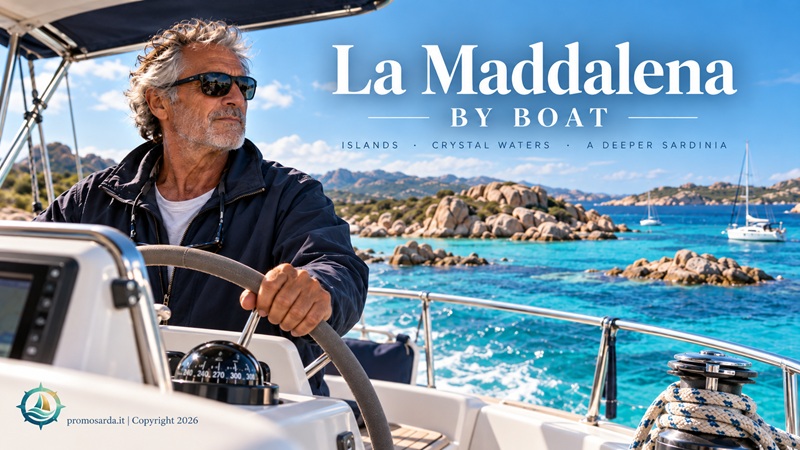
How to explore La Maddalena Archipelago by boat in 2026: the islands worth your time, which boat to choose, routes that actually make sense, Park permits, anchoring rules, wind, fuel and the mistakes tourists make before leaving Palau.
My name is Michele. I am 65, originally from Campania, and I moved to Porto Torres almost 45 years ago. I worked at sea, fished, sailed and later raced for pleasure, including regattas around Stintino. These days I spend much less time working on boats and much more time telling younger people why the sea does not care how expensive their sunglasses are.
La Maddalena is one of the most beautiful places you can reach by boat in Sardinia. That sentence is true and almost useless. What matters is which boat, which route, which wind, which day and who is driving. Search online and you will find beautiful itineraries presented as if Spargi → Budelli → Santa Maria → Caprera were a bus route. It isn’t. A good skipper changes the day according to conditions. A bad plan tries to force the sea to respect the brochure.
Beautiful water doesn’t cancel wind.
That is the starting point of this guide.
The Arcipelago di La Maddalena National Park includes La Maddalena, Caprera, Santo Stefano, Spargi, Budelli, Santa Maria, Razzoli and many smaller islands and rocks, with roughly 180 km of coastline. Its combination of granite, shallow sandy channels and Posidonia creates the colours people come here to photograph, but the same geography also produces narrow passages, exposed sectors, sudden chop and very different conditions within a few miles.
This article is updated for September 2026, including the Park’s current permit system and the new navigation rules introduced for the 2026–2027 summer seasons. The Park also revised its rental regulations again in July 2026, so this is one of those destinations where checking current official information before departure is not optional.
La Maddalena by Boat at a Glance
| Choice | Best for | Freedom | Typical cost level | Michele’s verdict |
|---|---|---|---|---|
| Large shared motorboat | First visit, families, budget | Low | € | Easiest |
| Small-group boat | Couples, swimming, fewer crowds | Medium | €€ | Best balance |
| Sailing boat / catamaran | Comfort, slow day, lunch, space | Medium | €€–€€€ | Excellent in the right weather |
| Private boat + skipper | Families/groups wanting flexibility | High | €€€ | Best experience if budget allows |
| Self-drive RIB | Experienced, confident boaters | Very high | €€ + fuel | Freedom + responsibility |
| Half-day / sunset | Short stays, repeat visitors | Medium | €–€€ | Better than rushing a full archipelago loop |
Current 2026 published prices show just how wide that range is: some conventional group excursions start around €50–€60 per adult, smaller all-inclusive excursions commonly move towards €85–€140 depending on season, while current catamaran tariffs range roughly from €100 in low season to €200 per person in August; private trips typically start from several hundred euros per boat and can climb substantially higher. These are examples, not fixed Park prices, so compare the actual inclusions before booking.
First Question: Tour or Rent Your Own Boat?
This decision matters more than choosing between Cala Corsara and Santa Maria.
Choose a Shared Boat Tour If…
You want somebody else responsible for navigation, permits, weather decisions and anchoring. You want to see several famous islands in one day. You are travelling with children or people who do not enjoy small RIBs. You would rather spend €50–€150 per person than deal with fuel, deposits and propellers.
The Park publishes a 2026 list of authorised passenger-transport companies and authorised itineraries, updated during the season. That is the list I would check before worrying about whether a company’s Instagram account has better drone footage.
Large motorboats are generally the cheapest option and can be comfortable because you get toilets, shade and more deck stability. Their weakness is obvious: more passengers and less flexibility. A smaller boat or catamaran costs more but usually gives you more water time and a skipper who can adjust stops more easily.
Choose a Private Boat with Skipper If…
You are four to ten people, want to swim rather than queue, have young children, want to avoid the busiest stops or care more about two excellent coves than collecting six island names.
This is where La Maddalena becomes much better.
A private skipper can say:
“No. Not Budelli first today.”
That sentence may be worth more than the extra cost.
You are paying partly for a boat.
You should also be paying for judgement.
Choose a Self-Drive RIB If…
You genuinely know what accepting command of a boat means.
I am not saying you need thirty years at sea. Plenty of visitors safely rent small boats every summer. But the fact that an operator is legally allowed to hand you a 40 hp RIB does not mean the Strait of Bonifacio has suddenly become a swimming pool.
Under Italian rules, a recreational boating licence is generally required within six nautical miles when engine power exceeds 30 kW / 40.8 hp, with additional engine-displacement conditions that can also trigger the licence requirement; navigating beyond six miles requires a licence regardless of engine power.
That deserves a separate article, because “40 hp = never need a licence” is an oversimplification.
A boat is not a scooter.
You do not simply turn left at Budelli because Google Maps told you to.
The Route Most Tourists Think They Want
The classic full-day archipelago circuit normally revolves around Spargi → Budelli → Porto della Madonna / Santa Maria / Razzoli → return through the inner archipelago, with exact sequence and stops changing according to the boat and conditions. Current commercial itineraries still broadly follow this pattern, normally taking around seven hours.
It is popular because it works.
But I would stop calling it “the best route”.
There is no best route independent of weather.
There is a best route today.
Route 1 – Spargi, Budelli & Santa Maria: The Classic Full Day
If conditions are settled and this is your first boat trip in the archipelago, this is the route I would normally want.
Spargi
Spargi is where the granite-and-turquoise postcard begins to make sense. Cala Corsara is the famous stop, but the island has several coves and a skipper who knows the area may choose a different one if Corsara is busy or exposed.
I prefer seeing Spargi relatively early.
Not because there is a commandment saying “Spargi before Budelli”.
Because arriving before the busiest part of the day can transform the experience.
A beautiful bay with six boats and the same bay with thirty boats are not the same place.
Michele’s rule
If your skipper changes Cala Corsara for another Spargi cove because of wind or traffic, do not complain that you “didn’t get the itinerary”.
You may have got the better skipper.
Budelli – Come for the Water, Not to Stand on the Pink Beach
Budelli produces one of the most repeated misunderstandings in Sardinian tourism.
Spiaggia Rosa is protected.
Current Park rules prohibit access to the beach itself and prohibit swimming, navigation, anchoring and stopping boats in the protected marine strip directly in front of the Pink Beach. It can be viewed from the authorised land-side walkway at a distance, but it is not a beach where your rented RIB should drop you for photographs.
I sometimes wonder how many different ways authorities need to write “do not go there”.
If your tour shows it from the permitted area, look.
Take the photograph.
Then leave it alone.
The beach still has pink sand precisely because people are no longer allowed to treat it as a souvenir shop.
Porto della Madonna – This Is Probably the Water You Saw Online
Between Budelli, Razzoli and Santa Maria lies the shallow-water landscape commonly associated with Porto della Madonna and the famous “natural pools”.
This is where pale seabed and transparent water can produce the almost artificial turquoise colour everyone expects.
It can also become extremely busy.
I prefer arriving when everybody else is somewhere else.
That is another advantage of a flexible skipper over an itinerary designed around the clock.
One important 2026 change
The Park has been developing a new mooring-management system, including buoy fields and areas where anchoring is prohibited to protect seabeds. The 2026 navigation ordinance also creates specific no-anchor corridors for emergency access. Do not rely on where boats anchored five summers ago; use the current Park zoning and follow the buoy/anchoring rules in force that day.
Santa Maria and Razzoli
Santa Maria gives you one of the archipelago’s more obvious sandy stops, with shallow water and an actual small dock area.
Razzoli feels rougher and more exposed. I like it because the archipelago begins looking less like a beach catalogue and more like a piece of granite sitting in the Strait of Bonifacio.
Whether I would insist on Razzoli?
No.
The sea decides.
If conditions mean the skipper replaces one northern stop with a sheltered alternative, I consider that normal seamanship, not failure.
Route 2 – Caprera: When One Island Is Enough
There is a common tourist mistake:
“I rented the boat for one day, therefore I must see all the islands.”
No.
Sometimes I would rather spend a day around Caprera than run from Palau to Razzoli and back simply to colour in a map.
Caprera gives you Cala Coticcio, Cala Brigantina, Cala Napoletana, the southern beaches and several different exposures within a relatively compact area. The island also has the advantage of being worth returning to by land for hiking, Garibaldi history and beaches.
Cala Coticcio
Cala Coticcio has become one of the most photographed coves in Sardinia and one of the easiest places to misunderstand.
The land trail lies within a high-protection TA zone and is not freely accessible. Current Park information requires visitors using the protected trail to go with an authorised environmental hiking guide (GAE) and pay a €3 environmental contribution, with under-12s exempt. Access control was actively operating again from May 2026.
Coming by boat does not give you permission to ignore marine zoning, landing restrictions or instructions protecting the area. In addition, the 2026 maritime ordinance identifies waters at Cala Coticcio among areas prioritised for manoeuvring by authorised passenger-transport vessels.
So when somebody tells me:
“I’ll just rent a boat and go directly onto Tahiti beach.”
My answer is:
Read the current map first.
Cala Coticcio is not more beautiful because you broke a rule to reach it.
Route 3 -Two Good Stops Instead of Six Average Ones
This is my favourite route for families and beginners.
I am deliberately not giving you a fixed sequence.
Choose one good Spargi cove + one second sheltered swimming area, or Caprera + an inner-island stop, according to wind and departure port.
Leave late morning if conditions allow.
Swim properly.
Eat.
Let children jump in the water twenty times.
Return before everybody becomes tired.
A six-year-old does not care if your route included four UNESCO-style names in the brochure.
They remember:
“The water was clear and Dad fell off the inflatable.”
That is a successful day.
Half Day vs Full Day
For a first visit, full day wins.
Distances are short on a map but speeds inside the Park are limited, and stopping, swimming, manoeuvring and choosing safe anchorages take time.
A half day works if you are:
- already staying on La Maddalena;
- repeating the archipelago;
- doing a private itinerary;
- concentrating on Caprera or Spargi;
- taking a sunset trip rather than trying to imitate the full circuit.
Trying to squeeze Spargi + Budelli + Santa Maria + Caprera into four hours is not efficient.
It is commuting in swimwear.
The Part Most Guides Underestimate: Wind
I would choose my boat after looking at the weather, not merely my budget.
The archipelago sits beside the Strait of Bonifacio. Wind can accelerate through channels and around granite headlands. The sea inside one bay may look innocent while the crossing around the next island is unpleasant.
Mistral — North-West
The Maestrale/Mistral is the wind visitors hear about most. Strong north-westerlies can make northern and exposed western sectors uncomfortable and create significant chop in passages.
Does that mean “never sail with mistral”?
No.
It means the route changes, the boat matters and sometimes the trip is cancelled.
A professional skipper may still find excellent sheltered water.
A tourist in a small 40 hp RIB should not interpret that sentence as encouragement to prove anything.
Grecale / Levante — North-East / East
These winds can make the eastern side of Caprera a very different proposition from the photographs. A calm-looking Cala Coticcio itinerary designed the night before may no longer be the clever route in the morning.
Scirocco — South-East
Southern and eastern exposures can become uncomfortable, changing where I would spend the day.
The important point is not memorising:
“Mistral = go here. Scirocco = go there.”
Local effects matter.
The skipper is looking at direction + strength + swell + sea state + boat + passengers.
Michele’s test
Ask your operator the evening before:
“What does tomorrow’s wind look like, and would you change the route because of it?”
I trust somebody who answers:
“We will decide in the morning.”
more than somebody who promises Budelli at 13:42 regardless of what the sea does.
You don’t argue with the weather. You change the plan.
The 2026 Speed Limits You Actually Need to Know
From 1 June to 30 September, Capitaneria Ordinance 33/2026 applies experimental navigation rules for both the 2026 and 2027 summer seasons. The maximum speed is 7 knots within 500 metres of the coast and 10 knots between 500 and 1,000 metres, with displacement-speed navigation required in that outer band.
That means your rental company’s advertisement saying:
“40 hp!”
does not mean:
“Drive at 40 hp past every beach.”
It means you have enough engine to make mistakes faster.
The Park Permit: Do Not Leave the Dock Without Understanding This
Private recreational boats entering the Park’s marine area require an access authorisation/ticket that allows navigation, anchoring, mooring and stopping within the regulated 300-metre coastal zone, according to the applicable rules. The Park explicitly recommends obtaining it before entering, because controls can result not only in sanctions but also in a 40% surcharge on the boating entry charge when collected at sea.
Current daily private-boat tariffs published by the Park are:
| Boat LOA | 2026 daily Park tariff |
|---|---|
| 0–10 m | €2 per linear metre |
| 10.01–24 m | €3 per linear metre |
| 24.01–35 m | €4.50 per linear metre |
| Over 35 m | €5 per linear metre |
The Park currently applies a 5% online reduction to most entry fees, excluding daily rental and economic activities, while sailing boats receive a 40% reduction. Kayaks, pedal boats and several other non-motorised craft categories are exempt.
Renting a RIB?
Ask the company three questions before paying:
Is this specific boat authorised for Park use today? Is the Park permit included? If not, who buys it and where?
Do not accept:
“Don’t worry.”
as documentation.
The Park updated the 2026 regulations governing rentals with and without skipper again in July, and explicitly describes the current system as transitional while the definitive Park Plan is being developed.
The 2026 Rental Cap Matters More Than Tourists Realise
Earlier in the 2026 season, the Park established limits on rental activity within the marine protected zones, including a maximum of 700 daily rental units under the approved framework, divided between craft categories. Rules were subsequently revised through new July disciplines.
The practical lesson is simpler than the bureaucracy:
book an authorised operator, especially in July and August.
A random cheap boat offered through a social-media message is not where I would try to save €40.
Anchoring in La Maddalena: Sand Yes, Posidonia No
This may be the single most important environmental rule for independent boaters.
Under the 2026 ordinance, anchoring on Posidonia oceanica meadows or other sensitive habitats is prohibited. Anchoring is allowed on suitable sandy or muddy seabeds, subject to zoning and local restrictions.
Learn what Posidonia looks like from above.
Dark patch?
Do not simply throw the anchor into it because the water is pretty.
Find permitted sand.
And when you retrieve the anchor, do not drag it thirty metres across the bottom because you forgot how much chain you released.
Posidonia is one of the reasons the water is so clear. The Park notes its role in trapping sediments, absorbing carbon dioxide, producing oxygen and supporting Mediterranean marine life.
Destroying it to photograph the water it helps create would be efficient stupidity.
Buoys Are Not Decorative
The Park’s current mooring strategy increasingly uses buoy fields to reduce anchor damage. The 2026 framework also provides designated emergency corridors where anchoring is prohibited and regulates the use of Park moorings.
If there is a regulated buoy field, use it according to the instructions.
Do not squeeze between boats because:
“The RIB fits.”
So does a shopping trolley.
That doesn’t make it a parking space.
Swimming from the Boat
Before somebody jumps from the stern, the person in command should know where every propeller is and what every nearby boat is doing.
The new 2026 ordinance specifically regulates swimming around moored vessels and passenger boats; for Park buoys, proximity swimming is allowed within the prescribed zone around the moored unit, while authorised passenger boats have their own assisted-bathing rules.
My simpler rule:
engine off when people are in the water near the stern.
And count people before restarting.
Yes, count.
Especially with children.
Fuel: The Boring Question That Becomes Interesting at 17:00
Most tourists ask:
“How far can this boat go?”
I ask:
“How much usable fuel will I have after wind, detours, manoeuvring and the return?”
For rentals, fuel is often charged separately. Clarify whether you return full-to-full, whether staff refuel it, what fuel consumption the operator expects and where the practical refuelling point is.
Do this before departure.
Not while floating near Budelli with one bar left on the gauge.
Michele’s fuel rule
I do not plan around the tank reaching zero.
There is always reserve.
Wind increases consumption.
Wrong turns increase consumption.
Chop increases consumption.
A friend who says:
“Go around once more!”
increases consumption.
Palau or La Maddalena: Where Should You Depart?
Palau
For most mainland visitors, Palau is the easiest departure point. It has a year-round tourist harbour with 475 berths, boat services and direct access to the channel opposite La Maddalena.
If your hotel is around Cannigione, Porto Cervo, Baja Sardinia or inland Gallura, Palau is usually the practical starting point.
In July and August:
arrive early.
Boat departure time is not parking-arrival time.
La Maddalena Town
If you are already staying on the island, starting here makes obvious sense. You avoid crossing from mainland Sardinia simply to board another boat and can sometimes take advantage of departures before mainland day-trippers arrive.
The regular Palau–La Maddalena ferry connection is provided by Delcomar/Ensamar and La Maddalena Lines, so staying on the island does not isolate you from the mainland.
Cannigione, Costa Smeralda or Santa Teresa Gallura
Boat trips also depart from other northern ports, but you are paying for more travelling time and fuel before reaching the central archipelago.
Sometimes this is worth it.
If I am staying in Porto Cervo with six people and chartering privately, I may prefer leaving nearby.
If I am paying per person for a shared trip whose main objective is La Maddalena, Palau often makes more sense.
Which Boat Would Michele Choose?
For two people on a reasonable budget: small-group sailing boat or motorboat.
For a family with young children: catamaran or comfortable small-group motorboat with shade and toilet.
For six adults splitting costs: private skippered RIB or boat becomes much more interesting.
For experienced boaters: self-drive RIB, after Park/weather briefing.
For somebody who has never driven a boat: skipper.
That final answer is not embarrassing.
I spent years around boats.
I still prefer somebody else driving when they know local water better than I do.
RIB vs Catamaran
This is an actual decision, not a style preference.
RIB
Faster. More agile. Excellent access to coves. Easy swimming from the stern. Fun in flat water.
Also:
more spray, less shade, less toilet comfort, more physical movement and considerably less enjoyable for some passengers when chop develops.
Catamaran
Stable. Wide deck. Better for families, groups and people who want lunch and relaxation. Sailing adds something to the day when conditions cooperate.
But it is not a magic carpet.
Strong wind still matters, and a larger boat cannot necessarily give you the same tiny-cove flexibility as a RIB.
The current 2026 market reflects that difference: published shared-catamaran tariffs commonly run above mass-market motorboat excursions.
Large Tour Boat vs Small Group: The Question Nobody Asks Correctly
People ask:
“Which one visits more islands?”
Wrong metric.
Ask:
How many passengers? How long are the swim stops? Is lunch included? Is shade guaranteed? Toilet? Can the route change with weather? Do passengers disembark or swim from the boat? Is the Park fee included?
A €55 trip can be excellent value.
A €150 trip can also be excellent value.
The question is what kind of day you are buying.
Is La Maddalena by Boat Good with Children?
Yes.
It can be one of the best family days in Northern Sardinia.
But choose the boat for the child rather than the photograph.
For younger children I prefer:
- proper shade;
- toilet;
- easy boarding ladder;
- not too many long high-speed transfers;
- enough deck space;
- correctly sized lifejackets;
- skipper comfortable with families.
I would not put a toddler on a tiny open RIB for seven hours in August simply because it was cheaper.
Ask about children’s lifejackets before boarding.
Snorkeling from a Boat
This is where La Maddalena becomes more interesting than simply collecting beaches.
Rocky granite edges, sandy channels and patches of Posidonia create very different underwater environments. Not every famous sandy beach is the best snorkeling stop, and not every good snorkeling area appears dramatic from the boat.
Best Snorkeling in Northern Sardinia: If you are choosing your stops partly for what is underwater, our guide to the best snorkeling spots in Northern Sardinia includes La Maddalena and Caprera alongside Asinara, Stintino, Capo Testa and Alghero.
A mask is worth carrying.
A speargun is an entirely different conversation involving fishing regulations, Park zoning and permits.
Do not confuse the two.
The Link with Our Main Boat Guide
This article is deliberately specific to La Maddalena. It does not repeat everything about RIB licences, insurance, safety equipment, rental contracts and boating across Northern Sardinia.
Northern Sardinia by Boat: If La Maddalena is only one part of your boating holiday, our Northern Sardinia by boat guide compares rental bases, routes and safety from Alghero and Stintino to Santa Teresa, Palau and the Maddalena Archipelago.
That should be the parent article.
This is the deep dive.
What I Check Before Accepting a Rental Boat
I walk around it.
Propeller.
Existing damage.
Tube condition.
Anchor and chain.
Ladder.
Fuel level.
Navigation lights if relevant.
Bilge.
Lifejackets.
Kill switch.
Emergency equipment.
Phone charging.
Documentation.
I photograph existing hull/propeller damage with the operator present.
Then I ask for the weather briefing and return procedure.
It takes ten minutes.
Ten minutes is cheaper than arguing about a damaged propeller at 18:30.
The Kill Switch Is Not Optional Decoration
If your RIB has an engine cut-off lanyard, attach it properly.
I have seen people wrap one casually around the steering console because:
“It’s annoying.”
Its entire purpose is to become annoying before the boat continues without you.
On a small fast craft, this is basic seamanship.
Phones Are Useful Until They Aren’t
Download your relevant information before departure.
Park zoning map.
Permit.
Rental company’s phone number.
Navigation information.
Weather.
Emergency contacts.
A waterproof phone case helps.
A power bank helps.
None of these makes the phone a substitute for knowing where you are.
Google Maps does not drive boats.
Emergency at Sea
For maritime emergency in Italy, 1530 is the Coast Guard emergency number; VHF Channel 16 is the international distress/calling channel commonly monitored for maritime emergencies.
If something goes wrong, give useful information:
who you are,
where you are,
what happened,
number of people aboard,
whether anybody is injured,
boat type/description.
“Near the beautiful blue beach” is not a position.
Coordinates are better.
Do Not Chase Corsica Because It Looks Close
On a clear day Corsica feels almost within reach.
Do not turn a La Maddalena rental into an improvised international excursion.
Distance from land, licence requirements, rental-contract limits, insurance, fuel and weather all change the question. The Bocche di Bonifacio are not where I decide to test how brave a small RIB feels.
If you want Bonifacio or southern Corsica, book a proper authorised trip or charter designed for it.
What About Drones?
The Park reminds visitors that drone overflight is prohibited within the protected area unless specific authorised circumstances apply.
So the fact that you saw spectacular drone footage online does not mean your drone can legally reproduce it tomorrow.
This happens surprisingly often in tourism:
the content that persuades people to visit a protected place encourages them to do something they are not permitted to do once there.
Check before flying.
Do Not Take Sand, Shells or Stones
The 2026 maritime ordinance prohibits taking sand, shells and other natural materials from the protected environment, and dumping solid or liquid waste or wastewater into the sea is prohibited.
There is nothing complicated here.
Photograph it.
Leave it.
This is not the supermarket.
When Is the Best Time for La Maddalena by Boat?
June
My favourite balance.
Long days, warm weather, good seasonal availability and less extreme crowd pressure than August.
July
Excellent sea conditions can occur, but crowds rise quickly.
Start early.
Book in advance.
August
Warm water.
Maximum services.
Maximum boats.
Maximum people convinced they discovered Cala Corsara.
Still beautiful.
Just not private.
September
Possibly my personal favourite for adults.
Warm sea.
Lower pressure.
Softer light.
But day-to-day weather becomes increasingly important.
May and October
Very rewarding on good days.
More variable.
Cooler water.
Not every operator runs daily.
This is when I value flexibility most.
Best Month: June or September?
If I had to choose:
June for reliability and long daylight.
September for atmosphere and fewer boats.
But a perfect September Tuesday beats a windy June Saturday.
The calendar does not steer.
What Time Should You Leave?
Early.
Especially with a private boat.
Leaving at 08:30 and reaching a good cove before the conventional excursion fleet can be worth more than another €100 of boat equipment.
The middle of the day is when famous locations accumulate boats.
The sea is still beautiful.
Your photograph may contain seventeen inflatable unicorns.
Can You Visit La Maddalena Without a Boat?
Absolutely.
La Maddalena and Caprera are connected by road, and you can take the car ferry from Palau, drive or cycle around the main island and visit many beaches by land.
But Spargi, Budelli, Razzoli and Santa Maria are another experience.
That is where a boat stops being a transport novelty and becomes the logical way to understand the geography.
The archipelago looks different when you see the islands in relation to each other.
Ferry or Boat Tour?
The ferry takes you to La Maddalena town.
A boat tour takes you through the archipelago.
They solve different problems.
Use the ferry if you want:
- town;
- restaurants;
- Caprera;
- beaches reachable by road;
- Garibaldi sites;
- cycling.
Use a boat excursion if your priority is:
- Spargi;
- Budelli;
- Santa Maria;
- offshore coves;
- swimming between islands.
Do both if you have time.
Can You See La Maddalena and Costa Smeralda in the Same Boat Day?
Technically, private charters can build long itineraries.
Would I recommend trying to combine every famous name in north-east Sardinia?
No.
La Maddalena deserves a day.
Costa Smeralda deserves another.
This obsession with seeing eight destinations between breakfast and aperitivo is why some tourists return from Sardinia with 900 photographs and no memory of sitting still.
Where I Would Eat
On a group tour, lunch may already be included. Current 2026 offers range from basic transport-style excursions with food purchased separately to small-group trips including aperitivo, pasta, wine and soft drinks.
On my own boat day, I prefer simple food.
Bread.
Cheese.
Fruit.
Something that survives heat.
Lots of water.
Not a five-course picnic requiring twelve plastic containers.
The best restaurant view in the archipelago is sometimes the stern ladder.
How Much Water?
More than you think.
Especially on a RIB.
Sea air disguises dehydration because you do not always feel as hot as you do walking inland.
Bring enough drinking water for everybody and extra.
Wine at lunch is not hydration.
This is information I apparently have to keep giving adults.
Seasickness
A catamaran or larger motorboat may feel easier for some passengers, but no boat eliminates motion.
If you know you suffer from seasickness, address it before departure using whatever advice/medication is appropriate for you.
Do not wait until Spargi to announce:
“I normally get very seasick.”
The boat cannot flatten the Strait.
What Makes a Good Skipper?
Not jokes.
Not music.
Not how fast they drive.
A good skipper:
reads conditions; explains decisions; keeps passengers away from unsafe manoeuvres; respects anchoring restrictions; knows when to change the route; does not crowd another boat unnecessarily; counts swimmers; watches fuel; returns with margin.
And sometimes says no.
The sea has taught me to like people who can say no.
Michele’s Three Things I Would Never Do
I would not promise myself a fixed island sequence before seeing the morning weather. A route is a proposal.
I would not throw an anchor onto Posidonia because every sandy patch was occupied. Find another place.
I would not take a licence-free rental to prove that I am capable of driving it in conditions that make me uncomfortable. Return early.
There will be another beach.
There may not be another propeller.
My Ideal First La Maddalena Boat Day
If I had friends visiting Northern Sardinia for the first time, I would book a small-group or private skippered boat, leave early from Palau or La Maddalena and tell the skipper only this:
“I would like Spargi, the northern archipelago if conditions are good, two or three proper swims, and no need to chase every famous beach.”
Then I would stop talking.
If the skipper says:
“Today we do something different.”
Good.
That is why I hired them.
La Maddalena by Boat FAQ
Is a boat trip to La Maddalena worth it?
Yes. For Spargi, Budelli, Santa Maria and Razzoli in particular, a boat is the natural way to understand the archipelago rather than simply another tourist activity.
What is the best La Maddalena boat tour route?
For a first visit in settled conditions, Spargi + Budelli area + Santa Maria/Razzoli is the classic combination. The exact route should change according to wind and sea state rather than being guaranteed in advance.
Is Palau or La Maddalena better for boat tours?
Palau is usually easier if you are staying on mainland Northern Sardinia. La Maddalena town is ideal if you are already sleeping on the island.
How long does a La Maddalena boat tour take?
Full-day excursions typically run around 6–8 hours. Current 2026 operators commonly advertise approximately seven-hour itineraries.
How much does a La Maddalena boat tour cost in 2026?
Mass-market shared trips currently start around €50–€60 per adult, while small-group/all-inclusive tours often cost €85–€140 or more. Published 2026 catamaran tariffs can reach roughly €150–€200 per person in peak season; private charters are normally priced per boat.
Can I rent a boat in La Maddalena without a licence?
Certain lower-powered boats can be operated without the standard Italian nautical licence if the legal engine-power, displacement and navigation-distance conditions are met. The commonly quoted threshold is 30 kW / 40.8 hp, but engine displacement and navigation area also matter.
Do I need a Park permit?
Private recreational boating within the Park’s regulated waters requires the appropriate Park authorisation. Buy/check it before departure; rental boats have their own daily authorisation procedures.
How much is the La Maddalena Park boat permit?
Current daily private-boating rates begin at €2 per metre for boats up to 10 m, increasing by length category.
Can boats anchor anywhere?
No. Under current rules you must not anchor on Posidonia oceanica or sensitive habitats; permitted anchoring is on suitable sand/mud and subject to local zoning, buoy fields and no-anchor corridors.
Can I swim at Spiaggia Rosa?
No. Swimming, navigation, anchoring and stopping boats in the protected marine area immediately in front of Spiaggia Rosa are prohibited, and access to the beach itself is forbidden.
Can I go to Cala Coticcio by boat?
Boats can visit the wider marine area subject to Park zoning and current navigation rules, but do not assume this means unrestricted landing. The protected land trail to Cala Coticcio is regulated and requires an authorised environmental hiking guide under current Park rules.
Which island has the best water?
I refuse to answer that seriously.
Spargi can look impossible.
Porto della Madonna can look tropical.
Coticcio can look unreal.
Then the wind changes and another cove wins.
Is a catamaran better than a RIB?
For comfort, shade, stability and families: often yes. For speed, flexibility and getting into smaller coves: RIB. The better boat depends on passengers and sea conditions.
Is La Maddalena good for snorkeling?
Yes, particularly around granite edges, sandy coves and Posidonia habitats. For specific spots, use our Best Snorkeling in Northern Sardinia guide.
Can I take sand from the beaches?
No. Do not remove sand, shells or natural material from the Park.
What happens if it is windy?
A responsible operator changes the route, delays departure or cancels. Strong wind is not something a booked itinerary overrides.
Final Thoughts: Stop Booking the Route. Book the Right Day at Sea.
La Maddalena sells itself badly.
Not because the photographs are bad.
Because they are too good.
People see one aerial photograph of Porto della Madonna and begin thinking the experience consists of reaching a coordinate.
It doesn’t.
The archipelago is wind.
Granite.
Channels.
Sheltered water.
Open water.
Sand.
Posidonia.
Boats moving around each other.
A beach that looks empty at nine and crowded at eleven.
A northern passage that is flat one morning and annoying the next.
I have spent enough of my life at sea to know that the best boating days rarely follow the plan exactly.
The plan gets you out of port.
The judgement gets you home.
So choose the boat according to the people travelling with you. Check the operator against the Park’s current authorisations. Understand whether your Park permit is included. Look at the weather. Fill the tank. Put water on board. Use the kill switch. Keep the anchor out of Posidonia. Do not chase Pink Beach restrictions for a photograph. And if the skipper changes Budelli for a quieter bay because the wind has moved, enjoy the quieter bay.
The person who comes back saying:
“We didn’t see everything.”
may have had the better day.
There are seven main islands.
You are not collecting them.
A boat is not a scooter. Beautiful water doesn’t cancel wind. And you don’t argue with the weather. You change the plan.
That is La Maddalena by boat.
