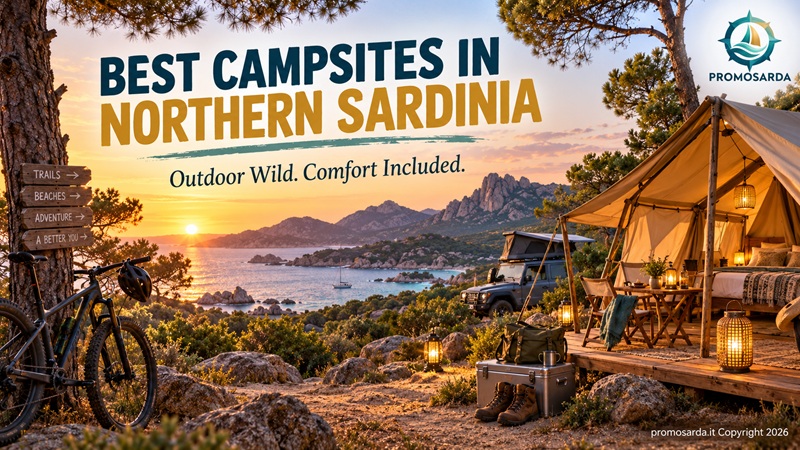
Where to camp if your idea of a Sardinian holiday involves hiking boots, mountain bikes, archaeological sites and muddy equipment as well as a beach towel.
I like camping. I also like hot showers, a decent mattress and somewhere sensible to charge a phone.
Apparently some people believe these positions are incompatible.
They are not.
I have slept outdoors with considerably less comfort than I would voluntarily choose today, but when I am spending several days hiking, cycling or exploring remote parts of Northern Sardinia, I normally prefer an organised campsite with proper facilities. I want water, toilets, electricity, somewhere to wash clothes and preferably somewhere I can eat when I return too tired to cook.
The objective is not to prove how little equipment I can survive with.
The objective is to wake up ready for another day outside.
This guide therefore selects campsites for their value as outdoor bases: proximity to trails, cycling, protected areas, archaeology, horse riding, birdwatching and interesting landscapes matters at least as much as the swimming pool.
Last checked: September 2026.
Best Northern Sardinia Campsites at a Glance
| Base | Best for | Type | Current rating reference |
|---|---|---|---|
| Isola dei Gabbiani, Porto Pollo | Active Gallura, cycling, watersports, horse riding | Full campsite/village | Booking accommodation 8.8/10 |
| Abbatoggia, La Maddalena | Caprera hiking & cycling | Campsite/village | Booking 8.7/10 |
| La Liccia, Santa Teresa | Capo Testa, Valle della Luna, Gallura | Full campsite/village | Booking 8.4/10 |
| Baia Blu La Tortuga, Aglientu | Aglientu, Vignola, coastal exploration | Full campsite/village | Booking 8.3/10 |
| International Camping Valledoria | Coghinas, cycling, horse riding, birdwatching | Full campsite | ~4.2/5 |
| Agricampeggio Saride, Alghero | Porto Conte, Capo Caccia, small-scale camping | Agricamping | ~4.2/5 |
| Oasi Gallura, Vignola | Camper + MTB/walking | Camper area | ~4.5/5 |
| I Platani, Alghero | Camper base for Porto Conte & Alghero | Camper area | ~4.5/5 |
A note about ratings: campsite reviews are messier than hotel reviews. One platform may review mobile homes rather than actual pitches, another combines camper and village experiences, and management can change. I use ratings as a filter, not as proof that every pitch is perfect.
First: Don’t Build Your Holiday Around Wild Camping
Northern Sardinia contains hundreds of places where pitching a tent would look wonderful in a photograph.
That does not mean you may sleep there.
The Sardinian Region’s current 2026 visitor guidance explicitly reminds travellers that free overnight camping outside authorised areas is prohibited, particularly in the context of protecting beaches and coastal environments. It also prohibits removing sand, stones and shells and reinforces protection of dunes and sensitive habitats.
For the sort of travelling I do, organised camping is usually the better solution anyway. Leave the expensive bike somewhere legitimate, shower, refill water, recharge everything, sleep properly and start again.
There is another summer issue: fire. Sardinia’s high wildfire-risk period currently runs from 1 June to 31 October, although dates can be adjusted according to conditions, and additional restrictions apply during high-risk periods.
So if you bring a portable camping stove, do not assume that owning one means you can use it anywhere. Follow the campsite’s designated cooking areas and current fire regulations.
A sandwich has never burned down a pine forest.
How I Chose These Campsites
I looked for places that make practical sense if your days include hiking, MTB or e-bike rides, birdwatching, archaeology, horse riding or long road-trip stages. I also favour useful facilities over luxury for its own sake: shade, washing machines, electricity, food, bike rental or storage, access for vehicles and a location that reduces unnecessary morning driving.
Two of my recommendations are specifically camper areas rather than traditional tent campsites. They are clearly labelled. They belong here because for an outdoor road trip they solve the same problem very well.
1. Isola dei Gabbiani — Best All-Round Adventure Camping in Gallura
Isola dei Gabbiani
Best for: active travellers, cycling, Porto Pollo, Gallura, horse riding and combining several outdoor sports.
If you want one campsite where nobody looks surprised because half your vehicle contains sports equipment, this is an obvious candidate.
The site occupies the Porto Pollo peninsula near Palau and offers actual camping pitches for tents, campervans and caravans, including more secluded Wild Tent pitches. The 2026 resort also supports bicycle hire and an unusually broad range of outdoor activities.
Its accommodation component currently scores 8.8/10 on Booking, with location at 9.5.
Why I would use it
From here, Palau is close, Gallura opens behind you and La Maddalena is immediately relevant for day trips. Porto Pollo is famous for wind sports, but an outdoor traveller can also use the area for cycling, walking and organised horse-riding experiences; the property itself lists activities including horse riding alongside its better-known water sports.
For a multi-sport week, this is probably my strongest eastern-Gallura choice.
What I would do from here
Day 1: easy exploration of Porto Pollo and nearby Gallura. Day 2: ferry to La Maddalena with hiking or cycling on Caprera. Day 3: Capo Testa and Valle della Luna. Day 4: inland Gallura or Monte Limbara by car.
That is a serious outdoor holiday without changing accommodation every night.
Gavino’s equipment note: Porto Pollo is windy for a reason. A good wind-resistant tent, strong guy lines and proper heavy-duty tent pegs are far more useful than an expensive camping gadget with six USB ports.
2. Abbatoggia Village — Best Camping Base for Caprera
Abbatoggia Village
https://abbatoggiavillage.it
+39 0789 738044 / +39 388 3924229
Best for: Caprera hiking, La Maddalena cycling, island exploration and travellers who want to stay inside the archipelago rather than commute from Palau.
Abbatoggia has one enormous advantage.
You are already there.
The campsite occupies a small peninsula about 5 km from La Maddalena harbour, surrounded by bays and Mediterranean vegetation inside the wider archipelago environment. It offers camping areas as well as mobile homes and camper facilities.
Its current Booking score is 8.7/10, with location at an exceptional 9.8/10. Bicycle rental is also available.
Why outdoor travellers should care
From La Maddalena you have access to Caprera’s 16-route hiking network, including Monte Tejalone, Cala Napoletana and Punta Crucitta–Candeo.
For me, this is much better than using La Maddalena only as a boat destination.
Sleep here. Wake early. Cross to Caprera before the day’s traffic builds. Walk.
Or rent a bike and use it for the appropriate roads and cycling routes, remembering that protected hiking trails are not automatically cycling routes.
Useful campsite features
Abbatoggia lists electricity, water, grey-water disposal, camper service and pitches around 8 × 6 metres, as well as discounts with external bicycle and vehicle rental services.
Gavino’s equipment note: an inexpensive bike lock belongs in the kit even inside a campsite. So does a compact bike repair kit containing pump, tyre levers, spare tube or tubeless plugs and a multitool.
A €3 tyre lever has saved more holidays than many €300 accessories.
3. La Liccia — Best Base for Capo Testa and Northern Gallura
Camping La Liccia
Best for: Capo Testa, Valle della Luna, Santa Teresa Gallura, short hikes, cycling and a comfortable tent-based stay.
This is probably the campsite I would choose for someone saying:
“I want to camp, but I do not want camping to become the activity.”
Excellent.
La Liccia is about 7 km from Santa Teresa Gallura, surrounded by a large garden and around a ten-minute walk from the coast. Current facilities include restaurant, pizzeria, supermarket/minimarket, laundry, pool, barbecue area and pitches for tents and campers. Its 2026 season runs approximately 9 May to 4 October.
Booking currently gives it 8.4/10, with location 8.7.
Why I like the location
From here you have a superb cluster of outdoor days:
Capo Testa + Valle della Luna for granite walking and Roman quarry traces; Punta Falcone for military remains and rougher terrain; Santa Teresa for an easy recovery evening; Rena Majori/Aglientu when you want a shorter coastal outing.
Bike rental is also listed among the site’s services.
Camping gear that matters here
Shade is useful, but wind remains Gallura’s favourite reminder that tents have aerodynamics.
Bring a small tent repair kit, spare guy line and a few rock/compact-ground pegs rather than relying entirely on the lightweight wire pegs supplied with many tents.
I have watched people reinforce tents with supermarket bags full of stones.
Buy better pegs.
4. Baia Blu La Tortuga — Best Full-Service Base around Aglientu
Baia Holiday Baia Blu la Tortuga
baiaholiday.com/baia-blu-la-tortuga
+39 079 602200 / Booking Center +39 0365 520682
Best for: couples or families who want outdoor days followed by substantial campsite facilities.
This is more camping village than minimalist campsite, and that is not an insult.
Sometimes after six hours outside I want a supermarket, shower, restaurant and laundry rather than an authentic conversation with a saucepan.
The Aglientu/Vignola Mare property currently scores 8.3/10 on Booking, with location at 8.8. It includes bicycle rental, laundry, sports facilities and extensive campsite services.
Why I would stay here
The north-Gallura coast between Vignola, Rena Majori and Santa Teresa makes a good base for coastal walking, cycling and day trips inland, while Monte Limbara remains realistic by car for a longer hiking day.
It also works if half the party is outdoors-oriented and the other half regards a holiday as an opportunity not to climb anything.
That matters.
The best outdoor base is occasionally the one that prevents your partner from hating your hobbies.
Gavino’s useful extra
Bring a lightweight folding daypack even if your main luggage lives permanently in the tent or camper. I use one for food runs, short walks and the inevitable day when the original plan changes completely.
5. International Camping Valledoria — Best Multi-Activity Base
International Camping Valledoria
Best for: cycling, horse riding, kayaking, birdwatching, Castelsardo and travellers who cannot decide what sport they want to do tomorrow.
This one fits the article almost suspiciously well.
The campsite sits beside the Coghinas river/coastal protected landscape, directly by the sea among pine, juniper and Mediterranean vegetation. It currently rates around 4.2/5 from more than 1,200 reviews.
Its services include bike rental, laundry, restaurant, market, Wi-Fi and dog facilities.
More importantly, the surrounding territory genuinely supports varied outdoor activity: the campsite itself promotes cycling, horse riding, kayaking on the Coghinas and birdwatching, while regional tourism information identifies the Valledoria/Coghinas environment for walking, riding, cycling and wildlife observation.
My version of three days here
Day 1: bicycle along the Valledoria/Coghinas landscape. Day 2: horse-riding excursion or kayak on the river with an appropriate operator. Day 3: Castelsardo + Elephant Rock + an inland archaeological detour.
That is exactly the kind of campsite I want in an outdoor cluster: the accommodation connects activities rather than becoming the destination itself.
Gavino’s equipment note: bring a pair of compact binoculars. They are useful here, on Asinara, around Porto Conte and almost anywhere wetlands or raptors are involved. Phones are excellent cameras. They are mediocre binoculars.
6. Agricampeggio Saride — Best Small Rural Campsite near Porto Conte
Agriturismo Saride
Best for: people who dislike large camping villages, Porto Conte hiking, Capo Caccia, archaeology and combining camping with local food.
This is much closer to my personal camping taste.
Saride is an agricamping site rather than a large resort, set on an eight-hectare farm with vineyards and olive trees in the Nurra, close to Porto Conte. It has only five equipped camping pitches, each with a 10 m² gazebo, electricity/light, water access and shared bathrooms with showers.
Its current business rating is about 4.2/5.
Why it is excellent for this website
Capo Caccia is roughly 12 km away, while Porto Conte, Porto Ferro and the western Alghero landscape are all close. The property also states that it can arrange or connect guests with horse riding and guided visits.
I would use Saride as a quiet base for:
Punta Giglio, Monte Timidone/Le Prigionette, Capo Caccia, Porto Ferro, Palmavera, Anghelu Ruju, then possibly an Argentiera day.
That is outdoor + archaeology + landscape in exactly the proportions I like.
Gavino’s detour
Do not drive into central Alghero every evening simply because you are “near Alghero”.
Have one evening in town.
Have another eating somewhere rural.
Your car also deserves a night off.
7. Oasi Gallura — Best Camper Base for Vignola and MTB
Area sosta camper Oasi Gallura
+39 338 7319626
Type: equipped camper area, not a tent campsite. Best for: camper travellers carrying bikes.
Oasi Gallura in Vignola Mare currently rates around 4.5/5 from more than 1,200 reviews and sits only around 50 metres from the coast. It provides camper pitches, Wi-Fi and local services within walking distance.
What interests me is not the beach.
The operator specifically describes walking and mountain-bike paths through the surrounding coastline and pine landscape, including routes around Vignola, the Aragonese tower, San Silverio and Punta di li Francesi.
If I were travelling with the small 4×4 plus bike, this would be a useful base for exploring the Aglientu side of Gallura without paying for a huge resort infrastructure I did not intend to use.
Camper equipment I would definitely carry
A levelling ramp set, long CEE campsite electrical cable, suitable CEE adapter, water hose with several connector sizes and a portable tyre compressor.
The compressor is useful for the vehicle.
It is also extremely good at making friends with cyclists.
8. I Platani — Best Camper Base for Alghero and Porto Conte
I Platani Area Sosta Camper
4,5•Area di sosta per camper
https://www.iplatani.it
+39 079 930204
Type: equipped camper area. Best for: people touring Northern Sardinia by camper who want Alghero without sleeping in the city.
I Platani currently rates around 4.5/5 from more than 700 reviews and lies on Via Arenosu outside Alghero.
The reason I include it is logistics.
It is roughly 7 km from Alghero, near the Riviera del Corallo beaches, with shuttle services and access towards a cycling route into town.
The 2026 published rate includes overnight parking, camper service and electricity, ranging seasonally from about €25 to €35 per vehicle for up to four people, excluding tourist tax.
From here I would use the camper as base camp and the bike/boots as transport:
Punta Giglio, Le Prigionette, Monte Timidone, Palmavera, Alghero, then north towards Porto Ferro and Argentiera.
Parking the camper and travelling light is considerably nicer than manoeuvring a large vehicle every time you want coffee.
Which Campsite Should You Choose?
For hiking: La Liccia for Capo Testa; Abbatoggia for Caprera; Saride for Porto Conte.
For MTB/e-bike: International Camping Valledoria, Oasi Gallura, Abbatoggia and Isola dei Gabbiani.
For horse-riding experiences: Valledoria or Gallura make the strongest thematic bases; use properly established riding centres rather than interpreting “I have ridden before” as permission to borrow somebody’s horse.
For archaeology: Saride is excellent for the Alghero/Nurra archaeological cluster; Valledoria works for Castelsardo and Anglona; Abbatoggia adds Garibaldian and military history to the outdoor side of Caprera.
For camper touring: I Platani + Oasi Gallura make a very efficient west-to-east combination.
For maximum comfort: La Liccia or Baia Blu La Tortuga.
For the strongest outdoor atmosphere: Isola dei Gabbiani.
My Camping Gear List for Northern Sardinia
I am not going to tell you that you need 47 pieces of equipment before sleeping twenty metres from a restaurant.
You don’t.
But there are a few things I repeatedly use.
The Essentials I Would Buy First
A good three-season tent. For Sardinia I care more about ventilation and wind stability than extreme cold performance. Look for proper guy-out points and a rainfly that can handle a sudden weather change.
Heavy-duty tent pegs. Standard lightweight pegs are frequently inadequate on hard, dry or rocky ground. I carry a mixture rather than sixteen identical ones.
Extra guy line. Weighs almost nothing. Very useful after a strong maestrale reminds you which part of the tent you failed to tension.
Tent footprint or groundsheet. Protects the floor from sharp dry ground and makes packing a muddy tent less unpleasant after rain.
Rechargeable headlamp. Better than using a phone torch while carrying dishes, opening a tent or repairing a bicycle.
Large power bank. Navigation, photographs, ferry bookings and GPX apps make phones work harder outdoors. For several days I prefer more battery reserve than I think I need.
Reusable water container. A collapsible 5–10 litre water carrier is very convenient at a pitch even when drinking-water taps are available.
Compact first-aid kit. Plasters, disinfectant, blister treatment, gauze, elastic bandage and whatever personal medication you actually require.
Mosquito/insect repellent. Especially useful around wetlands, lagoons and vegetated campsites.
Quality cool box or compact camping fridge. Particularly useful if you are moving between pitches and eating breakfast before facilities open.
Those are all natural future affiliate-link opportunities because they solve real problems rather than being inserted into the article because Amazon sells them.
Useful Gear for Campsites with Electricity
Many Sardinian campsites supply relatively modest electrical connections. For example, La Liccia publishes 3A or 6A connections, while other campsites may offer similarly limited amperage.
That means I would carry a proper CEE camping hookup cable, an appropriate CEE adapter, and preferably an extension of useful length rated for outdoor use.
I would not assume I can simultaneously run an electric kettle, hairdryer, induction plate, refrigerator and the machinery required to launch a small satellite.
Check the pitch’s amperage.
Good affiliate-friendly items for this section
CEE camping extension cable, CEE-to-domestic adapter, outdoor power splitter, USB multi-port charger, high-capacity power bank, rechargeable camping lantern.
All are genuinely useful and easy to integrate naturally into the article later.
Cooking Equipment: Useful, but Fire Rules Come First
For organised camping I like a compact camping stove, a lightweight pan, one good knife, two mugs and far fewer kitchen accessories than camping catalogues believe necessary.
However, the 2026 wildfire-danger period runs from 1 June to 31 October, with restrictions that can become more stringent according to conditions.
Use cooking equipment only where and how the campsite permits it.
A campsite barbecue area exists for a reason.
Camping cooking equipment worth mentioning later
Portable camping stove, nesting cookware set, insulated mug, folding water container, compact cooler, rechargeable lantern, windscreen approved for the stove setup where permitted.
Do not publish advice telling readers to improvise campfires.
Northern Sardinia does not need the authenticity.
Equipment for Cyclists
If you are camping because you intend to cycle, I would add:
helmet, good lock, compact pump, tyre levers, spare tube, tubeless repair plugs if applicable, multitool, chain quick-link, small bottle of chain lubricant, hydration pack and lightweight bike cover.
A bike cover seems unnecessary until your saddle and drivetrain spend the night underneath resin, dust or unexpected rain.
If using an e-bike, confirm whether your campsite allows battery charging and where it should be done. Do not create your own electrical engineering project across a wet pitch.
Equipment for Hikers
My campsite kit and hiking kit overlap deliberately.
Daypack, trekking poles, reusable water bottles or hydration bladder, headlamp, compact first-aid kit, power bank, offline maps, sun hat, sunscreen and lightweight windproof layer.
A small dry bag is also useful even when you are not going anywhere near a kayak. I use one for electronics, documents and clothes that I would prefer not to discover soaked after a bottle opens inside the backpack.
The Item People Forget: A Rubbish Bag
I carry several strong rubbish bags.
One is for rubbish.
One often becomes wet-equipment storage.
One may end up protecting a backpack.
And one normally comes home carrying something that somebody else left beside a trail.
Very sophisticated equipment.
Available in most supermarkets.
Tent, Camper or Glamping?
I understand all three.
Tent
Best if you want the simplest setup, own good equipment and enjoy actually camping. Cheapest and most flexible, but wind, heat and packing become part of the experience.
Camper or small van
Probably the best format for the kind of Northern Sardinia road trip I like. Equipment stays organised, bikes can travel securely and changing base every few nights is straightforward.
Glamping or mobile home
Perfectly legitimate.
If somebody wants to hike twenty kilometres and then sleep in an actual bed, I will not report them to the camping police.
The outdoor activity is outside.
Your mattress does not have to suffer.
Camping with a Mountain Bike: My Setup
I try to keep the campsite simple: tent or vehicle → bike parked securely → water → tool bag in one fixed place → dirty footwear outside sleeping area → tomorrow’s clothing prepared before bed.
This sounds boring.
Boring systems are excellent at 06:15.
Searching for one cycling glove underneath three bags while everybody else is waiting is less excellent.
A small folding storage crate is one of those unglamorous things I now appreciate enormously. Shoes, repair equipment, cables, headlamps and food stop migrating independently around the vehicle.
Another affiliate opportunity.
Camping and Archaeological Sites
A campsite near an archaeological landscape is a base.
It is not permission to camp beside the monument.
Do not move stones to stabilise a tent.
Do not build little walls.
Do not collect ceramics, worked stone or “interesting fragments”.
Do not excavate.
If I notice something potentially archaeological, I document its position without disturbing it and follow the correct reporting process.
Sleeping outdoors does not temporarily suspend cultural-heritage law.
Camping with a 4×4
My little off-roader is useful for camping because it carries equipment comfortably and reaches legitimate rural roads that a low car dislikes.
That does not mean I drive from the campsite directly across the landscape.
Use authorised access.
Respect barriers.
Do not park on vegetation.
Do not drive onto dunes.
Current regional guidance specifically reiterates protection of Sardinian dunes from vehicle access.
A four-wheel-drive system increases traction.
It does not increase your legal rights.
Best Camping Season in Northern Sardinia
For an outdoor-focused camping holiday, May, June, September and early October are much more interesting to me than peak August.
May gives you long enough days, flowers and excellent hiking temperatures.
June adds swimming without full peak-season intensity, although fire risk and heat are increasing.
September is superb for mixed activity, especially later in the month.
October can be wonderful for hiking and cycling, but some campsites begin closing during the month.
July and August work perfectly well for conventional camping holidays but require more careful outdoor planning: early starts, more water, less exposed hiking and considerably greater attention to wildfire risk.
A Camping Road Trip I Would Actually Do
For a 10–12 day outdoor road trip I would not change campsite every night.
Nights 1–3: Alghero/Nurra — Saride or I Platani depending tent vs camper. Explore Porto Conte, Punta Giglio, Monte Timidone, Palmavera and Argentiera.
Nights 4–6: Valledoria/Aglientu — International Camping Valledoria or Baia Blu La Tortuga. Add Castelsardo, Coghinas cycling/horse riding and coastal Gallura.
Nights 7–9: Santa Teresa/Porto Pollo — La Liccia or Isola dei Gabbiani. Capo Testa, Valle della Luna and Punta Falcone.
Nights 10–12: La Maddalena — Abbatoggia. Walk or cycle Caprera.
Four bases.
A huge part of Northern Sardinia.
And importantly, enough time to stop unfolding and refolding the same tent every morning.
FAQ
What are the best campsites in Northern Sardinia for hiking?
La Liccia for Capo Testa, Abbatoggia for Caprera and Saride for Porto Conte are my strongest choices.
What is the best Northern Sardinia campsite for cycling?
International Camping Valledoria is especially good because bike rental and cycling are directly integrated with the surrounding Coghinas outdoor area. Isola dei Gabbiani and Abbatoggia are also excellent active bases.
What is the best campsite near Alghero for outdoor activities?
For a small, quieter camping experience I prefer Saride because of its proximity to Porto Conte and Capo Caccia. Camper travellers should also consider I Platani.
What is the best campsite near Capo Testa?
La Liccia is the most convincing combination of location, facilities and current reviews in this shortlist.
Can I wild camp in Northern Sardinia?
Do not assume so. The Sardinian Region’s current visitor guidance explicitly prohibits free overnight camping outside authorised areas in its coastal-protection rules. Use an authorised campsite or recognised stopping area.
Can I use a camping stove in Sardinia?
Use one only where campsite rules and current fire regulations allow it. Sardinia’s elevated wildfire-risk period currently runs from 1 June to 31 October and restrictions may change according to conditions.
Do Northern Sardinia campsites have electricity?
Most organised campsites do, but connection types and available amperage differ considerably. Bring suitable CEE equipment and verify the individual pitch specification.
Should I bring a special tent for Sardinia?
You do not need a Sardinia-specific tent. Prioritise ventilation, reasonable sun management and good wind stability.
Is a camper better than a tent for an outdoor road trip?
For repeated base changes and expensive sporting equipment, often yes. For a fixed base and minimal luggage, a tent remains excellent.
What camping gear is most useful in Sardinia?
A good tent, strong pegs, headlamp, power bank, water container, first-aid kit, insect repellent, cooler/fridge and proper CEE electrical equipment are the items I would prioritise.
Final Thoughts: Comfort Is Equipment Too
When I was younger, a worse night’s sleep somehow seemed to make a camping trip more authentic.
Age improves certain opinions.
Now I want a campsite that allows me to wake at seven, drink coffee, put on boots and leave.
I want the bike charged.
I want clean water.
I want somewhere to wash mud off my legs.
I want to come back in the evening knowing that dinner can involve a camping stove if permitted, a campsite restaurant if I am tired, or bread, cheese and absolutely no cooking if I have made intelligent decisions.
A campsite should support the adventure.
It should not consume it.
The best bases in Northern Sardinia let you walk Caprera, ride beside the Coghinas, search for griffons around Porto Conte, explore the granite of Capo Testa or spend a day looking at Nuragic archaeology — then come back somewhere organised enough that tomorrow still seems attractive.
And yes.
I still carry rubbish bags.
A four-star campsite does not prevent somebody from leaving a bottle beside the trail the next morning.
