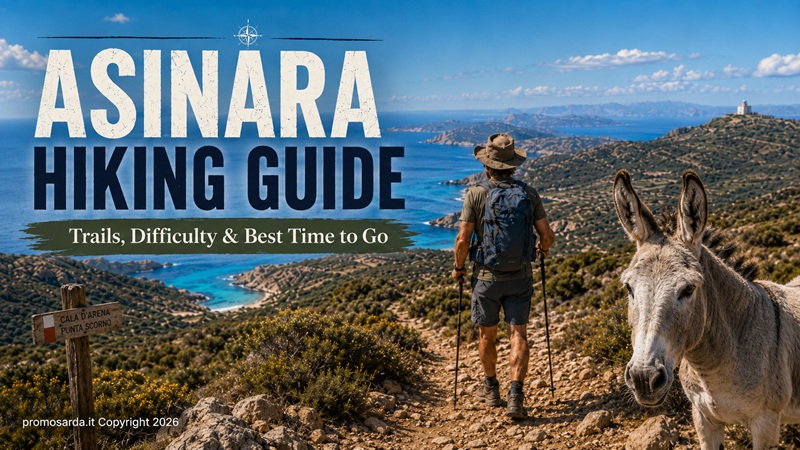
How to explore Asinara National Park by bike without turning a beautiful day into a logistical experiment: the best cyclable trails, ferry strategy, e-bike rental, history, wildlife and the routes I would actually choose.
The first mistake people make with Asinara is looking at its shape on a map. Long, narrow, one main road: easy. Then they arrive and discover wind, rough concrete, dirt tracks, almost no shade, limited water, tempting detours and a ferry that has absolutely no interest in waiting because you wanted one more photograph of a white donkey. On a bicycle, Asinara is magnificent precisely because distances that feel disconnected from a vehicle begin to make geographical sense. You move from a former prison to a quarantine station, past grazing animals and First World War remains, through granite and Mediterranean scrub, and eventually understand that the island is not a collection of attractions. It is one continuous historical landscape.
I ride mountain bikes regularly and I like Asinara by bike a lot. But I do not interpret “there is a dirt path” as “I am allowed to cycle it”. The National Park makes explicit distinctions between trails that are fully cyclable, partially cyclable and not cyclable at all. That is the starting point for this guide. Cycling and hiking within the Park must remain on the routes intended and marked for those activities, and temporary closures can also be imposed when environmental conditions require them.
Information checked for the 2026 season.
Asinara by Bike: Quick Facts
| Question | Practical answer |
|---|---|
| Is Asinara good for cycling? | Excellent, especially by MTB or e-bike |
| Main island road | Approx. 25 km from Fornelli to Cala d’Oliva |
| Surface | Mostly concrete main road + selected dirt roads/trails |
| Best months | April–May, June with caution, September–October |
| Summer | The Park strongly discourages cycling because of heat, sun, scarce water and lack of shade |
| Best easy trail | Sentiero dell’Acqua, 6.9 km |
| Best history trail | Sentiero della Memoria, 5.5 km |
| Best MTB-style route | Sentiero del Granito, 11.2 km, mostly cyclable |
| Can I bring my own bike? | Yes, Delcomar carries bicycles on Porto Torres–Asinara |
| Can I rent on the island? | Yes, official 2026 bike rental is listed at Fornelli |
| Best bike for most visitors | E-bike / e-MTB |
| Guide mandatory? | Not for ordinary permitted cycling routes |
| Can I cycle every Park trail? | Absolutely not |
Why a Bike Makes So Much Sense on Asinara
The island’s backbone is a roughly 25 km concrete road connecting Fornelli with Cala d’Oliva, passing or giving access to the principal areas of Fornelli, Campu Perdu, La Reale, Trabuccato and Cala d’Oliva. Secondary dirt roads branch towards places such as Santa Maria, Tumbarino, Elighe Mannu and Punta dello Scorno, and the Park’s thematic trails branch from this network.
A bicycle sits nicely between walking and a motorised tour. Walking lets you see everything but limits how much island you can cover in one day. A vehicle covers enormous ground but changes your relationship with distance. On a bike, the old prison settlements are far enough apart to understand why they were separate and close enough that you can connect several in a single outing.
The main road is not a silky cycleway. Park planning documents describe concrete pavement with degraded and cracked sections, particularly farther north, plus narrower bends, steeper gradients and localised road-edge problems. That is why I prefer an e-MTB, MTB or reasonably robust gravel bike rather than a delicate road setup.
And another distinction: Asinara is peaceful, but the road is not completely traffic-free. Park services include authorised transport and visitor vehicles, so ride as if you may meet one around the next bend.
The Most Important Rule: Not Every Trail Is a Bike Trail
This is where a lot of generic internet itineraries become unreliable. The Park publishes an explicit ciclabilità classification for its thematic routes. I would follow that rather than an old GPX file uploaded by somebody who once rode through without being stopped.
| Official Park trail | Length | Cycling status |
|---|---|---|
| Sentiero dell’Acqua | 6.9 km | Fully cyclable |
| Sentiero della Memoria | 5.5 km | Fully cyclable |
| Sentiero del Granito | 11.2 km | Mostly cyclable |
| Sentiero del Castellaccio | 8.3 km | Partially cyclable |
| Sentiero del Muflone | 6.1 km | Not cyclable |
| Sentiero dell’Asino Bianco | 7.8 km | Not cyclable |
| Sentiero della Natura | 2 km | Not cyclable |
| Sentiero del Leccio | 13.7 km | Not cyclable |
| Sentiero del Faro | 17.9 km | Not cyclable |
| Sentiero di Cala Sabina | 1.3 km | Not cyclable |
| Sentiero di Trabuccato | 6.5 km | Not cyclable |
These classifications come directly from the current Park trail catalogue.
Gavino wouldn’t do this: ride the Lighthouse Trail because an app describes it as a “great MTB track”. The Park says not cyclable. That ends the discussion.
1. Sentiero dell’Acqua — My First Choice for an Easy Bike Ride
Start: Fornelli | Distance: 6.9 km | Loop: yes | Maximum elevation difference: 42 m | Cyclability: 100%.
If somebody tells me they want to cycle Asinara but they are not a cyclist, I start here. The Water Trail leaves from the visitor area at Fornelli and follows easy dirt roads through a landscape organised around something surprisingly important on this island: water.
You pass coastal ponds, wells, watering points, small dams, reservoirs and old hydraulic infrastructure. The route also reaches the restored guard position at Punta Salippi, then continues towards the Fornelli prison area. In the plain are remains associated with the First World War prison camp, including a ruined chapel and small cemetery.
That combination is exactly why I like outdoor routes here. You start thinking you are going for an easy bicycle ride and end up asking why a water reservoir exists, who built the cemetery and what this island was doing during the First World War.
For families with older children who already cycle confidently, this is one of the first routes I would investigate. Heat remains the limiting factor, not elevation.
2. Sentiero della Memoria — The Best Bike Route for History
Start: Cala Reale | Distance: 5.5 km | Loop: yes | Elevation: essentially flat | Cyclability: 100%.
If you arrive on the public ferry from Porto Torres, this is the most logical thematic bicycle route because Cala Reale is the ferry landing point and the trail starts from its visitor centre area.
The Memory Trail is much more interesting than the numbers suggest. In only 5.5 km it connects the Austro-Hungarian chapel, Campo Faro, former penitentiary structures, an Italian military cemetery, Campu Perdu, prehistoric Domus de Janas and the Austro-Hungarian ossuary, which contains the remains of more than 5,000 First World War prisoners. The route also passes the Park’s marine observatory and the marine-animal recovery centre.
Asinara’s First World War history is grim. Thousands of Austro-Hungarian prisoners reached the island from Serbia after an exhausting retreat marked by disease and enormous mortality; many of those who later died on Asinara are commemorated at Campu Perdu.
This is one of those rides where I stop often.
Not because I am tired.
Because riding straight past an ossuary to improve an average-speed statistic would be ridiculous.
3. Sentiero del Granito — The One for MTB Riders
Start: Fornelli | Distance: 11.2 km | Maximum elevation difference: 75 m | Cyclability: mostly cyclable.
The Granite Trail is my pick for somebody who actually enjoys riding dirt rather than merely using a bicycle as transport.
It begins east of Fornelli and moves into the southern granite landscape through coastal ponds, Mediterranean scrub and former prison infrastructure. Around Punta Barbarossa the landscape becomes increasingly rocky, eventually reaching old granite quarry areas where working traces, tools and handmade shelters survive. Cala Sant’Andrea sits beside an integral-protection sector, so the route itself is also a practical lesson in the difference between looking at a protected place and treating it as recreational space.
The important word is mostly.
Mostly cyclable is not secretly another way of saying fully cyclable.
Some sections become rough enough that pushing the bike is the sensible or required choice.
That does not offend me.
I have never considered walking beside a mountain bike a moral failure.
4. Sentiero del Castellaccio — Bike First, Boots Last
Start: Fornelli | Distance: 8.3 km | Maximum elevation difference: 212 m | Cyclability: partial.
This is a particularly good example of how to combine cycling and walking correctly. From Fornelli the route passes former prison infrastructure and climbs towards the ruined Castellaccio, which dominates the southern plain and the Strait of Fornelli.
The Park specifically identifies an area near a natural spring where bicycles and other vehicles are parked; from there the final ascent becomes steeper and continues on foot. The summit looks towards Isola Piana, Stintino and the Nurra.
Perfect.
Ride what should be ridden.
Walk what should be walked.
The bicycle does not need to reach every stone you do.
What About the White Donkey Trail?
This is where the name tricks cyclists.
Sentiero dell’Asino Bianco sounds like the obvious Asinara bike ride. It isn’t.
The official trail is 7.8 km and non-cyclable. It starts from Cala Reale and explores the historic sanitary station and Trabuccato landscape while passing areas where the island’s donkeys are frequently seen.
You do not need to enter that trail by bicycle to see donkeys anyway. Both grey Sardinian donkeys and Asinara’s famous white form live across the island. The Park describes the white donkey as an albino phenotype characterised by a white coat, pink skin and partially pigmented eyes; the animals are notably sensitive to strong light.
That last detail should make one rule obvious.
Do not surround one with bicycles for a selfie.
The Route I Would Choose for a First Day Trip
For most visitors arriving from Porto Torres, I would build the day around Cala Reale rather than pretending the ferry lands at the perfect beginning of every route.
My first-day structure would be: Porto Torres → ferry to Cala Reale → Memory Trail → Campu Perdu → main-road exploration according to time, fitness and weather → return to Cala Reale well before the ferry.
The key phrase is well before.
I do not plan island cycling around the theoretical minute I can arrive back at a pier.
A puncture does not care about timetables.
Neither does a headwind.
The Bigger Ride: Following Asinara’s Main Road
The island’s principal concrete road runs approximately 25 km from Fornelli to Cala d’Oliva. In principle this makes a superb end-to-end bicycle itinerary, connecting the southern prison landscape with Campu Perdu, Cala Reale, Trabuccato and finally Cala d’Oliva.
In practice, an end-to-end ride requires transport planning. The regular Delcomar ferry from Porto Torres lands at Cala Reale, not Fornelli. So an itinerary that begins at one extreme and ends at the other requires either suitable maritime transport, an authorised ground transfer, a guided arrangement or an overnight plan.
This is why I would not publish “Fornelli to Cala d’Oliva — 25 km, easy day!” and stop there.
Twenty-five kilometres is the geography.
Getting yourself and the bicycle back is the itinerary.
Cala Reale to Cala d’Oliva: The Northern Option
For a day visitor landing at Cala Reale, riding north on the main road towards Trabuccato and Cala d’Oliva gives a good introduction to the inhabited and penitentiary history of the island without trying to cover the entire Park.
Cala d’Oliva is one of Asinara’s most distinctive settlements: a small white village built around narrow stone-paved streets, with the former Central Branch prison complex higher above it. The ex-prison area now includes the Osservatorio della Memoria, preserving the twentieth-century history of the island.
This is also where Asinara’s more recent history becomes impossible to separate from the landscape. From the 1970s the island’s prison system was intensified for high-security detention; figures connected with organised crime, terrorism and Sardinian banditry were held here, and Giovanni Falcone and Paolo Borsellino spent a protected period on Asinara in 1985 while preparing anti-Mafia proceedings. The prison finally closed in the 1990s and the National Park was established in 1997.
One caution: once at Cala d’Oliva, do not interpret the nearby Lighthouse, Leccio, Cala Sabina or Trabuccato hiking trails as optional MTB extensions. The Park currently classifies all of them as non-cyclable.
Park the bicycle appropriately and walk where walking is allowed.
Cala Reale to Fornelli: The Southern Option
South from Cala Reale, the landscape gradually shifts towards the broad Fornelli area and the island’s strongest concentration of genuinely bike-friendly thematic routes.
This is the direction I prefer if the bicycle itself is an important part of the day rather than merely transport, because reaching Fornelli unlocks the Water Trail, most of the Granite Trail and part of Castellaccio.
The problem is the return.
If you came to Cala Reale on the public ferry, remember you still need to cycle back to Cala Reale unless you have arranged another legitimate transfer.
That sounds obvious.
It becomes less obvious at 16:30 when somebody is looking at a beautiful cove and saying, “We have plenty of time.”
Can You Cycle the Whole Island in One Day?
A reasonably fit rider can cover a lot of Asinara in one day.
That does not mean the best day is the one with the highest number of kilometres.
The Park itself recommends dividing a thorough visit into at least three days, roughly corresponding to the Fornelli, Cala Reale and Cala d’Oliva sectors.
That recommendation makes sense.
If you ride the entire spine, add side trails, stop at historical sites, watch animals, eat something, photograph the landscape and make the return ferry comfortably, time disappears rapidly.
A one-day visit should have a theme.
History: Cala Reale + Memory Trail.
Cycling: Fornelli + Water/Granite.
Long scenic ride: main island road with carefully planned transport.
Everything: come back tomorrow.
E-Bike or Normal Bike?
For the average traveller, I would take an e-bike or e-MTB.
Not because Asinara is an Alpine climbing destination. It isn’t. The advantage is range insurance against wind, heat and accumulated distance.
A normal MTB is excellent for a rider who cycles regularly. A gravel bike can work very well on the main road and easier dirt roads, but I would want tyres robust enough for rough surfaces rather than racing rubber. I would not choose a conventional road bike as my first option because the main concrete surface is cracked and degraded in places and the cyclable thematic routes include dirt.
The e-bike warning is simple: do not plan battery use to zero.
Wind changes range dramatically. So do rider weight, tyre pressure, assistance level and dirt surfaces.
My target is to return with battery remaining, not with a good story about how I pedalled a 25 kg e-bike without assistance for twelve kilometres.
Bringing Your Own Bike from Porto Torres
This is straightforward. Delcomar’s Porto Torres–Asinara service accepts bicycles, and the company’s online booking interface has a bicycle selection in the vehicle section. The public service operates between Porto Torres’ Segni pier and Cala Reale.
For the current seasonal schedule, Delcomar lists daily service during 1 May–20 July and 1–30 September, with Porto Torres departures at 08:30 and 16:30 and returns from Asinara at 10:00 and 18:00. From 21 July–31 August there are three daily pairs of sailings; in low season the service drops to selected days. Always re-check shortly before travelling because ferry schedules are exactly the kind of information that should never be copied blindly from last year’s blog.
Delcomar currently advertises the route from €10, but bike supplements and passenger categories should be checked directly in the booking system when purchasing.
Renting an E-Bike in Porto Torres
For a Cala Reale day trip, renting in Porto Torres is often logistically cleaner than arriving on the island without a bike and then discovering that the Park’s official island rental is at Fornelli.
A particularly useful option is Northwesternbikers, based on Via Antonietta Bassu in Porto Torres and currently rated about 4.9/5. A current Asinara rental product using this supplier arranges e-bike collection around the ferry departure area and explicitly reminds customers to purchase the bicycle supplement for the crossing.
Another strong local option is Ebikebyvelasport on Corso Vittorio Emanuele II, currently around 4.9/5 from more than 200 reviews; its published contact information specifically uses the domain ebikeasinara.it.
Birbike on Via Sassari is another Porto Torres rental with a current rating around 4.8/5, offering conventional bicycles and e-bikes and actively promoting Asinara cycling.
These ratings and commercial arrangements can change. I would verify bike size, battery, helmet, repair kit, ferry-bike supplement and exact morning handover procedure before paying.
Renting a Bike on Asinara
The Park’s official 2026 authorised-operator page lists Herculis Asinara Rent e-Bike for bicycle rental at Fornelli, with telephone contacts +39 345 518 8764 and +39 347 198 7798.
The important word is Fornelli.
The normal Porto Torres public ferry arrives at Cala Reale.
So before deciding “I’ll just rent on the island,” establish how you are reaching Fornelli. If you use a Stintino–Asinara passenger service, confirm the landing point and whether bicycle/rental arrangements are compatible with your booking. The Park currently lists several authorised passenger services on the Stintino–Asinara route.
This is the kind of small logistical detail that separates a good itinerary from a very long morning.
Guided Bike Tour or Self-Guided?
If you can read a map, manage your bicycle, understand battery/range or basic mechanical problems and intend to remain on clearly permitted routes, Asinara can work very well self-guided.
A professional guide adds value when history and ecology matter as much as riding. At Campu Perdu, Trabuccato or Cala d’Oliva, there are buildings you can look at for thirty seconds or understand for twenty minutes. Those are two completely different visits.
The Park recommends using authorised operators for supported visits. Some older official operator documents explicitly listed guided bike-tour providers, but the Park’s current 2026 authorised-operator webpage presently returns no entries under its guided-bike-tour category, while continuing to list the Fornelli bike rental. I would therefore verify current-season authorisation directly with the Park before booking any company specifically marketed as an authorised guided cycle tour.
That is a useful E-E-A-T detail rather than an inconvenience.
An old “authorised operator” PDF is not a permanent licence.
The Animals: Slow Down
The white donkey gets the publicity, but Asinara is much more than one photogenic animal. The island also supports grey Sardinian donkeys, horses, goats, wild boar, mouflon and a significant bird population.
On a bicycle, give animals ridiculous amounts of space.
Do not ring the bell at them.
Do not chase them off the road.
Do not offer food because a donkey has learned to look charming.
The Park explicitly prohibits disturbing or feeding wildlife. It also prohibits damaging habitats and removing archaeological material, minerals, plants and shells.
Gavino’s rule: if an animal changes direction because of you, you were probably too close.
The Archaeology Rule Still Applies on a Bike
The Memory Trail reaches Domus de Janas, but archaeology can appear in a wider landscape as fragments, worked stone or something that simply looks unusual.
My mountain bike does not turn me into an archaeologist because it got me there faster.
Do not dig.
Do not rearrange stones.
Do not put an object in your saddlebag “to show somebody later”.
The Park explicitly prohibits the removal or damage of archaeological material.
Photograph without disturbing the context, record the position and report anything genuinely significant to the appropriate authority.
The most valuable part of an archaeological object may be exactly where you found it.
Water Is the Real Difficulty
People ask me about elevation.
I ask how much water they have.
Asinara National Park explicitly says cycling and hiking are strongly discouraged during the summer months because of intense solar exposure, high temperatures, limited water availability and lack of shade. The Park identifies spring and autumn as its preferred hiking and cycling seasons.
This is stronger wording than “bring sunscreen”.
I would treat it accordingly.
For a long outing, carry enough water to be independent. Do not build a route around a fountain you saw mentioned in an old GPX comment. The island has food and refreshment services in its principal visitor areas, but that does not make it a town with a bar every five kilometres.
The current 2026 authorised-operator page lists food service at Fornelli, Cala Reale and Cala d’Oliva.
Use them.
Do not depend on them for survival.
My Asinara Cycling Kit
I keep this simple: helmet, gloves, sunglasses, 2+ water bottles or hydration pack, food, sunscreen, compact first-aid kit, phone, offline map, power bank, spare tube even if tubeless, plugs, tyre levers, pump/CO₂, multitool, chain quick-link and light wind layer.
With an e-bike I add one thing mentally:
battery discipline.
If I have used half the battery before half the planned ride is finished, I change the plan.
I do not negotiate with percentages.
Wind Changes the Ride More Than Elevation
Maestrale is not unusual in northern Sardinia.
A headwind that felt pleasantly cooling in the morning can make an exposed return unpleasant and can reduce e-bike range significantly.
This is especially important if you design a route that sends you far from Cala Reale before turning back for a fixed ferry.
I always want a time reserve and an energy reserve.
Preferably both.
Can You Swim During an Asinara Bike Ride?
Yes, where bathing and access are permitted.
But this is a National Park and Marine Protected Area with differentiated protection zones. For example, Cala d’Arena is an integral reserve where access and bathing are prohibited, even though the Lighthouse Trail passes through the wider northern landscape.
Again:
pretty water is not automatically public water.
Follow current signage.
Can You Take a Drone on a Cycling Trip?
For recreational filming, do not plan on it.
The Park states that drone use within the protected area requires authorisation and that permits are not issued for recreational purposes, only for scientific or public-interest uses.
Good.
One less object to carry.
Best Time of Year for Asinara by Bike
April and May are my favourites. The island is green, seasonal water is still present, temperatures are generally more sensible and flowers transform the landscape.
June can still work, but I become increasingly conservative with heat and departure time.
July and August: the Park strongly discourages cycling. I would not publish a fake “summer cycling is amazing, just start early!” reassurance when the managing authority itself uses stronger language.
September: improving, but early September can still be very hot.
October: excellent when weather cooperates.
Winter: beautiful and quiet, but ferry frequency is reduced and weather becomes the main variable. Delcomar’s low-season public service is not daily.
Is Asinara by Bike Good for Families?
It can be, but route selection matters more than the child’s age.
For a child who already cycles confidently, I would favour short sections around Cala Reale or the fully cyclable, low-gradient Water or Memory trails, under suitable temperatures.
I would not use a child as the reason to hire an e-bike and then double the planned distance.
Children become tired.
Adults become tired too.
Adults just call it “a technical problem with pacing”.
Where to Stay Before the Ferry
For a one-day cycling trip, I like sleeping in Porto Torres the night before rather than driving in from Alghero at dawn while wondering whether the bicycles are correctly booked.
B&B La finestra sul porto currently rates around 4.8/5, while Golden House affittacamere Porto Torres currently sits around 4.9/5. Both meet the rating threshold I use when recommending accommodation on this site.
For dinner the evening before, Ristorante All’improvviso currently rates around 4.7/5. The following morning I would eat properly rather than attempting 30 kilometres on coffee and optimism.
Current ratings checked in September 2026; verify again when booking.
Can You Sleep on Asinara?
Yes, the Park’s current planning documents and authorised-operator information list accommodation at Cala d’Oliva, making a two-day bike-and-hike visit possible.
I am deliberately not recommending a specific island property here because I have not found a sufficiently robust current independent rating that meets the accommodation threshold we use on this site.
A useful guide should occasionally leave money on the table.
My Perfect Two-Day Asinara Bike Plan
Day 1: ferry to Cala Reale → Memory Trail → Campu Perdu and historic sites → cycle towards Cala d’Oliva → explore the village and prison-memory landscape → overnight north if accommodation meets your requirements.
Day 2: arrange legitimate transport or ride according to your return logistics towards Fornelli → Water Trail → selected cyclable parts of the Granite/ Castellaccio area → return to the appropriate departure pier.
This is dramatically better than trying to collect every landmark in seven hours.
You begin to notice things.
The vegetation changes.
The granite changes.
The buildings change.
Even the silence changes.
Asinara by Bike vs 4×4 vs Hiking
Bike: best balance between distance, independence and environmental immersion.
4×4: best for visitors who want broad coverage, historical interpretation and little physical effort.
Hiking: best for non-cyclable thematic trails and detailed landscape observation.
I would not choose one permanently.
I would choose according to the day.
A bike is not automatically the “greenest” way to behave if you use it to enter routes where bikes are prohibited.
Respect is measured by behaviour, not equipment.
Asinara by Bike FAQ
Can you cycle around Asinara?
Yes. Cycling is an established Park activity along the main road and trails specifically designated as cyclable. The island’s main road is approximately 25 km end-to-end.
Can I take a bicycle on the Porto Torres–Asinara ferry?
Yes. Delcomar explicitly permits bicycles and its booking system includes a bicycle option.
Where does the Porto Torres ferry arrive on Asinara?
At Cala Reale.
Can I rent a bike on Asinara?
Yes. The Park’s 2026 authorised-operator list includes Herculis Rent Bike at Fornelli.
Is an e-bike worth it on Asinara?
For most visitors, yes. The assistance is particularly valuable over a long day when wind and distance begin to accumulate.
What is the easiest Asinara bike trail?
The 6.9 km Sentiero dell’Acqua at Fornelli: loop route, only 42 m maximum elevation difference and officially fully cyclable.
What is the best historical cycling route?
The 5.5 km Sentiero della Memoria from Cala Reale, which links First World War, prison and prehistoric sites.
Can I cycle to Punta della Scomunica?
Not via the official Leccio Trail. The Park currently classifies the Leccio Trail as non-cyclable.
Can I cycle to Punta dello Scorno lighthouse?
Not along the official Lighthouse Trail, which is classified non-cyclable.
Is the White Donkey Trail cyclable?
No. Despite the attractive name, the official 7.8 km White Donkey Trail is not open as a cycling trail.
Can you bike Asinara in August?
The Park strongly discourages hiking and cycling during the summer months because of intense heat, solar exposure, low water availability and lack of shade.
Do you need a mountain bike?
Not necessarily for the main road, but a robust bike is preferable. An e-MTB is my all-round choice if you want to combine the main road with authorised dirt sections.
Are there restaurants on Asinara?
Food services are currently listed by the Park at Fornelli, Cala Reale and Cala d’Oliva. Opening arrangements can be seasonal, so check before relying on them.
Can I feed the white donkeys?
No. The Park prohibits disturbing and feeding wild/feral fauna.
Final Thoughts: The Bike Is a Tool, Not the Objective
I know people who arrive somewhere like Asinara and immediately ask:
“How many kilometres can we do?”
Wrong first question.
Ask:
“What do we want to understand?”
If the answer is the First World War, cycle the Memory Trail slowly.
If it is the southern granite landscape, get yourself to Fornelli and ride the Water and Granite routes.
If it is the island as geography, plan the long road.
If it is Punta dello Scorno, leave the bike and hike the permitted trail another day.
I like mountain bikes because they get me to places.
I do not need them to enter every place.
That difference matters on Asinara more than almost anywhere else in Northern Sardinia.
Slow down for the animals. Do not feed them. Keep off trails closed to bikes. Do not collect shells, stones, plants or interesting-looking historical objects. Do not calculate the last ferry as though punctures, wind and curiosity do not exist.
And if you find an empty bottle beside a First World War chapel?
You know the routine. Put it in the backpack. The e-bike can carry the extra twenty grams.
