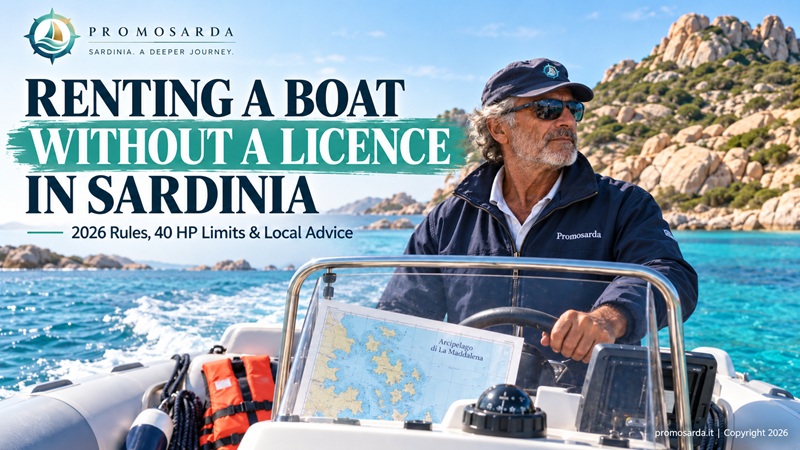
Can you really rent a 40 HP boat in Sardinia without a boating licence? Michele explains the current Italian rules, the 6-mile limit, engine displacement, foreign-tourist requirements, insurance, safety, protected areas and the mistakes that can turn a cheap RIB rental into a very expensive day.
My name is Michele. I am 65. I was born in Campania and moved to Porto Torres almost 45 years ago. I worked at sea, fished, sailed, raced for pleasure and have spent enough time around boats to recognise one particular sentence that makes me nervous:
“Don’t worry. You don’t need a licence.”
Sometimes that sentence is legally correct.
It is still incomplete.
In Sardinia you can indeed rent many small motorboats and RIBs without an Italian patente nautica. But the famous “40 horsepower rule” is only part of the law. Engine displacement matters as well. So does how far from the coast you navigate. Your age matters. Your nationality can matter. The boat’s flag and rental contract can matter. Marine protected areas can impose rules far stricter than the general national limit.
And once the boat leaves the dock, there is another difference that matters even more:
No licence does not mean no responsibility.
This guide is updated to September 2026. For the legal sections I have cross-checked the current Italian boating code and implementing regulations against the Gazzetta Ufficiale, MIT and current rules of the main protected areas relevant to Northern Sardinia. Local Harbour Master ordinances and protected-area rules can still change during the season, so always confirm the specific boat and navigation area with the rental operator before departure.
The Short Answer
| Question | 2026 answer |
|---|---|
| Can an Italian resident drive some motorboats without a boating licence? | Yes |
| Is 40 HP the only legal condition? | No |
| Maximum general distance without the standard licence? | Within 6 nautical miles from the coast |
| Does engine displacement matter? | Yes |
| Can a jet ski be driven without a licence? | No |
| Minimum national age for a licence-exempt natante? | 16 |
| Does that mean a rental company must rent to a 16-year-old? | No |
| Can foreign tourists automatically rely on the Italian 40 HP rule? | Do not assume so — foreign-document rules require a separate check |
| Can a rental contract impose a smaller navigation area? | Yes |
| Can a marine protected area impose additional restrictions? | Absolutely |
| Must a rental company give an unlicensed renter operating instructions? | Yes, including written instructions in Italian and English |
The Famous “40 HP Rule” — And Why It Is Not Actually a 40 HP Rule
This is the first correction I would make to most articles on the subject.
Under the current Article 39 of the Italian Recreational Boating Code, within six nautical miles a standard boating licence becomes compulsory not only when engine power exceeds 30 kW / 40.8 CV, but also when the engine exceeds specific displacement limits. The wording was updated in 2025 and now distinguishes injected two-strokes and supercharged diesel engines more precisely.
For an ordinary licence-exempt motorboat, the relevant ceilings are:
| Engine type | Displacement threshold |
|---|---|
| 2-stroke, carburetted | 750 cc |
| 2-stroke, injected | 900 cc |
| 4-stroke outboard, carburetted or injected | 1,000 cc |
| 4-stroke inboard, carburetted or injected | 1,300 cc |
| Naturally aspirated diesel | 2,000 cc |
| Supercharged diesel | 1,300 cc |
| Engine power | 30 kW / 40.8 CV |
The important word here is and from the user’s practical perspective: the engine must stay within the applicable power and displacement limits for the licence exemption to apply. MIT explicitly explains the principle: staying below the power threshold does not save you if the relevant displacement limit is exceeded, and vice versa.
So when somebody tells you:
“It’s 40 horsepower. No licence.”
my next question is:
What engine is it?
Not because I enjoy reading engine plates on holiday.
Because the law does.
Why you will see so many 40 HP rental RIBs in Sardinia
Operators deliberately use engine configurations that fit the licence-exempt market. That is why “40 CV”, “40 HP” and senza patente appear everywhere from Alghero to Stintino, Palau and Cannigione.
But do not decide legality from a decal on the cowling.
The operator should know the engine’s official declaration of power and displacement.
If the answer to a technical legal question is:
“Everyone uses this one.”
ask again.
A Small but Important Double-Check: Some Online Government Information Is Older
This is exactly why I did not rely on a single source for this guide.
The MIT information page still clearly explains the 30 kW / 40.8 CV principle and the fact that displacement can independently trigger the licence requirement, but that page was last updated in 2021 and therefore shows an older grouping of some displacement categories.
The 2025 Gazzetta Ufficiale text is newer and specifically lists the 900 cc limit for injected two-strokes and separates naturally aspirated from supercharged diesel engines.
For this article, I use the newer statutory wording.
That is what “updated for 2026” should mean.
Not changing the year in the title.
Six Nautical Miles: The Other Limit People Forget
Even with a qualifying licence-exempt engine, the standard exemption applies to navigation within six nautical miles from the coast. Beyond six miles, a boating licence is required regardless of the small engine you have fitted. Jet skis are also subject to a licence requirement regardless of engine power.
Six nautical miles is approximately 11.1 kilometres.
But do not turn that into:
“Excellent. I am allowed to travel 11 kilometres offshore.”
That is the wrong way to think.
The six-mile rule is a legal maximum associated with the licence requirement, not a route recommendation.
Your rental contract may say two miles.
The operator may restrict you to a gulf.
The boat’s technical limits may be different.
A Park may restrict access.
The weather may make one mile too much.
Michele’s rule
A legal ceiling is not a target.
When I see someone who has driven a RIB twice planning a route specifically because it remains 5.9 miles from land, I do not think:
“Excellent understanding of maritime law.”
I think:
“Why are you trying so hard to reach the limit?”
“Natante” Matters Too
Most boats marketed in Sardinia as senza patente are small natanti da diporto rather than registered imbarcazioni da diporto. In practical terms, a natante is the smaller recreational-craft category, normally up to 10 metres.
This distinction also affects the minimum age rules.
Current Article 39 allows licence-exempt operation from 16 years of age for a natante and from 18 for an imbarcazione, assuming the engine and navigation remain inside the licence-exempt conditions.
That does not mean:
“My 16-year-old can rent a RIB in Palau.”
Being legally old enough to operate a qualifying natante is not the same thing as being old enough to enter the operator’s rental contract. Commercial companies commonly impose their own higher minimum age, often 18 or above, and can impose experience requirements as well.
Check before booking.
Renting vs Chartering: “Locazione” and “Noleggio” Are Not the Same Thing
This is a distinction I particularly want in this article because English-language tourism sites routinely blur it.
If you rent a boat without a skipper and take control of it yourself, the relevant Italian legal concept is normally locazione.
If the provider supplies the vessel while retaining its availability and the crew remains under the provider, that is noleggio in the statutory sense.
The distinction is not just vocabulary. The 2026 reform of the Recreational Boating Code states that with a boat taken under locazione, the conduttore takes temporary possession and assumes the risks deriving from his or her own conduct. In noleggio, by contrast, the unit remains in the provider’s availability and the crew remains under the provider.
In tourist English both may be advertised as “boat rental”.
Legally, they are not the same relationship.
Michele translates it
Boat + you driving = you have taken the responsibility seriously.
Boat + professional skipper = you are buying a different service.
This does not mean every scratch automatically becomes your financial responsibility regardless of circumstances or contract. Insurance and contractual conditions still matter.
It means you should read the contract before learning what “deductible” means beside a damaged propeller.
The Rental Company Has to Brief an Unlicensed Renter
This is one of the best pieces of the current legislation.
For a natante rented under a locazione agreement where Article 39 does not require a boating licence and the renter does not possess one, the operator must explain and provide in writing the essential instructions for commanding the boat.
Since the 2024 implementing update, those standard instructions are specifically required in Italian and English.
So this:
“Throttle forward. Reverse here. Anchor there. Bye.”
is not what I consider an adequate handover.
Take the briefing seriously.
Ask how to start and stop the engine, use the kill switch, lower and raise the engine if appropriate, deploy and recover the anchor, recognise the permitted navigation area, read the fuel gauge, contact the operator, approach the harbour and respond if the engine does not restart.
The person explaining it has probably already seen every mistake you are about to make.
Listen.
Foreign Tourists: This Is the Part You Should Check Before Paying
This deserves its own section because an English-language article cannot responsibly tell every tourist “40 HP means no licence required”.
Current Article 34 of the Italian implementing regulation contains specific provisions for foreign citizens commanding recreational craft in Italian territorial waters. Foreign citizens who possess a boating qualification or recognised equivalent from their country of citizenship/residence can command Italian craft within the limits of that qualification. For foreign-registered boats, the licence requirement can be governed by the law of the vessel’s flag state. EU citizens can dispense with a qualification in certain circumstances where they carry an original declaration from the competent authority confirming that the relevant national legislation does not issue such a qualification.
That means your nationality/document situation needs to be checked separately from the engine’s 40 HP marketing label.
Before booking from abroad
Send the operator this question:
“I am a citizen/resident of [country], I do not hold a boating licence, and I want to rent this specific boat without a skipper. Please confirm which original documents I need under the current Italian rules.”
Get the answer before paying a non-refundable deposit.
Do not assume that because a booking platform labels a listing “boat without licence”, the platform has analysed Article 34 for your nationality, residence and the flag/status of that particular craft.
This is one of the most important distinctions in this entire guide.
What About British, American, Canadian or Other Non-EU Visitors?
I would not publish a single blanket answer.
Current Article 34 distinguishes nationality/residence, qualifications and vessel registration, and its explicit no-title declaration mechanism refers to EU citizens and Italian citizens resident there.
So for a non-EU visitor without a boating qualification:
ask the professional operator to confirm eligibility for that specific rental in writing before booking.
If there is any doubt, use a skipper.
A skipper is considerably cheaper than discovering your interpretation of Italian maritime law during a Coast Guard inspection.
A New 2026 Option: The D1 Boating Licence
There is now another interesting middle ground.
Italy’s new Category D, type D1 licence became operational in 2026. It can be obtained from age 16 and permits daylight navigation with qualifying recreational craft up to 12 metres within six nautical miles, with engines up to 85 kW / 115.6 CV, subject to the detailed displacement limits and licence conditions. Under 18, it is limited to natanti and jet skis.
This is obviously not licence-free boating.
But for somebody who regularly holidays in Sardinia and wants more capability than the usual 40 CV rental, D1 is now worth knowing about.
For a one-week tourist?
Probably not your solution.
For somebody who comes every summer?
Different conversation.
The Boat Rental Contract: Read the Boring Part Before the Beautiful Part
The photograph you booked contains turquoise water.
The contract contains the part that can cost money.
The 2026 reform makes the responsibility principle particularly clear for locazione: the person taking the rented unit assumes the risks arising from his or her conduct.
Before signing, I want clear answers on:
| Contract question | Why I ask |
|---|---|
| Is fuel included? | Often it is not |
| What navigation area is permitted? | It may be far smaller than six miles |
| Is entry into an MPA/Park included? | Often requires separate authorisation |
| What is the security deposit? | Know what can be retained |
| What is the damage excess/deductible? | Insurance does not automatically mean zero liability |
| Is propeller/lower-unit damage covered? | Common shallow-water damage |
| What about damaged tubes? | Relevant on RIBs |
| What happens if the anchor is lost? | More common than tourists think |
| What is the late-return policy? | Sunset does not negotiate |
| Who pays towing/recovery after misuse? | Read this before needing it |
| Is there a weather-cancellation policy? | Especially important with Mistral |
| Is a Park permit included? | Critical around La Maddalena/Asinara |
I would photograph the signed conditions.
Not because I expect trouble.
Because memory becomes surprisingly creative after a €600 argument.
Insurance Does Not Mean “I Can’t Lose Money”
There is a persistent holiday belief that “the boat is insured” means whatever happens is the rental company’s problem.
No.
Insurance policies have terms.
Rental contracts have exclusions.
Deposits exist for a reason.
A propeller damaged on a rock, a tube cut against a quay, anchor equipment lost because you tied the rope badly or damage caused by operating outside the authorised area may become a contractual dispute even when the boat carries insurance.
Ask for the damage excess, not just whether insurance exists.
Those are two different questions.
Michele’s Ten-Minute Boat Inspection
Before leaving, I photograph the propeller, skeg/lower unit, hull or RIB tubes, console and any existing obvious damage. I check that the fuel level corresponds with what the contract says, test steering, identify reverse, understand the trim/tilt control if present, find the kill switch, locate the anchor and line, find the lifejackets and verify that a child actually has a child-sized one rather than an adult jacket somebody expects them to grow into during the trip.
Then I ask:
What do I do if the engine does not restart?
That question tells me a lot about the operator too.
Safety Equipment: Do Not Assume It Is There Because It Should Be
Italy’s updated safety-equipment table varies according to distance from the coast and type of navigation. For navigation within six miles, the current official Annex V includes, among other requirements, appropriate lifejackets for everyone aboard, a lifebuoy with line and prescribed distress-signalling equipment; the exact mandatory set changes with navigation distance and craft characteristics.
A responsible rental boat should be equipped for the authorised navigation.
I still physically look.
If there are six people aboard, I want six appropriate lifejackets.
If one passenger is four years old, I want equipment appropriate for that child.
I do not want:
“They’re somewhere under the seat.”
I want to know which seat.
The Kill Switch
If the boat has an engine cut-off safety lanyard, use it correctly.
Not around the steering wheel.
Not resting beside the throttle.
Attached to the person actually driving.
On a small open boat, falling away from the controls while the engine continues running can turn a simple accident into a very different one.
A boat is not a scooter.
Although scooters at least usually stop when you fall off.
Learn Reverse Before You Need Reverse
I have watched beginners leave the quay confidently because forward is easy.
Then return six hours later discovering reverse for the first time while approaching somebody else’s €300,000 boat.
Before departure:
engage forward gently.
Neutral.
Reverse gently.
Know the throttle response.
A harbour is a bad classroom.
Do Not Learn Anchoring at Cala Coticcio
Practise the sequence somewhere appropriate and legal before arriving in a crowded cove.
Know how much line/chain you have.
Know which end of the rope is attached to the boat.
Yes.
I have to write that.
Look at the seabed. In protected areas, anchoring restrictions can include Posidonia oceanica and other sensitive habitat. La Maddalena’s current rules, for example, prohibit anchoring on Posidonia and regulate anchoring/mooring through zoning and designated facilities. The national licence exemption does not cancel Park rules.
Marine Protected Areas: “No Licence” Does Not Mean “Go Anywhere”
This is probably the second biggest legal misunderstanding after the 40 HP rule.
Italian boating law determines when you need a licence.
A National Park or Marine Protected Area determines what you may do inside that protected area.
Different question.
La Maddalena Archipelago
La Maddalena has its own access and commercial-rental authorisation system, plus specific navigation, anchoring, mooring and seasonal speed rules. In 2026 the Park updated its disciplines for rental and charter activities during the season. So a Palau operator handing you a licence-exempt RIB does not automatically mean that every Park zone is available to you exactly as you wish.
This is why we created a dedicated guide rather than putting La Maddalena into one paragraph.
ANCHOR → La Maddalena by Boat: If Spargi, Budelli or Caprera is your main objective, read our La Maddalena by boat guide before booking: it covers the current Park permits, anchoring rules, protected areas, routes and the weather decisions that matter once you leave Palau.
Asinara
Asinara is even more obvious.
In the Area Marina Protetta, Zone A prohibits recreational navigation; free motor navigation is not permitted in Zone B; authorised access corridors operate under specific conditions and speed limits; motor navigation in Zone C requires Park authorisation and is limited to 10 knots; the Passaggio dei Fornelli has a 3-knot limit.
The Park’s 2026 commercial discipline also requires authorisation for the relevant rental/charter activity.
So if somebody rents you a 40 CV RIB in Stintino and says:
“You can just go wherever around Asinara.”
I would ask for a much more precise explanation.
The Rental Company’s Limit Beats Your Ambition
Imagine the law potentially allows you to stay within six miles.
The contract says:
maximum two miles from the coast and no crossing to Island X.
You obey the contract.
Imagine the operator says:
stay inside the gulf today because the Mistral is increasing.
You stay inside the gulf.
A licence exemption does not create a constitutional right to use every horsepower you paid for.
Where I Would Rent a Licence-Free Boat in Northern Sardinia
| Base | Beginner suitability | Main advantage | Main caution |
|---|---|---|---|
| Alghero | Good in suitable weather | Sheltered bay options, dramatic coast | Capo Caccia/AMP rules and exposed sections |
| Stintino | Good locally | Sheltered-looking water, beautiful coast | Asinara AMP requires planning |
| Porto Torres | Moderate | Useful western base | Longer exposed transfers |
| Isola Rossa / Costa Paradiso | Moderate–low for complete beginners | Spectacular granite coast | Fewer easy refuge options; exposure |
| Santa Teresa Gallura | Moderate | Capo Testa and Bocche scenery | Strait of Bonifacio wind can become serious |
| Porto Pozzo | Good in the right itinerary | More sheltered starting geography | Do not confuse sheltered departure with sheltered whole day |
| Palau | Excellent choice, complex rules | La Maddalena on the doorstep | Park traffic, permits, wind, busy summer water |
| Cannigione | Very good for cautious beginners | Gulf provides gentler route options | Longer routes still enter exposed/regulated waters |
| Golfo Aranci / Olbia area | Good | Large rental market and route choice | Tavolara protected-area rules if heading there |
If I were putting somebody with zero boating experience on their first self-drive RIB, I would favour a route with a sheltered departure, short distances, several safe alternatives and an operator who is willing to say:
“Today, stay here.”
I would not choose a destination because TikTok showed me the furthest beach.
The Strait of Bonifacio Is Not Your Training Area
The water between Northern Sardinia and Corsica is famous for wind.
A small licence-free RIB may be legally operable by the renter in the permitted area.
That does not mean I would use it for an ambitious open-water plan with a first-time driver.
The combination of Mistral, current, traffic and short steep sea can transform a pleasant trip quickly.
If your dream is Bonifacio:
take a properly suited charter.
Or get more experience.
Beautiful water doesn’t cancel wind.
Mistral: The Forecast Number Is Not the Whole Forecast
People look at an app and ask:
“Is 15 knots okay?”
For what boat?
From where?
Going where?
With what sea state?
With children?
Against what return direction?
Wind direction changes the answer.
So does its trend.
I care whether the wind is rising at 14:00, not merely what it is at 09:00.
A rental operator who tells you:
“Come back by 13:30. It will build.”
has probably just improved your holiday.
Do not reply:
“But I paid for the full day.”
The sea does not process refunds.
Check the Return Trip Before the Outbound Trip
A classic beginner mistake is to spend the morning travelling with favourable wind or sea and then discover that home is in the opposite direction.
Before leaving the dock, ask:
What will the return look like?
I would rather have an uncomfortable twenty-minute outward run and an easy return than the reverse late in the afternoon with tired passengers and less fuel.
Fuel: “Not Included” Can Mean More Than Extra Money
Licence-free RIBs often have fuel charged separately according to use.
That is not the important part.
The important part is knowing:
tank capacity, starting level, expected consumption, how much reserve you should keep, whether refuelling is done by you or the operator and what happens if you return unusually low.
Do not plan fuel around ideal brochure consumption.
Wind changes it.
Load changes it.
Chop changes it.
Constant acceleration changes it.
Getting lost changes it.
Michele’s fuel calculation
I like arriving with fuel I did not need.
Nobody has ever ruined my afternoon by returning with too much reserve.
Number of Passengers: “It Fits” Is Not the Standard
A rental boat has an authorised carrying capacity.
Do not add one more person because:
“She’s small.”
The maximum number of people is determined by the craft’s technical documentation/category, and the person in command is responsible for operating with an appropriate number of people aboard. Official Italian guidance specifically treats passenger capacity as a documented characteristic of recreational craft.
Also remember that six adults plus coolers, bags, water and snorkelling equipment make a small boat behave very differently from two adults.
Legal capacity and comfortable capacity are not always the same number.
Alcohol: The Skipper Gets Water
This one surprises people.
Italian law has specific alcohol rules for recreational craft and an especially strict regime for people under 21 and for those operating a recreational unit used for commercial purposes; Article 2 defines units subject to rental and charter contracts as commercially used units. For those categories, Article 53-ter penalises alcohol levels beginning above zero, including the 0–0.5 g/L band.
A rental boat is not an exemption because you do not possess a boating licence.
My practical rule is simpler than the legislation:
the person driving drinks zero alcohol until the boat is returned.
Everyone else can discuss Vermentino.
The driver can discuss it at dinner.
What If You Drive Without a Licence When One Was Actually Required?
This is not a €50 parking ticket.
Article 53 of the Recreational Boating Code sets an administrative sanction of €2,755 to €11,017 for commanding or operating a recreational unit without the required qualification.
That is why the difference between:
40 HP marketing,
40.8 CV statutory threshold,
engine displacement,
six-mile limit,
foreign-document rules
is not academic trivia.
If you are unsure, ask before leaving.
Your Phone Is Not Navigation Training
I carry a phone.
Of course I do.
Weather.
Position.
Contacts.
Maps.
Useful.
But a blue dot does not teach right of way.
It does not show you every swimmer.
It does not recognise an underwater rock.
It does not explain a Park zone automatically.
It does not know that your rental contract forbids the route you entered.
Google Maps does not drive boats.
Learn the basics before you leave.
Swimmers and Divers
Near beaches, coves and anchored boats, expect people in the water.
Do not enter crowded swimming water under power because somebody on shore is waving at you.
Know the local approach corridors.
Reduce speed early.
Look behind you before reversing.
And watch for dive flags/buoys.
Italian sanctions specifically address dangerous conduct around speed-restricted areas, beaches, buoy fields and dive signals.
The absence of a licence requirement does not reduce the distance between a propeller and a person.
Children on a Licence-Free RIB
I like taking children on boats.
I dislike treating children like luggage.
Correct lifejacket.
Shade.
Water.
Sun protection.
A place to sit securely.
No child sitting on the bow tube while somebody accelerates because:
“He loves it.”
He will love ice cream too.
Choose the safer activity.
A larger licence-free RIB may feel more stable and comfortable than the cheapest possible boat, but once again check the engine specification rather than assuming length changes the licence rule by itself.
First-Time Driver? I Would Pay for 20 Extra Minutes of Instruction
If an operator offers a proper familiarisation session, take it.
Dock departure.
Slow manoeuvres.
Turning.
Reverse.
Stopping distance.
Trim if relevant.
Anchor.
Reboarding.
Return to berth.
Those twenty minutes improve the day more than Bluetooth speakers.
If you cannot confidently put the boat back beside the dock at slow speed, you are not ready to start trying to park between five anchored yachts.
When I Would Cancel a Licence-Free Rental
I would cancel or change the plan if I had strong or rapidly increasing wind, poor visibility, thunderstorms, an operator visibly uncomfortable with the forecast, mechanical doubts about the boat, passengers already anxious before departure, or a route requiring exposed water beyond the experience of the person driving.
I would also walk away from an operator who refuses to explain the authorised area or gives me a boat without a credible safety briefing.
Sometimes losing a deposit is cheaper than winning an argument with yourself.
When I Would Choose a Skipper Instead
A skipper makes particular sense when this is your first ever day controlling a motorboat; your route depends on La Maddalena’s more complicated zones; you want to cover a large area; your group wants lunch and alcohol; you are travelling with very young children; the forecast is marginal; or nobody wants to spend the day checking anchor, fuel and return time.
The skipper is not “admitting defeat”.
You are buying local decision-making.
I have decades around boats.
If a local skipper knows that coastline better than me, I listen to him.
Self-Drive vs Skipper: Michele’s Version
| Self-drive licence-free boat | Boat with skipper |
|---|---|
| More independence | More local knowledge |
| Usually lower base cost | Higher price |
| You handle navigation | Skipper handles navigation |
| You handle anchoring | Skipper handles anchoring |
| You watch fuel | Skipper manages operation |
| You remain sober | You can relax |
| You choose the route within limits | Route adapted professionally |
| Mistakes are yours too | Command responsibility stays with professional structure |
The funny thing is that tourists sometimes choose self-drive because they want freedom.
Then spend the entire day watching the fuel gauge.
The Three Questions I Would Ask Any Sardinian Rental Company
I would not ask:
“Can I go to Budelli?”
first.
I would ask:
“Am I legally eligible to drive this exact boat with my nationality and documents?”
Then:
“What exact navigation area does your contract allow?”
Then:
“Based on tomorrow’s forecast, where would you personally not go?”
The answers tell me almost everything.
Parent Boat Guide
Northern Sardinia by Boat: If you are still deciding where to rent, our Northern Sardinia by boat guide compares the main departure areas, rental options, routes and sea conditions from Alghero and Stintino to Santa Teresa, Palau and La Maddalena.
La Maddalena
La Maddalena by Boat: If the reason you want a licence-free RIB is Spargi, Budelli or Caprera, read our La Maddalena by boat guide first: Park permits, anchoring, Posidonia, seasonal speed rules and wind can matter more than the engine’s 40 HP label.
Renting a Boat Without a Licence in Sardinia FAQ
Can you rent a boat without a licence in Sardinia?
Yes, qualifying recreational craft can be rented under locazione without an Italian boating licence when the statutory engine-power/displacement, navigation-distance, age and other applicable requirements are met. Foreign visitors must additionally check the rules applying to their nationality, qualification status and the specific craft.
Is 40 HP the maximum without a boating licence in Italy?
The statutory power threshold is 30 kW / 40.8 CV, but this is not the only condition. Engine displacement limits also apply.
Can a 40 HP engine still require a licence?
Yes, potentially, if its displacement exceeds the applicable statutory threshold. This is why you should verify the official engine specification rather than power alone.
How far can I go without a boating licence?
The national licence exemption applies within six nautical miles from the coast. Your boat, contract, local ordinance or protected area may impose a smaller permitted area.
Can I drive from Sardinia to Corsica without a licence?
Do not plan a Corsica crossing on the assumption that a licence-free Italian rental makes it permissible. Distance, nationality/document rules, rental-contract restrictions, insurance and international/flag-state considerations all enter the picture. For a visitor, use an appropriately authorised skippered service rather than improvising a cross-border trip.
Can I rent a boat without a licence if I am British or American?
Do not rely on the engine-power rule alone. Current Italian regulations contain separate provisions for foreign citizens and recognised boating qualifications. Ask the rental company to confirm in writing which documents apply to your citizenship/residence and that particular boat before paying.
Can an EU tourist rent without a licence?
Potentially, but current Article 34 includes specific documentary rules. EU citizens from a jurisdiction where no boating qualification is issued can rely on an official declaration from the competent authority under the conditions described in the regulation. Carrying the required original documentation matters.
How old must you be?
National law permits a qualifying licence-exempt natante to be operated from 16, while the corresponding minimum for an imbarcazione is 18. Rental companies can impose a higher contractual age.
Can I rent a jet ski without a licence?
No. Current Article 39 requires a boating qualification for a moto d’acqua regardless of engine power.
Must the rental company teach me how to drive the boat?
For a qualifying natante under locazione rented to someone without a boating licence, the operator is required to explain and provide the essential command instructions in writing. The implementing rules specify Italian and English.
Is fuel included?
It depends on the operator. Many rentals charge fuel according to consumption. Confirm the method before departure.
Is insurance included?
Do not stop at “yes”. Ask about the policy, your damage excess/deductible, security deposit and exclusions for propeller, tubes, anchor, groundings, unauthorised navigation and other damage.
Can I enter La Maddalena National Park with a licence-free rental?
Possibly with an appropriately authorised boat and the required Park permissions, but the Park has its own current rules governing access, rental activities, navigation, anchoring and protected zones. See our dedicated La Maddalena by Boat guide rather than treating the national licence exemption as Park permission.
Can I independently explore Asinara in a 40 HP RIB?
Do not assume so. Asinara’s marine protected area has zones with very different navigation rules: motor navigation is prohibited or restricted in important sectors and authorisation is required in others.
Can I drink alcohol while driving a rented boat?
My recommendation is zero alcohol for the driver. Italian law applies a particularly strict zero-threshold regime to people under 21 and to those commanding units used for commercial purposes, a category that includes units subject to rental/charter contracts.
What happens if I drive a boat that legally required a licence?
Article 53 provides a sanction from €2,755 to €11,017 for commanding an recreational unit without the required qualification.
Final Thoughts: “No Licence Required” Is the Beginning of the Conversation
I understand why these boats are popular.
They make Sardinia accessible.
You arrive in Stintino, Alghero, Cannigione or Palau.
You see a five- or six-metre RIB.
Forty horsepower.
Turquoise water.
A reasonable price.
No course.
No exam.
Keys in your hand.
That feels like freedom.
And it can be.
But freedom on a boat is different from freedom in a hire car.
There is no white line telling you where the road ends.
There is no guardrail around a shallow rock.
A cloud does not close the road before a squall.
Nobody paints Posidonia yellow so you know not to anchor on it.
And when the Mistral arrives, the sea does not know you rented the boat until 18:00.
The legal part is therefore simple only after you have checked it properly: engine power, displacement, six-mile limit, age, nationality/documents, rental conditions and local protected-area rules.
Then comes the part no legislation can do for you.
Judgement.
If you have never driven a boat, accept a proper briefing.
If you are uncomfortable, take a skipper.
If the rental company changes your permitted route because the weather is deteriorating, thank them.
If you use half the fuel going somewhere, do not assume the other half automatically brings you home.
If the only safe sandy anchoring patch is occupied, find somewhere else rather than destroying Posidonia.
And if you look at the water and think:
“Maybe today isn’t the day.”
you have already learned something useful about boats.
A boat is not a scooter.
The absence of a licence means the State has allowed you to conduct a certain category of craft under certain conditions.
It does not mean the sea has certified you.
