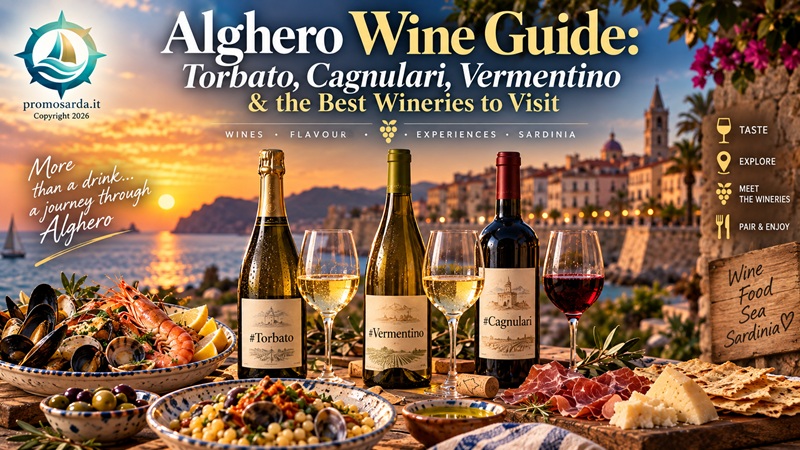
A local guide to wine tasting in Alghero and the Nurra – what Torbato and Cagnulari actually taste like, where Vermentino fits in, how the wines are made, which wineries are worth visiting and how to plan a tasting as part of a northern Sardinia trip.
I have always thought that wine is one of the things visitors discover too late about Alghero. They arrive knowing about the old town, the Catalan history, Capo Caccia and the beaches. If they know one Sardinian wine, it is usually Vermentino. Then they drive north towards Fertilia, Porto Conte or Santa Maria La Palma and begin noticing something that people who live here almost stop seeing: vineyards everywhere.
That flat, windy countryside behind Alghero is the Nurra, and wine is not an accessory to the landscape. It is one of the things that created it.
The Alghero DOC extends from the coast inland for roughly 30 kilometres and includes Alghero, Olmedo, Ossi, Tissi, Usini, Uri, Ittiri and part of Sassari. Within a relatively compact area you find limestone and clay, alluvial soils, sandstone formations and other geological variations, all exposed to a warm Mediterranean climate, maritime influence and the maestrale. The original research for this guide identified the combination of sea, wind and geological diversity as central to understanding the savoury and mineral sensations often associated with the area’s wines.
Then there are the grapes. Vermentino is important, excellent and impossible to ignore, but the two names I would particularly want a wine-loving visitor to remember are Torbato and Cagnulari. Torbato gives Alghero one of Sardinia’s most distinctive white-wine stories. Cagnulari gives the same territory a red identity that tourists rarely know before arriving.
If Vermentino tells you something about Sardinia, Torbato and Cagnulari tell you something specifically about this corner of Sardinia.
Where to Eat in Alghero: A Local’s Guide to Sardinian Food, Seafood, Pizza & Gelato
Alghero Wineries – Quick Reference
| Winery | Why I would go | Wines I would focus on |
|---|---|---|
| Sella & Mosca | Best first large-estate visit | Torbato, sparkling Torbato, Cagnulari |
| Cantina Santa Maria La Palma | Cooperative history + production tour | Vermentino, Cagnulari, sparkling wines |
| Poderi Parpinello | Family winery + useful grape comparison | Centogemme Torbato, Kressia Cagnulari |
| Ledà d’Ittiri | Intimate wine + olive-oil experience | Cagnulari, Vermentino |
| Podere Guardia Grande | Strongest maritime-terroir experience | Saldenya Vermentino, L’Alghè Cagnulari |
| Tenute Delogu | Winery + food + wine resort | Vermentino, Cagnulari, Cannonau |
| Cantina Rigàtteri | Small educational cellar visit | Local varieties, production process |
I would not try to visit all seven. Two well-chosen wineries teach you more than five rushed tastings. That was also the logic of the original shortlist.
Why Alghero Wine Tastes the Way It Does
If you want to understand wine rather than simply drink it, start outside the glass. Alghero’s wine country is unusually maritime. Some vineyards sit very close to the coast, and even the inland part of the denomination remains relatively near the sea. The maestrale regularly crosses this open country, and soils vary considerably over short distances.
When wine people use the word salinity, I would not take it literally. You are not drinking seawater. Think instead of savouriness, tension and a slightly mouth-watering mineral sensation that can appear after the fruit.
With a good Alghero white, I often think of the sequence like this: fruit first, then freshness, then something drier and more savoury, then the finish. That final part is often where the wine begins to reveal more about where it came from.
And this is why tasting the same grape from two producers is much more interesting than simply ticking varieties off a list. A Torbato does not explain Torbato. A Vermentino does not explain Vermentino. Wine becomes interesting when you start comparing.
Torbato – The Wine I Would Come to Alghero Specifically to Taste
If this guide convinces you to remember only one unfamiliar grape, make it Torbato.
The variety developed in Sardinia during the centuries of Spanish influence and today is closely concentrated around Alghero. Under Alghero DOC, the varietal wine is based overwhelmingly on Torbato, and the grape is used both for still and sparkling wines. The original material describes its classic profile through marine and mineral impressions, fruit, good persistence and a characteristic slightly bitter finish.
What Does Torbato Smell Like?
Forget the textbook for thirty seconds. Pour the wine, smell it once immediately, wait, then smell it again.
Depending on producer and vinification, I would look for white flowers, pear or other white-fleshed fruit, citrus, Mediterranean herbs, sometimes chamomile and something mineral or almost marine. Sella & Mosca’s Catore, for example, has been described through helichrysum, pear and chamomile. That helichrysum note interests me because it belongs so naturally to Sardinia: dry Mediterranean scrub, hot summer air, herbs warming beside the road.
You do not have to identify every aroma correctly. Nobody is grading you. What matters is noticing whether the wine changes after a minute in the glass.
What Happens in the Mouth?
This is where Torbato becomes more distinctive for me. I do not primarily associate it with obvious sweetness of fruit. The first impression can be fresh and reasonably broad, then comes sapidity, structure and frequently a light bitter note in the finish.
That bitterness is not a defect. Think almond skin rather than medicine. It can make the wine feel gastronomic rather than merely refreshing, which is precisely why I like Torbato with food.
Still Torbato – One Grape, Several Interpretations
One of the best things about Torbato is that you can use it to understand different winemaking decisions without changing grape variety.
Sella & Mosca’s Catore uses hand-harvested grapes, cold maceration, soft pressing and temperature-controlled fermentation. Poderi Parpinello’s Centogemme offers another interpretation, with cold maceration and controlled fermentation producing a profile that moves from white flowers and pale fruit into acidity, salinity, structure and a light bitter-almond finish. Those are exactly the sort of wines I would like to put side by side, not to declare a winner but to understand the grape.
Sparkling Torbato – Tank vs Traditional Method
This is where the wine lesson becomes even more interesting.
Sella & Mosca’s Miràll is 100% Torbato made using cuvée close, with the secondary fermentation taking place in a pressurised tank. This generally preserves aromatic immediacy, brightness and freshness. The wine has been described through acacia flower, grapefruit, yeast and bread crust, followed by a fresh, savoury palate.
Then taste Oscarì. Again 100% Torbato, but produced through the traditional method, with secondary fermentation in bottle and ageing on the lees.
Same grape. Same broad territory. Different production.
Tank fermentation generally pushes you towards freshness and fruit. Traditional-method bottle fermentation with time on the lees can create more bread, yeast and pastry-like aromas and a creamier texture, while retaining the grape’s acidity and savoury character. The contrast between the two methods is laid out clearly in the original Torbato section.
You do not need a sommelier qualification to notice it. Put the glasses beside each other.
That is wine education at its best.
What Should You Eat with Torbato?
Start with Alghero’s natural habitat: seafood.
Frittura mista, grilled fish, shellfish, octopus, bottarga pasta, seafood fregola and light fish starters all make sense. The original pairing section was already built around precisely those dishes.
I particularly like sparkling Torbato with fried fish because acidity and bubbles cut through the richness of the frying. Then I would move to a still Torbato with the main seafood course.
If someone put good fried calamari and a cold bottle of Torbato in front of me on a summer evening in Alghero, I would not feel an urgent need to improve the situation.
Cagnulari – The Red Wine Tourists Rarely Know Before They Arrive
Cagnulari is the other discovery.
Torbato explains one white-wine side of Alghero. Cagnulari explains why this territory should not be treated purely as a seafood-and-white-wine destination.
Also known locally as Cagliunari, it is an old red grape associated with north-west Sardinia. Historically it was often blended or consumed locally rather than promoted as a prestigious varietal wine. Its modern revival is one of the more interesting stories in the area. The original research also notes traditional low-bush or low-espalier training and the grape’s ability to accumulate colour, sugar and polyphenols under the sunny conditions of the territory.
This is not a grape that became internationally fashionable and was then imported into local viticulture.
It survived because people here kept growing it and eventually decided it deserved to be taken seriously on its own.
What Does Cagnulari Smell Like?
Start with the colour, usually deep ruby and sometimes violet in youth. Then smell.
The classic vocabulary includes wild berries, red fruit, sour cherry, spice, liquorice and balsamic notes. Santa Maria La Palma’s expression moves through liquorice, berries and marasca cherry, while Podere Guardia Grande’s L’Alghè has been described through red berries, cherry in spirit, mace, cinnamon and eucalyptus.
That eucalyptus reference is useful because it helps explain what wine people mean by balsamic.
Not balsamic vinegar.
Think aromatic freshness, herbs, menthol and Mediterranean vegetation.
How Cagnulari Opens in the Mouth
I would expect more body than Torbato, obviously, but not necessarily a brutal red. The Alghero DOC profile is dry, structured and tannic without requiring aggression. The denomination’s Riserva category also requires extended ageing, allowing the grape to develop additional complexity.
On the first sip, pay attention to fruit, then structure, then what the tannin does to your mouth.
A good Cagnulari should not feel as though somebody dried your gums with kitchen paper.
The tannin should support the wine, not punish you.
Poderi Parpinello’s Kressia, for example, uses temperature-controlled fermentation followed by roughly 10-12 days of maceration, producing ripe red fruit, spice, structure and relatively soft tannins. This is exactly the sort of production detail that makes a cellar visit useful.
Ask:
“How long do you leave the wine on the skins?”
Suddenly the technical answer connects directly with the colour and tannin you feel in the glass.
What Should You Eat with Cagnulari?
This is where Alghero moves inland.
Pecorino, mature cheese, salumi, roast pork, porceddu, lamb, sheep, beef and rich ragù all make sense.
I particularly like Cagnulari with a Sardinian cheese board. Start with a younger cheese, move towards mature pecorino and keep going back to the wine. You will understand food pairing more quickly that way than by reading fifty rules.
Vermentino – Do Not Ignore It Just Because It Is Famous
It would be contrarian nonsense to write an Alghero wine guide and treat Vermentino as somehow less interesting because tourists already know the name.
Vermentino matters enormously here.
It is planted throughout Sardinia and reaches its best-known geographically protected expression in Vermentino di Gallura DOCG in the north-east. Around Alghero and the Nurra, however, producers make large quantities of very good Vermentino too, frequently as Vermentino di Sardegna DOC.
What changes is terroir and winemaking.
Not the spelling on the label.
The original draft already contrasts Santa Maria La Palma’s fresh, maritime style with Podere Guardia Grande’s more aromatic Saldenya, illustrating just how different two local expressions of the same grape can become.
What Does Vermentino Smell Like?
A young Vermentino from the area may give you white flowers, citrus, pear, apple, peach, Mediterranean herbs and, depending on site and producer, more tropical fruit and saline or mineral sensations.
Cantina Santa Maria La Palma’s Aragosta Vermentino di Sardegna DOC is a classic example of the direct maritime style: pale colour, floral and pale-fruit aromas, dry palate and lively mineral freshness. Podere Guardia Grande’s Saldenya moves further into pineapple, lychee, grapefruit and chamomile with saline and mineral sensations.
Same grape.
Same broad coastal area.
Different vineyard.
Different choices.
Different wine.
What Happens in the Mouth?
Take a sip and notice how quickly the acidity arrives, how broad the wine feels, whether the fruit remains obvious, whether something savoury appears and how long the flavour remains after swallowing.
A straightforward Vermentino can be wonderfully direct: dry, citrusy, floral and refreshing. More ambitious examples can become broader and more textured.
That is why Vermentino works equally well as a beach-house aperitivo, a seafood wine and something worth studying seriously in a cellar.
Torbato vs Vermentino – The Comparison I Would Make Every Visitor Try
If I were organising a first wine lesson in Alghero, I would put two chilled glasses beside each other.
One Vermentino.
One Torbato.
Smell the Vermentino first. Then Torbato. Go back.
In broad terms, Vermentino can feel more immediately floral and fruity. Torbato often becomes more interesting after another minute, when its savouriness, herbs, mineral character and slightly bitter finish begin to emerge.
For me, Vermentino often introduces itself. Torbato sometimes makes you ask another question.
With raw or simply cooked seafood, both can work. With frittura I particularly like sparkling Torbato. With grilled fish, Vermentino is extremely easy. With bottarga I want enough acidity and savouriness to stand beside the intensity of the roe.
And with fregola?
I am prepared to repeat the Torbato-versus-Vermentino experiment until the evidence becomes statistically convincing.
For scientific reasons.
The Real Alghero Wine Country Is Outside the Old Town
Alghero is where many visitors sleep, eat and drink. Much of the wine story happens behind it.
Drive towards Fertilia, the airport, Santa Maria La Palma, Porto Conte, Lago di Baratz or the inland roads towards Olmedo and Sassari and the landscape opens.
Low countryside.Vineyards.Olive groves.Mediterranean scrub.Farm roads.Wind.
This is the Nurra.
A winery marketed as “Alghero” may actually sit near Santa Maria La Palma, along the road towards Sassari, close to the airport or on the Porto Conte side of the countryside. That does not make it less Algherese in wine terms. This whole landscape belongs to the same viticultural system.
Santa Maria La Palma – The Agricultural Face of Alghero
If the old town is the cultural face of the destination, Santa Maria La Palma is one of the best places to understand its agricultural one.
The cooperative winery is based there, smaller producers operate in the surrounding countryside and vineyards stretch towards Porto Conte and the western coast.
This makes it perfect for a very Sardinian kind of day:
morning beach – lunch – vineyard – tasting – dinner.
I prefer that to:
winery – winery – winery – winery.
After the fourth cellar, even the most enthusiastic visitor begins nodding thoughtfully at information they stopped processing two hours earlier.
Fertilia – The Gateway Between Beaches and Vineyards
Fertilia itself is not a famous wine village, but geographically it is one of the gateways between Alghero and the northern vineyard belt.
If you are staying around Fertilia, Punta Negra, Le Bombarde or Porto Conte, several winery visits become extremely easy to combine with beach days.
That is one of the great strengths of Alghero as a wine destination.
You do not have to choose between wine holiday and seaside holiday.
The two landscapes are almost touching.
Olmedo – Part of the Same Wine Geography
Olmedo also belongs inside the Alghero DOC production territory.
I would not create a separate “Olmedo wine day” merely to tick another town off the itinerary. I would think of Olmedo as part of the same inland vineyard landscape and choose wineries according to the experience they offer rather than the municipality written beneath their address.
Wine geography is often more useful than administrative geography.
The Best Wineries to Visit Around Alghero
1. Sella & Mosca – The Best First Winery
Sella & Mosca is the obvious starting point, and I mean that positively.
Founded in 1899, it is not simply a tasting room but a substantial historic estate with vineyards, old cellars, an enoteca and a genuine sense of scale.
Large estates are useful for first-time wine visitors because they make the whole sequence physically visible: vineyard, harvest, fermentation, cellar, ageing, bottle.
But the strongest reason to visit for this guide is Torbato.
If the tasting allows it, I would deliberately compare still Torbato, tank-fermented sparkling Torbato and traditional-method Torbato, then finish with Cagnulari.
That turns a winery tour into an actual lesson in winemaking.
Do not ask:
“What is your best wine?”
Ask:
“Why did you decide to make Torbato in these different ways?”
That question is much more interesting.
Best for: first-time wine tourists, serious beginners, Torbato enthusiasts.
Focus: Catore, Miràll, Oscarì and Cagnulari.
My verdict: if you have one wine half-day and almost no knowledge of Alghero wine, start here.
2. Cantina Santa Maria La Palma – The Winery That Explains the Nurra
Santa Maria La Palma tells a completely different story.
Its identity comes from a community of growers in the agricultural countryside around Santa Maria La Palma, making the visit particularly useful if you want to understand wine as farming rather than simply as a prestigious bottled product.
The winery has done a great deal to make Cagnulari visible again, producing it in several expressions. This is where I would compare a younger Cagnulari with a more structured or aged version if the tasting allows it.
Then move to Vermentino.
The contrast between the two wines is almost the territory speaking in two languages: flowers, citrus and mineral freshness on one side; red fruit, spice, tannin and balsamic character on the other.
The winery’s Akènta Sub project, involving underwater maturation of sparkling wine, adds a memorable tourism story. I would enjoy it, but I would not let the novelty distract me from Cagnulari and Vermentino. Those grapes tell you more about the land.
Best for: production-curious visitors, cooperative history and broad tastings.
Focus: Cagnulari in several forms, Vermentino and sparkling wine.
My verdict: perhaps the best winery for understanding wine as agriculture and community.
3. Poderi Parpinello – The Family Winery for Grape Comparison
Poderi Parpinello feels closer to the smaller family-winery experience many visitors imagine before arriving.
Its most useful wines for this guide are Centogemme Torbato and Kressia Cagnulari.
One white.One red.Same producer.Excellent comparison.
Kressia also gives you the opportunity to connect production with sensation because the Cagnulari spends roughly 10-12 days in contact with its skins during fermentation.
Ask the winemaker why that length of maceration works for the wine.
Why not six days?Why not twenty?
Because extraction changes.Colour changes.Tannin changes.Aroma changes.
Wine becomes much easier to understand when you connect what happened in the cellar with what you feel in your mouth.
Poderi Parpinello can fit naturally into a day built around the western stops in our Best Beaches in Northern Sardinia guide.
Best for: enthusiasts who like smaller producers and production details.
Focus: Torbato vs Cagnulari.
My verdict: one of the most useful visits once you already know the basic vocabulary.
4. Ledà d’Ittiri – Wine, Olive Oil and a More Intimate Experience
Ledà d’Ittiri is for somebody who says:
“I do not want a large winery. I want to sit in the countryside and talk about what I am drinking.”
The estate combines vineyards and olive groves and offers structured tastings built around local wine, pecorino, sausage, pane carasau, olives and its own olive oil.
A tasting containing Vermentino and Cagnulari is particularly useful because you can compare the wines before and after food.
Taste Vermentino.Eat cheese.
Taste again.Taste Cagnulari.
Eat sausage.Taste again.
The wine seems to change.It has not.
Your mouth has.
This is one of the simplest ways to understand food pairing.
Best for: couples and adults wanting an intimate experience.
Focus: Vermentino, Cagnulari and olive oil.
My verdict: one of the nicest alternatives to the large-estate visit.
5. Podere Guardia Grande – Where the Landscape Explains the Wine
If “maritime terroir” sounds abstract, this is one of the places where it becomes much easier to understand.
The coastal position towards Capo Caccia and Porto Conte, Mediterranean vegetation and exposed landscape make the connection between vineyard and sea unusually visible.
I would begin with Saldenya Vermentino, then move to L’Alghè Cagnulari.
The first gives you aromatic fruit, freshness and salinity. The second moves towards red berries, spice and balsamic sensations.
Same landscape.Two grapes interpreting it differently.Walk outside before the tasting.Feel the wind.Smell the vegetation.Look towards the sea.
Then drink.
Suddenly words such as “Mediterranean herbs” and “salinity” become less theoretical.
Best for: terroir-oriented visitors and scenery.
Focus: Saldenya followed by L’Alghè.
My verdict: perhaps the easiest winery for connecting what is outside the glass with what is inside it.
6. Tenute Delogu – When a Tasting Becomes a Wine Stay
Tenute Delogu makes sense for somebody who wants the winery to become part of the accommodation experience.
The estate combines vineyards, modern cellar facilities, tasting experiences and wine-resort accommodation, working with varieties including Vermentino, Cagnulari and Cannonau.
That last grape creates a useful comparison.
Many foreign visitors already recognise Cannonau as a Sardinian red. Taste it beside Cagnulari.
Cannonau tells one Sardinian story.
Cagnulari tells another, much more specifically tied to the north-west.
The wine-resort format also solves the least romantic question in wine tourism:
who drives afterwards?
Best for: couples, wine weekends and travellers wanting accommodation with the winery.
Focus: Vermentino, Cagnulari and Cannonau side by side.
My verdict: strongest option if wine tourism is meant to occupy more than ninety minutes of the holiday.
7. Cantina Rigàtteri – For Visitors Interested in How Wine Is Actually Made
Rigàtteri appeals to the person who has stopped asking only:
“What aromas should I find?”
and started asking:
“Why does the wine taste like this?”
A small-cellar experience makes it easier to follow the journey from vineyard to bottle and ask practical questions about grape arrival, fermentation, temperature, tanks, ageing and bottling.
This is the type of winery I would visit after a larger estate rather than before.
At that point you already know what a fermentation tank is.
Now you can ask why this producer uses it in a particular way.
Best for: curious enthusiasts and production-focused visitors.
My verdict: one of the most interesting choices for somebody genuinely interested in the “how”.
Large Winery or Small Winery?
Ideally, do one of each.
A large producer such as Sella & Mosca or Santa Maria La Palma gives you history, infrastructure, scale, multiple labels and a structured production overview. A smaller producer such as Parpinello, Ledà d’Ittiri, Guardia Grande or Rigàtteri generally gives you more direct conversation and a closer connection with individual vineyards and cellar decisions.
Neither is automatically more authentic.
A cooperative representing local farming families can be every bit as culturally authentic as a tiny family estate.
They simply tell different stories.
Steel, Wood, Lees and Skin Contact – Four Ideas Worth Knowing Before You Visit
You do not need an oenology degree. Four concepts will improve almost every winery tour.
Stainless Steel
Steel is neutral. It lets wine ferment without intentionally adding flavours from the vessel. For fresh whites such as Vermentino or Torbato, this can preserve fruit, flowers and acidity very effectively.
Do not equate steel with cheap wine.
That is simply wrong.
Wood
Barriques and larger barrels can affect oxygen exposure, tannin, texture, aroma and ageing potential.
The important question is not:
“Is this wine aged in wood?”
but:
“What is the producer trying to achieve with the wood?”
Good barrel ageing should not make every wine taste primarily of furniture.
Lees
Lees are largely spent yeast and other particles left after fermentation. Contact with fine lees can add texture and complexity and, particularly in sparkling wine, contribute bread, pastry and creamy sensations.
This helps explain why a traditional-method Torbato can taste very different from a fresh tank-fermented sparkling version.
Skin Contact
For red wine, fermenting juice with the grape skins extracts colour, tannin and many aroma compounds.
This is why a question such as:
“How long does your Cagnulari stay on the skins?”
is so useful.
Suddenly cellar technique becomes something you can taste.
How Many Wines Should You Taste?
For somebody genuinely trying to understand them, three to five wines is usually enough.
If I could design an introductory Alghero tasting flight, I would choose:
| Glass | What it teaches you |
|---|---|
| Sparkling Torbato | Acidity, bubbles, local grape |
| Still Torbato | Same grape without secondary fermentation |
| Vermentino | White-grape comparison |
| Young Cagnulari | Local red character |
| Aged / Riserva Cagnulari | Effect of time and ageing |
Five glasses can teach you an extraordinary amount.
By glass nine, human confidence often increases more quickly than sensory accuracy.
How to Taste Without Pretending to Be a Sommelier
Look at the wine briefly. Smell it before swirling, then swirl and smell again. Instead of desperately searching for fourteen aromas, identify perhaps three categories: fruit, flowers or herbs, and something else.
Then taste structure.
Dry or sweet? Fresh or soft? Light or full? Tannic? Savoury? Long finish or short?
Those questions are often far more useful than announcing that the wine reminds you of a fruit nobody else at the table has ever smelled.
Then eat something and taste again.
That second sip can teach you more about pairing than half a textbook.
The Questions I Would Ask at a Winery
You do not need technical knowledge to ask useful questions. I would ask where the grapes are grown, what the soil is like, how the maestrale affects the vineyard, when Torbato is harvested compared with Vermentino, whether a wine ferments only in steel or also sees wood, how long Cagnulari remains on the skins, what changes between a young Cagnulari and Riserva, and why a particular sparkling wine uses tank fermentation rather than traditional method.
One of my favourite questions remains:
“Which of your wines do people from here actually drink most often?”
The answer is not always the expensive bottle being highlighted in the tasting room.
That can be very educational.
Best Time for Wine Tasting in Alghero
If wine is one of the main reasons for the trip, I particularly like May, June, September and early October.
May and June give you green vineyards, long days and easier combinations with beach or countryside walks. July and August are possible but can be very hot, and tourism pressure is much higher.
September is my favourite compromise.
The sea is still warm.
The August crowds begin to ease.
Restaurants remain active.
And harvest activity gives the countryside another energy.
Harvest does not happen on one universal date. It depends on producer, grape, vineyard and vintage. Some grapes can begin coming in from late August, while specific selections may remain on the vines much later.
Visiting during harvest can be fascinating, but remember that this is a working period.
Do not assume “harvest season” automatically means tourists are invited to pick grapes.
Ask.
Half-Day Wine Itinerary – First Visit
If you only have half a day, visit one winery properly.
For a first experience I would choose Sella & Mosca. Concentrate on Torbato in several styles and finish with Cagnulari.
Then return to Alghero and drink one of those wines with dinner.
That final step is important.
Wine tastes different when it stops being a tasting sample and becomes part of a meal.
Continue with our Where to Eat in Alghero guide and pair Torbato with seafood or Cagnulari with cheese and meat.
Half-Day Alternative – Santa Maria La Palma
Choose Santa Maria La Palma instead if your primary curiosity is the production process, cooperative history and the connection between a large number of local growers and one winery.
A late-afternoon tasting works particularly well.
Finish around early evening.
Return to Alghero.
Dinner.
No complicated itinerary required.
The Perfect One-Day Wine Itinerary
In the morning, visit one large producer: Sella & Mosca or Santa Maria La Palma.
Have a reasonably light lunch.
In the afternoon, choose one smaller producer according to personality: Parpinello for Torbato and Cagnulari, Ledà d’Ittiri for wine and olive oil, Guardia Grande for terroir and landscape, Rigàtteri for production technique.
Then stop.Return to Alghero.Leave the car.Walk.Eat.
That large-producer / small-producer contrast is much more educational than racing through three similar tours.
Wine + Beach – The Itinerary I Probably Like Best
You came to Sardinia, not Burgundy.
Use the sea.
Spend the morning at Mugoni, Le Bombarde, Lazzaretto or another beach around Alghero. Have a light lunch. Book one late-afternoon winery tasting. Return for dinner in town.
Choose the coast using our Best Beaches in Northern Sardinia guide.
The vineyards and sea around Alghero are not separate tourism products.
They are almost touching.
Two Days for Serious Wine Lovers
I would use two non-consecutive half-days rather than forty-eight uninterrupted hours.
Day 1: Sella & Mosca, focusing on Torbato, sparkling Torbato and Cagnulari.
Day 2: one smaller producer selected according to what interested you most on Day 1.
If terroir fascinated you, choose Guardia Grande. If production fascinated you, Rigàtteri. If comparing local grapes fascinated you, Parpinello. If food pairing and olive oil interested you, Ledà d’Ittiri. If you want a wine resort, Tenute Delogu.
This is enough.
The temptation in wine regions is always to add another winery because it is only twelve minutes away.
Resist occasionally.
How Much Does a Tasting Cost?
There is no useful universal price because a basic tasting, vineyard tour, sunset experience, premium-flight tasting and food-pairing experience are different products.
For a practical planning article, I would avoid freezing one price beside each winery because those numbers age quickly. Instead, say:
Expect prices to vary according to the number of wines, food pairing, tour length and whether the experience is private. Check the producer’s official booking page before reserving.
That will remain accurate much longer.
Should You Book in Advance?
Yes.
Especially in June, July, August and September.
Large wineries may have organised visitor programmes and defined sessions. Small producers may work entirely by appointment.
If you need the tasting in English, mention that when booking.
Do not assume every scheduled tour will automatically be multilingual.
Wine vocabulary is complicated enough in your first language.
Can You Visit Without a Car?
Yes, but you need to think about transport.
Some wineries are close enough to Alghero to make taxi transfers realistic. Others sit properly in the countryside.
Possible solutions include taxi, private transfer, designated driver, organised wine tour or staying at a wine resort.
And organise this before the tasting.
Not afterwards.
Driving After a Wine Tasting
A tasting is still alcohol.
It does not become non-alcoholic merely because someone explains fermentation before pouring it.
If you are driving, tasting and spitting is completely normal in serious wine settings. You should still comply with local driving laws and never drive impaired.
If somebody else is driving and you want to finish the tasting samples, enjoy them.
Wine tourism is not supposed to become a professional qualification.
Should You Spit Wine?
Absolutely, if you want to.
Professionals do it constantly.
Taste.
Spit.
The useful sensory information has already happened.
You do not learn additional terroir through your bloodstream.
Likewise, you do not have to finish every glass.
Nobody at the winery will emotionally collapse because you left three centimetres of Cagnulari.
Families and Winery Visits
Check winery by winery.
Large estates generally have more space and tourism infrastructure. Smaller tasting experiences may be explicitly adult-oriented.
If you are travelling with children, ask before booking whether they may join the tour, whether non-alcoholic alternatives exist and how long the experience lasts.
A ninety-minute explanation of fermentation that fascinates you may be experienced very differently by an eight-year-old.
Wine Resort or Hotel in Alghero?
For a first visit, I would generally sleep in Alghero itself.
Restaurants, old-town walks, bars and not needing to drive after dinner are major advantages.
For a wine-focused stay, however, one night in the countryside can be excellent. Ledà d’Ittiri and Tenute Delogu are examples of estates where wine tourism can be integrated with accommodation.
My preferred combination would probably be:
two or three nights in Alghero,
one night among vineyards.
That gives you both cities within the same destination.
Which Bottles Would I Buy?
If I wanted my suitcase to explain Alghero, I would begin with:
- one still Torbato,
- one sparkling Torbato,
- one Cagnulari,
- one Vermentino if space remains.
Then I would buy according to what I actually enjoyed.
Not according to which bottle has the heaviest glass and most serious-looking label.
Taste first.
Buy afterwards.
Shipping Wine Home
Ask the winery.
Shipping depends on producer, destination, number of bottles, carrier and alcohol-import rules.
Some wineries organise European shipping directly. Outside Europe, arrangements can become more complicated.
The important rule is:
ask before buying six bottles.
Wine becomes considerably less romantic once customs forms appear.
What Should You Eat During a Tasting?
Typical pairings such as pecorino, salumi, pane carasau, olives and olive oil are not arbitrary tourist snacks. They belong naturally to the local pantry and also allow you to understand what happens to wine when food changes your palate.
Do not eat everything immediately.
Taste the wine first.
Then food.
Then wine again.
That second sip is the lesson.
Alghero Wine Pairing Cheat Sheet
| Food | Wine I would start with |
|---|---|
| Raw seafood | Sparkling Torbato or Vermentino |
| Frittura mista | Sparkling Torbato |
| Grilled fish | Still Torbato or Vermentino |
| Seafood fregola | Torbato |
| Bottarga pasta | Savoury still Torbato |
| Lobster alla catalana | Torbato or structured Vermentino |
| Mild pecorino | Vermentino or young Cagnulari |
| Mature pecorino | Cagnulari |
| Salumi | Cagnulari |
| Porceddu | Cagnulari |
| Lamb / sheep | Cagnulari |
| Beef | Structured Cagnulari |
Pairing rules are suggestions, not criminal law.
Experiment.
What About Cannonau?
You will find Cannonau around Alghero and several producers make it.
Drink it.
It remains one of Sardinia’s most important red grapes.
But I would not make it the protagonist of this wine trip because I want Alghero to introduce you to something more geographically specific.
Cannonau says Sardinia.
Cagnulari says north-west Sardinia.
That distinction is worth preserving.
And Vermentino di Gallura?
Same grape.
Different geographical denomination.
Vermentino di Gallura DOCG belongs to Gallura in north-eastern Sardinia. The Alghero/Nurra area is in the north-west and produces its own very worthwhile Vermentino, commonly under Vermentino di Sardegna or other relevant designations.
Geography matters on wine labels.
When our food and wine cluster will reach Santa Teresa Gallura, Arzachena and Olbia, Vermentino di Gallura deserves a dedicated guide of its own.
A Small Detour South – Bosa and Malvasia
Drive south from Alghero towards Bosa and the wine story changes.
The Planargia around Bosa has its own remarkable identity built around Malvasia di Bosa DOC and villages such as Bosa, Modolo, Magomadas, Flussio and Tinnura.
I would deliberately not explain Malvasia di Bosa properly here.
It deserves its own article.
What matters for the wine traveller is the progression:
Alghero – Torbato, Cagnulari, Vermentino
then
Bosa and Planargia – Malvasia di Bosa.
Within one relatively compact north-western Sardinian trip, you move from fresh and savoury maritime whites and native reds into an entirely different wine tradition.
Malvasia di Bosa: Wineries, Cellars & the Wine Route of Planargia
Alghero Wine Guide FAQ
Is Alghero a good destination for wine lovers?
Yes. The attraction is the concentration of very different winery experiences within a small area: large historic estates, cooperative production, small family cellars, maritime vineyards and wine resorts, combined with distinctive grapes such as Torbato and Cagnulari.
What wine is Alghero famous for?
For a visitor interested in what is most geographically distinctive, I would prioritise Torbato and Cagnulari. Vermentino is also extremely important throughout the Nurra.
What does Torbato taste like?
Depending on producer and style, expect white fruit, flowers, Mediterranean herbs, mineral or marine impressions, good acidity and often a slightly bitter, savoury finish.
What is Cagnulari?
A red grape strongly associated with north-west Sardinia and the Alghero DOC area, generally showing berries, cherry, spice, liquorice and balsamic notes with noticeable but potentially supple tannin.
What food goes with Cagnulari?
Pecorino, salumi, porceddu, lamb, sheep, beef and richer meat dishes.
Is Vermentino produced around Alghero?
Yes, extensively. The Alghero and Nurra landscape is important Vermentino country even though the most internationally famous denomination for the grape, Vermentino di Gallura DOCG, lies in north-eastern Sardinia.
Which winery should I visit first?
For the broadest introduction, Sella & Mosca. For production and cooperative history, Cantina Santa Maria La Palma. For a more intimate family experience, look at Parpinello, Ledà d’Ittiri, Guardia Grande or Rigàtteri depending on your interests.
How many wineries should I visit in one day?
For most visitors, two maximum.
One large producer and one smaller producer make an excellent combination.
Can I combine wine tasting and beaches?
Very easily. The vineyard country around Fertilia, Santa Maria La Palma and Porto Conte is close to many of Alghero’s best beaches.
When is harvest season?
Broadly from late summer into autumn, varying substantially by grape, vineyard, vintage and desired wine style. Do not expect one universal harvest date.
What is the best period for a wine trip?
My favourite combination is May, June or September, with September particularly interesting for harvest atmosphere and warm-sea weather.
My Perfect Four-Day Alghero Wine Trip
I would not create four wine days.
Day 1: Alghero old town, seafood and Torbato with dinner. Let wine appear naturally before studying it.
Day 2: beach in the morning, Sella & Mosca or Santa Maria La Palma in the afternoon, dinner back in town.
Day 3: no winery. Capo Caccia, Porto Conte, swimming, food, rest.
Day 4: a smaller producer such as Parpinello, Guardia Grande, Ledà d’Ittiri or Rigàtteri. This time ask more questions, compare wines and buy the bottles you actually want.
That rhythm is how wine tourism works best for me.
Wine. Place. Food. Rest.
Then wine again.
Final Thoughts – Alghero Is a Wine Destination Hiding Behind a Beach Destination
Alghero has spent decades being sold through photographs of blue water, old walls, Catalan history, Capo Caccia and sunsets.
All of those things are real. But drive ten or fifteen minutes inland and another Alghero appears. The roads flatten. The city disappears. Vineyards begin.
The maestrale crosses open countryside.
And suddenly the glass you drank with dinner starts making more sense.
Torbato becomes more than an unfamiliar word on a wine list. Cagnulari becomes more than the red somebody in an enoteca told you to try. Vermentino becomes more interesting once you compare two vineyards rather than two labels.
That is when wine tourism works for me.
Not when someone teaches you the correct words to describe a glass, but when the glass helps you understand the place.
When I was younger, I treated wine much more simply.
White with fish. Red with meat. Cold bottle. Friends.
Enough.
There was nothing wrong with that, and there still isn’t. I still think a cold Torbato beside fried calamari can be considerably more important than identifying nine separate aromas.
But getting older has made me more curious about why things taste the way they do.
Why that vineyard is there.
Why one producer harvests later.
Why the same grape works as both a still wine and a traditional-method sparkling wine.
Why Cagnulari spent so long hidden inside local wine culture and is now something producers actively want visitors to remember.
If you are the kind of traveller who asks those questions, do not treat Alghero’s wineries as something to do only if one afternoon turns cloudy.
Give them half a day.
Give one producer enough time to explain itself.
Taste Torbato beside Vermentino.
Taste young Cagnulari beside a more mature one.
Then return to Alghero and order the same wine with dinner.
That glass may taste different.
Not because the wine changed.
Because now you know where it came from.
