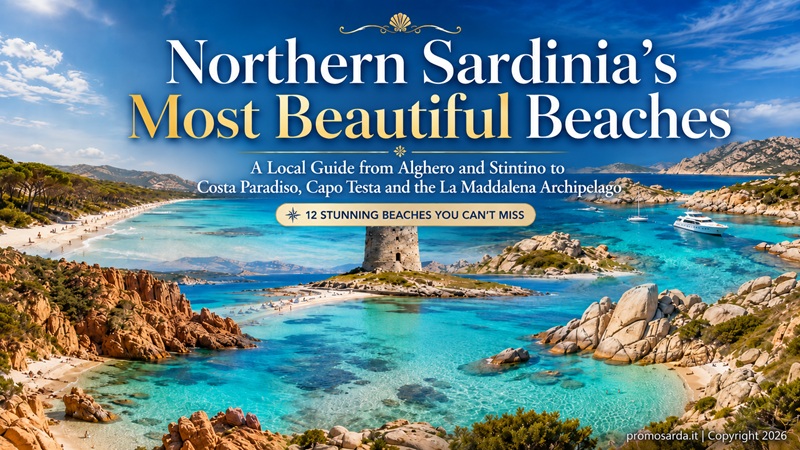
A local guide to Northern Sardinia’s most beautiful beaches, from Alghero and Stintino to Costa Paradiso, Capo Testa and the La Maddalena Archipelago
People often ask me which is the best beach in northern Sardinia. It sounds like a simple question. It isn’t.
I was born and raised in Sassari and I am now in my forties. I have been going to many of these beaches since I was a boy, first squeezed into cars with cousins and coolers, later with friends, girlfriends, my own family, visiting relatives and occasionally people from abroad who arrived convinced that every Sardinian beach looked exactly like La Pelosa.
They don’t. And that is precisely what makes the north of Sardinia so interesting.
Within a couple of hours you can move from the amber sand and open Atlantic-like character of Porto Ferro to the almost lagoon-like water of La Pelosa; from the red rock of Isola Rossa and Costa Paradiso to the pale granite of Gallura; from a two-kilometre family beach such as Mugoni to a tiny protected cove such as Cala Coticcio.
Some beaches on this list I first visited thirty years ago and still recognise immediately. Others have changed.
A few have changed so much in the way we are allowed to experience them that I deliberately returned recently. La Pelosa is the clearest example. Rena Bianca is another. Cala Coticcio, which once seemed to belong to the category of places you simply “found”, now belongs to a protected landscape where getting there correctly is part of visiting it correctly.
I do not consider that necessarily a bad thing. When I was twenty, we mostly asked whether a beach was beautiful. Today I also ask whether it can survive being beautiful and famous at the same time. This is therefore not simply my ranking of the beaches with the bluest water.
It is the guide I would give to a friend arriving in Northern Sardinia and asking:
Where should I actually swim?
The Best Beaches in Northern Sardinia at a Glance
I have deliberately arranged them roughly from west to east rather than pretending that number one is objectively “better” than number two.
| Beach | Area | Best for | Access | Booking in 2026? |
|---|---|---|---|---|
| Maria Pia | Alghero | Families, easy days | Very easy | No |
| Le Bombarde | Alghero | Swimming, atmosphere | Easy | No |
| Lazzaretto | Alghero | Clear water, small coves | Easy | No |
| Mugoni | Porto Conte | Families, calm water | Very easy | No |
| Porto Ferro | Nurra | Wild coast, sunsets, surf | Easy | No |
| La Pelosa | Stintino | Iconic shallow turquoise water | Easy, regulated | Yes |
| Le Saline | Stintino | Space, relaxed beach days | Easy | No |
| Ezzi Mannu | Stintino | Families, avoiding crowds | Easy | No |
| La Marinedda | Isola Rossa | Families, scenery, watersports | Easy | No |
| Cala Li Tinnari | Costa Paradiso | Solitude, wild coast | Moderate | No |
| Li Cossi | Costa Paradiso | Dramatic scenery | Walk required | No |
| Rena Majori | Aglientu | Families, long beach | Easy | No |
| Rena Bianca | Santa Teresa | Town + beach, families | Very easy | Yes, summer |
| Rena di Ponente/Levante | Capo Testa | Families, windy days | Easy | No |
| Cala Spinosa | Capo Testa | Snorkelling, scenery | Steep trail | No |
| Cala Corsara | Spargi | Boat day, extraordinary water | Boat | No separate beach ticket |
| Cala Coticcio | Caprera | Protected nature, hiking | Guided trail | Regulated |
| Spiaggia del Relitto | Caprera | Families, history, swimming | Moderate | No general beach booking |
If somebody gave me only six days and demanded six different experiences, I would choose La Pelosa, Mugoni, Porto Ferro, Li Cossi, Cala Spinosa and Cala Corsara.
If children were involved, I would replace Porto Ferro and Cala Spinosa with Rena Bianca and Rena di Ponente.
That difference already explains why I distrust universal beach rankings.
1. Maria Pia, Alghero — The Beach Locals Sometimes Undervalue
Maria Pia is not the beach most travel writers use on the cover of an article about Sardinia.
Perhaps that is exactly why I like it.
It sits just outside Alghero, continuing north from the urban Lido di San Giovanni, with pale fine sand and dunes backed by old junipers. The regional tourism authority highlights both those dunes and the shallow seabed suitable for families.
I went here repeatedly when I was younger because it required almost no ceremony. You could finish something in Alghero, buy food, go swimming and still be back in the historic centre for the evening.
That remains its great advantage.
Maria Pia is a very good beach that does not require your entire day to revolve around it.
For families staying in Alghero, that matters.
The water is often beautifully clear and the sandy bottom is pleasant for children. You also have the enormous advantage of Alghero being immediately behind you.
Would I cross Sardinia exclusively to see Maria Pia? No.
Would I happily spend a morning here every time I stay in Alghero? Absolutely.
Local verdict: one of Northern Sardinia’s best beaches when convenience matters almost as much as beauty.
2. Le Bombarde — The Alghero Classic I Remember from My Twenties
If Maria Pia is uncomplicated, Le Bombarde has always felt more social.
When we were younger, saying you were going to Le Bombarde sometimes meant almost as much as saying you were going to the beach. You knew there would be people there. Friends might appear. Somebody would stay too long. Somebody else would decide that sunset drinks were now part of the original plan.
The beach lies around ten kilometres north of Alghero and forms a broad crescent of fine light sand bordered by reddish rocks and vegetation.
One practical characteristic matters: the seabed becomes deep relatively quickly. SardegnaTurismo specifically notes this, while also confirming the extensive services, parking, bars and restaurant around the beach.
That makes Le Bombarde excellent for confident swimmers but not my first choice for very small children.
The sea can be wonderfully transparent.
It is also no secret whatsoever.
In July and August, come early or accept company.
I have not seen a fundamental transformation here of the kind that happened at La Pelosa. Le Bombarde has simply become a more intensely visited version of the beach I remember.
Best for: swimmers, young couples, people wanting services and atmosphere.
I would avoid it: if your definition of paradise requires fifty metres between you and the next towel.
3. Lazzaretto — Better Than Many Visitors Realise
A few minutes from Le Bombarde is Lazzaretto, and I have always found the comparison interesting.
Le Bombarde gets the louder reputation.
Lazzaretto often wins the argument once people actually swim there.
The main beach is only a little over 300 metres long, but the coastline around it contains smaller rocky inlets and coves. The official tourism description emphasises the clear blue water, pale sand and small surrounding bays.
For me, the pleasure of Lazzaretto is moving.
Swim along one side. Put on a mask. Look around the rocks. Walk to another little section.
It feels less like occupying a rectangle of sand for eight hours.
One memory I still associate with Lazzaretto is learning that the best beach towel location at 10 a.m. is not necessarily the best location at 4 p.m. Parts of the beach receive shade earlier because of the surrounding landscape — something the official description also notes on the western side.
That can be either a problem or a blessing in August.
Usually, by four o’clock, I consider it a blessing.
4. Mugoni — My Best Family Beach near Alghero
If friends come to Sassari with children and ask me for one easy beach day near Alghero, I often say Mugoni.
Not La Pelosa. Not something requiring a hike. Mugoni.
It stretches for roughly two kilometres inside the great bay of Porto Conte and is backed by pine and eucalyptus trees. Because of its protected position, the water is generally much calmer than on the exposed western coast. It has parking, restaurants, bars, beach facilities, boat rental and other services, and the regional tourism authority specifically recommends it for families. This is one of the beaches I associate most strongly with childhood. And remarkably, the fundamental experience is still familiar. Trees behind you. Calmer water ahead. Enough length that the beach does not feel visually compressed. Mugoni’s water may not always produce the almost fluorescent turquoise photographs of La Pelosa.
I do not care.
A beach is somewhere you spend time, not merely somewhere you photograph. After three hours with children, shade within walking distance begins to look every bit as attractive as turquoise water.
Best for families near Alghero: Mugoni.
I would say that without hesitation.
5. Porto Ferro — The Beach That Reminds You Sardinia Has a Wild Side
Porto Ferro is where I send people who have begun to believe every Sardinian beach is a sheltered turquoise swimming pool.
It isn’t.
Porto Ferro is a long, deep bay at the northern end of the Alghero coast, with around two kilometres of unusually dark amber, reddish and golden sand. Its setting between reddish promontories and Mediterranean vegetation gives it a personality completely different from the classic pale-sand beaches farther north.
I went here a great deal when I was younger. Porto Ferro meant wind. Waves. Watching the sea before automatically entering it. Sunsets. People interested in surfing.
And the wonderful sensation that you had left the manicured Mediterranean behind.
It remains one of my favourite beaches in Northern Sardinia, but with a qualification:
respect the sea here.
An exposed west-coast beach can behave very differently from Mugoni.
Check conditions. Pay attention to flags and lifeguard information where provided. If the sea looks unsuitable for your swimming ability, enjoy the landscape instead.
Some of my best memories of Porto Ferro involve barely swimming at all.
That tells you what kind of place it is.
6. La Pelosa — Still Extraordinary, No Longer Simple
I have already written an entire guide about La Pelosa because it now deserves one.
I first knew this beach in a completely different era. No QR code. No 1,500-person daily limit. No sitting at home deciding months in advance which day you would go swimming.
The La Pelosa of 2026 operates very differently.
Between 15 May and 15 October 2026, access is limited to 1,500 visitors per day. Five hundred daily places can be reserved in advance and another 1,000 are released two days beforehand, with the daily booking window opening at 09:00. Children under 12 do not require reservations. The official portal also warns visitors about unauthorised booking websites.
Official La Pelosa booking website
I revisited it recently precisely because writing about the La Pelosa I knew in my twenties would now be misleading.
You also need to respect the protection rules, including putting a mat beneath your towel and not removing sand.
Does all this damage the spontaneity? Of course.
Is it still worth going? Yes.
La Pelosa remains the most astonishing shallow-water beach in this part of Sardinia.
On the right morning, the first metres of water barely seem to have colour at all. Then comes pale turquoise, then blue, with the old Torre della Pelosa and Asinara creating a landscape almost too carefully composed to be natural.
The difference is that today I no longer recommend La Pelosa casually.
Plan it. Book it. Respect it. Then enjoy it.
7. Le Saline — Where I Go When Somebody Has Had Enough of La Pelosa
South of Stintino, Le Saline is the antidote to several things people complain about at La Pelosa. It is longer.
It feels more open. There is less of that sensation that every square metre of beach is internationally famous.
The pale shore has small smooth pebbles rather than La Pelosa’s powdery sand, and the sea takes on a cleaner, deeper character.
I remember Le Saline from years ago as a place where the beach itself seemed to stretch beyond whatever group you had arrived with.
That remains much of its appeal.
If your child absolutely requires flour-soft sand, you may prefer another beach.
If you want to arrive, swim, spread out and hear something other than the conversations of six neighbouring families, Le Saline can be wonderful.
It is also an excellent reminder that Stintino is not one beach.
8. Ezzi Mannu — The Beach I Recommend to People Who Say They Hate Famous Beaches
A little farther along the Stintino coastline is Ezzi Mannu.
This is one of those places where I almost hesitate to use superlatives.
Not because it lacks beauty.
Because its attraction is partly that nobody needs to stand beside you explaining that it is “the most beautiful beach in Europe”.
Ezzi Mannu is open, clear, spacious and straightforward.
On good days the water can be magnificent.
On busy summer days there is still a better chance of finding breathing room than at Northern Sardinia’s celebrity coves.
When I was younger, beaches like this were often where the real summer happened.
The famous beaches were places you showed visiting relatives.
The long beaches were where you actually stayed.
I think tourists increasingly understand the difference.
9. La Marinedda — Red Granite Changes Everything
Drive east and the visual language begins to change.
At La Marinedda, near Isola Rossa, the red granite becomes part of the beach.
This gives the entire coastline a stronger colour contrast: pale sand, green and turquoise water, deep vegetation and warm reddish rock.
The beach has a gently shelving seabed, services, parking, restaurants and watersports facilities and is considered suitable for children. It is also well known to windsurfing enthusiasts.
I first came here young enough to care far more about waves than parking.
I still associate La Marinedda with looking at the sea rather than simply entering it.
When conditions change, the character changes.
On calm days it can feel almost gentle.
With wind and swell, it becomes energetic.
That makes it more interesting to me than beaches that seem to offer the same experience every day.
Best for: families on calm days, watersports, couples staying around Isola Rossa.
And stay for the evening if you can.
The red rock becomes particularly beautiful when the light softens.
10. Cala Li Tinnari — The One You Have to Earn
There are beaches you recommend to everybody.
Li Tinnari is not one of them.
That is a compliment.
It sits between Isola Rossa and Costa Paradiso and remains far less immediate than Northern Sardinia’s drive-up beaches.
The regional tourism authority describes access either by sea or via walking routes; one approach involves roughly a one-kilometre trail from a parking area, while another connects from Li Cossi.
The beach mixes pale sand with smooth pebbles, and a stream reaches the coast behind it.
I remember coming here when I was younger with exactly the wrong quantity of water.
That mistake improves your memory.
Today I would tell anybody attempting it in summer to take the walk seriously. Good footwear, water, sun protection and realistic expectations matter.
What do you gain? Space. Rock. Water.
Silence relative to the famous beaches.
And the deeply satisfying sensation that geography, not a beach club, decided where the beach should be.
11. Li Cossi — The Most Dramatic Walk-to-Beach Arrival
Li Cossi is one of the few beaches where the approach is part of the reason I recommend it.
You enter through Costa Paradiso and follow a panoramic path beside extraordinary pink and reddish rock formations.
The beach eventually appears where a small river meets the sea between steep cliffs.
SardegnaTurismo describes it as one of the most striking beaches of northern Sardinia, protected within a cove surrounded by pink trachyte cliffs.
The first time I came here as a young man, the landscape impressed me more than the beach itself.
That remains true. If La Pelosa is about water colour, Li Cossi is about composition.
The path. The river. The enclosed sand.
The giant rock walls. The sea beyond. It feels like arriving somewhere.
The downside is obvious: in high summer, many other people have also discovered that feeling.
Come early.
And do not expect a huge beach.
12. Rena Majori — An Excellent Beach That Rarely Needs to Shout
Between Aglientu and Santa Teresa Gallura lies Rena Majori, backed by a large pine forest.
This is another beach I recommend to families because it combines beauty with a degree of practicality.
The sand is pale, the seabed generally slopes gradually, the rocks create small natural pools and there is a substantial parking area. The regional tourism authority specifically highlights its suitability for children and snorkelling.
Rena Majori belongs to the category of Sardinian beaches whose reputation outside Italy is slightly lower than their quality.
That is useful.
There are no QR-code rituals.
No global celebrity mythology.
You go to the beach.
Sometimes that is precisely what you want.
The pine forest behind it is also a genuine advantage during the hottest part of the summer day.
My recommendation: if you are driving from Castelsardo or Costa Paradiso towards Santa Teresa, do not regard Rena Majori merely as somewhere you pass.
Give it half a day.
13. Rena Bianca — The Other Famous Northern Beach That Now Requires Planning
Rena Bianca sits almost ridiculously close to the centre of Santa Teresa Gallura.
You can walk from town down towards approximately 700 metres of pale sand and shallow water.
This combination of genuine beauty and urban convenience is unusual.
When I first came here years ago, the experience was simple.
Walk down.
Find somewhere.
Swim.
That is another reason I returned more recently.
Like La Pelosa, Rena Bianca has moved towards controlled access.
For the 2026 summer season, from 1 June to 30 September, 30% of tickets were released for advance booking beginning on 20 April, while the remaining 70% become available 72 hours ahead at 08:00. The official booking service also clarifies that the access ticket applies to the free public beach and does not include sunbed or umbrella concessions.
Official Rena Bianca booking platform
For some people, another reservation system will sound irritating.
I understand.
But Rena Bianca is small, extremely convenient and located beside one of Northern Sardinia’s busiest summer towns.
Unlimited access was never going to become more sustainable as tourism increased.
My recent impression?
Still beautiful.
Still remarkably convenient.
Now simply a beach that belongs in your itinerary before you arrive, not after breakfast.
14. Rena di Ponente and Rena di Levante — The Smart Local Choice at Capo Testa
These are technically two beaches, but I treat them as one strategy.
The narrow isthmus leading onto Capo Testa has a beach on either side: Rena di Ponente to the south-west and Rena di Levante to the north-east.
Why is that useful?
Because wind matters in Sardinia.
Their opposite orientations often allow you to choose the more sheltered side depending on conditions. The official regional guide specifically recommends this wind-based choice and notes the shallow sandy bottoms of both beaches.
This is the sort of thing locals learn almost automatically.
Tourists sometimes select a beach six months earlier because of a photograph.
A Sardinian often selects one at breakfast because of the wind.
That is a much better system.
Both beaches are attractive for families.
Both have beautiful granite surroundings.
And from here you are already in position to explore the rest of Capo Testa.
If I had young children and was staying in Santa Teresa, this pair would be extremely high on my list.
15. Cala Spinosa — The Beach I Would Never Recommend in Flip-Flops
Now we move from easy to earned.
Cala Spinosa is a tiny cove cut into the northern side of Capo Testa, below the granite landscape near the lighthouse.
It is beautiful.
It is also not Mugoni.
The official tourism guide describes a steep, winding path taking approximately twenty minutes from the Capo Testa parking area and specifically advises caution. The bay itself has predominantly rocky shallow seabed and excellent conditions for snorkelling when the sea is calm.
I have returned here as an adult, and age has changed one detail:
I now look at people’s shoes.
A surprising number of visitors arrive dressed as though the descent from the road to a rocky Gallura cove were the corridor between a hotel pool and a bar.
Use proper footwear.
Carry water.
Do not bring your entire domestic life down the trail.
The reward is a much more intimate environment than the large family beaches.
Granite seems to close around the water.
Put on a mask and the attraction doubles.
Best for: couples, confident older children, snorkellers, people who do not mind a trail.
Not my recommendation for: toddlers, mobility limitations or anyone whose beach luggage requires wheels.
16. Cala Corsara, Spargi — The Boat-Day Beach I Would Choose First
If La Pelosa is the great mainland beach of the north-west, Cala Corsara is one of the beaches that justifies taking a boat into the La Maddalena Archipelago.
It sits on Spargi, an uninhabited granite island within the National Park.
Spargi cannot simply be reached by road or ferry with your car; visitors arrive by private boat or excursion from La Maddalena and nearby ports.
Cala Corsara is a combination of small pale sandy sections, granite and extraordinarily clear water.
The first time I visited, years ago, arriving by boat was part of the magic.
It still is.
But the archipelago is considerably busier today.
So my strongest advice is not to obsess over whether your excursion gives you exactly forty-seven minutes at exactly one named beach.
Choose a reputable operator.
Allow sea conditions to influence the route.
The best boat days in La Maddalena are not railway timetables.
Cala Corsara remains one of the places I would show anybody claiming that photographs exaggerate Sardinian water.
Sometimes photographs fail in the opposite direction.
17. Cala Granara, Spargi — The One People Remember After Coming for Corsara
Cala Corsara gets the headlines.
Cala Granara is one of the reasons Spargi deserves more than a single famous name.
The National Park itself lists Cala Corsara and Cala Granara among the archipelago’s particularly notable beaches.
Granara is softer in character.
Pale sand, low vegetation, granite and the kind of water that makes people spend fifteen minutes discussing which shade of blue it technically is.
I have never felt the need to settle that argument.
It is blue enough.
The main practical point is identical to Cala Corsara: access is by sea, and what you experience depends partly on your excursion and conditions.
If your boat stops here when it is relatively quiet, do not spend the entire time wishing you were at a beach with a more famous name.
You may already be exactly where you want to be.
18. Cala Coticcio, Caprera — The Beach Whose New Rules Changed My Opinion
Cala Coticcio is the beach on this list where “I went there years ago” is no longer sufficient travel advice.
It sits on Caprera and is nicknamed “Tahiti”, a name I normally find slightly embarrassing.
Here I understand it.
Tiny pale sandy areas sit between pink-grey granite and extraordinarily clear turquoise water.
But Cala Coticcio is also within a terrestrial area of high protection.
In 2026 the Park reinforced daily control of access to Cala Coticcio and Cala Brigantina, with the surveillance service operating from 12 May. Terrestrial access is not free wandering: visitors must go with an authorised environmental hiking guide. The Park requires a separate €3 environmental contribution after arranging the excursion with the guide; children up to 12 are exempt from that contribution.
Official Cala Coticcio access information
I knew Cala Coticcio in a period when visitors talked much more casually about getting down there.
I returned with a different mentality.
And, surprisingly, I preferred the new one.
Not the paperwork.
Nobody develops emotional attachment to paperwork.
I preferred the idea that arriving somewhere fragile carried obligations.
The Park’s own description is unambiguous: Coticcio is an area requiring a high level of environmental protection.
If you want an easy family beach with a café and no preparation, go elsewhere.
If you want one of the most remarkable natural places in Northern Sardinia and are willing to visit it under its current rules, go.
Properly.
19. Spiaggia del Relitto, Caprera — The Easier Caprera Classic
After Cala Coticcio, Spiaggia del Relitto almost feels relaxing from a planning perspective.
The beach lies on the Punta Rossa side of Caprera.
Its name comes from the remains of a motor-sailing vessel that was wrecked there in 1955, part of whose structure still lies beside the shore.
The attraction is not merely the wreck.
The sand is pale.
The water moves through emerald, turquoise and blue.
The seabed stays relatively shallow near shore before gradually deepening.
This is one of the better choices if you want to combine Caprera’s wild atmosphere with a relatively conventional swimming day.
Children find the wreck fascinating.
Adults photograph it.
Everybody eventually ignores it and goes into the water.
Which is probably the correct order of priorities.
What About Spiaggia Rosa on Budelli?
It cannot responsibly appear in a list titled “best beaches to visit” without an explanation.
You cannot use Spiaggia Rosa like a normal beach.
The Pink Beach at Budelli is strictly protected. The National Park states that visitors may admire it but may not walk on the sand or swim in the water immediately in front of it.
This is not theoretical.
Visitors who ignore the restriction have been fined; the Park reported another intervention in September 2025 after tourists entered the prohibited beach.
So if your boat excursion passes Budelli, look.
Take photographs from where your authorised operator permits.
And leave the beach alone.
I remember a period when many Sardinians thought of environmental restrictions as something imposed after a problem.
Places such as Spiaggia Rosa taught us that sometimes the restriction is the reason there is still something worth seeing.
Which Northern Sardinia Beach Has the Clearest Water?
People love asking this as though I carry a measuring instrument.
On the right day, the shortlist is ridiculous.
La Pelosa has the most extraordinary shallow-water transparency.
Cala Corsara may produce the most spectacular colour from a boat.
Cala Coticcio gives you perhaps the strongest combination of transparency, granite and intimacy.
Cala Spinosa is my choice for clear rocky water and snorkelling.
But clarity changes with wind, swell, recent weather and the amount of human traffic in shallow water.
The “clearest beach” on Tuesday may not be the clearest on Wednesday.
That is the local answer, even if Google prefers a single winner.
Best Beaches in Northern Sardinia for Families
If I were travelling with young children, my priorities would change completely.
I would focus on Mugoni, Maria Pia, La Pelosa, La Marinedda, Rena Majori, Rena Bianca and the Rena di Ponente/Levante pair.
Mugoni may be the most stress-free overall because of its sheltered position, length, trees and services. The regional tourism information explicitly notes its family suitability.
La Pelosa has exceptional shallow water but requires planning.
Rena Bianca combines shallow water with the enormous convenience of Santa Teresa immediately above it, although summer access now requires booking.
Le Bombarde is beautiful, but because the seabed becomes deep quite quickly, I prefer the alternatives above with very young children.
Cala Spinosa and Li Tinnari?
Wonderful places.
Not where I would choose to transport a stroller, a tired four-year-old and half of a supermarket.
Best Beaches for Snorkelling
If I have a mask in the car, my choices change again.
Cala Spinosa is particularly good because the seabed is largely rocky and full of small underwater structures.
Li Cossi is excellent around the rocky edges.
Lazzaretto offers variety between sand and rocky sections.
Cala Coticcio’s environment is extraordinary, provided you remain strictly within the rules applying to your visit.
Caprera in general rewards anyone who prefers exploring underwater to simply standing waist-deep in sand.
Rena di Ponente and Levante also offer beautifully transparent water around granite formations.
Best Wild Beaches in Northern Sardinia
“Wild” is an abused tourism word.
A beach with a €25 cocktail bar behind it is frequently described online as wild because someone photographed it facing the other direction.
For me, the genuinely wilder experiences on this route are Porto Ferro, Li Tinnari, parts of Costa Paradiso, Cala Spinosa and the protected environments of the La Maddalena Archipelago.
They are not necessarily empty.
That is an important distinction.
A place can remain geographically wild while attracting many humans.
Northern Sardinia in 2026 has very few secret beaches left that are simultaneously extraordinary, easily accessible and completely empty in August.
Anyone promising you one is probably selling accommodation nearby.
Which Beach Should You Visit When the Mistral Blows?
This is one of the questions that should rank higher on Google than “most Instagrammable beaches Sardinia”.
The maestrale, the north-westerly wind, can transform your beach day.
Do not blindly follow the itinerary you created six months earlier.
Check the wind.
Mugoni’s position inside Porto Conte generally gives it more protection than exposed west-coast beaches.
At Capo Testa, Rena di Ponente and Rena di Levante provide one of the cleverest natural solutions: because they face opposite directions, you can often select the more sheltered side according to the day’s wind.
And if the sea is genuinely rough?
Do something else.
Visit Castelsardo.
Eat.
Go to a Nuragic site.
Tour a museum.
Sardinia will still have beaches tomorrow.
This is perhaps the most local advice in the entire article.
June, July, August or September: When Are the Beaches Best?
My answer has changed very little in twenty years.
June is excellent.
Long days, beautiful light, generally good beach weather and less pressure than August.
July is classic summer.
Warm, reliable, busier.
August is spectacular and exhausting.
The water is beautiful, everything is open and half of Italy appears to have had the same idea.
I do not tell people to avoid August if that is when they can travel.
I tell them to book what requires booking, wake earlier and reserve restaurants.
September is my favourite overall month.
The sea has retained summer heat, the light softens and the island begins to breathe again.
For a trip centred on the best beaches of Northern Sardinia, I would choose the second half of June or the first three weeks of September before almost any other period.
North-West Sardinia or North-East Sardinia: Which Has Better Beaches?
This question can destroy a Sardinian dinner.
So I will answer carefully.
The north-west — Alghero, Porto Ferro, Stintino — feels more varied to me.
You get limestone cliffs, broad Porto Conte, wild exposed coastline and the strange tropical illusion of La Pelosa.
The northern Gallura and archipelago — Aglientu, Santa Teresa, Capo Testa, La Maddalena — give you granite.
Granite changes everything.
It creates small pools, sculpted coves, islands, protected corners and the famous emerald colours.
If you want traditional sandy family beaches plus interesting towns, choose the north-west.
If you dream about granite coves and boat excursions, move east.
If you have thirteen days?
Do what I have been doing my entire life.
Refuse to choose.
Three Costa Smeralda Beaches Worth Adding If You Continue East
Strictly speaking, the main route in this guide follows the northern arc used in my Northern Sardinia itinerary, ending around La Maddalena.
But people searching for “Northern Sardinia beaches” frequently continue into the Costa Smeralda, so three names deserve mentioning.
Capriccioli is my favourite for families. Its small coves sit between pink granite, and the eastern side has shallow sandy water and protection from north-westerly wind.
Spiaggia del Principe is the classic scenic choice: a curved white-sand beach inside a deep bay surrounded by pink granite, historically associated with Aga Khan IV and the development of the Costa Smeralda.
Liscia Ruja is the practical big-beach alternative. At over 500 metres, it is among the largest and best-equipped beaches in the Costa Smeralda and combines substantial free stretches with beach facilities.
All three are worth seeing.
But if somebody tells you the only beautiful beaches in northern Sardinia are on the Costa Smeralda, send them west.
They have homework to do.
My Personal Northern Sardinia Beach Awards
If you absolutely force me to choose, this is how I would do it rather than create one meaningless ranking.
| Category | My choice | Why |
|---|---|---|
| Most spectacular first impression | La Pelosa | The shallow turquoise water really is unusual |
| Best family beach | Mugoni | Calm, spacious, shade and services |
| Best wild beach | Porto Ferro | Open coast, colour and personality |
| Best scenic walk-in beach | Li Cossi | The approach is half the experience |
| Best beach near a town | Rena Bianca | Extraordinary location below Santa Teresa |
| Best for snorkelling | Cala Spinosa | Granite and rocky seabed |
| Best boat-trip beach | Cala Corsara | Classic Maddalena colours and scenery |
| Most special protected experience | Cala Coticcio | Tiny, fragile and genuinely exceptional |
| Best underrated option | Rena Majori | Excellent without the international mythology |
| Beach I would visit most often | Mugoni | A beach has to work as a beach, not just a photograph |
And that final category is more important than it appears.
The Beaches That Changed — and the Ones That Didn’t
Growing older in northern Sardinia gives you an unusual measuring stick.
You do not only notice whether a restaurant closed.
You notice whether a beach feels different.
Mugoni still feels recognisable to me.
Porto Ferro still behaves like Porto Ferro.
Li Cossi still requires that little moment of anticipation before the cove appears.
Rena Majori remains reassuringly itself.
But La Pelosa has changed dramatically as a visitor experience. The controlled 2026 season runs from May to October and daily attendance is capped at 1,500.
Rena Bianca has changed too. It now uses seasonal controlled access and a booking allocation divided between advance and 72-hour availability.
Cala Coticcio has perhaps changed most philosophically. The current system explicitly treats it not as a normal free-access beach but as a highly protected natural zone requiring authorised guided access from land.
And Spiaggia Rosa has moved beyond regulated access altogether: its beach and immediate water are protected from visitor use.
If I were twenty again, I might complain about all of this.
At forty-something, I see another side.
What looked permanent when I was young was not necessarily permanent.
Sand moves.
Dunes erode.
Too many feet become an environmental force.
Popularity is not weightless.
That is something decades of going to the same coastline teaches you better than any environmental slogan.
Best Northern Sardinia Beaches Without a Car
A car makes this coast dramatically easier.
But not every beach requires one.
Maria Pia is easy from Alghero and can even be reached by bicycle from the city area.
Rena Bianca is effectively Santa Teresa’s town beach.
La Pelosa has seasonal public transport possibilities from Stintino and wider connections through Sassari/Porto Torres, although schedules should always be checked for the actual travel date.
For La Maddalena, the relevant mobility problem is different: once you are dealing with Spargi and other islands, boats replace roads.
If your entire Northern Sardinia holiday will be beach-focused and you refuse to rent a car, I would base myself in Alghero or Santa Teresa Gallura rather than somewhere remote inland.
Do You Need to Book Northern Sardinia’s Beaches?
Most beaches in this article remain normal public beaches without an advance reservation.
The three major exceptions worth planning around are La Pelosa, Rena Bianca and Cala Coticcio’s protected terrestrial access.
For 2026, use only the official channels:
Official La Pelosa access and booking
Official Rena Bianca booking system
Official La Maddalena Park information for Cala Coticcio and Cala Brigantina
This is especially important for La Pelosa, whose authorised site explicitly warns about other websites selling purported bookings.
I would bookmark those three before the holiday.
Then forget about administration and concentrate on swimming.
Northern Sardinia Beaches FAQ
What are the most beautiful beaches in Northern Sardinia?
For a first trip, I would prioritise La Pelosa, Mugoni, Li Cossi, Rena Bianca, Cala Spinosa, Cala Corsara and Cala Coticcio. They represent very different coastal landscapes rather than seven versions of the same beach.
What is the best beach in Northern Sardinia?
For sheer visual impact, La Pelosa remains my mainland choice. For the islands, I would choose Cala Corsara or Cala Coticcio.
Which Northern Sardinia beach is best for children?
My first choice is Mugoni, followed by Rena di Ponente/Levante, Rena Majori, Maria Pia and Rena Bianca. La Pelosa also has extraordinarily shallow water but requires advance planning.
What are the best beaches near Alghero?
Maria Pia, Le Bombarde, Lazzaretto, Mugoni and Porto Ferro give you five very different options within the wider Alghero/Nurra area. Mugoni is my family choice; Porto Ferro is my wild-coast choice.
What are the best beaches near Stintino besides La Pelosa?
Le Saline and Ezzi Mannu. Both offer more space and significantly less logistical pressure than La Pelosa.
What beaches near Santa Teresa Gallura are worth visiting?
Start with Rena Bianca, then visit Rena di Ponente or Levante according to wind conditions, Cala Spinosa for snorkelling and Rena Majori if you want a larger beach.
Is La Pelosa still worth visiting?
Yes. The booking system and environmental rules make it less spontaneous than in the past, but the water and landscape remain exceptional.
Is Rena Bianca free?
Rena Bianca is a public beach, but during the regulated summer season access is managed through a booking/ticket system. The official booking service makes clear that the access ticket concerns the free beach and does not include paid sunbed or umbrella services.
Can you visit Cala Coticcio without a guide?
Not by using the protected terrestrial trail as an ordinary independent beach walk. The Park states that Cala Coticcio and Cala Brigantina are high-protection TA zones and access is allowed with an authorised environmental hiking guide.
Can you swim at Spiaggia Rosa in Budelli?
No. The National Park states that you may admire Spiaggia Rosa but not walk on the beach or swim in the protected water immediately in front of it.
What is the best month for a Northern Sardinia beach holiday?
For me, June and September. You keep much of the summer experience while reducing some of the heat, traffic and August crowding.
Are Northern Sardinia beaches crowded?
The famous small beaches can be extremely busy in July and August. Long beaches such as Porto Ferro, Le Saline, Ezzi Mannu and Rena Majori generally give you more physical space.
Is North Sardinia or South Sardinia better for beaches?
There is no meaningful winner. Northern Sardinia is particularly strong if you like variety: granite coves, archipelagos, long exposed beaches, sheltered bays and shallow family beaches can all be combined within one road trip.
Final Thoughts: The Best Beach Is Sometimes the One You Choose That Morning
When I was younger, we did not rank beaches. We argued about them.
Which is different. Someone preferred Porto Ferro because there were waves.
Someone wanted Mugoni because there was no wind. Someone insisted on Stintino.
Someone had heard from a cousin that the sea at Isola Rossa was perfect.
Nobody had fifteen browser tabs open showing “The 25 Most Instagrammable Beaches in Sardinia”.
Perhaps we were simply less organised.
But there was something useful in the old approach.
We looked at the day.
Wind. Sea. Heat. Who was coming. Whether there were children.
Whether we wanted to drive. Whether we wanted lunch somewhere.
Then we chose the beach. I think visitors should do more of that.
Book the places that now require booking, certainly. La Pelosa cannot be treated spontaneously in high season anymore. Neither can Rena Bianca in the same way it once could. Cala Coticcio deserves even more preparation and respect.
But do not schedule every swimming hour thirteen days in advance. Leave room for Mugoni because the maestrale is blowing.
Leave room to discover that you prefer Le Saline to La Pelosa. Leave room to reach Li Cossi and decide to stay until evening.
Leave room for your child to refuse to leave Rena Majori because he has finally constructed whatever civilisation he has been building in the sand.
The beaches of Northern Sardinia are famous for their colour. After a lifetime of visiting them, that is not what I value most.
What I value is their difference. Porto Ferro could never be confused with La Pelosa.
Mugoni could never be confused with Cala Spinosa. Li Cossi could never be confused with Rena Bianca.
And Cala Corsara could not really be anywhere except the Maddalena Archipelago. I have watched some of these places change.
Others have hardly changed at all. I have visited them as a boy, a teenager, an adult and now as the person who tells younger people that maybe they should bring more water and better shoes. And I still cannot tell you which is definitively the most beautiful.
That seems to me a very good problem for Northern Sardinia to have.