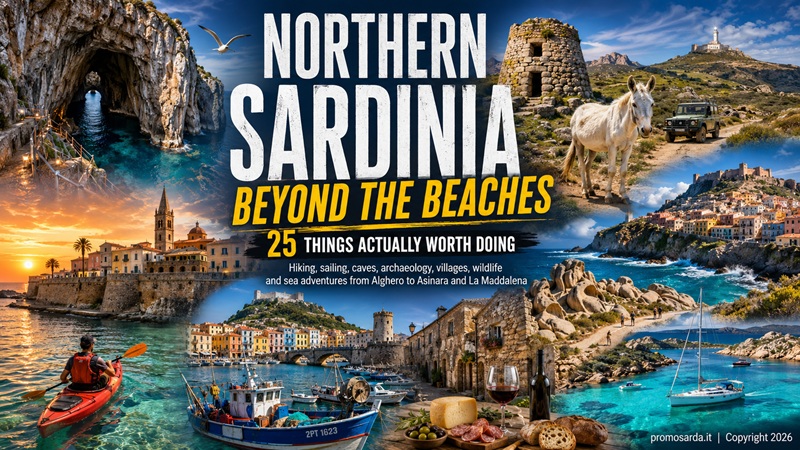
Hiking, sailing, cycling, caves, archaeology, wildlife, food, villages and outdoor adventures from Alghero to Asinara and La Maddalena Northern Sardinia has a small image problem. Its beaches are too beautiful…
That sounds like a ridiculous complaint, but it has consequences. People arrive with photographs of La Pelosa, Cala Corsara and Capo Testa saved on their phones and unconsciously organise the entire holiday around the idea that every good day must involve sand. I understand. I grew up in Sassari, and many of my earliest summer memories involve exactly that calculation: where is the wind coming from, whose car are we taking, and which beach are we going to? But if you spend ten days in northern Sardinia and only move between beaches, you will leave having seen something spectacular and missed something important.
Because between Bosa and the Maddalena Archipelago you can walk on limestone cliffs, explore prehistoric stone monuments, descend into a cave from the side of a mountain, visit an island that was a high-security prison within living memory, cycle through protected landscapes, sail between granite islands, drink Malvasia beside the Temo, eat with fishermen, explore medieval villages and drive through an inland Gallura that looks almost nothing like the coast. Some of these things I have been doing since I was young. Others I have rediscovered as an adult. And for anything involving boats, I increasingly defer to a friend who has forgotten more about the sea than I will ever know. His name is Michele.
He was born in Campania but moved to Porto Torres almost forty-five years ago. He worked as a fisherman, sailed for decades and took part in amateur sailing regattas around Stintino. He is now sixty-five and more or less retired, although describing Michele as retired from the sea would be like describing somebody as retired from breathing. His advice is usually shorter than mine. Often considerably less diplomatic. It is also usually correct. So this is our list of 25 things worth doing in Northern Sardinia when you finally leave the beach.
Northern Sardinia Beyond the Beaches: Quick List
| ExperienceBest areaBest forTime needed | |||
|---|---|---|---|
| Neptune’s Cave | Capo Caccia | Families, nature | 2–4 hrs |
| Hike Porto Conte | Alghero | Hiking, views | Half/full day |
| Kayak Porto Conte | Alghero | Active travellers | 2–4 hrs |
| Explore Alghero Old Town | Alghero | Everyone | Half day |
| Drive Alghero–Bosa | West coast | Road trips | Half/full day |
| Explore Bosa & Malvasia | Bosa | Couples, culture | 1 day |
| Monte d’Accoddi | Sassari | Archaeology | 1–2 hrs |
| Nuraghe Santu Antine | Torralba | History, families | 2 hrs |
| Stintino tuna heritage | Stintino | Culture, food | 2–3 hrs |
| Pescaturismo | Stintino | Food, families | Half/full day |
| Asinara 4×4 tour | Asinara | First-time visitors | Full day |
| Cycle Asinara | Asinara | Active travellers | Full day |
| Hike Asinara | Asinara | Nature | Full day |
| Sail around Asinara | Stintino | Sea lovers | Full day |
| Explore Castelsardo | Castelsardo | Culture | Half day |
| See Elephant Rock | Castelsardo | Families | 30–60 min |
| Visit Aggius | Gallura | Culture | Half day |
| Explore Tempio Pausania | Gallura | Food, architecture | Half day |
| Hike Capo Testa | Santa Teresa | Walking, scenery | Half day |
| Valle della Luna | Capo Testa | Landscape | 2–4 hrs |
| Sail La Maddalena | Palau | Everyone | Full day |
| Explore Caprera | Caprera | History, nature | Full day |
| Cycle Caprera | Caprera | Active travellers | Half/full day |
| Dive or snorkel | Various | Sea life | 2–5 hrs |
| Eat through Gallura | Gallura | Food lovers | Indefinite |
1. Descend the Escala del Cabirol to Neptune’s Cave
Yes, Grotta di Nettuno is famous. No, that does not make it optional. The cave is hidden inside the enormous limestone mass of Capo Caccia, and approaching it from land requires descending the 654 steps of the Escala del Cabirol. Inside, you enter a world of stalactites, stalagmites and the underground Lake La Marmora. The official Alghero tourism service states that the cave extends through more than a kilometre of galleries and can be reached either by land or by boat. In 2026, land visits require a reserved time slot; boat services generally operate from April to November when sea conditions allow. I did those stairs much more happily at twenty than I do now. The view has improved with age. The stairs have not.
What visitors often get wrong
The climb back is the demanding part. Wear proper footwear and carry water. Official 2026 visitor guidance specifically warns about the irregular staircase, 119-metre height difference and physical effort required. From June to October, parking logistics have also changed: visitors travelling by land are directed to park at Casa Gioiosa and use the shuttle towards Capo Caccia rather than leaving vehicles wherever space appears along the road. This is one of those attractions worth planning rather than improvising.
2. Hike Above the Sea in Porto Conte Regional Park
The landscape around Porto Conte and Capo Caccia deserves more than a photograph from the road. This protected area combines limestone cliffs, Mediterranean scrub, forests, archaeological sites and marine habitats. The regional tourism authority treats Porto Conte and Asinara together as two of north-west Sardinia’s great protected landscapes, and explicitly highlights hiking, caves and coastal scenery around Capo Caccia. What I like about walking here is perspective. From the beach, Capo Caccia is a wall. From above, you begin to understand the shape of the entire bay.
Best season
April, May, early June, late September and October. In August I would start early. Very early. A coastal trail with little shade at 13:00 is not improved by the fact that you are in Sardinia.
3. Explore Porto Conte by Kayak
This is one of the experiences I would recommend to anyone who likes the sea but does not necessarily want a motor underneath them. The protected geography of Porto Conte Bay gives you opportunities to explore coves, rocky coast and sections that feel completely different when seen from water level. Kayaking also forces you to notice smaller things. Rock formations. Shallow seabeds. Birds. Changes in water colour. And, importantly, how quickly the wind changes your opinion of distance. This is where Michele normally interrupts.
Michele’s rule: “If the wind is supposed to rise at two, don’t start thinking about returning at two.”
That is very much his style. He plans the return before departure. For a guided kayak trip, use an established local operator, especially if you have limited sea experience. Conditions matter more than fitness.
4. Walk Alghero After the Day-Trippers Leave
Alghero is technically a coastal city, but one of the best things to do there requires no swimming whatsoever. Stay until evening. Walk the old walls. Follow the bastions. Enter the narrow streets behind them. Visit the cathedral area, towers and small artisan shops. Alghero is known as the capital of Sardinia’s Riviera del Corallo, and its Catalan influence remains visible in the historic centre and local language. Coming from Sassari, Alghero has always felt both close and culturally distinctive. We went there when I was young for the sea. As an adult, I probably enjoy the city more after sunset. Try local seafood. Try lobster alla catalana if your budget and season cooperate. And listen. There are very few places in Italy where the linguistic history sounds quite like this.
5. Drive the Alghero–Bosa Coastal Road Slowly
Do not type Bosa into your navigation system and treat this road as fifty-odd kilometres you need to complete. That would be a waste. The coastal route between Alghero and Bosa is one of the great drives in Sardinia, with cliffs, empty stretches of Mediterranean vegetation and repeated views of the western sea. The official tourism authority recommends this route specifically for its landscape, describing roughly 60 kilometres of winding coast loved by motorists and motorcyclists. I have driven it many times. The mistake tourists make is attempting to “do” Alghero and Bosa in the same hurried afternoon. Stop. Look. If somebody behind you wants to complete the road in record time, allow them to become somebody else’s problem.
6. Spend a Day in Bosa Without Treating It as a Photo Stop
Bosa deserves more than twenty minutes beside the river. Walk Sa Costa, the old quarter climbing beneath Castello di Serravalle. Cross the Temo. Look back at the coloured houses. Visit the castle area. Then stop moving. The official regional guide highlights Bosa as one of the signature destinations of Sardinia’s north-west and specifically suggests drinking local Malvasia while watching evening light over the Ponte Vecchio. For once, official tourism advice and my personal advice are identical. Drink the Malvasia. Preferably after parking the car for the night.
7. Visit Monte d’Accoddi and Realise Sardinian History Is Much Older Than the Nuraghi
A lot of visitors reach Sardinia knowing one archaeological word: nuraghe. Good start. But Sardinia was interesting before the Nuragic civilisation too. Near Sassari, Monte d’Accoddi is one of the strangest prehistoric monuments on the island: a monumental altar complex whose form is often compared with a stepped platform. It gives you a radically different perspective on Sardinian prehistory. The official northern Sardinia tourism overview specifically identifies Monte d’Accoddi as one of the major archaeological attractions around Sassari. You do not need an entire day. That is part of its usefulness. Combine it with Sassari, Porto Torres or a transfer day between destinations.
8. Walk Inside Nuraghe Santu Antine
If Monte d’Accoddi expands the timeline, Santu Antine gives you the monumental Nuragic experience. Near Torralba, the massive stone complex feels far more architectural when you enter it than when you see it in photographs. Corridors. Stone chambers. Passages inside walls built without modern mortar. Children often enjoy this site more than adults expect because it feels like exploration. I would choose Santu Antine over trying to visit four minor Nuragic sites in a single afternoon. Archaeology suffers when converted into a checklist.
9. Learn Why Stintino Exists at the Museo della Tonnara
Stintino makes much more sense after visiting the Museo della Tonnara. The museum explains the village through tuna fishing, maritime work and its relationship with Asinara. Its displays include historic photographs, videos, testimonies, tools, documents, clothing used during the mattanza and reproductions of fishing boats and tuna-trap systems. The standard adult ticket listed for 2026 is €5, with seasonal opening hours. When I was younger, some of the world described in museums like this still existed in people’s stories around the table. That distance has grown. Museums become more important when living memory becomes thinner.
10. Try Pescaturismo Instead of Another Generic Boat Trip
This is one of the activities I think international visitors underestimate. Pescaturismo allows visitors to spend time with working fishing traditions rather than merely ordering fish in a restaurant later. Stintino’s official tourism site actively promotes pescaturismo as a way to experience the daily life of local fishermen. The Asinara National Park also includes authorised fishing-tourism operators among its recognised services. This is exactly the kind of experience that gives a holiday context. You see where the food comes from. How people read the sea. Why wind matters. Why fishermen discuss weather with a seriousness tourists normally reserve for flight delays.
Michele’s view
Michele is unsurprisingly suspicious of anything that romanticises fishing. His description is shorter:
“Fishing is beautiful when you’re the guest.”
Then he laughs. Usually.
11. See Asinara Properly on a Guided 4×4 Tour
If you only visit Asinara National Park once, a guided 4×4 tour is probably the most efficient introduction. The island is long enough that covering its historical and natural highlights entirely on foot in one day requires compromises. Authorised operators offer 4×4 excursions, while the Park’s current 2026 directory also includes marine excursions, bike rental, diving, educational services and other ways of experiencing the island. A good guided route gives context to: Fornelli, Cala Reale, Cala d’Oliva, former prison areas, wildlife, coastline, and the island’s strange history. Asinara is too complicated to reduce to white donkeys.
12. Cycle Asinara
If you are reasonably fit, cycling changes the island completely. The Park currently recognises bike-rental services at Fornelli, and the official regional tourism material identifies mountain biking as one of the standard ways of exploring Asinara. The advantage is silence. The disadvantage is also silence when you realise you have underestimated the heat. Distances are real. Shade can be limited. Wind matters. Take enough water. I would much rather cycle Asinara in May, June or September than in the middle of an August afternoon.
13. Hike One of Asinara’s Trails
Walking reveals a different island again. There are routes through granite landscapes, historical sites and wildlife areas, and some trails are also largely cycleable. The Sentiero del Granito, for example, is described by a local authorised operator as an approximately 11.2-kilometre route through the southern part of the island, including old quarry landscapes and protected coastal areas. But do not simply download an old GPX file and assume everything remains accessible exactly as it was. This is a protected national park. Zones and access rules matter. Use current Park information.
14. Sail Around Asinara Instead of Only Crossing to It
Seeing Asinara from land and seeing it from sea are different experiences. From a boat you understand its isolation. You see the long shape of the coastline rather than a sequence of destinations connected by a road. The National Park’s authorised-operator list includes multiple sailing and marine-excursion services for 2026. This is another place where Michele becomes useful.
Michele on planning an Asinara day
He does not begin with the boat. He begins with weather. Then route. Then fuel. Then crew. Then equipment. Only after that does he discuss where to swim. His version:
“Beautiful water doesn’t cancel wind.”
For private boating, that mindset is worth remembering. A forecast is not something to check after breakfast because the sky looks cloudy. It is part of the route plan.
15. Visit Castelsardo in the Late Afternoon
Castelsardo is one of the places that proves Northern Sardinia can compete with itself even without water. The medieval settlement climbs steeply from the sea beneath the old Doria stronghold. Walk upward through the narrow lanes. Visit the castle area and weaving museum. Then stay until the light begins to soften. The regional tourism authority identifies Castelsardo as one of north-west Sardinia’s defining historic towns and highlights its Doria castle and defensive character. Practical advice: Do not wear the shoes you bought because they looked good at dinner. Castelsardo is vertical.
16. Stop at Elephant Rock, but Understand What You’re Looking At
Roccia dell’Elefante is one of the easiest attractions to underestimate. At first glance: rock shaped like elephant. Photograph. Leave. But the geological formation also contains prehistoric domus de janas burial chambers. That turns a roadside curiosity into part of a much older cultural landscape. Children see an elephant. Adults get archaeology. Everyone is happy. Allow half an hour rather than building half a day around it.
17. Go Inland to Aggius
Gallura is not only Costa Smeralda and granite beaches. Aggius is one of the places I recommend when somebody says they want to see an inland Sardinian village without driving halfway across the island. Granite surrounds the settlement. The streets are compact. Traditional crafts and rural culture remain part of the identity. Visit the ethnographic museum if open, walk the village, and pay attention to how radically the landscape has changed from the coast. This is precisely what a good Northern Sardinia itinerary should do. Make the island stop looking uniform.
18. Eat Zuppa Gallurese in Tempio Pausania
Tempio Pausania is the place where I would schedule a meal and allow the town to form around it. Granite architecture gives the historic centre a serious, almost mountain-town character that surprises visitors arriving from the coast. Then comes food. Zuppa gallurese is one of those Sardinian dishes whose English translation creates entirely the wrong expectation. It is not a light soup. Bread, broth and cheese are layered and baked into something substantial enough to change your afternoon plans. Pair it with local meats and Vermentino. Then cancel whatever vigorous physical activity you had planned immediately afterwards.
19. Walk Capo Testa Instead of Driving to the Lighthouse and Leaving
Capo Testa rewards wandering. Giant granite forms have been eroded into shapes that look sculpted rather than geological. Paths move between boulders, Mediterranean vegetation and sea views. The region is also where Sardinian wind becomes part of the landscape rather than simply weather. Do not limit yourself to one viewpoint beside the car park. Walk. Bring proper shoes. And carry water even when the distance looks short. Granite terrain makes straight-line maps deceptive.
20. Explore Valle della Luna
Cala Grande, widely known as Valle della Luna, is one of Capo Testa’s most distinctive landscapes. The valley sits between massive weathered granite formations and small coastal inlets. It is not a conventional attraction. There is no entrance lobby telling you what to feel. That is part of the appeal. The best time, for me, is outside the hottest hours. Late afternoon light gives the granite more depth and makes the landscape considerably more atmospheric. Treat it as a walk, not a quick photo stop.
21. Spend a Full Day Sailing the La Maddalena Archipelago
If you have to pay for one substantial sea excursion in northern Sardinia, La Maddalena is probably where I would spend the money. Spargi. Budelli. Razzoli. Santa Maria. Caprera. Granite islands separated by water that frequently looks unreasonable. But this is also a national park, which means boating is not simply a matter of hiring something with an engine and following other boats. Within 300 metres of the coast, activities including navigation, anchoring and mooring require the appropriate Park authorisation and compliance with current regulations.
Michele’s advice before renting a RIB
This is where his manner becomes particularly useful:
“A boat is not a scooter.”
He means that inexperienced renters often focus on whether a licence is legally required rather than whether they actually understand: weather, fuel range, anchoring, navigation, restricted areas, propeller safety, emergency procedures, and what happens when the afternoon wind rises. His recommendation for beginners is simple: take a skipper. There is no prize for becoming captain for one day.
22. Visit Caprera for Garibaldi — Then Stay for the Landscape
Many visitors come to Caprera because of Giuseppe Garibaldi. That is entirely reasonable. His final home and historical sites give the island enormous cultural significance. But Caprera is also one of the most enjoyable landscapes in the archipelago. Forest. Granite. Military history. Coves. Trails. This is one of those days where history and outdoors fit together naturally rather than competing for time. If travelling with children, alternate the cultural portion with walking or swimming. Everyone’s attention span improves.
23. Cycle Caprera Instead of Driving Everywhere
Caprera is particularly suited to slower exploration. Bicycle or e-bike lets you move between landscape and historical sites without repeatedly turning the day into park-drive-park-drive. I particularly like cycling here outside July and August. May and September are better. October can be excellent. The air matters. The heat matters. And, unlike a car, a bicycle makes elevation personal very quickly. Plan realistically.
24. Go Snorkelling Somewhere That Is Not a Sandy Beach
A strange thing happens to visitors in Sardinia. They see turquoise water and assume sand automatically means better swimming. For snorkelling, the opposite is often true. Choose rock. Around Cala Spinosa, Capo Testa, Lazzaretto, Porto Conte, Caprera and parts of the La Maddalena Archipelago, rocky margins create much more interesting underwater structure than broad sandy shallows. Bring a mask. Enter where conditions are calm. Do not chase wildlife. Do not stand on marine vegetation because you are tired. And if you want something more serious, use an authorised diving or snorkelling operator. Both Asinara and La Maddalena maintain official systems for authorised diving activities. Asinara’s 2026 directory lists authorised dive centres including services departing from Cala d’Oliva and Stintino. This subject deserves its own guide. It will get one.
25. Let Food Become an Activity
I deliberately left this until last because food is often treated as something that happens between activities. In Sardinia it can be the activity. Do not only ask “where can we eat?” Ask what the place itself produces or historically ate. In Stintino: fish, tuna traditions, bottarga. In Alghero: seafood and Catalan influence. In Bosa: Malvasia. In Gallura: zuppa gallurese, meats, cheeses, Vermentino. Across the north: pecorino, pane carasau, malloreddus, fregola, seadas. Go to a winery. Try an agriturismo. Book pescaturismo. Talk to the person serving the wine if they have time. Buy cheese from somewhere that sells cheese rather than somewhere that sells fridge magnets and happens to have cheese beside them. The most memorable meal of a trip is rarely the one you identified by typing “best restaurant near me” at 20:15.
What Are the Best Things to Do in Northern Sardinia for Families?
I would choose experiences that create contrast rather than making children endure adult sightseeing all day. My ideal family selection is: Neptune’s Cave — adventure and nature. Nuraghe Santu Antine — feels like exploration. Museo della Tonnara — short enough to remain interesting. Asinara 4×4 — animals, landscape and history without excessive walking. Capo Testa — giant granite is naturally entertaining. La Maddalena boat day — swimming breaks up sightseeing. Pescaturismo — depending on the child’s age and interest. The mistake is scheduling three cultural attractions consecutively and then wondering why an eight-year-old has become emotionally attached to a vending machine.
Best Things to Do in Northern Sardinia for Couples
I would build an entirely different list: Alghero at sunset. The Alghero–Bosa coastal drive. Malvasia in Bosa. A sailing day. Li Cossi or Costa Paradiso late afternoon. Capo Testa before sunset. A proper Gallurese dinner. An overnight stay somewhere you can walk back from the restaurant. Romance improves substantially when nobody has to discuss who is driving.
Best Adventure Activities in Northern Sardinia
For active travellers, my shortlist would be: Hiking: Porto Conte, Capo Testa, Asinara, Caprera. Cycling: Asinara, Caprera, Porto Conte. Kayaking: Porto Conte and selected sheltered coastal areas. Sailing: Asinara and La Maddalena. Snorkelling: Capo Testa, Caprera, Porto Conte. Diving: Asinara, Capo Caccia and La Maddalena. 4×4: Asinara. And later in this cluster we will deal separately with horse riding, serious diving and longer cycling itineraries because each deserves proper treatment.
What Should You Do When It’s Too Windy for the Beach?
This may be the single most useful section of the article. Northern Sardinia does not guarantee calm sea because your hotel booking says “beach holiday”. If the wind makes your chosen coast unpleasant, do not spend four hours fighting an umbrella. Choose: Castelsardo. Bosa. Aggius. Tempio Pausania. Sassari. Monte d’Accoddi. Santu Antine. Museo della Tonnara. A winery. Or simply drive to the other side of a peninsula where conditions may be completely different.
Michele’s version
“You don’t argue with the weather. You change the plan.”
Five seconds. Entire philosophy.
When Is Northern Sardinia Best for Outdoor Activities?
For beach-only holidays, July and August have obvious appeal. For everything in this article, I prefer the shoulder seasons.
April and May
Excellent for: hiking, cycling, archaeology, villages, Asinara, wildflowers. Swimming depends on your tolerance.
June
Possibly the best all-round month. Long days. Generally excellent weather. Sea already becoming pleasant. Outdoor activities still manageable.
July and August
Excellent for boating and swimming. Less ideal for midday hiking and serious cycling. Start early.
September
My favourite overall. Warm sea. Better walking temperatures. Excellent sailing days when conditions cooperate. Less pressure than August.
October
Excellent for food, walking, villages and road trips. Sea activities become more weather-dependent.
Do You Need Guided Tours in Northern Sardinia?
Sometimes yes. Sometimes absolutely not. You do not need somebody carrying a flag to walk through Alghero. You do not need a guide to drink Malvasia in Bosa. But a good guide is worth paying for when the experience depends on: access rules, environmental protection, specialist knowledge, navigation, wildlife, archaeology, or safety. Asinara is the obvious example. The National Park maintains an official 2026 authorised operator directory, covering 4×4 excursions, bike rental, boat services, diving, education and other activities.
Official Asinara authorised operators
La Maddalena likewise requires authorisation for several activities inside the protected area.
Official La Maddalena Park authorisations
When a national park tells you who is authorised, I would use that list before a random advertising platform.
Michele’s Five Rules for Going to Sea in Northern Sardinia
I asked Michele what he would tell somebody renting a boat here for the first time. I expected a speech. I got five rules. 1. Check the weather before you leave. Not only whether it will rain. Wind direction and strength matter more. 2. Know where you’re going before you untie the boat. Do not invent your itinerary after leaving harbour. 3. Know the fuel situation. His exact phrase was less polite. 4. Know what safety equipment is onboard and where it is. A lifejacket buried beneath seven bags is technically onboard. That is not the same thing as useful. 5. Turn back before conditions force you to turn back. This is the one he considers most important. His explanation:
“The sea tells you first. People listen later.”
That sentence will probably become the introduction to his boating guide.
A Perfect 7-Day “Beyond the Beaches” Itinerary
If somebody had already seen enough sand and gave me seven days, I would structure them like this:
Day 1 — Alghero + Neptune’s Cave
Old town in the morning or evening, Capo Caccia and the cave in between.
Day 2 — Porto Conte
Hiking or kayaking.
Day 3 — Bosa
Drive the coast slowly, explore the town, stay for dinner and Malvasia.
Day 4 — Archaeology
Monte d’Accoddi + Santu Antine.
Day 5 — Stintino
Museo della Tonnara + pescaturismo or village exploration.
Day 6 — Asinara
Full-day 4×4, bike or guided excursion.
Day 7 — Gallura
Aggius + Tempio Pausania + a proper regional lunch. And if you have another two days: Capo Testa + La Maddalena. At which point you are probably beginning another holiday.
Northern Sardinia Beyond the Beaches FAQ
What is there to do in Northern Sardinia besides beaches?
Northern Sardinia offers hiking, sailing, cycling, kayaking, diving, archaeological sites, medieval villages, caves, national parks, food experiences, pescaturismo and guided 4×4 excursions.
What are the best non-beach attractions in Northern Sardinia?
My first choices are Neptune’s Cave, Asinara National Park, Castelsardo, Bosa, Nuraghe Santu Antine, Capo Testa and La Maddalena.
Is Asinara worth a full day?
Yes. A full day allows you to combine its natural landscape, wildlife and unusually rich prison and quarantine history without rushing.
What is the best way to see Asinara?
For a first visit, I recommend a guided 4×4 excursion. Cycling and hiking are excellent alternatives for active visitors, while sailing is better if your priority is the coastline.
Can you cycle on Asinara?
Yes. The Park’s 2026 authorised-services directory includes bicycle rental at Fornelli.
Can you visit Neptune’s Cave without booking?
For land access in 2026, a time-slot reservation is compulsory. Sea access operates differently and depends on boat services and weather.
Is Northern Sardinia good for hiking?
Very. Porto Conte, Asinara, Costa Paradiso, Capo Testa and Caprera provide particularly interesting coastal and protected landscapes.
What should I do in Northern Sardinia when it’s windy?
Check which coast is sheltered rather than automatically abandoning the sea. Otherwise choose inland attractions such as Castelsardo, Bosa, Aggius, Tempio, Sassari, Nuragic sites or museums.
Is Northern Sardinia good for cycling?
Yes, particularly Asinara, Caprera and the Porto Conte area. Spring, June and September are more comfortable than peak midday summer heat.
Can you rent a boat and explore La Maddalena independently?
It is possible under the appropriate conditions, but the National Park regulates navigation, anchoring and mooring within its protected waters and requires relevant authorisations.
Is a skipper worth paying for in La Maddalena?
For visitors without meaningful boating experience, I think yes. The archipelago combines traffic, protected zones, wind and anchoring considerations that make local knowledge valuable.
What local food experiences are worth doing?
Pescaturismo around Stintino, Malvasia tasting around Bosa, traditional Gallurese cuisine around Tempio/Aggius and seafood in Alghero are good starting points.
What are the best activities for children besides beaches?
Neptune’s Cave, Santu Antine, Asinara wildlife excursions, Capo Testa, short boat trips and the Museo della Tonnara work particularly well.
What month is best for an active Northern Sardinia holiday?
June and September are my preferred months because they combine good weather and sea conditions with temperatures more suitable for hiking and cycling than peak summer.
Final Thoughts: Sometimes the Best Day in Sardinia Begins Without a Swimsuit
For most of my life, summer mornings in northern Sardinia began with the same question. “Where are we going to the sea?” That habit is difficult to lose. Even now, when somebody visits me, my first instinct is to think about beaches. Mugoni if the conditions are right. Porto Ferro if somebody wants something wild. Stintino if we are prepared to plan. But some of the days I remember best no longer involve beaches at all. Walking through Bosa in the evening. Cycling somewhere slowly enough to smell the vegetation. Standing inside Santu Antine. Seeing Asinara from a completely different angle after having known it all my youth as something distant. Watching somebody visit Castelsardo for the first time. Eating too much in Gallura and abandoning whatever we had planned afterwards. And going to sea with Michele. That last experience teaches you something. I look at the coastline.
He looks at the wind. I notice the colour of the water. He notices how the boats are moving at anchor. I ask whether tomorrow will be a good day. He asks what time we intend to return. That difference between visiting a place and understanding how it works is probably what I have come to appreciate most as I get older. Northern Sardinia is famous for its beaches. It deserves to be. But the sea, the villages, the granite, the archaeology, the food and the people existed before anyone began compiling lists of the world’s most beautiful beaches. Leave the towel in the hotel occasionally. You may discover the part of Sardinia you remember longest.