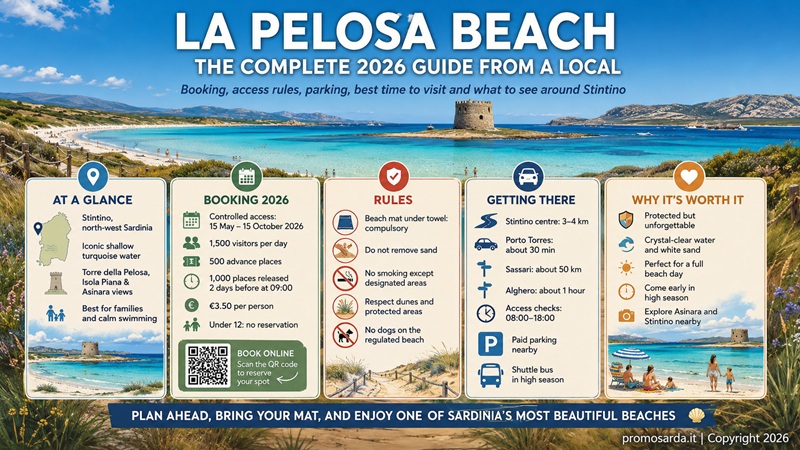
Booking La Pelosa, tickets, access rules, parking, buses, where to stay, restaurants, the best time to visit and what to see around Stintino
There are places you grow up with and only later realise that the rest of the world considers them extraordinary.
For me, La Pelosa is one of those places.
I am from Sassari, about 50 kilometres from Stintino, and I am now in my forties. When I was younger, a summer trip to La Pelosa was much less complicated than it is today. You woke up, looked at the weather, filled a bag with towels, sandwiches and far too much water, got into the car and went.
There was no QR code waiting on your phone. No carefully timed online booking. No daily visitor limit to think about weeks or months before your holiday.
There were also days when La Pelosa felt physically larger than it does now.
That is partly childhood memory, of course, but not entirely. The beach has suffered erosion over the decades, while its popularity has grown enormously. Sardinia’s official tourism website describes La Pelosa as an exceptionally beautiful but fragile environment that has undergone changes and erosion under the pressure of enormous visitor numbers.
Today there are rules. Quite a few of them.
As a local, I occasionally hear people complain about the booking system, the compulsory beach mat or the restrictions. I understand them. Going to the beach in Sardinia was once supposed to be the simplest thing imaginable.
But I also remember La Pelosa before Instagram, before cheap flights filled the island throughout summer and before photographs of this tiny corner of north-west Sardinia travelled around the world.
So my view is simple: the rules can be inconvenient, but losing La Pelosa would be considerably worse.
And despite everything that has changed, when I walk into that transparent water and turn towards the old tower, the place still has the ability to surprise me.
This guide explains exactly how to visit it in 2026, including the details that are easiest to get wrong.
La Pelosa Beach at a Glance
La Pelosa is located at Stintino, at the extreme north-western tip of Sardinia, facing Isola Piana and the island of Asinara.
Its reputation comes from an unusual combination of extremely pale sand, shallow transparent water and natural protection from the open sea. The seabed remains shallow for dozens of metres, creating the turquoise and pale-blue colours that have made the beach famous internationally.
The unmistakable landmark in front of the beach is Torre della Pelosa, built in 1578. Behind it are Isola Piana and, farther away, Asinara.
For the 2026 season, the essential facts are:
| La Pelosa 2026 | Details |
|---|---|
| Controlled-access season | 15 May–15 October 2026 |
| Daily capacity | 1,500 people |
| Advance allocation | 500 places/day |
| Short-notice allocation | 1,000 places/day |
| Short-notice bookings open | 09:00, two days before |
| Ticket | €3.50 per person/day |
| Children | Under 12 do not need a reservation |
| Max booking | 4 people per reservation |
| Access checks | 08:00–18:00 |
| Entry document | QR code |
| Mat underneath towel | Compulsory |
These are official 2026 conditions.
Do You Need to Book La Pelosa Beach in 2026?
Yes, between 15 May and 15 October 2026.
During this period La Pelosa has controlled access and a maximum capacity of 1,500 visitors per day. Admission requires a valid reservation and QR code.
Outside the regulated period, the seasonal reservation system does not apply, although municipal or environmental rules can obviously change in future years.
The booking system is one of the most important things to understand before travelling to Stintino.
Arriving at La Pelosa with a hotel reservation, a rental car and a free parking space does not mean you have a place on the beach.
The beach ticket and everything else are separate.
Official La Pelosa Booking Website: Avoid Fake Ticket Sites
There is one detail I would put in bold letters on every Sardinia travel website:
Do not simply Google “La Pelosa tickets” and buy from the first website that appears.
The authorised booking portal explicitly warns visitors that other websites have appeared offering access reservations and says that no third party has been authorised to sell La Pelosa bookings.
Use:
Official La Pelosa booking website
The Comune di Stintino itself directs visitors to this booking service.
For the actual booking interface:
Official La Pelosa booking platform
This matters especially in July and August, when demand is very high.
When Should You Book La Pelosa?
This is where the 2026 system has become more useful for tourists planning a holiday months in advance.
The 1,500 daily places are split into two allocations.
Option 1: Book La Pelosa well in advance
500 places per day can be booked in advance for dates between 15 May and 15 October 2026.
There is no requirement to wait until 48 hours before the visit for these places.
If La Pelosa is a non-negotiable part of your Sardinia holiday — perhaps you are coming from the UK, Spain, Germany or mainland Italy and only have one day available — this is the option I would use.
Do not leave a once-in-a-lifetime beach visit to chance.
The advance system can also accommodate consecutive periods of between 1 and 31 days, subject to availability.
Option 2: Try for the 1,000 short-notice places
Another 1,000 places per day become available two days before the intended visit.
The booking window opens at 09:00 local Italian time for the second following day.
Some accommodation businesses in Stintino have access to a quota within those same 1,000 places between midnight and 09:00. Any remaining availability can then be booked by the public.
In peak summer, I would be online at opening time rather than casually checking later that afternoon.
Recent availability data from the official system shows days reaching zero remaining places, which demonstrates that selling out is not a theoretical possibility.
My advice as a local
If you are visiting in July or August, reserve as early as your plans allow.
If you are staying locally for a week and can be flexible about which day you go, trying the 48-hour allocation is more reasonable.
If your entire Northern Sardinia itinerary depends on seeing La Pelosa on one particular date, use the early allocation.
How Much Does La Pelosa Cost in 2026?
The official access fee is €3.50 per person per day.
Children who have not yet turned 12 do not need to be included in the reservation.
A reservation can contain a maximum of four people.
Once you begin the confirmed reservation process, the places are temporarily held while payment is completed. The official instructions state that confirmed places are held for 30 minutes; if payment is not completed, they return to availability.
Keep your QR code available on your phone.
Access checks operate between 08:00 and 18:00, and the QR code can be verified at the info point or beach access walkways.
La Pelosa Rules: What You Can and Cannot Do
This is the other major source of search traffic around the beach, largely because La Pelosa has rules you will not encounter on every Sardinian beach.
The main restrictions displayed by the official La Pelosa portal include:
- a mat must be placed underneath your beach towel;
- removing sand is forbidden;
- smoking is prohibited except where specifically allowed;
- rubbish must not be abandoned;
- dogs are prohibited from the controlled beach area;
- detergents and similar products cannot be used;
- feet and beach equipment should be cleaned appropriately rather than carrying sand away;
- access to protected dune areas must be respected.
Why Is a Beach Mat Mandatory at La Pelosa?
This sounds strange until you see how fine the sand is.
If you put a normal terrycloth towel directly onto very fine sand, a surprising amount remains trapped in the fibres when you leave.
Multiply that tiny amount by thousands of visitors every day, summer after summer.
The mat requirement is intended to reduce accidental sand removal. Sardinia’s official tourism portal specifically identifies the mat-under-the-towel rule as part of the measures introduced to protect the beach.
When friends from outside Sardinia ask me what they need to bring, this is therefore the first thing I mention after the booking.
Bring a beach mat.
Not just a towel.
If you forget, buy one before settling on the beach rather than arguing with the staff. The rule exists for a reason.
Can You Take Sand from La Pelosa?
No.
And this is one Sardinian rule that visitors should take very seriously.
Do not fill a bottle with sand as a souvenir. Do not take shells or beach material home simply because they look pretty.
At La Pelosa, the official visitor information expressly prohibits removing sand.
The best souvenir from this beach is a photograph.
Preferably one without your car keys buried somewhere underneath the sand.
Are Dogs Allowed at La Pelosa?
Dogs are listed among the prohibitions for the regulated beach area on the official La Pelosa information site.
If you are travelling through Sardinia with a dog, do not assume you can simply bring it onto La Pelosa. Check current municipal rules and identify dog-friendly alternatives before travelling.
The same planning is advisable if you intend to visit Asinara National Park, where the park’s official visitor information also states that dogs, cats and other pets are not permitted on the island.
Can You Smoke at La Pelosa?
The official rules list smoking among the prohibited activities, other than any specifically designated areas.
Do not bury cigarette ends in the sand.
That sentence should not need to exist, but experience suggests otherwise.
How to Get to La Pelosa by Car
For most travellers exploring Northern Sardinia, a car remains the simplest way to reach Stintino.
La Pelosa sits north of the village, along Viale La Pelosa.
Approximate road-trip logic is:
Stintino centre → La Pelosa: around 3–4 km
Porto Torres → La Pelosa: roughly half an hour depending on traffic
Sassari → La Pelosa: roughly 50 km
Alghero → La Pelosa: normally around an hour, depending on route and summer traffic
The exact journey time can change dramatically in August.
That is another thing those of us from Sassari remember. The distance to Stintino has never changed; the amount of time required to cover the final kilometres certainly has.
On peak summer mornings, leave earlier than Google Maps makes you think necessary.
Parking at La Pelosa
There is paid parking along and around the coastal road serving La Pelosa, but finding a parking space and holding a beach reservation are two completely different things.
In 2026 paid parking was activated alongside the controlled-access season. Local reporting notes that spaces around the beach are chargeable and that payment can be made at parking meters or through supported parking applications. Crucially, paying for parking does not provide access to La Pelosa without a valid beach QR code.
Parking tariffs vary according to period and day.
The parking operator publishes seasonal rates, with higher tariffs during July and August and at weekends.
My practical advice is more valuable than memorising a tariff that may change next summer:
Do not structure your morning around finding the closest possible parking space.
Arrive early, accept a short walk if necessary and check the current road signs before leaving the car.
And never park illegally on vegetation or roadside areas simply because the official spaces are full.
Can You Reach La Pelosa by Bus?
Yes, and during the busiest weeks this can be considerably less stressful than driving.
For summer 2026, the relevant regional connection is ARST Line 727, linking Sassari, Porto Torres, Stintino and La Pelosa. The final stop is close to the beach.
Because Sardinian seasonal public-transport timetables can change, I would always check the ARST timetable shortly before travelling rather than building an itinerary around an old blog timetable.
For visitors without a car, the practical chain is generally:
Sassari → Porto Torres/Stintino → La Pelosa
depending on the current service.
There are also local connections between Stintino and the beach area in the tourist season; Sardinia’s official tourism information notes that Stintino and La Pelosa are connected by shuttle/bus services.
Is the bus better than the car?
In July and August, possibly.
You eliminate parking anxiety.
The disadvantage is losing flexibility for visiting nearby beaches, viewpoints and restaurants.
For a single La Pelosa day from Sassari or Porto Torres, public transport can make sense.
For a broader Stintino road trip, I would still prefer a car.
Can You Get to La Pelosa by Boat?
This question requires an important distinction.
You can explore the waters around Stintino by boat, but I would not think of La Pelosa as a “boat-access beach” in the way some isolated Sardinian coves are.
The more interesting boat excursion from Stintino is Asinara National Park.
Stintino is the closest mainland departure area for visiting Asinara, and the National Park maintains an official list of authorised maritime operators serving the Stintino–Asinara route.
If you want one beach day and one boat day, my recommendation would be:
Day 1: La Pelosa
Day 2: Asinara excursion
That combination makes much more sense than trying to turn the La Pelosa visit itself into a boat excursion.
Is La Pelosa Good for Children?
Very.
This is one of the reasons La Pelosa became so popular with families long before social media discovered it.
The sea is generally extremely shallow close to shore, and the natural geography around Isola Piana and Asinara helps shelter the area. Sardinia’s official tourism website specifically describes the calm, shallow water as particularly suitable for families with children.
That does not mean parents can stop supervising children.
Wind, changing sea conditions, heat and crowds still matter.
But in terms of the seabed and access to shallow water, La Pelosa is one of Northern Sardinia’s classic family beaches.
Children under 12 also do not require their own access booking under the 2026 system.
When Is the Best Time to Visit La Pelosa?
This depends on whether your priority is swimming, atmosphere, photography or avoiding crowds.
May
Potentially beautiful and relatively peaceful.
The sea may still feel cool, particularly for visitors accustomed to warmer Mediterranean summer water, but the landscape is greener and the beach experience can be far calmer.
June
One of my favourite periods.
The days are long, the weather is normally suitable for the beach and visitor numbers have usually not yet reached August intensity.
For many international travellers, June offers one of the best compromises between weather and crowds.
July
Beautiful, reliably summery and busy.
Book ahead.
August
The sea can be magnificent.
So can the traffic.
August is when Sardinia is at its busiest, especially around the Italian Ferragosto holiday period.
If August is your only option, go. I would never tell somebody to skip La Pelosa simply because it is August.
But reserve early and begin the day early.
September
Possibly the best overall month.
The water retains summer warmth, the harshest heat often begins to soften and visitor pressure gradually decreases.
Early and mid-September can be superb.
Early October
A gamble, but sometimes a wonderful one.
Warm sunny days still occur, the beach can feel dramatically calmer and the light is beautiful.
You must simply accept greater weather uncertainty.
Best overall choice?
For me:
June or September.
The official Sardinian tourism portal also recommends visiting outside the peak July-August period if you want to appreciate La Pelosa with less intense crowding.
What Is the Best Time of Day for La Pelosa?
If you care about atmosphere and photography, come early.
Morning generally gives you:
less heat,
easier parking,
a calmer feeling,
beautiful water colours,
and more time before the main visitor concentration.
Late afternoon can also be excellent once some day visitors begin leaving.
Midday produces the brightest turquoise water, but also the strongest summer sun.
If travelling with children, I would much rather be on the beach at 08:30 than arriving around midday searching for parking in August.
Is La Pelosa Worth It?
I get asked this more than any other question.
And I understand why.
You have to book.
You pay to enter during the regulated period.
You may pay quite a bit for parking.
You need a mat beneath your towel.
There are access controls.
It can be crowded.
So is La Pelosa actually worth all this trouble?
Yes.
Not because it appears on every “best beaches in Sardinia” list, but because the geography really is unusual.
You walk surprisingly far into water that remains pale, transparent and shallow. Beyond it sits the old stone tower. Behind that, Asinara.
On a clear morning the colour transitions from almost transparent to pale aquamarine, turquoise and then deep Mediterranean blue.
I have seen it dozens of times.
It still works on me.
Where to Eat Near La Pelosa
I would divide food options into two categories: convenient places around the beach road and better destination restaurants in Stintino itself.
For a proper meal close to the beach, Ristorante Bar L’Ancora Porticciolo is on Viale La Pelosa and currently carries a strong user rating of about 4.3/5. It is useful when you do not want to drive back into Stintino between the beach and dinner.
Another option along the same coastal zone is Trattoria Chiringuito Da Fabiano, also currently around 4.3/5. Its location works particularly well at the end of a beach day.
In Stintino itself, Ristorante Lina – Stintino (SS) is one of the established names I would consider for seafood. Its current rating is approximately 4.3/5, backed by a substantial number of reviews.
For something that feels more like a destination dinner than convenient beach food, Trattoria Opera Viva currently sits around 4.5/5 and is another solid Stintino choice.
What should you eat in Stintino?
This is a fishing village whose history is intimately connected to tuna and the sea.
Look for:
local fish,
octopus,
lobster when seasonally appropriate,
bottarga,
fregola with seafood,
grilled fish,
Sardinian wines,
seadas for dessert.
I would personally avoid coming all the way to Stintino simply to order a generic tourist pizza every evening.
At least once, let the place decide what you eat.
Where to Stay Near La Pelosa
If La Pelosa is your priority, location matters enormously.
Being close enough to avoid a long summer drive can transform the experience.
One attractive option is Club Hotel Ancora – Yacht Club – Stintino, which currently has a rating around 4.5/5. Its position in the La Pelosa/Stintino coastal area makes it particularly convenient for beach-focused stays.
For travellers preferring an apartment-style solution, Capo Falcone Charming Apartments is very close to the northern beach area and currently scores around 4.5/5.
If you prefer a small B&B rather than a resort environment, B&B Sa Serra currently has an excellent rating of around 4.8/5.
Another smaller option is B&B Mr. Caruba, currently around 4.7/5.
These ratings are naturally dynamic, so I would check recent reviews again before booking.
Stay beside La Pelosa or in Stintino village?
Choose near La Pelosa if:
you mainly want the beach;
you have young children;
you hate parking;
you want to walk rather than drive in the morning.
Choose Stintino village if:
restaurants and evening walks matter more;
you are doing an Asinara excursion;
you want more atmosphere after sunset;
La Pelosa is only one part of your visit.
For a two- or three-night stay, I personally prefer the village or the stretch between Stintino and La Pelosa rather than isolating myself completely beside the beach.
What Else Is There to See Near La Pelosa?
Quite a lot, which is why I dislike itineraries that drive from Alghero to La Pelosa, spend five hours on the sand and immediately drive back.
La Pelosetta
Right beside La Pelosa is the smaller La Pelosetta cove, facing the famous tower.
The landscape is more rocky and intimate than the main beach.
Torre della Pelosa
The tower that appears in almost every photograph dates from 1578 and once formed part of the coastal defence system.
It gives the entire bay its visual identity.
Without the tower, La Pelosa would still have extraordinary water.
With it, the landscape becomes unmistakable.
Capo Falcone
Above the beach rises Capo Falcone.
The surrounding landscape offers a completely different perspective from the soft, shallow water below. The historic Torre del Falcone stands around 200 metres above sea level, and the area opens views both towards the exposed western coastline and towards the more protected waters facing Asinara.
Stintino
Do not skip the village.
Stintino was founded in 1885, when families living on Asinara were relocated as the island was transformed for quarantine and penal use. Fishing — particularly tuna fishing — became fundamental to the community’s identity.
Walk around the old harbour before dinner.
It gives the beach a context.
Museo della Tonnara
If you want to understand why tuna appears so frequently in Stintino’s cultural and culinary identity, the local tuna-fishing museum is a worthwhile addition.
It also gives you somewhere meaningful to go if the weather decides that your perfect beach afternoon is not happening.
Asinara: The Best Excursion from Stintino
If you have two days in the area, this is what I would do:
Day 1 — La Pelosa
Day 2 — Asinara National Park
The island spent more than a century in unusual isolation connected with quarantine facilities and penal institutions. Today it is a protected national park with landscapes, wildlife and cultural history radically different from the resort coast.
Visits can involve authorised boat transport and, depending on the operator and programme, walking, cycling, guided vehicles or other organised activities.
Most importantly, do not book a random excursion because someone approaches you in a car park.
The Asinara National Park publishes its own list of authorised operators, including operators on the Stintino–Asinara passenger route.
Official Asinara National Park authorised operators
La Pelosa or Le Saline?
If La Pelosa is sold out, the holiday is not ruined.
This section of Sardinia has many beaches.
Le Saline, south of Stintino, offers a completely different experience: a longer, more open coastline with pale pebbles and much more space.
If La Pelosa is the jewel box, Le Saline feels like the horizon.
Families particularly focused on shallow turquoise water will probably prefer La Pelosa.
Travellers who dislike controlled access and compact beaches may actually enjoy Le Saline more.
La Pelosa or Ezzi Mannu?
Ezzi Mannu is another useful alternative south of Stintino.
Again, do not expect a replica of La Pelosa.
That is the mistake.
La Pelosa is unusual precisely because there are not ten identical versions beside it.
Ezzi Mannu offers space, clear water and a more open beach environment. Both Ezzi Mannu and Le Saline are highlighted among the coastline around Stintino by Sardinia’s official tourism information.
How Long Should You Spend at La Pelosa?
For a first visit, I would allow at least half a day.
With children, I would probably make it most of the day but leave before everyone becomes exhausted.
A good plan might be:
08:00–08:30 — arrive and check in
08:30–12:30 — beach and swimming
12:30–14:00 — lunch
afternoon — La Pelosetta, Stintino or rest
evening — old harbour and dinner in Stintino
Trying to combine La Pelosa, Asinara and Castelsardo on the same day is not efficient travel.
It is collecting names.
What Should You Bring to La Pelosa?
The essentials are surprisingly simple:
Your QR code — without the reservation, the rest of this list is irrelevant during controlled-access season.
A beach mat — compulsory underneath your towel.
Your towel — on top of the mat.
Water — especially in July and August.
High-SPF sunscreen — the pale sand and shallow water reflect enormous amounts of light.
Hat and sunglasses.
Snorkelling equipment if you enjoy exploring the clearer rocky areas.
A bag for your rubbish.
Patience, particularly during August.
What should you not bring home?
Sand.
Is La Pelosa Accessible Without a Car?
Yes.
This is one of the reasons I would not describe a rental car as absolutely essential if somebody is staying in Sassari, Porto Torres or Stintino solely to visit La Pelosa.
Summer bus services make it possible.
But if your plans include Alghero, Argentiera, Ezzi Mannu, Castelsardo, Capo Caccia and inland Northern Sardinia, a car becomes dramatically more useful.
La Pelosa without a car is realistic.
Northern Sardinia without a car is a different challenge.
Where Is La Pelosa Exactly?
La Pelosa is on the Capo Falcone peninsula, north of Stintino, in north-west Sardinia.
Geographically, it faces a remarkable sequence:
La Pelosa → Torre della Pelosa → Isola Piana → Asinara
That geography explains much of the beach’s character.
The natural barriers protect the bay from some of the energy of the open Mediterranean, contributing to its famously shallow and relatively calm water.
Is La Pelosa Really Smaller Than It Used to Be?
This is where my answer becomes personal.
When I think of La Pelosa in my youth, I remember a less regulated and somehow more generous place. Beach towels everywhere, families carrying enormous coolers and cars arriving without anybody having made an online plan weeks earlier.
Some of that is nostalgia.
But the environmental problem is real.
The official Sardinian tourism authority notes that the beach has suffered changes and erosion over decades, linked in part to very high visitor pressure. Protective measures now include controlled behaviour, wooden walkways, barriers around the dunes and specific rules designed to prevent further sand loss.
So when somebody tells me that La Pelosa was “better before all the rules”, I understand what they mean.
It was certainly easier.
But “easier” and “sustainable” are not the same thing.
The challenge now is making sure somebody from Sassari can write another guide like this twenty or thirty years from now and still have a beach to describe.
One Day at La Pelosa: My Ideal Itinerary
If a friend were visiting me from abroad, this is the day I would plan.
Arrive early.
Not because Instagram needs an empty beach, but because La Pelosa is most enjoyable before the day becomes complicated.
Walk down using the official access points. Show the QR code. Put the mat beneath the towel.
Then forget the administration.
Go into the water.
Walk out until you instinctively expect it to become deep.
Keep walking.
Turn around.
From the sea, look back at the narrow strip of pale sand. Then towards the Torre della Pelosa and the darker shape of Asinara in the distance.
That view explains the entire fuss.
Around lunchtime, leave the strongest sun and eat something.
Later, visit La Pelosetta or drive into Stintino.
Walk beside the harbour when the temperature falls.
Eat fish.
Have a glass of Vermentino if you are not driving.
And if you still have another day available, book Asinara.
That is a much better experience of Stintino than racing into La Pelosa, taking twenty photographs and leaving.
La Pelosa FAQ
Do you have to book La Pelosa Beach in 2026?
Yes. Between 15 May and 15 October 2026, access is regulated and a reservation with QR code is required. Daily capacity is limited to 1,500 visitors.
What is the official website for La Pelosa tickets?
The authorised website is spiaggialapelosa.it. The official portal warns that unauthorised sites offering bookings exist.
Book La Pelosa on the official website
How far in advance can I book La Pelosa?
For 2026, 500 of the 1,500 daily places can be booked in advance without waiting for the short-notice window. Another 1,000 are released for booking two days before the visit.
What time do last-minute La Pelosa bookings open?
The 2026 official information states that reservations for the second following day open at 09:00 Italian local time.
How much is a La Pelosa ticket?
The 2026 fee is €3.50 per person per day.
Do children need tickets for La Pelosa?
Children who have not yet turned 12 do not need to be included in the reservation.
Why do I need a mat at La Pelosa?
Visitors must place a mat underneath their beach towel. The measure helps prevent fine sand from becoming trapped in towels and being removed from the beach.
Can I go to La Pelosa without booking?
During the 2026 controlled-access period, you should not plan on entering the regulated beach without a reservation and QR code.
Can I book La Pelosa when I arrive?
Possibly, if availability remains, but this is a bad strategy in peak summer. Demand can exhaust the available allocation.
Is parking included in the La Pelosa ticket?
No. Beach access and parking are separate. Paying for parking does not guarantee entry to the beach.
Is there public transport to La Pelosa?
Yes. Summer services connect Sassari, Porto Torres and Stintino with the La Pelosa area; the 2026 regional service includes ARST Line 727.
Can I take my dog to La Pelosa?
Dogs are listed among the prohibitions for the regulated beach area on the official La Pelosa portal.
Can I smoke at La Pelosa?
Smoking is prohibited other than in specifically permitted areas under the published protection rules.
Can you take sand from La Pelosa?
No. Removing sand from the beach is expressly prohibited.
Is La Pelosa suitable for young children?
Yes. Its exceptionally shallow, generally calm water makes it one of Northern Sardinia’s most popular family beaches. Normal supervision is still essential.
What is the best month to visit La Pelosa?
For the best compromise between warm weather and lower visitor pressure, I would choose June or September. July and August offer classic summer conditions but are significantly busier.
Is September good for La Pelosa?
Very. For many locals, September is one of the most enjoyable periods: the sea remains warm while temperatures and visitor pressure can be more comfortable.
Is La Pelosa worth visiting in August?
Yes, provided you book in advance, arrive early and accept that August is peak season.
What can I see near La Pelosa?
The best nearby additions are La Pelosetta, Capo Falcone, Stintino, the Museo della Tonnara, Le Saline, Ezzi Mannu and Asinara National Park.
Can you visit La Pelosa and Asinara on the same day?
Technically you could construct some sort of rushed itinerary, but I would not recommend it. Give La Pelosa one day and Asinara another.
Final Verdict: Should You Visit La Pelosa?
Yes.
But visit it differently from the way we did when I was twenty.
Back then we treated La Pelosa almost as though it were indestructible. We could decide to go at breakfast and be standing in the water before lunch.
Today you need to book.
You need a QR code.
You need the mat.
You need to think about parking.
You need to respect areas that were once crossed without much thought.
That sounds like progress in the wrong direction until you understand why it happened.
La Pelosa is not an enormous beach capable of absorbing unlimited tourism. It is a small, delicate piece of coastline that became internationally famous.
And fame has consequences.
So I no longer judge a day at La Pelosa by how easy it is to organise.
I judge it at about nine in the morning, when the sun has risen enough to illuminate the shallow water, the Torre della Pelosa appears almost suspended between sea and sky, and Asinara sits behind it.
At that moment, it still looks like the beach I remember.
Perhaps that is the best argument for all the rules.