Casu Marzu (Kumaru):
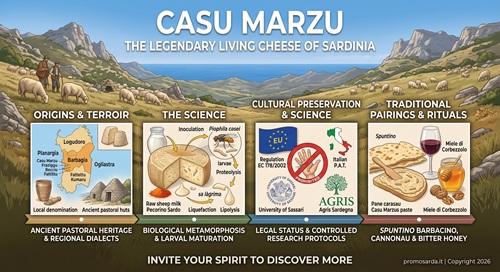
The Definitive Guide to Sardinia’s Legendary Living Cheese
Casu Marzu (also known across various Sardinian dialects as Casu Becciu, Casu Fraziggu, Casu Fattittu, or locally Kumaru) stands as one of the most audacious, extreme, and fiercely debated gastronomic delicacies in the world.
Crafted from raw sheep’s milk (Pecorino Sardo), this ancestral cheese undergoes a radical biochemical metamorphosis orchestrated by the larvae of the cheese fly (Piophila casei). The digestive enzymes of these larvae break down milk fats and proteins through intense lipolysis and proteolysis, yielding an ultra-creamy, molten paste with a pungent, burning, and profoundly complex flavor profile.
This guide explores the history, science, regional traditions, nutritional composition, quality selection, and culinary pairings of Sardinia’s living cheese, complete with recommendations for authentic accessories and traditional accompaniments.
1. Origins, Regional Dialects & Terroir
While modern food health codes classify it as an anomaly, Casu Marzu is rooted in centuries of pastoral heritage across the mountainous interior of Sardinia.
Affiliate Recommendation: Sardinian Pastoral Heritage & Regional Gastronomy Guides (Available on Amazon)
Local Denominations Across Sardinia
Depending on the linguistic sub-region, the cheese takes on distinct local names:
- Casu Marzu / Caxu Marzu: Widespread in central and southern Sardinia (Campidano and surrounding areas).
- Casu Fraziggu / Casu Fràtigu: Common across the Baronia and Logudoro regions.
- Casu Becciu: Spoken in parts of the Sassari province and northern plains.
- Casu Fattittu: Traditional to the Nuorese hinterlands.
- Kumaru / Casu Modde: Local variants heard across specific rural sub-dialects in central pastoral hamlets.
Heartland Production Zones
Casu Marzu is not mass-produced in commercial dairies; it is traditionally curated by shepherds in key pastoral regions:
- The Barbagia (Nuoro, Oliena, Orgosolo, Fonni, Mamoiada): The rugged granitic heart of the island where transhumance and sheep farming remain central to cultural identity.
- Goceano & Logudoro (Ozieri, Bono, Pattada): Renowned for lush upland pastures yielding high-fat raw sheep milk.
- Ogliastra & Planargia (Bosa, Baunei): Coastal-mountain transitions where local variations in curing humidity alter the cheese’s final creaminess.
2. The Science: How Piophila casei Creates the Cheese
The transformation of Pecorino Sardo into Casu Marzu is a delicate biological process traditionally initiated during late spring and early summer:
- Base Production: Shepherds craft a traditional wheel of Pecorino from whole, raw sheep’s milk with minimal initial salt brine to avoid repelling insects.
- Inoculation: The top rind is cut open or perforated, olive oil is occasionally rubbed on top to attract flies, and the wheel is placed in ventilated curing rooms where female cheese flies (Piophila casei) lay hundreds of microscopic eggs inside the paste.
- Larval Hatching & Proteolysis: As the translucent larvae hatch (growing up to 8mm in length), their digestive juices release enzymes that aggressively digest the cheese’s complex proteins and milk fats.
- Liquefaction (La Lagrima): The dense curd softens into a glistening, viscous, spreadable paste. When droplets of clear liquid seep from the paste, locals refer to this essence as sa làgrima (“the tear”).
3. Legal Status & Cultural Preservation
- Sanitary Regulations: Under European Union Regulation (EC) No. 178/2002 and EC No. 852/2004, the sale and commercial distribution of food containing living insect larvae is prohibited due to hygiene standards and the theoretical risk of enteric myiasis.
- Guinness World Records (2009): Named the “World’s Most Dangerous Cheese” due to regulatory bans.
- Traditional Agri-Food Product (P.A.T.): In 2004, the Italian Ministry of Agricultural, Food and Forestry Policies recognized Casu Marzu as a Prodotto Agroalimentare Tradizionale (P.A.T.) of Sardinia. This designation acknowledges that its production methods have been practiced continuously for over 25 years, paving the way for research into controlled, sterile laboratory rearing protocols developed by Agris Sardegna and the University of Sassari.
4. Estimated Nutritional Breakdown
Because Casu Marzu is an artisanal product undergoing variable biological digestion, exact values vary per wheel. Based on laboratory analyses of proteolytically matured sheep milk curds, the approximate macronutrient profile per 100 grams is as follows:
| Component | Value (per 100g) | Notes |
|---|---|---|
| Energy | ~370 – 410 kcal | High caloric density derived from sheep fats |
| Protein (Total N) | ~24.0 – 28.0 g | Heavily broken down into bioavailable free amino acids & peptides |
| Fat (Total Lipids) | ~30.0 – 35.0 g | Elevated free fatty acid content (butyric, caproic acids) |
| — Saturated Fat | ~19.0 – 22.0 g | Typical profile for ovine dairy |
| Carbohydrates / Sugars | < 0.5 g | Lactose is virtually zero, consumed during fermentation |
| Sodium (Salt) | ~1.8 – 2.5 g | Derived from early curing |
| Calcium | ~750 – 900 mg | Rich mineral matrix preserved from raw sheep’s milk |
| Phosphorus | ~450 – 550 mg | Essential structural micronutrient |
5. How to Identify a High-Quality Casu Marzu
For those invited to experience an authentic pastoral gathering in Sardinia, assessing quality requires strict sensory evaluation:
- 1. Larval Vitality (The Golden Rule): The white translucent larvae must be alive and moving. In Sardinian tradition, if the larvae inside an unchilled wheel have died, the cheese has spoiled beyond safe consumption, producing rancid toxic byproducts.
- 2. Color and Consistency: The interior paste should range from a warm creamy ivory to an amber hue. Avoid wheels with dark brown, grayish, or blackened curd patches.
- 3. Aromatics: The scent should be intensely sharp, animalic, and ammonia-tinged, but free of rotten, putrid sulfur odors.
- 4. Moisture: Spreadable, glossy, and weeping (lagrimante).
6. Global Comparisons: Other Living & Mite-Aged Cheeses
Casu Marzu belongs to a broader international family of traditional living and mite-fermented cheeses:
- Marcetto / Cacio Marcetto (Abruzzo, Italy): A traditional sheep cheese also inoculated with Piophila casei, producing a fiery, spreadable cream in the Apennines.
- Casso Frosche (Molise, Italy): A southern Italian variant utilizing natural larval inoculation in pecorino wheels.
- Milbenkäse (Würchwitz, Germany): Cured using millions of cheese mites (Tyroglyphus casei) that consume the crust and excrete enzymes that mature the interior over rye flour.
- Mimolette (Lille, France): An iconic orange cow’s milk cheese whose rind is colonized by flour mites (Acarus siro) to aerate and mature the cheese paste.
7. Traditional Recipes & Serving Rituals
Casu Marzu is never cooked over high heat, as cooking destroys its volatile aromatic compounds and active enzymatic structure. It is enjoyed raw in focused rustic pairings.
Recipe 1: The Classic Spuntino Barbaricino
A shepherd’s lunch balancing fat, smoke, crunch, and bold tannins.
- Ingredients:
- $50\text{ g}$ Authentic Casu Marzu (spreadable paste)
- 2 sheets Sardinian Pane Carasau (or Pane Guttiau with olive oil)
- 1 glass Cannonau di Sardegna DOC (Full-bodied red wine, >14%{ ABV}
- Preparation Steps:
- Lightly warm a sheet of Pane Carasau near an open hearth or oven until crisp.
- Using a wooden spatula, spread a thin layer of Casu Marzu across the rough surface of the flatbread. (Note: Diners can consume the paste with larvae intact, shielding their eyes as larvae can jump up to$15cm, or place the cheese briefly in a sealed paper bag to suffocate the larvae prior to spreading).
- Fold the flatbread and enjoy immediately alongside a glass of dry Cannonau wine, whose bold tannins cleanly cut through the fiery creaminess.
Recipe 2: Contrasto Dolce-Piccante (Bitter Honey & Casu Marzu Toast)
A pairing highlighting the historic pastoral balance between pungent dairy acidity and Sardinia’s wild mountain flora.
- Ingredients:
- $40 g Casu Marzu
- 4 slices Toasted artisanal rustic sourdough bread
- 2 tbsp Sardinian Corbezzolo (Strawberry Tree) Honey or Abbamele
- Crushed organic walnuts or toasted almonds
- Preparation Steps:
- Toast thick slices of rustic country sourdough bread over hardwood embers until golden.
- Spread a thin dollop of Casu Marzu across the warm surface.
- Drizzle a fine ribbon of bitter Corbezzolo Honey (Miele di Corbezzolo) or reduced honey-pollen nectar (Abbamele) over the top.
- Top with crushed toasted walnuts. The natural, herbal bitterness of the honey balances the cheese’s intense ammonia heat.
8. Summary Checklist for Enthusiasts
- [ ] Provenance: Sourced directly through traditional pastoral networks in Barbagia, Nuoro, Goceano, or Logudoro.
- [ ] Accompaniments: Fresh Pane Carasau, Cannonau di Sardegna DOC, and Sardinian bitter honey.
- [ ] Quality Indicator: Ensure active larval movement before serving; never consume dry, inert, or discolored wheels.
- [ ] Preservation: Keep chilled in sealed glass jars to slow fermentation when not immediately consuming.