Guide to Cannonau di Sardegna: History, Terroir, Longevity, and Top Bottles
1. Introduction: The Soul of Sardinian Viticulture
Cannonau is not merely Sardinia’s flagship red wine; it is an enduring cultural icon, a centerpiece of Mediterranean gastronomy, and a cornerstone of the island’s globally celebrated “Blue Zone” longevity.
Known for its deep ruby-to-garnet hue, generous alcohol levels, robust tannins, and an aromatic bouquet rich in ripe red berries, wild Mediterranean maquis (macchia mediterranea), and warm baking spices, Cannonau represents one of the most distinctive expressions of the Mediterranean terroir.
Quick Wine Snapshot
- Primary Grape: Cannonau (Grenache / Garnacha Tinta lineage)
- Denomination: Cannonau di Sardegna DOC (Established 1972)
- Primary Terroirs: Nuoro, Ogliastra, Barbagia, Romangia, Campidano
- Flavor Profile: Crushed blackberry, ripe plum, wild thyme, myrtle, white pepper, leather
- Typical ABV: 13.0% – 15.5%
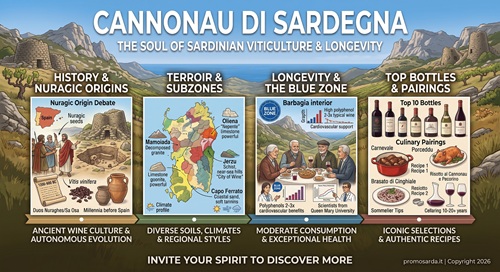
2. History & The Nuragic Origin Debate
For decades, ampelographers assumed that Cannonau was introduced to Sardinia during the Spanish Aragonese crown rule in the early 14th century as a direct import of Spain’s Garnacha.
However, major archaeological excavations in the late 20th and early 21st centuries—notably at the Nuragic sites of Duos Nuraghes (Borore), Sa Osa (Cabras), and Monastir—uncovered carbonized grape seeds (Vitis vinifera) dating back to approximately 1200–900 BC.
These discoveries demonstrate that the Nuragic civilization was cultivating vines and producing wine thousands of years before the Spanish arrival. While genetically Cannonau and Garnacha belong to the same overarching varietal family, Cannonau has evolved autonomously across microclimates for millennia, developing unique clones and characteristics adapted to Sardinian soils.
3. Subzones, Terroir, and Regional Geography
Sardinia’s diverse geological makeup and weather patterns create starkly different styles of Cannonau across the island.
| Zone / Town | Soil & Climate | Wine Profile |
|---|---|---|
| Mamoiada & Nuoro (Barbagia) | Decomposed granite, high elevation (600–800m ASL) | High acidity, perfumed aromatics, elegant tannins, great aging potential |
| Oliena (Nepente) | Calcareous limestone and granite foothills | Rich, concentrated, structured; famous “Nepente” style |
| Jerzu & Lanusei (Ogliastra) | Steep schist and limestone slopes near the sea | Intense fruit, deep color, balanced salinity and mineral backbone |
| Capo Ferrato (Southeastern) | Sandy, coastal alluvial soils, maritime breezes | Softer tannins, earlier drinking window, savory minerality |
The Three Official Subzones (Sottozone)
Under the official Cannonau di Sardegna DOC disciplinare, three geographical subzones are recognized for their historical pedigree:
- Oliena (or Nepente di Oliena): Located in the province of Nuoro; famed for its concentration and bold character, famously praised by poet Gabriele D’Annunzio.
- Jerzu: Situated in the Ogliastra province; known as the “City of Wine,” producing structured, mineral-driven reds from dramatic hillside vineyards.
- Capo Ferrato: Produced across Castiadas, Muravera, San Vito, and Villaputzu; characterized by coastal softness and maritime influence.
4. DOC Classifications & Technical Specifications
To carry the official Cannonau di Sardegna DOC designation, wines must adhere to strict production parameters:
- Cannonau di Sardegna DOC (Rosso / Rosato):
- Minimum 85% Cannonau grapes (up to 15% authorized non-aromatic red Sardinian varieties).
- Minimum Alcohol by Volume (ABV): 12.5%.
- Maturation: Minimum 6 months before commercial release.
- Cannonau di Sardegna DOC Riserva:
- Minimum Alcohol by Volume (ABV): 13.0%.
- Aging: Minimum 2 years of total maturation, including at least 6 months in oak barrels.
- Cannonau di Sardegna DOC Classico:
- Exclusive strictly to the traditional core provinces of Nuoro and Ogliastra.
- Minimum 90% Cannonau.
- Lower maximum grape yield (8.5 tons/ha vs. 11 tons/ha for standard DOC).
- Minimum Alcohol by Volume (ABV): 13.5%.
- Aging: Minimum 2 years, with at least 12 months in wooden barrels.
5. Nutritional Profile & The Blue Zone Connection
Sardinia’s central mountainous interior (Ogliastra and Barbagia) was the world’s first validated Blue Zone—a region where people live exceptionally long, active lives, frequently surpassing 100 years of age.
Researchers (including Dr. Gianni Pes, Michel Poulain, and Dan Buettner) have highlighted moderate, routine Cannonau consumption as a notable dietary constant among Sardinian centenarians.
Approximate Nutritional Breakdown (Per 5 oz / 150 ml Glass)
| Nutrient | Amount |
|---|---|
| Calories | 125 – 135 kcal |
| Carbohydrates | 3.0 – 3.8 g |
| Residual Sugars | < 1.5 g (Dry) |
| Protein | 0.1 g |
| Fat | 0.0 g |
| Sodium | 5 – 10 mg |
| Potassium | 140 – 190 mg |
Why Cannonau is Unique: Polyphenols and Procyanidins
Scientific studies indicate that Sardinian Cannonau contains 2 to 3 times the concentration of polyphenols and oligomeric procyanidins (OPCs) found in typical red table wines:
- Thick Protective Skins: High solar radiation and UV exposure in high-elevation Sardinian vineyards force the grapes to develop thick skins saturated with protective flavonoids and resveratrol.
- Prolonged Maceration: Traditional island winemaking uses extended skin-contact maceration (15–30 days), transferring exceptional levels of antioxidants into the wine.
- Cardiovascular Support: Research from Queen Mary University of London indicates that red wine procyanidins suppress endothelin-1, a peptide associated with vascular constriction and arterial stiffness.
6. How Cannonau Compares Globally
While Cannonau shares genetic roots with Grenache / Garnacha, distinct terroirs create noticeable differences:
- vs. Spanish Garnacha (Priorat, Campo de Borja): Spanish Garnacha often leans toward riper, jammy fruit and slate minerality. Cannonau carries more savory, herbal notes (myrtle, thyme, dried rosemary) and firmer structural tannins.
- vs. Southern Rhône (Châteauneuf-du-Pape / Gigondas): Rhône Grenache is commonly blended with Syrah and Mourvèdre. Cannonau is predominantly produced as a monovarietal (100%), highlighting unmasked red berry, wild game, and dry balsamic nuances.
- vs. Australian Grenache (McLaren Vale, Barossa): Australian Grenache often shows plush confectionary raspberry and eucalyptus, whereas Cannonau retains a rustic, mineral, and dry Mediterranean profile.
7. Buyer’s Guide: How to Select a Top Cannonau
When selecting a bottle, consider the following indicators:
- Look for “Classico” or “Riserva”: For cellaring potential, complex spice, and oak structure, prioritize Riserva (min. 2 years aging) or Classico (Nuoro/Ogliastra heartland).
- Key Provenance Communes: Keep an eye out for top winemaking villages on the front or back label, such as Mamoiada (renowned for high-elevation freshness and finesse), Oliena (powerful and full-bodied), and Jerzu (stony, structured, and balanced).
- Verify the DOC Band: Check for the official Italian governmental DOC paper seal over the capsule with a unique serial number.
- Recommended Vintages: Outstanding recent years include 2016, 2019, 2020, and 2021.
Sommelier Tip: To allow Cannonau’s wild herbal bouquet to open fully, serve between 16°C–18°C (60°F–64°F) in wide-bowl stemware such as a [Riedel Vinum Syrah/Grenache Glass Set], using an [Electric Wine Aerator] for younger vintages.
8. Top 10 Iconic & Award-Winning Cannonau Bottles
| # | Winery & Wine Label | Region / Subzone | Major Awards & Distinctions |
|---|---|---|---|
| 1 | Giuseppe Sedilesu “Carnevale” | Mamoiada (Nuoro) | Gambero Rosso Tre Bicchieri; 94+ Robert Parker |
| 2 | Argiolas “Senes” Riserva | Serdiana / Ogliastra | Tre Bicchieri; Decanter Platinum Winner |
| 3 | Sella & Mosca “Mustazzo” | Alghero (DOC) | 5StarWines Vinitaly; 93+ Wine Spectator |
| 4 | Tenute Dettori “Dettori Rosso” | Romangia (Sennori) | Benchmark Natural Wine Icon; Tre Bicchieri |
| 5 | Cantina di Oliena “Nepente Classico” | Oliena (Nuoro) | Top Value; Decanter Gold Medal |
| 6 | Cantina Jerzu “Chùccu” Riserva | Jerzu (Ogliastra) | Mundus Vini Gold; James Suckling 92 Pts |
| 7 | VikeVike “Cannonau di Sardegna” | Mamoiada (Nuoro) | Slow Wine “Chiocciola” (Snail) Award |
| 8 | Pala “Centosere” Cannonau | Serdiana (Cagliari) | Tre Bicchieri Best Value; Wine Enthusiast 91 Pts |
| 9 | Cantina Dorgali “Nùn” Riserva | Dorgali (Nuoro) | 5StarWines Vinitaly; Decanter Gold |
| 10 | Tenute Soletta “Corona Majore” | Codrongianos (Sassari) | Bibenda 5 Grappoli; Gambero Rosso Award |
Sommelier Tasting Notes on Top Selections:
- Giuseppe Sedilesu “Carnevale” Riserva: Sourced from centenarian bush vines (alberello) at 650m altitude in Mamoiada. Unfiltered, delivering marasca cherry, licorice root, crushed granite, and seamless, velvety tannins.
- Argiolas “Senes” Riserva: Named in honor of Sardinia’s centenarians (Senes = “elders”). Matured in French oak; shows layers of ripe blackberry, cocoa nibs, sweet pipe tobacco, and aromatic scrub.
- Sella & Mosca “Mustazzo”: A polished, high-altitude selection showing focused black plum, cedarwood, and balsamic freshness.
9. Culinary Pairings & Authentic Sardinian Recipes
Cannonau pairs with robust, savory, fat-balanced, and slow-cooked meat dishes.
- Classic Pairings: Porceddu (Sardinian roasted suckling pig), Pecorino Sardo DOP Stagionato, Culurgiones d’Ogliastra with sausage ragù, and Pane Carasau with seasoned charcuterie.
Recipe 1: Brasato di Cinghiale al Cannonau (Wild Boar Braised in Cannonau)
A classic recipe where the rich acidity and tannins of Cannonau break down hearty wild game into a tender stew.
- Yield: 4–6 servings
- Prep Time: 20 mins (plus 12-hour marinade)
- Cook Time: 3 hours
Ingredients:
- 1 kg (2.2 lbs) wild boar shoulder or beef chuck, cut into 4 cm cubes
- 1 full bottle (750 ml) Cannonau di Sardegna DOC
- 2 medium yellow onions, chopped
- 2 carrots, diced
- 2 celery stalks, diced
- 3 cloves garlic, crushed
- 2 sprigs fresh rosemary, 3 bay leaves, and 4 fresh myrtle leaves (or dried juniper berries)
- 2 tbsp concentrated tomato paste
- 3 tbsp Extra Virgin Olive Oil (EVOO)
- Fine sea salt and freshly cracked black pepper
Step-by-Step Instructions:
- Marinate (12 Hours): Place meat in a large bowl with half the chopped vegetables, garlic, herbs, and black pepper. Pour over the bottle of Cannonau. Cover and refrigerate for 8–12 hours.
- Brown the Meat: Remove meat and pat dry. Strain and reserve the wine marinade. Heat olive oil in an [Enameled Cast-Iron Dutch Oven] over high heat. Sear the meat in batches until deeply browned on all sides, then set aside.
- Sauté the Aromatics: Lower heat to medium. Add the remaining fresh diced vegetables and sauté for 6–8 minutes until soft. Stir in the tomato paste.
- Braise: Return the browned meat to the pot. Pour in the reserved Cannonau wine marinade. Bring to a brisk boil for 5 minutes to allow alcohol vapors to evaporate.
- Slow Simmer: Reduce heat to low, cover tightly, and simmer for 2.5 to 3 hours (or bake at 150°C / 300°F) until fork-tender.
- Serve: Season with salt to taste and serve with creamy polenta or warm Pane Carasau.
Recipe 2: Risotto al Cannonau e Pecorino Sardo DOP
A vibrant purple risotto balancing the fruit acidity of Cannonau with the savory depth of aged sheep’s milk cheese.
- Yield: 4 servings
- Prep Time: 10 mins
- Cook Time: 25 mins
Ingredients:
- 320 g (1.5 cups) Carnaroli or Vialone Nano rice
- 300 ml Cannonau di Sardegna DOC
- 1 liter warm vegetable or light meat broth
- 1 small shallot, finely minced
- 40 g unsalted cold butter
- 80 g aged Pecorino Sardo DOP Stagionato, finely grated
- 2 tbsp Extra Virgin Olive Oil
- Freshly cracked black pepper and salt
Step-by-Step Instructions:
- Toast the Rice: Heat olive oil in a wide sauté pan over medium heat. Sauté the shallot until translucent. Add the rice and toast dry for 2–3 minutes until grains are hot and slightly translucent.
- Wine Reduction: Pour in 250 ml of Cannonau. Stir continuously until the wine is fully absorbed and the rice takes on a deep purple hue.
- Add Broth: Add warm broth one ladle at a time, stirring continuously and waiting for each ladle to absorb before adding the next (approx. 15–18 minutes).
- Mantecatura (Emulsification): Remove pan from heat when rice is al dente. Stir in the remaining 50 ml of room-temperature Cannonau, cold butter, and grated Pecorino Sardo DOP. Beat vigorously for 2 minutes until creamy and velvety (all’onda).
- Finish: Rest for 1 minute, then plate with a sprinkle of fresh black pepper and pecorino flakes.
10. Sommelier Serving Guide & Recommended Accessories
- Serving Temperature: 16°C – 18°C (60°F – 64°F)
- Glassware Choice: Large Bordeaux or Syrah/Grenache glasses
- Decanting Time: 30 minutes for standard DOC; 1–2 hours for Riserva and Classico
- Cellaring Potential: 5–7 years (Standard DOC); 10–20+ years (Top Riservas & Classicos)
Curated Sommelier Equipment:
- Decanter: [Wide-Base Crystal Wine Decanter ] for proper oxygenation and sediment separation.
- Wine Preservation: [Coravin Timeless Three+ Preservation System ] to sample aged vintages glass by glass.
- Cheese Service: [Stainless Steel Hard Cheese Slicer & Serving Board ] for plating Pecorino Sardo DOP pairings.