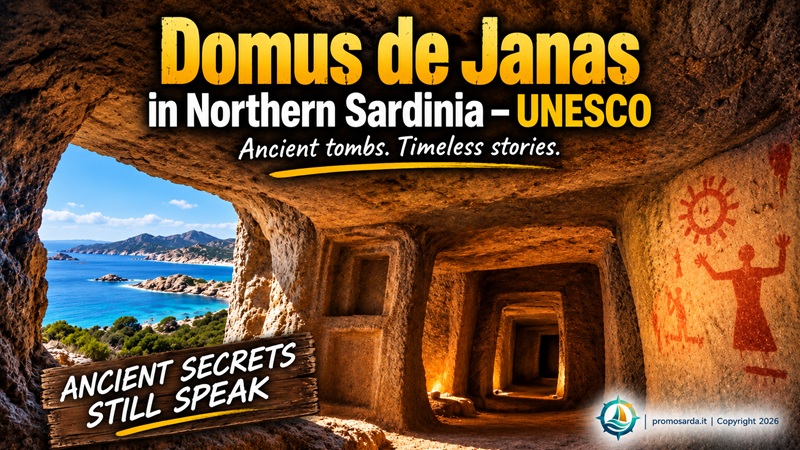
The most important prehistoric rock-cut tombs in Northern Sardinia, from Anghelu Ruju and S’Incantu to Sant’Andrea Priu, Cheremule and the Elephant Rock
My name is Gavino. I am from Nuoro. I hike, ride mountain bikes, spend too much time looking at old stones and am interested enough in archaeology to know when I should stop pretending I am an archaeologist.
That distinction matters here.
The domus de janas are among the easiest Sardinian monuments to underestimate. From outside, some look like holes in rock. Step closer and a completely different world appears: corridors, rooms, carved pillars, imitation roofs, false doors, bull horns, red pigment, symbolic engravings and entire funerary spaces created with stone tools thousands of years before the nuraghi.
Then in July 2025 something important happened: UNESCO inscribed “Funerary Tradition in the Prehistory of Sardinia – The domus de janas” on the World Heritage List under criterion (iii). UNESCO describes the property as a serial group of hypogean burials and necropolises created between the 5th and 3rd millennia BCE, representing the richest and most extensive expression of this funerary architecture in the western Mediterranean. Around 3,500 hypogea are known across Sardinia.
Northern Sardinia contains an unusually dense concentration of the inscribed components. That makes it possible to build something better than a single archaeological stop: a genuine prehistoric road trip through different landscapes, architectural styles and funerary traditions.
If you want the wider chronological picture — nuraghi, Tombs of Giants, Monte d’Accoddi and later Bronze Age landscapes — pair this article with our Northern Sardinia Archaeology Road Trip. This page goes deliberately deeper into the domus de janas themselves.
Northern Sardinia UNESCO Domus de Janas at a Glance
| Site | Area | Main reason to visit | Access style |
|---|---|---|---|
| Anghelu Ruju | Alghero | 38 tombs, scale, architecture | Managed archaeological site |
| Puttu Codinu | Villanova Monteleone | Nine tombs + rural landscape | Guided/managed visits |
| Monte Siseri / S’Incantu | Putifigari | Painted and sculpted architecture | Walk + protected tomb |
| Mesu ’e Montes | Ossi | 18 tombs, “domestic” architecture | Short rural walk |
| Su Crucifissu Mannu | Porto Torres | 22 tombs, major northern necropolis | Access should be checked |
| Orto del Beneficio Parrocchiale | Sennori | UNESCO tombs inside a town | Municipal access |
| Roccia dell’Elefante | Castelsardo | Domus inside iconic natural rock | Roadside stop |
| Petroglyph Park | Cheremule | Tombs + rare human engravings | Archaeological park |
| Sant’Andrea Priu | Bonorva | Monumental Tomba del Capo | Managed paid site |
| Sa Pala Larga | Bonorva | Painted/symbolic basalt tombs | Rural/forest access |
| Sos Furrighesos | Anela | Seven tombs inside woodland | Walk from parking |
One technical detail: UNESCO’s decision refers to 17 component parts, while the geographic database displays 18 mapped records because Cheremule’s Petroglyph Park is represented as two geographical subparts, A and B.
First: What Exactly Is a Domus de Janas?
Literally translating the modern Sardinian name as “fairy house” is charming.
It is also not an archaeological explanation.
These were prehistoric rock-cut funerary structures, often collective tombs, excavated into limestone, sandstone, volcanic rock or other suitable geology. Their chambers can imitate features of the houses of the living: beams, pitched roofs, pillars, door frames, fireplaces and other architectural elements appear carved into stone.
That is one of the ideas that changed the way I look at them.
The dead were not simply put into holes.
People constructed houses for another condition of existence.
UNESCO emphasises exactly this combination of architecture, symbolism, social organisation and belief, interpreting the domus de janas as exceptional testimony to the funerary traditions and ideas about the afterlife of Sardinia’s prehistoric communities.
They Are Older Than the Nuraghi
This needs saying because tourists naturally associate Sardinian prehistory with nuraghi.
Most domus de janas belong primarily to the Neolithic and Copper Age, beginning millennia before the great Nuragic towers.
By the time communities were building complex nuraghi, some of these tombs were already ancient places.
Several remained in use or were reused later.
Sant’Andrea Priu is the most spectacular northern example because its story continues through Roman and Christian periods.
So when you travel from Anghelu Ruju to Santu Antine on our broader Northern Sardinia archaeological route, you are not moving between monuments from one culture.
You are moving through enormous chronological distance.
Why UNESCO Chose Them
The inscription was made under criterion (iii): exceptional testimony to a vanished cultural tradition. UNESCO specifically highlights the variety of tomb plans, their decorative complexity, their development over time and the way they document ritual, spirituality and increasingly complex social organisation between the fifth and third millennia BCE.
That is more interesting than saying:
“Old tomb. UNESCO.”
Look for three things when you visit:
architecture, symbolism and landscape.
The best tomb is not automatically the biggest one.
1. Anghelu Ruju – The Best First Domus de Janas Site
Alghero | 38 tombs | Managed site | My best introduction
If somebody knows nothing about the domus de janas, I start at Anghelu Ruju.
It is big enough to explain the concept properly.
The necropolis contains 38 tombs excavated into sandstone, with the earliest phases generally dated around 3200–2800 BCE. Some are accessed vertically through narrow shafts; others use a dromos, an open-air corridor leading towards the chambers.
Look inside and you begin seeing the recurring language of these monuments: false doors, architectural carving, taurine imagery and pigment.
The site was discovered accidentally in 1903.
Archaeology often begins with somebody doing something completely unrelated.
Current practical information
Anghelu Ruju is one of the easiest sites in this guide to organise. Its official visitor service currently lists opening daily except Christmas, normally 10:00–14:00 November–March, 10:00–18:00 April/May/October and 10:00–19:00 June–September. Current full admission is €7.
Check again before travelling.
Hours are temporary human arrangements.
Five-thousand-year-old tombs are more patient.
Gavino’s advice
Visit Anghelu Ruju before Palmavera.
That chronological jump is one of the easiest ways to understand that “prehistoric Sardinia” is not one single period.
2. Puttu Codinu – Nine Tombs and the Landscape Around Them
Villanova Monteleone | Nine hypogea | Best for rural context
Puttu Codinu lies among the rolling landscape around Monte Minerva and contains nine hypogeic tombs cut into low limestone outcrops. Archaeological evidence places their initial development within the Ozieri cultural horizon, with later reuse continuing into the Bronze Age.
This is less monumental than Anghelu Ruju.
That is exactly why I like it.
At a huge necropolis, the tombs dominate.
Here the territory becomes part of the visit.
Watercourses.
Pasture.
Woodland.
Gentle hills.
Places for settlement and animals.
Suddenly funerary architecture does not feel isolated from daily life.
The official UNESCO heritage portal currently publishes guided visits 10:00–18:00, closed Monday, with Coop. Itinera contact details.
If you enjoy arriving at archaeological sites partly on foot rather than from a large visitor car park, this is a good one.
3. Monte Siseri / S’Incantu – The One That Makes Me Stop Talking
Putifigari | Four tombs | Painted architecture | One of the masterpieces
S’Incantu means something close to “the enchantment.”
For once, the name is not overselling it.
Monte Siseri contains four domus de janas, but the famous Tomb of the Painted Architecture is the reason to come. It preserves complex carved and painted architectural decoration, including false architectural elements and taurine symbolism. The most important visitable tomb is considered one of Sardinia’s outstanding examples of prehistoric funerary art.
When someone calls the people who made these structures “primitive”, I want to bring them here.
Stone tools.
Controlled geometry.
Colour.
Symbolism.
Spatial planning.
Five thousand years later we are still trying to interpret what they meant.
That is not primitive.
That is difficult.
Reaching it
The UNESCO heritage portal describes a rural-road approach followed by approximately 1 km on foot, around twenty minutes, with some steeper sections.
Good shoes.
Water.
No sandals because the archaeological site appeared on your beach holiday.
Gavino’s detour
Putifigari fits beautifully into a slower Alghero–Villanova Monteleone inland day.
This is also where our Best Hikes in Northern Sardinia and archaeology cluster start to overlap: I like sites where the walk towards them is part of the experience rather than wasted time between parking and monument.
4. Mesu ’e Montes – When a Tomb Looks Like a House
Ossi | 18 tombs | Domestic architecture | Short rural walk
Mesu ’e Montes is one of the clearest places to understand why archaeologists talk about the architecture of the living being transferred into the world of the dead.
The necropolis contains 18 multi-chamber domus de janas, arranged along the slopes of Monte Mamas. Several reproduce architectural elements such as roofs, structural details and symbolic features within the chambers.
The approach itself is useful: after a short unpaved vehicle section, the official heritage information describes around 500 metres on foot to reach the necropolis.
Ossi is currently investing heavily in conservation, safety and accessibility works linked to Mesu ’e Montes, with a €1.5 million project approved in July 2026.
That means one practical thing for visitors:
check access before going.
UNESCO status often increases conservation work as well as tourism.
Sometimes protecting a monument temporarily makes visiting it less convenient.
That is acceptable.
5. Su Crucifissu Mannu – The Necropolis Between Sassari and Porto Torres
Porto Torres | 22 tombs | Excellent archaeological landscape connection
Su Crucifissu Mannu contains 22 domus de janas spread across a limestone plateau and is one of northern Sardinia’s major prehistoric burial areas. Its position is especially interesting because Monte d’Accoddi is only about 2.2 km away, creating one of the densest prehistoric landscapes in the Sassari–Porto Torres corridor.
This is exactly why I do not like visiting monuments as disconnected dots.
Stand here and start thinking territorially.
Tombs.
Settlement landscape.
Sanctuary.
Movement routes.
Water.
Farmland.
The map begins to matter.
Current access
Su Crucifissu Mannu has been opening for organised cultural events and visits; during Monumenti Aperti 2026, the site recorded 457 visitors.
Because regular access arrangements are less straightforward than Anghelu Ruju, I would contact the managing organisation or Porto Torres tourism services before building the day around it. The UNESCO heritage portal currently lists Cooperativa Memoria Storica as the contact.
Internal link that belongs here
If Su Crucifissu Mannu interests you, continue directly into our Northern Sardinia Archaeology Road Trip, because this is where linking the domus to nearby Monte d’Accoddi (HERE our Monte d’Accoddi full guide) becomes genuinely useful.
6. Orto del Beneficio Parrocchiale – UNESCO Archaeology in the Middle of Sennori
Sennori | Two interconnected tombs | Urban archaeology
Not every archaeological adventure needs a 4×4.
Sometimes you park in town.
The Orto del Beneficio Parrocchiale domus lie within the former garden of the Church of San Basilio, directly in Sennori’s urban fabric. The funerary complex consists of two interconnected rock-cut tombs and preserves important carved decoration including three bucrania, or taurine protomes, within the main chamber.
I love this site for one reason:
people live beside it.
Shops.
Town hall.
Church.
Five-thousand-year-old tomb.
Normal Sardinian Tuesday.
Access
The UNESCO management documentation describes the site as unattended, fenced and managed by the Municipality, with access arranged on request.
Therefore do not arrive expecting a ticket office.
Contact Sennori first.
This is one of those situations where ten seconds on the phone saves an hour standing outside a locked gate.
7. Roccia dell’Elefante – The Most Photographed Domus People Do Not Realise Is a Domus
Castelsardo | Two tombs | Natural landmark + UNESCO archaeology
Everybody photographs the Elephant Rock.
Not everybody knows they are photographing a prehistoric funerary monument.
The roughly four-metre volcanic boulder outside Castelsardo contains two domus de janas carved into it. The rock itself naturally resembles an elephant, creating one of Sardinia’s rare places where geology, prehistoric archaeology and roadside tourism collapse into one object.
It is also one of the easiest stops here.
The official heritage information places it beside the SS134 outside Castelsardo towards Sedini.
Gavino wouldn’t do this
Climb all over it because there is no turnstile.
“Beside the road” does not mean “unprotected”.
And please do not pose inside the chamber while kicking the rock because someone wants the perfect photograph.
Five thousand years survived without your reel.
It can survive without it.
8. Cheremule Petroglyph Park – Where the Human Figure Appears
Cheremule | Multiple necropolises | Petroglyphs | One of the most unusual stops
Cheremule is the intellectual detour.
The Petroglyph Park incorporates the prehistoric complexes of Moseddu, Mattarigotza and Tennero, with approximately 37 tombs across the wider archaeological area. UNESCO’s mapped property divides the Petroglyph Park into two geographical subparts.
The famous Branca Tomb is particularly important because of rare anthropomorphic petroglyphs.
Human figures immediately attract interpretation.
People see one and want a story:
god.
priest.
warrior.
ancestor.
alien, eventually, because the internet never gets tired.
My position is less exciting.
Look carefully.
Read the archaeological interpretation.
Accept when meaning remains uncertain.
Mystery is not a defect in archaeology.
It is often the honest answer.
9. Sant’Andrea Priu – The Monumental One
Bonorva | Major necropolis | Tomba del Capo | Best for long-term reuse
Sant’Andrea Priu is one of the northern sites I would recommend even to somebody who says:
“I am not really into archaeology.”
The reason is scale.
Its extraordinary Tomba del Capo contains 18 chambers covering around 250 square metres, creating an almost labyrinthine interior.
But size is only part of the story.
The site was reused through later periods, including Roman and Christian phases. That makes it an unusually clear demonstration that ancient monuments continued to be understood, appropriated and transformed by people living thousands of years after their original creators.
History does not remove the previous layer.
It sits on top of it.
Current access
The Comune di Bonorva confirms the site is paid-entry and publishes the archaeological-area contact +39 348 564 2611 for current visitor information.
This is one site where I would strongly consider a guided explanation.
You will see the rooms without one.
You will understand much more with one.
10. Sa Pala Larga – The One People Skip After Sant’Andrea Priu
Bonorva | Basalt tombs | Paint and symbolic carving | More remote
This is what happens with famous neighbours.
Everybody visits Sant’Andrea Priu.
Then leaves.
Sa Pala Larga, also known as Aidu ’e Santos, lies about eight kilometres from Bonorva within the Mariani natural area at roughly 600 metres elevation. Its large funerary chambers preserve traces of painting and symbolic carving.
The approach uses rural/forest roads and then the archaeological area itself.
This feels more like my style.
Less visitor-centre archaeology.
More landscape archaeology.
Why pair them?
Because Sant’Andrea Priu demonstrates scale and reuse.
Sa Pala Larga gives you context and quiet.
Do both and Bonorva becomes a destination.
Do only the famous one and Bonorva becomes a pin.
11. Sos Furrighesos – End in the Forest
Anela | Seven tombs | Woodland setting | Best archaeology + outdoor crossover
If I had to choose the domus de janas site that feels most like a Gavino ending, I would choose Sos Furrighesos.
Seven tombs.
Rock engravings.
Forest.
A walk.
The necropolis lies in woodland in the Anela area and includes decorated tombs whose archaeological material spans from the Ozieri cultural horizon through later prehistoric phases.
The current official access instructions take you by road towards the forestry area, then to a designated parking point, followed by approximately 500 metres on foot.
This is the kind of archaeological place where I naturally pick up somebody else’s plastic bottle on the return.
It is difficult to leave rubbish beside a five-thousand-year-old tomb without feeling slightly embarrassed for our century.
The UNESCO Sites People Often Confuse
This section is important because the 2025 inscription generated a lot of enthusiastic but inaccurate marketing.
Monte d’Accoddi — Extraordinary, but not part of the inscribed property
Monte d’Accoddi was included in the broader nomination process but the World Heritage Committee explicitly excluded it from the final inscription.
Visit it anyway.
It is one of the most important prehistoric sites in Sardinia.
UNESCO is not a star rating.
Monte Baranta — Not included
Also explicitly excluded from the final inscribed property.
Again:
still important.
Li Muri — Not part of the final UNESCO property
. Li Muri was excluded from the final UNESCO inscription but remains one of Gallura’s essential prehistoric sites; see our complete Arzachena Archaeological Park guidefor the wider Neolithic and Nuragic landscape around it
Mandra Antine — Spectacular, but not one of the final 17 components
Mandra Antine near Thiesi contains exceptional painted decoration, including rare red, black and yellow polychromy.
I would absolutely visit it.
But I would not label it an inscribed UNESCO component if it is not one.
Accuracy makes archaeology more interesting.
Not less.
Santu Pedru — Important, not one of the final inscribed components
The Alghero area’s Santu Pedru necropolis remains an important prehistoric site, and the same local management currently offers special guided access to its Tomb of the Tetrapod Vases.
But again:
not everything important needs the UNESCO logo.
My Best Five If You Do Not Have Time for Eleven
If somebody made me reduce the northern UNESCO list to five, I would choose:
Anghelu Ruju for scale and introduction; Monte Siseri / S’Incantu for prehistoric art; Mesu ’e Montes for architecture; Sant’Andrea Priu for monumentality and reuse; Roccia dell’Elefante because geology and archaeology meet in a way almost anyone remembers.
For a sixth?
Cheremule.
Now we are already failing at choosing five.
A Three-Day Domus de Janas Road Trip
Day 1 — Alghero hinterland: Anghelu Ruju → Monte Siseri / S’Incantu → Puttu Codinu. Sleep Alghero or Sassari.
Day 2 — Sassari / north-west: Mesu ’e Montes → Sennori Orto del Beneficio → Su Crucifissu Mannu if access is confirmed. Optional Monte d’Accoddi as a non-UNESCO but essential prehistoric comparison.
Day 3 — Meilogu / Anglona / Goceano: Cheremule Petroglyph Park → Sant’Andrea Priu → Sa Pala Larga, or continue east towards Sos Furrighesos. Roccia dell’Elefante fits better if your itinerary is already moving towards Castelsardo.
Could you do everything in three days?
Technically.
Should you?
No.
A tomb becomes considerably less interesting when you are mentally calculating whether you can reach the next one before closing.
If You Have Only One Day From Alghero
Do:
Anghelu Ruju + Monte Siseri.
If Monte Siseri access/logistics do not work, substitute Puttu Codinu.
This gives you a large necropolis plus a highly decorated monument.
Good contrast.
If You Have Only One Day From Sassari
Do:
Mesu ’e Montes + Su Crucifissu Mannu if confirmed + Monte d’Accoddi.
Only the first two are part of the UNESCO domus property.
Monte d’Accoddi gives chronological and ritual contrast.
If You Are Staying in Castelsardo
The Elephant Rock is obvious.
But I would add Cheremule if archaeology genuinely interests you.
Driving one hour inland for a prehistoric rock-art landscape gives you something completely different from another coastal viewpoint.
Best Site for Children
Anghelu Ruju.
It is open, varied and physically understandable.
Children can see entrances, rooms, corridors and different tomb types.
The Elephant Rock is also an easy win because the natural shape makes the archaeological object immediately memorable.
Best Site for Serious Archaeology Interest
S’Incantu.
Then Cheremule.
Then Sant’Andrea Priu.
I know.
That is three.
Serious archaeology is inconvenient like that.
Best Site for Photography
Externally:
Roccia dell’Elefante.
For archaeological detail:
S’Incantu, subject to visitor rules and photography restrictions.
For landscape:
Sos Furrighesos or Puttu Codinu.
Never sacrifice conservation for the image.
A photograph is not important enough to touch pigment, carvings or fragile walls.
Do Not Touch the Red Pigment
This deserves saying.
Painted prehistoric surfaces have survived thousands of years.
Skin oils.
Moisture.
Rubbing.
Flash restrictions where applied.
Physical contact.
All matter.
If a guide tells you not to enter an area, do not negotiate.
If a barrier ruins your photograph, your photograph is less important.
Do Not Trace the Engravings With Your Fingers
Same problem.
Visitors naturally want to “feel” a carving.
Twenty thousand visitors all having the same natural impulse becomes erosion.
Look.
Photograph when permitted.
Keep hands away.
What If You Find Pottery or Stone Tools?
Leave them where they are.
The location of an object is archaeological information.
Picking up a fragment because you intend to “give it to the museum later” may destroy context.
Take a photograph without moving it.
Record the location.
Report it to the competent archaeological authorities.
Our Northern Sardinia Archaeology Road Trip contains the fuller practical section on accidental archaeological discoveries and Italian heritage law.
Gavino likes finding things.
That is exactly why Gavino does not pocket them.
Archaeology and Hiking: The Natural Combination
Several sites here require short walks rather than technical hiking.
That is ideal.
Monte Siseri.
Mesu ’e Montes.
Sa Pala Larga.
Sos Furrighesos.
The approach gives your eyes time to adjust to the terrain.
If you want archaeology embedded inside longer outdoor routes, our Best Hikes in Northern Sardinia and Mountain Biking in Northern Sardinia guides connect prehistoric landscapes with places such as Nuraghe Appiu, Monte Limbara and other inland routes.
The trail is the spine.
The territory is the story.
When to Visit
My favourite periods are March–May and late September–November.
Why?
Cooler walking.
Better vegetation.
Less heat inside exposed rural sites.
Fewer people.
Summer works, especially for managed sites, but I go early.
Rock does not provide much shade because it has existed for five thousand years and never received the memo about tourist comfort.
Footwear
For Anghelu Ruju:
normal comfortable walking shoes.
For Monte Siseri, Mesu ’e Montes, Sa Pala Larga and Sos Furrighesos:
proper shoes with grip.
This is not mountaineering.
It is also not a flip-flop competition.
Do You Need a Guide?
For some sites:
no.
For others:
the guide transforms the experience.
The more decoration, reuse and symbolic architecture a tomb contains, the more useful specialist interpretation becomes.
Sant’Andrea Priu without explanation is impressive.
Sant’Andrea Priu with somebody explaining the transformations is history.
S’Incantu without interpretation is beautiful.
With interpretation you start seeing architectural language.
That difference matters.
UNESCO Does Not Mean Every Site Has Tourist Infrastructure
This is probably the most important practical warning in the article.
A serial World Heritage property can include:
ticketed sites,
municipally managed sites,
rural archaeological areas,
unattended monuments,
sites requiring advance contact.
The UNESCO inscription does not mean every component suddenly acquired toilets, parking, a café and someone selling refrigerator magnets.
Always verify access.
Especially Sennori, Su Crucifissu Mannu, Sa Pala Larga and the more rural components.
Leave It Better
Archaeology has already survived farming, weather, animals, vegetation, political change and five thousand years of people.
The least we can do is not leave a plastic bottle.
I carry a small rubbish bag when visiting rural sites.
Not because I work for the municipality.
Because I was going back to the car anyway.
Leave it better.
Domus de Janas FAQ
What are the domus de janas?
Prehistoric rock-cut tombs created by Sardinian communities primarily during the Neolithic and Copper Age. UNESCO’s inscribed serial property dates broadly from the fifth to third millennia BCE.
What does “domus de janas” mean?
The modern Sardinian expression is commonly translated as “houses of the fairies.” Archaeologically, they are funerary hypogea, not dwellings built for mythical beings.
Are the domus de janas UNESCO World Heritage?
Yes. Funerary Tradition in the Prehistory of Sardinia – The domus de janas was inscribed on the UNESCO World Heritage List in 2025 under criterion (iii).
How many UNESCO component sites are there?
The final World Heritage property contains 17 component parts. UNESCO’s geographic database displays 18 mapped records because one component, Cheremule’s Petroglyph Park, is geographically divided.
How many domus de janas exist in Sardinia?
UNESCO refers to approximately 3,500 known hypogea across the island.
What are the best domus de janas in Northern Sardinia?
For a first trip I recommend Anghelu Ruju, S’Incantu/Monte Siseri, Mesu ’e Montes, Sant’Andrea Priu and Cheremule Petroglyph Park.
Is Anghelu Ruju UNESCO?
Yes. It is component 001 of the inscribed serial World Heritage property.
Is Sant’Andrea Priu UNESCO?
Yes. UNESCO’s geographical data lists Sant’Andrea Priu among the inscribed components.
Is Monte d’Accoddi UNESCO?
Not as part of this inscription. The World Heritage Committee explicitly excluded Monte d’Accoddi from the final 2025 property.
Is Li Muri UNESCO?
Not within this World Heritage property. It was also excluded from the final inscription.
Is Roccia dell’Elefante UNESCO?
Yes. The two domus cut into the Elephant Rock form one of the northern components of the serial property.
Can I enter every domus de janas?
No. Access varies according to conservation, ownership, management and current works. Follow barriers and local instructions.
Are they safe for children?
Many managed sites are suitable for families, but tomb entrances can involve low ceilings, uneven stone and steps. Supervise children.
Can I take archaeological objects home?
No. Leave archaeological material where it is and report genuine chance discoveries to the competent authorities.
Final Thoughts: The Smallest Door Can Lead to the Biggest Story
Nuraghi impress from a distance. Domus de janas usually do not.
That may be why I like them.
You can walk beside a limestone wall and see almost nothing.
Then notice an opening ,crouch , Look inside.
A beam is carved into the ceiling. A door exists that nobody can open.
Horns emerge from stone.
A room imitates a house whose real wooden equivalent disappeared five thousand years ago.
Suddenly the missing village is partly visible through its tomb.
That is extraordinary.
The people who created these places did not leave written explanations.
We have architecture.
Objects. Pigment. Bones. Landscape. Comparisons.
Archaeology reconstructs the rest carefully.
I prefer that to fantasy.
Calling them fairy houses is beautiful.
Knowing that real people spent enormous effort building spaces for their dead is better.
Visit slowly.
Use the official interpretation.
Take the short walk.
Do not touch the pigment.
Do not move the pottery.
Do not call every prehistoric monument UNESCO.
And if you find a piece of rubbish beside a five-thousand-year-old tomb, take it back to a twenty-first-century bin.
We can at least be responsible for our own layer.
