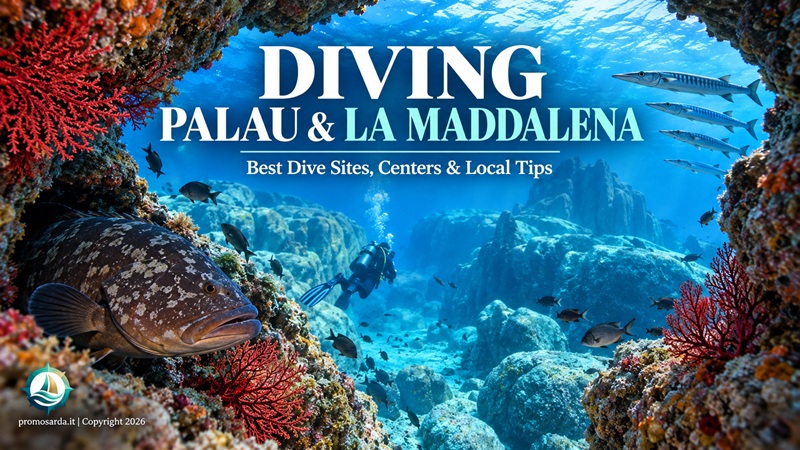
Granite secche, red gorgonians, giant groupers, currents and protected waters — a local diver’s guide to scuba diving between Palau, Caprera, Spargi and the La Maddalena Archipelago
My name is Federico. I am 35. Lifeguard, swimming instructor, freediving coach and scuba diver. I surf, sometimes kite, and I have spent enough of my life in the sea to know one thing very clearly: loving it does not mean trusting it blindly. It means respecting it more.
Palau and La Maddalena are among the places where I feel this most strongly. Above water the archipelago is already famous: granite islands, wind, transparent bays, boats everywhere in summer. Underwater the same granite becomes another world. Blocks turn into walls. Channels become passages. Secche rise from deeper water. Gorgonians occupy the shaded faces. Groupers use holes that look designed for them. Barracuda appear where current carries food.
This is not Alghero. There are no great limestone cave systems like Nereo. If cave diving is your priority, read our complete Diving Alghero and Grotta di Nereo guide instead. Palau and La Maddalena are about granite, current, visibility, marine life and variety.
And variety is the important word. Operators based in Palau advertise roughly 40–60 accessible sites between the La Maddalena Archipelago and nearby Lavezzi, while a current local dive-site catalogue maps more than 40 sites inside the archipelago alone.
If you are comparing this area with Asinara, Capo Testa and Alghero before deciding where to base a diving holiday, our complete scuba diving guide to Northern Sardiniagives you the wider picture.
Diving Palau & La Maddalena at a Glance
| Question | My answer |
|---|---|
| Best overall dive | Washington Rock / Secca Washington |
| Best for variety | Spargiottello |
| Best Caprera dive | Punta Coticcio |
| Best beginner-style site | Secca di Mezzo Passo |
| Best advanced site | Mortoriotto |
| Main underwater landscape | Granite secche, walls, channels, Posidonia |
| Typical wildlife | Groupers, barracuda, dentex, amberjack, morays, congers, lobsters |
| Main season | Roughly May–October |
| Water temperature | About 15°C early season to ~25°C late summer/autumn, varying with depth |
| Visibility | Often around 15–30 m |
| Best base without ferry | Palau |
| Best base for island atmosphere | La Maddalena |
| Park permit needed? | Yes, depending activity; individual scuba permit currently €5/day |
| Best months for me | June and September |
Water around Palau is reported by established local operators at roughly 15°C in early spring to 25°C around late summer/autumn, with typical visibility around 15–30 metres.
Why Diving Here Feels Different
Granite is the reason.
Caprera, Spargi, Budelli and the smaller islands are not merely granite above water. The rock continues beneath it in huge rounded formations. That creates the three things Mediterranean divers need: structure, shadow and current.
Structure gives animals shelter. Shadow supports coralligenous communities and gorgonians. Current moves nutrients and sometimes brings the larger fish.
This is why I look in two directions on these dives. Into the rocks for morays, lobsters, nudibranchs and groupers. Then out into the blue for barracuda, dentex and amberjack.
A diver who spends the entire dive staring thirty centimetres from the wall sees half the Archipelago. Non-divers — or divers taking a surface interval day — can explore the same archipelago with our La Maddalena & Caprera by Bike guide .
1. Secca Washington – My Number One
Area: between Spargi and Budelli | Type: secca/wall | Top: about 6 m | Maximum routes: to roughly 40 m | Best for: gorgonians, groupers, multi-level diving.
If someone gave me one dive in La Maddalena and asked me to choose before seeing the weather report, I would say Washington Rock.
Then I would see the weather report.
Because that comes first.
The shoal rises to around six metres and drops into deeper terrain between Spargi and Budelli. Long wall sections support healthy red gorgonians at surprisingly accessible depths, including extensive growth around the 20–25 metre range. Groupers, congers and spider crabs are among the characteristic encounters.
What I like is the profile. You can work deeper along the wall, then gradually return across the summit instead of finishing over nothing.
A good safety stop should still be a dive.
Washington gives you that.
Federico’s verdict
The signature dive of the archipelago.
Not because it is deepest.
Because everything works together: granite, colour, fish, depth range and the blue around you.
2. Spargiottello Shoal – The Dive I Would Repeat
Area: north-west of Spargi | Depth: about 4–35 m | Current: often moderate | Best for: gorgonians, groupers, repeat dives.
Spargiottello is not one dive.
That is why I like it.
The principal shoal rises to around five metres. On the north-western side, red and yellow gorgonians appear at roughly 25 metres; the opposite side steps gradually back towards shallower water and can hold spider crabs and sea hares.
You can bring a relatively inexperienced certified diver here on the correct profile and still give a much stronger diver something worth seeing deeper.
That matters when couples travel together and have very different logbooks.
The ocean should not become a relationship argument.
3. Spargiottello Channel – Same Place, Different Conversation
Depth: around 32 m in the channel | Level: experienced recreational diver | Best for: morphology, controlled buoyancy, orientation.
Now we make Spargiottello more serious.
The channel is a narrow cleft in the granite, open above, descending towards roughly 32 metres with a pale sandy bottom. The official-style local site description identifies this as the technically more demanding version because of its complex shape and limited visual references for orientation.
This is exactly the kind of dive where a diver with 100 messy dives can be less comfortable than somebody with 40 very good ones.
Numbers in a logbook matter.
Quality matters more.
Good trim.
Controlled breathing.
Awareness of your guide.
Do those before worrying about whether the canyon looks dramatic on video.
4. Spargiottello Archaeological Zone – Look, Never Collect
Another section contains remains interpreted as a probable Roman-era wreck, with pottery fragments scattered across sand and Posidonia.
You know my rule already.
Look. Photograph. Leave.
An archaeological fragment does not become a souvenir because it is underwater.
The same principle Gavino uses on land applies here, except now you have fins.
Bad buoyancy plus archaeology is not a good combination.
5. Punta Coticcio – Groupers in Granite
Area: east Caprera | Type: secca/wall | Typical range: 5–25+ m | Best for: groupers, dentex, nudibranchs, granite landscape.
Cala Coticcio is famous above water.
Punta Coticcio is more interesting to me below it.
Large granite blocks form channels, dens and sheltered pockets. PADI lists groupers, dentex, morays, amberjack and other Mediterranean species among the characteristic fauna, while current local documentation describes nudibranch-rich walls and deeper sections around the secca.
The nice thing here is scale.
A big grouper beside a big granite block looks correct.
Like both belong there.
Because they do.
Important distinction
The highly regulated terrestrial access to Cala Coticcio is a different activity from scuba diving. Do not confuse trail permits and guided terrestrial access with the Park’s scuba framework. The National Park maintains separate rules and authorisation systems for the two activities.
6. Il Fiordino – Small, Sheltered, Useful
Just south of Punta Coticcio, Il Fiordino is a small natural inlet with sheltered underwater terrain. Local descriptions particularly value it for shallower and night-diving conditions, where benthic life becomes more active under torchlight.
I like places like this because good diving is not automatically big diving.
Sometimes you want 15 metres, a torch and time.
No current battle.
No depth ambition.
Just look properly.
7. Secca di Mezzo Passo – Where I Would Start a Multi-Day Trip
Area: channel between La Maddalena and Sardinia | Range: roughly 2–23 m | Best for: orientation dive, newly certified divers, first day.
The current La Maddalena dive catalogue presents Secca di Mezzo Passo as one of the easier places to become familiar with the archipelago’s underwater environment. Its shallower granite structure and manageable depth range make it a logical check dive.
I like check dives.
Some divers treat them as an insult.
Why?
New water.
Different suit.
Rental equipment.
Different cylinder.
Maybe six months since your last dive.
Do twenty metres well before doing thirty-five badly.
It is not complicated.
8. Isolotti dei Monaci – Granite, Current and Open Water
East of Caprera, the Monaci area offers several distinct dives around a granite mini-archipelago, including shoal, lighthouse and wreck-related terrain. Current local documentation gives depths extending from approximately three to 35 metres depending on the selected site.
This is where I start paying even more attention to current and surface conditions.
The exposed eastern side of Caprera can feel very different from a sheltered channel.
Your dive computer knows depth.
It does not know whether the boat ride home is about to become unpleasant.
Listen to the skipper.
9. Scoglio del Pilastrino – A Good Biodiversity Dive
Range: roughly 5–25 m | Best for: mixed Mediterranean life and photographers.
Pilastrino sits in the channel between Sardinia and La Maddalena, where moving water helps support a surprisingly rich community. Local site inventories mention Aplysina sponges, red gorgonians and diverse fish life around the granite structure.
This is one I like with a camera.
But photography has one rule.
The photograph is optional.
Buoyancy is not.
If getting the picture means lying on Posidonia or grabbing rock, you do not need the picture.
10. Scoglio del Gotto – More Exposed, More Serious
North of Barrettinelli di Fuori, Gotto is more exposed and reaches roughly 25 metres. Red gorgonians, groupers, morays and coralligenous habitat characterise the site.
Exposed sites have a simple advantage.
Less boring water movement.
They also have a simple disadvantage.
Less boring water movement.
Your guide decides whether the first is worth the second on that day.
11. Punta Galera – History on the Bottom
Punta Galera combines shoal diving with traces of maritime history. Current site documentation describes Roman pottery around 24 metres alongside remains associated with the vessel Nicole, including mechanical components and scattered metal structure.
Again:
history underwater does not need your help relocating itself.
Keep hands off.
Good buoyancy.
Good photography.
Leave it.
12. Mortoriotto – For the Stronger Diver
Area: southern edge of the Park | Depth: to about 40 m | Level: advanced | Best for: deeper coralligenous habitat, Savalia, pelagics.
Mortoriotto is where I stop recommending dives casually.
The rocks drop towards roughly forty metres and support rich coralligenous life, including Savalia savaglia, sometimes called false black coral, together with lobster, amberjack and dentex.
Forty metres changes things.
Gas.
No-decompression time.
Narcosis.
Contingency.
I do not care that your holiday is short.
If the guide considers the conditions wrong, there are forty other sites.
Go somewhere else.
The sea does not owe us the itinerary we booked.
Palau or La Maddalena: Where Should a Diver Stay?
This question actually matters.
Stay in Palau if you want maximum logistical simplicity
Palau is on mainland Sardinia. You arrive by car, leave your equipment at the dive centre and do not need to coordinate a ferry every time you move elsewhere. It is also well positioned for both La Maddalena and Lavezzi, and current operators describe most sites as reachable within minutes to roughly 50 minutes by boat depending on destination.
If you are arriving through Olbia and the holiday is mainly about diving:
Palau is efficient.
Stay on La Maddalena if you want the archipelago to continue after you remove the wetsuit
You are already on the island.
Evening in La Maddalena.
Caprera next door.
Punta Tegge.
No rush back to mainland life.
If the trip is diving + island holiday, I prefer La Maddalena.
If it is diving + driving around northern Sardinia, Palau wins.
Simple.
Dive Centers I Would Compare
The Park maintains an official 2026 authorised dive-centre list, most recently updated on 25 August 2026. Before booking dives inside the protected area, I would cross-check any operator against that list rather than relying only on Google ratings or an old recommendation.
Palau: two obvious starting points
Nautilus Diving Center – PADI 5 Star Scuba Diving Center Palau, Sardinia is at Via Roma 14, Palau, phone +39 333 757 5677, and operates daily boat diving towards La Maddalena and Lavezzi. It currently shows a 5.0/5 public rating from more than 700 reviews. Its published prices currently include €85 for a single guided Park dive, €145 for a double dive and packages down to €475 for ten dives; 12 L cylinder, weights, guide and refreshments are included, while complete equipment rental is €35/day.
For somebody travelling specifically to dive, I like that the price structure is clear.
Scuba Point – 5 Star PADI Diving Center Palau: La Maddalena, Sardegna operates directly from Palau tourist harbour, phone +39 333 904 0860, with a current 4.9/5 public rating. It publishes €80 for a single afternoon dive and €140 for a morning double dive; packages currently run from €265 for four dives to €510 for ten, with equipment rental at €35.
If I am staying in Palau, I compare these two first.
Not because no other centre can be good.
Because both have strong logistics, large current review histories and transparent diving programmes.
On La Maddalena
AREA11 DIVING CENTER operates from Via Padule 100, with a current public rating around 4.7/5.
La Maddalena diving ASD is at Località Punta Tegge 3, phone +39 338 877 3779. Its current published pricing is €65 for one dive, €120 for a two-tank outing and €550 for ten dives; complete equipment is listed at €25. The centre currently requires a Scuba Review after more than 12 months without diving.
That last rule does not annoy me.
I like it.
A diver forgetting how to deploy an alternate air source annoys me more.
How Much Does Diving Palau & La Maddalena Cost?
Current published examples give a useful range:
| Service | Typical current published example |
|---|---|
| Single guided dive | ~€65–85 |
| Two guided dives | ~€120–145 |
| 4-dive package | ~€235–270 |
| 10-dive package | ~€475–550 |
| Full equipment rental | ~€25–35 |
| Nitrox supplement | ~€8–10 |
| Discover Scuba | ~€150–155 |
Prices change. Inclusions change.
Ask whether the quote includes:
tank, weights, guide, boat, Park-related fees, Nitrox and full equipment.
One centre’s €65 and another centre’s €85 may not be selling exactly the same thing.
2026 Park Rules: Read This Before Booking
The La Maddalena Archipelago National Park regulates scuba diving and maintains specific permit systems. Its current online rates list an individual scuba-diving permit at €5 for one day or €75 for the calendar year, and the Park recommends obtaining the relevant authorisation before the activity.
This creates an important distinction.
There is an official framework for individual diving.
There is also an annual list of authorised dive centres, and protected dive points have their own conservation rules.
For a visitor who does not know the archipelago?
I would use an authorised centre.
Every time.
Not because I am incapable of underwater navigation.
Because local operators know:
current, wind, mooring systems, Park rules, site profiles, boat traffic and which of forty possible sites is good today.
That is worth money.
Official Park contact
For current authorisation questions the Park lists the URP at 0789 790224 / 225 / 226 / 227 and autorizzazioni@lamaddalenapark.it.
Save official information.
Not somebody’s forum answer from 2017.
The 2026 Marine Rules Matter Above Water Too
Diving begins on a boat.
So maritime rules affect us.
The Harbour Master’s Ordinance 33/2026 regulates navigation, mooring and maritime activity for summer seasons 2026 and 2027, with measures applying from 1 June to 30 September and particular attention to safety and protection of Posidonia oceanica.
This is why a good diving centre may use a mooring point you do not understand, delay entry or change site because traffic and conditions make the original plan less intelligent.
Do not pressure the skipper because you read about Washington Rock.
They know where the boat is.
Current, Wind and the Strait of Bonifacio
Michele would enjoy this section.
Maybe too much.
Palau sits beside one of the most wind-sensitive parts of Sardinia. The Bocche di Bonifacio accelerate and channel wind, and the maze of islands produces very different conditions within short distances.
Mistral outside Spargi can be unpleasant.
Meanwhile another site behind Caprera may be perfectly diveable.
That geographical variety is one of the strengths of the area.
Forty sites are not useful only because forty is a large number.
They give the diving centre alternatives.
If you want the surface-side explanation — wind, routes, seamanship, mooring and why local skippers change plans — Michele covers it in our Northern Sardinia by boat guide.
Federico stays below the waterline when possible.
Best Dive Sites for Beginners
First, define beginner.
Never breathed from a regulator?
Do a Discover Scuba programme.
Do not book Washington because somebody said it was the best dive.
Current Palau operators offer introductory programmes, with Nautilus publishing Discover Scuba at €155.
Newly Open Water certified?
I would ask for:
Secca di Mezzo Passo, shallow granite sites selected according to conditions, appropriate sections around Punta Coticcio and other protected sites the centre knows suit your recent experience.
PADI currently lists Punta Coticcio as usable at Open Water training level, but that does not mean every profile on every day is automatically suitable.
Certification defines a limit.
It does not replace judgement.
Best Sites for Advanced Divers
For a solid Advanced diver comfortable with current and 30+ metre profiles:
Washington Rock, Spargiottello Channel, Mortoriotto, deeper Monaci profiles and other outer secche.
But I would still make the first dive of the trip conservative.
Your certification card does not remember that you spent the winter sitting at a desk.
Your body does.
Is Palau Better Than Alghero for Diving?
Different question.
Alghero wins for caves.
Grotta di Nereo changes the whole character of a diving trip.
Palau / La Maddalena wins for site density and variety.
More secche.
More granite.
More island choices.
More route flexibility according to wind.
If I wanted four days of different recreational boat dives, I would probably choose Palau or La Maddalena.
If the entire point of my holiday was overhead limestone environments, I would choose Alghero.
That is why our Diving Alghero and Grotta di Nereo guide and this page belong together.
Palau vs Asinara
Again:
not better and worse.
Asinara feels wilder and more isolated.
Palau/La Maddalena gives you a much larger menu.
If I had one day?
Asinara can feel more special.
If I had five dive days?
La Maddalena wins on flexibility.
And if you are building an Asinara trip around land activities too, our complete Stintino and Asinara guide and Asinara hiking guide explain the island far better than repeating that information here.
Best Time to Dive Palau & La Maddalena
May
Quiet.
Cooler.
Good visibility.
Bring enough neoprene.
June
My favourite.
Long days.
Less August madness on the surface.
Excellent balance.
July
Very good diving.
More boats.
August
Warmest holiday atmosphere.
Maximum marine traffic.
Book early.
Listen carefully to boat procedures.
September
Probably my favourite with June.
Warm water.
Less traffic.
Beautiful light.
October
Still excellent in suitable weather.
The diving season for Palau operators commonly runs from around March into November, while local archipelago guides identify May–October as the strongest general period.
My answer remains:
June or September.
What Wetsuit?
If you need one universal answer:
5 mm is the normal starting point for the main summer season.
But that is not the final answer.
Deeper water can be cooler.
Spring can be much cooler.
Some divers freeze in August.
Some people apparently contain antifreeze.
I do not.
By cooler months or repetitive deeper diving I consider more thermal protection.
Cold increases gas consumption.
Cold reduces enjoyment.
Cold makes divers hurry.
None of those improves a dive.
Nitrox
Useful here.
Especially for repetitive diving in the 20–30 metre range when your training, MOD and planned profile support it.
Nautilus currently offers 32% Nitrox fills for €8; Scuba Point publishes a €10 Nitrox supplement.
Analyse your gas. Set your computer. Know the MOD.
Nitrox is not magical Mediterranean oxygen.
Marine Life: What You Can Realistically Expect
Think Mediterranean, but healthy Mediterranean.
Common highlights include brown grouper, dentex, barracuda, amberjack, morays, congers, octopus, lobster, nudibranchs, red and yellow gorgonians, sponges and protected Posidonia meadows. Current local site descriptions also document Savalia savaglia at some deeper locations.
The large groupers are what many people remember.
I understand.
A mature grouper has presence.
It looks at you as if evaluating whether you are worth moving for.
Often the answer is no.
Good.
That is how protected marine life should behave.
Do Not Touch the Gorgonians
This should not need a heading.
Apparently it does.
Gorgonians are not branches for stabilising a photograph.
Posidonia is not grass for kneeling.
Rock walls are not handrails.
If your buoyancy becomes unstable, solve the buoyancy problem.
Do not outsource it to the habitat.
I spearfish where it is legal and ethical.
I also dive protected areas.
I have no difficulty understanding the difference.
Protected means protected.
Diving With Non-Divers
Palau is excellent for mixed groups.
Your partner can join a boat as a snorkeling companion with some operators, spend the day on La Maddalena, explore Caprera or simply stay in Palau.
Scuba Point currently publishes a half-day companion option with snorkeling equipment for €45; La Maddalena Diving also runs dedicated snorkeling excursions.
If the non-diver actually wants good shore snorkeling rather than just waiting for you, our best snorkeling spots in Northern Sardinia guide is more useful than pretending every dive site is equally good from the surface.
Three Days of Diving I Would Actually Plan
Day 1: easy/moderate local site — Mezzo Passo, sheltered granite or equivalent chosen by the centre. Check weighting, gas, equipment and how the guide works. Day 2: Washington + Spargi/Spargiottello if conditions permit. Real archipelago day. Day 3: Caprera/Punta Coticcio or a deeper outer site according to certification. If experienced and conditions are good, Mortoriotto or another advanced secca can replace the easier profile.
Notice what I did not write:
Monday Washington, Tuesday Mortoriotto, Wednesday Coticcio guaranteed.
The sea decides.
You make a good plan.
Then you make a better plan when conditions change.
Scuba Review: Do It Before It Becomes Embarrassing
If you have not dived in a year, refresh.
La Maddalena Diving currently makes a review mandatory after a 12-month gap. Nautilus and Scuba Point also offer refresher programmes.
I support this.
Someone will occasionally tell me:
“I have been diving for twenty years.”
Then I ask:
“When was your last dive?”
Four years ago.
That means you have also been not diving for four years.
Both facts matter.
Safety: Keep the Boring Part Boring
I like dramatic underwater scenery.
I like boring safety procedures.
That is the correct combination.
Before boarding I want to know:
gas analysed if using Nitrox,
computer working,
BCD inflates and dumps,
regulator breathes correctly,
buddy arrangement clear,
SMB available where appropriate,
maximum depth understood,
turn pressure understood,
surface procedure understood.
DAN recommends diving within certification limits, using a buddy and adequate surface support, staying hydrated, checking equipment and using conservative ascent practice.
If this sounds basic:
good.
Keep it that way.
Insurance
For a travelling diver I prefer specialised diving cover that actually addresses hyperbaric treatment, medical evacuation and the activities/depths I intend to do.
Do not assume ordinary travel insurance means:
“anything involving scuba is covered.”
Read it.
Our broader Northern Sardinia scuba diving guide goes deeper into dive insurance, decompression illness, hyperbaric facilities and no-fly planning so I do not need to repeat an entire medical section here.
Emergency Numbers
Life-threatening emergency in Italy:
112.
DAN Europe international diving emergency hotline:
+39 06 4211 5685, active 24/7. DAN specifically advises calling local emergency services first when the situation is dangerous or life-threatening.
Put the numbers in the phone.
Not in a screenshot buried beneath 4,000 holiday photographs.
Flying After Diving
For minimum no-fly planning, DAN guidance uses at least 12 hours after one no-decompression dive and 18 hours after repetitive/multi-day no-decompression diving, with longer intervals required/conservative after decompression diving.
My final day?
I stop diving.
Eat.
Walk.
Go to church if I feel like it.
Watch the sea from outside it.
It will still be there.
Diving Palau & La Maddalena FAQ
Is Palau good for scuba diving?
Very. Palau is strategically positioned for the La Maddalena Archipelago and Lavezzi, with dozens of sites accessible by boat and a strong concentration of established dive centres.
What is the best dive site near Palau?
My choice is Secca Washington / Washington Rock for its gorgonians, depth range, granite morphology and marine life.
What are the best dives in La Maddalena?
Washington Rock, Spargiottello, Punta Coticcio, the Monaci area and several outer secche are among the strongest choices.
Is La Maddalena good for beginner divers?
Yes. The area has shallow and moderate-depth sites suitable for newly certified divers, and local centres also run introductory Discover Scuba programmes.
Can Open Water divers dive Punta Coticcio?
PADI currently lists Open Water as useful training for the site, but the actual route, conditions and depth must remain within your certification and the guide’s assessment.
How deep is Washington Rock?
The top lies at roughly six metres, while deeper routes extend towards about 40 metres. You do not need to reach maximum depth to have an excellent dive.
Can I dive independently inside La Maddalena National Park?
The Park currently maintains an individual scuba permit system, priced at €5/day or €75/year. Site-specific regulations and protected-dive-point rules still apply, so visiting divers should verify current requirements directly with the Park.
How do I find authorised dive centres?
The National Park publishes a 2026 authorised dive-centre list, updated most recently on 25 August 2026.
Is Palau or La Maddalena better as a diving base?
Palau is easier logistically and ideal if you have a car. La Maddalena is better if you want your entire holiday to feel like an archipelago stay.
What is the best month?
June and September are my favourites. May and October can also be excellent.
Is Nitrox available?
Yes. Major Palau operators currently offer Nitrox fills and training.
How much is a dive?
Current published guided single dives are broadly around €65–85, with double dives around €120–145 depending on centre and inclusions.
Can non-divers join?
Some centres offer snorkeling/companion spaces subject to boat and programme availability.
Is La Maddalena better than Alghero for diving?
For granite secche, marine life and number of recreational sites, I prefer La Maddalena. For cave diving, Alghero/Capo Caccia is far more distinctive.
Final Thoughts: I Would Come Back for Washington, but Stay for Everything Else
People ask divers: “What did you see?”
Sometimes I do not know how to answer.
A grouper? Yes.
Barracuda? Probably.
Gorgonians? Many.
But that is not always what remains in my head.
At La Maddalena I remember granite disappearing into blue.
The moment you leave the boat and the surface noise goes away. The top of a secca below you. Sunlight on pale rock. Then the wall. Red gorgonians underneath. A grouper watching from a hole.
Your breathing slows. That is why I dive,not to go deeper than somebody else nor to collect sites. Not to prove I am comfortable in current.
I dive because underwater there are moments when everything unnecessary disappears.
I am Catholic. I do not need every beautiful thing to become a sermon.
But there are days here when I look at an animal moving through clear water, beside granite shaped for thousands of years, and gratitude is the most natural reaction I have.
Then the practical part returns.
Check gas.
Find buddy.
Watch depth.
Start ascent.
Because loving the sea also means wanting to come back tomorrow.
And because the best dive in La Maddalena is not the deepest one.
It is the one you finish safely, still wishing you had another tank.
