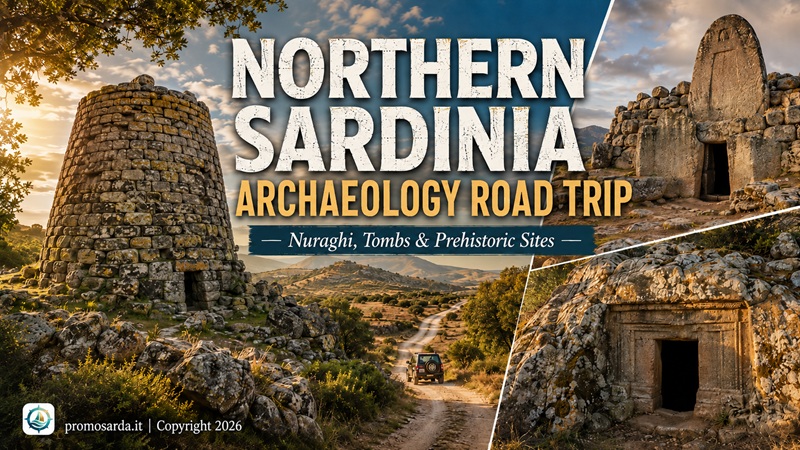
A five-day route through 5,000 years of Sardinian history, from Alghero and Sassari to the Valley of the Nuraghi, Anglona, Tempio and the prehistoric landscape of Arzachena
My name is Gavino. I am from Nuoro. I hike, ride mountain bikes, spend far too much time examining stones and have been interested in archaeology since I was young enough to think every unusual piece of pottery was probably Roman. Experience teaches you something useful: most stones are stones, most pieces of pottery are not treasures, and when you really do find something potentially archaeological, the interesting part begins by not touching it.
I am not an archaeologist. I am an archaeology enthusiast, and I am the Outdoor Guide of this website. That means I can show you how I personally connect the landscape, the roads, the monuments and the places around them. When interpretation needs professional archaeological expertise, I listen to archaeologists. When a site offers an official guided visit, I often take it. And when Italian law says a chance archaeological discovery must be reported, I do not decide that my glove compartment is a museum.
Northern Sardinia is exceptional for this kind of journey because you can move through very different prehistoric worlds in a few days: rock-cut Neolithic tombs, a unique monumental sanctuary, nuraghi, entire Bronze Age settlements, collective Tombs of Giants, sacred-water architecture and landscapes where monuments still make sense in relation to hills, passes, farmland and old routes. This road trip deliberately complements our broader Northern Sardinia Beyond the Beaches: 25 Things Actually Worth Doing guide. Here archaeology is not a detour. It is the reason for the journey.
The Route at a Glance
| Day | Area | Main sites | Sleep |
|---|---|---|---|
| 1 | Alghero / Porto Conte | Anghelu Ruju, Palmavera, optional MUSA/Sant’Imbenia | Alghero |
| 2 | Sassari / Nurra | Monte d’Accoddi, Museo Sanna | Sassari or Alghero |
| 3 | Meilogu / Bonorva | Santu Antine, Sant’Andrea Priu | Logudoro or Sassari |
| 4 | Anglona / Gallura | Elephant Rock, Predio Canopoli, Nuraghe Majori | Tempio Pausania |
| 5 | Arzachena | Li Muri, Li Lolghi, La Prisgiona, Coddu Vecchiu, optional Malchittu/Albucciu | Arzachena / Gallura |
Could you compress it into three days? Yes. I would not. Five days lets you look rather than collect.
First: Understand What You Are Looking At
One reason archaeology becomes boring is that visitors are given twenty names without being told what changed between them. A domus de janas is a rock-cut prehistoric tomb. UNESCO’s serial World Heritage property, inscribed in 2025, recognises the funerary tradition represented by Sardinia’s thousands of hypogea, created mainly between the fifth and third millennia BCE. UNESCO describes roughly 3,500 known examples across Sardinia and considers them the richest manifestation of this type of hypogeal funerary architecture in the western Mediterranean.
A nuraghe belongs to a later world: monumental stone structures primarily associated with Sardinia’s Bronze and Iron Age Nuragic civilisation. Some are simple single towers; others become astonishingly complex fortresses surrounded by villages. A Tomb of Giants is not a tomb for unusually tall Sardinians. These are monumental collective Bronze Age burials, frequently characterised in northern Sardinia by a long funerary chamber and a curved ceremonial façade or exedra. Then you have sacred wells and sanctuaries, where water, ritual and architecture meet. Do not compress all of this into “the nuraghi”. You are crossing millennia.
A Very Important UNESCO Correction
Since 2025 you will see “UNESCO” appearing increasingly often in Sardinian archaeological marketing. Good. The recognition is deserved. But use the name accurately. UNESCO inscribed “Funerary Tradition in the Prehistory of Sardinia – The domus de janas” in 2025. The final decision specifically excluded some components proposed during the nomination process, including Monte d’Accoddi and the Li Muri necropolis, from the inscribed serial property. They remain extremely important archaeological sites; they simply should not individually be labelled UNESCO World Heritage components on that basis. Something does not become more interesting because we add the wrong badge to it.
Day 1 — Alghero: “Death” Before the Nuraghi
1. Necropolis of Anghelu Ruju
Start here, not with a nuraghe. That is important. Anghelu Ruju contains 38 rock-cut tombs excavated into sandstone, with initial phases dating around 3200–2800 BCE and use continuing for roughly fifteen centuries into the Early Bronze Age. Some tombs use vertical well-like entrances, while others are approached through open-air corridors or dromoi. Inside are carved architectural details, false doors, taurine imagery and traces of red ochre connected with funerary symbolism.
This immediately destroys the idea that prehistoric Sardinia began with nuraghi. People here were creating elaborate funerary architecture long before the great Bronze Age towers appeared. Anghelu Ruju was discovered accidentally in 1903. I like that fact because archaeology is full of discoveries made when somebody was doing something else.
How I visit it: slowly. Do not attempt to enter every chamber simply because an opening exists. Look at the relationship between tombs, landscape and access corridors. Try to identify carved architectural details rather than simply photographing the largest hole. The current cultural circuit is administered by Fondazione Alghero, with the archaeological sites managed through local visitor services including guided assistance.
Gavino’s advice: visit Anghelu Ruju before Palmavera. Chronology suddenly becomes visible.
2. Nuraghe Palmavera
Now jump forward. Palmavera lies near Porto Conte and is one of north-west Sardinia’s most important Nuragic settlements. The surviving complex combines a central two-tower structure, defensive enclosure and village; fewer than fifty huts are currently visible, but the settlement may originally have contained around 150–200.
This is when you should stop thinking of nuraghi as isolated towers. A tower makes a good photograph. A settlement explains people. Where did they gather? Where did they produce things? How did structures relate to each other? What does the monument control visually? The questions become better.
Porto Conte also gives you an additional advantage: archaeology sits inside a landscape already worth exploring. Our Best Hikes in Northern Sardinia and Mountain Biking in Northern Sardinia guides use this same territory for Punta Giglio, Monte Timidone and the Porto Conte trail network. This is how I prefer to understand a place: walk it, ride it, then study who occupied it thousands of years earlier.
Optional: Sant’Imbenia and MUSA
If you still have concentration left, the wider Porto Conte landscape also contains the Nuragic complex of Sant’Imbenia, while Alghero’s archaeological museum, MUSA, forms part of the Fondazione Alghero cultural circuit. I would choose one rather than rush both. Archaeological fatigue is real. After the seventh display case, even people who love Bronze Age ceramics begin thinking about dinner.
Where I sleep
Alghero. No debate. You already have a large choice of hotels and B&Bs, restaurants and an evening city worth walking. If you have followed our previous Alghero guides, use the same city base rather than changing accommodation for the sake of ten kilometres.
Day 2 — Sassari: The Monument That Does Not Fit the Pattern
3. Monte d’Accoddi
If you see only one prehistoric monument in Northern Sardinia and want the one that creates the most questions, this may be it. Monte d’Accoddi is a prehistoric sanctuary used during the fourth and third millennia BCE. Its monumental stepped platform and long access ramp are unique in Sardinia and unusual in the western Mediterranean; the complex includes evidence for an earlier sanctuary, settlement activity, sacred stones and nearby hypogeal burials.
People often call it a “Sardinian ziggurat”. I understand why. Its appearance invites the comparison. But similarity is not proof that somebody sailed from Mesopotamia to Sassari with an architectural plan under his arm. The official archaeological interpretation emphasises the monument’s singularity while placing it within the prehistoric communities and ritual landscape of Sardinia. That is interesting enough.
What I actually look at: the ramp first, then the relationship between ramp and platform, then the surrounding stones and settlement traces. Do not stare exclusively at the top. Monumentality is about how a person approaches a structure as much as how it looks in aerial photography.
Current 2026 practical information: Monte d’Accoddi is about 11–13 km from Sassari, at Strada Vicinale Monte d’Accoddi 4. Current 2026 admission is €5 full price and includes guided-visit options; from April through October the published schedule is Tuesday–Sunday, 10:00–18:00, with Monday and public-holiday closures and last entry an hour before closing. Very current note: the Sassari tourism service currently announces that visits will be suspended 7–17 September 2026 for redevelopment works. If you are reading this after that period, verify the site again because this paragraph should eventually become obsolete.
4. Museo Nazionale “Giovanni Antonio Sanna”
Now go into Sassari. The Museo Sanna, Via Roma 64, is the museum I would pair with this road trip because it gives physical context to what you are seeing outside. Its collection ranges from prehistory through later historical periods, and in April 2026 the museum reopened its renovated Nuragic, Phoenician-Punic and Roman galleries following a major reorganisation.
This is particularly useful after Monte d’Accoddi because archaeological sites mostly show you structures. Museums show you objects: ceramics, tools, bronzes, material culture. The people return to the stones.
Current regular opening is Tuesday and Thursday/Saturday mornings, Wednesday and Friday afternoons, plus the first Sunday of each month; because the schedule is unusual, check it before building the day around the museum. Gavino’s rule for archaeological museums: visit fewer rooms properly. You are allowed to walk past a display case. The museum police will not arrest you.
Day 3 — Meilogu: Enter the Nuragic Landscape
5. Nuraghe Santu Antine
Now we arrive at one of the great ones. Santu Antine, outside Torralba, dominates the Cabu Abbas plain in the area commonly called the Valley of the Nuraghi. Construction developed between the Middle Bronze Age and Iron Age. The surviving central tower stands around 17 metres high and was originally taller, with a trilobed bastion built around it.
You do not need to be an archaeologist to understand why this site matters. Walk inside. Look upward. Follow the corridors. Then go outside and look across the plain. The building changes when you understand what it sees.
Santu Antine is also one of the strongest demonstrations that “primitive” is an almost useless word when discussing ancient architecture. Dry stone. No reinforced concrete. Still standing.
How long? At least ninety minutes for somebody genuinely interested, more with a proper guided explanation. The Comune di Torralba remains responsible for the archaeological area and publishes current site contact information at +39 079 847010.
Gavino’s detour: do not race directly to Bonorva. Spend a little time simply driving the Meilogu countryside and identifying other nuraghi on hills and plains. Santu Antine becomes more meaningful when you understand that it belonged to a densely monumentalised landscape.
6. Sant’Andrea Priu — The Tomb That Refused to Stop Being Used
Drive towards Bonorva. At Sant’Andrea Priu, approximately twenty rock-cut domus de janas occupy a trachyte outcrop. The complex dates initially to the fourth–third millennia BCE, but its story did not stop in prehistory. The extraordinary Tomba del Capo contains eighteen chambers occupying about 250 square metres, and parts of the necropolis were later reused and transformed during Roman and Byzantine/Christian periods.
This is one of my favourite archaeological lessons. We divide history into periods because books need chapters. People living beside an ancient monument do not necessarily care about our chapter headings. A prehistoric tomb can become something else, and something else again.
Sant’Andrea Priu became one of the northern Sardinian components associated with the 2025 UNESCO recognition of the domus de janas funerary tradition. Current municipal information describes the site as paid-entry and provides the archaeological-area contact +39 348 564 2611.
Don’t miss nearby: the rural church of Santa Lucia and the surrounding plain help make the archaeological landscape much easier to read. I would finish Day 3 here. Not add another four nuraghi because Google Maps says they are nearby.
Day 4 — Anglona to Gallura: Strange Rocks, Sacred Water and Granite
This is the most varied driving day. Good.
7. Elephant Rock — Archaeology Hidden Inside a Natural Landmark
Near Castelsardo, along the road towards Sedini, stands the famous Roccia dell’Elefante. Most tourists stop because the rock looks like an elephant. I stop because somebody turned it into a funerary place thousands of years before Instagram.
The roughly four-metre trachyte boulder contains two domus de janas, probably excavated during the Final Neolithic around 3200–2800 BCE. This is the quickest stop in the entire road trip and one of the best examples of natural geology and human archaeology occupying the same object.
Do not climb into places that are closed or unstable simply because the monument sits beside a road. Roadside does not mean expendable.
Cultural detour
Castelsardo is minutes away. This is where I would take coffee, walk the old town and deliberately break the prehistoric chronology for an hour. A road trip needs rhythm.
8. Predio Canopoli — The Sacred Well People Skip
Continue through Anglona to Perfugas. Predio Canopoli is a Nuragic sacred well built from carefully worked limestone blocks laid without mortar. A paved vestibule and staircase descend towards the water chamber; the precision of the masonry is one of the reasons the monument is frequently compared architecturally with Sardinia’s better-known sacred wells.
This is an excellent stop because by now you have seen tombs, a sanctuary, nuraghi and villages. Now water enters the religious landscape. Nearby, Perfugas’ archaeological-paleobotanical museum gives the area an unusually long time depth, with evidence extending from Palaeolithic occupation through later prehistoric and historical periods. If you are travelling with somebody who complains that “all nuraghi look the same”, bring them here. Different problem. Different architecture.
9. Nuraghe Majori — Where Archaeology and Forest Finally Meet
Now enter Gallura. Nuraghe Majori, about two kilometres outside Tempio Pausania, sits at roughly 500 metres altitude inside a woodland of cork oak, holm oak and other Mediterranean vegetation. It is built in granite rather than the basalt or limestone character you have seen elsewhere, and the setting immediately changes the feeling of the journey.
There is another inhabitant: bats. A small colony uses the monument, which is one more reason not to behave as if archaeological ruins were playground equipment.
Current 2026 visitor information publishes opening 1 May–31 October, daily 10:00–13:00 and 14:00–18:00, with a simple visit at €3.50 and guided visit at €5. The site combines beautifully with our future Monte Limbara Hiking Guide because archaeology here makes far more sense when paired with Gallura’s granite and forest environment.
Gavino’s detour: Pascaredda. If time and current access allow, add the Tomb of Giants of Pascaredda near Calangianus. The broader Monti di Deu archaeological landscape contains nuraghi, a dolmen, a Tomb of Giants and sacred-water architecture within the Limbara forest environment. This is what people miss by driving directly from beach to beach.
Day 5 — Arzachena: The Archaeological Finale
The Arzachena area is where I stop trying to choose one monument. The correct unit here is the archaeological landscape.
Current municipal visitor information organises the main monuments into the Malchittu, Capichera and Li Muri areas, with individual and cumulative tickets available. In 2026 a cumulative ticket covering all seven archaeological monuments is published at €20 full price, while individual-site prices start at €4.
If archaeology is the reason you came, buy the combination that fits the number of monuments you genuinely have time to understand. Do not buy seven and then sprint because you paid for seven.
10. Li Muri — Before the Nuraghi, Again
Start with Li Muri. Chronology first. The necropolis dates to the late fourth millennium BCE and is famous for its distinctive stone-circle funerary architecture. Four principal cist-like tombs were formed by upright slabs and surrounded by circular arrangements of stones; the funerary form is so characteristic of north-eastern Sardinia that archaeology historically used the term “Gallurese culture” for the prehistoric cultural expression associated with sites like this.
After several days looking at domus cut into rock, Li Muri teaches you an important lesson: prehistoric Sardinia was not architecturally uniform. Different regions did different things.
Remember the UNESCO nuance: Li Muri formed part of the wider nomination process but was not included in the final set of components inscribed in 2025. Still worth visiting? Obviously. UNESCO is not my personal archaeological rating system.
11. Li Lolghi — A Tomb Built Twice
Nearby Li Lolghi is one of Gallura’s great Tombs of Giants. The monument preserves two major construction phases. An earlier gallery tomb dates to the Early Bronze Age, around the nineteenth–seventeenth centuries BCE; during the Middle Bronze Age the monument was expanded with the great exedra, stele and longer funerary arrangement characteristic of a Tomb of Giants.
This is much more useful than simply saying “big old tomb”. You can see architecture evolving. Archaeological evidence from pottery in front of the exedra has also been interpreted as indicating ritual meals associated with commemoration of the dead. Stand in the exedra. Then imagine people gathered there. Architecture becomes behaviour.
12. La Prisgiona — The Site That Changes How You Think About Nuraghi
If you have enough time for only one major Arzachena monument, choose La Prisgiona. The site developed broadly between the fourteenth and eighth centuries BCE and combines a trilobed fortress with a large settlement extending over roughly five hectares. Around one hundred huts have been identified within the village landscape, with archaeological evidence for food preparation, craft production and specialised working spaces.
This is why La Prisgiona matters. Not the tower. The system: fortress, village, production, storage, water, tombs nearby, territory. The Nuragic world begins looking less like scattered mysterious towers and more like organised communities. And suddenly Santu Antine makes more sense too.
Current 2026 hours: Arzachena currently publishes La Prisgiona at 09:00–19:00 during the listed operating period, with other monuments having slightly different schedules. Check the official archaeological-areas page before setting your sequence.
13. Coddu Vecchiu — Walk There If You Have Time
The Tomb of Giants of Coddu Vecchiu stands only around 700 metres from La Prisgiona. The tomb began as an earlier gallery burial, probably in the Early Bronze Age, before being monumentalised during the Middle Bronze Age with an exedra and an extraordinary central stele approximately four metres high.
There is a roughly one-kilometre connecting route described through the archaeological landscape from La Prisgiona towards Coddu Vecchiu. Walk it if conditions and access allow. This is exactly what we discussed when creating Gavino’s outdoor identity: the trail is the spine; the territory is the story.
Walking between settlement and burial monument is different from driving into two separate car parks. Distance tells you something.
14. Malchittu and Albucciu — Only If Your Brain Still Works
The Nuraghe Albucciu is an unusual corridor-type monument, while nearby Malchittu adds a small temple associated with ritual activity. The same archaeological district also includes the Moru Tomb of Giants.
Should you add them after Li Muri, Li Lolghi, La Prisgiona and Coddu Vecchiu? Maybe. I know myself. I would. But I would not take somebody who stopped asking questions three hours earlier. There is no honour in archaeological exhaustion.
If You Have Only Three Days
| Day | Do this |
|---|---|
| 1 | Anghelu Ruju → Palmavera → Monte d’Accoddi |
| 2 | Santu Antine → Sant’Andrea Priu |
| 3 | Li Muri → Li Lolghi → La Prisgiona → Coddu Vecchiu |
What disappears? Sassari museum, Castelsardo, Predio Canopoli, Tempio and several secondary sites. That hurts. But it preserves the chronological structure.
If You Have Only One Day
From Alghero, do Anghelu Ruju + Palmavera. From Sassari, do Monte d’Accoddi + Santu Antine if your schedule allows. From Olbia/Costa Smeralda, do the Arzachena archaeological park: Li Muri + Li Lolghi + La Prisgiona + Coddu Vecchiu.
Do not try to cross Northern Sardinia because a website promised “the 12 best sites in one day”. That website does not care whether you enjoy them.
Best Archaeological Site for Children
Palmavera or La Prisgiona. Why? Visible architecture, rooms, towers, a settlement. Children generally understand spaces better than explanations about funerary symbolism. Monte d’Accoddi can also work brilliantly if somebody explains the monument rather than forcing a child to read fifteen panels. Sant’Andrea Priu is fascinating but darker, more funerary and conceptually less immediate.
Best Site for Someone Who Knows Nothing About Sardinian Archaeology
Santu Antine. It is immediately impressive. Then La Prisgiona. After those two, go backwards to Monte d’Accoddi and Anghelu Ruju. The chronology will surprise you.
Best Site for an Archaeology Enthusiast
For architecture: Santu Antine. For prehistoric religion: Monte d’Accoddi. For funerary archaeology: Sant’Andrea Priu. For settlement archaeology: La Prisgiona. For regional prehistoric identity: Li Muri. I refuse to choose one. That is how I end up taking five days.
Best Time for an Archaeology Road Trip
April, May, late September and October are my first choices. March and November can also be excellent. The main enemy is not archaeological difficulty. It is heat. Most of these sites are outdoors. Shade varies. Stone becomes hot. Attention collapses before your legs do. In July and August I visit early and use museums during the hottest hours. A museum at 14:00 is not admitting defeat. It is civilisation.
You Need a Car
For this particular road trip, yes. Some individual museums and monuments can be reached without one, but the archaeology is scattered through countryside and small settlements. The car also lets you do something I consider essential: stop when the landscape becomes interesting.
That said, archaeological access tracks are not invitations to off-road driving. Park where instructed. If a track is closed, private, eroded or pedestrian-only, my little 4×4 stays where it belongs. Having four-wheel drive does not confer archaeological immunity.
The Archaeology Kit I Keep in the Car
Nothing dramatic: walking shoes, hat, water, sunscreen, light jacket outside summer, phone charger/power bank, binoculars, small notebook, offline maps and a rubbish bag. No metal detector. No digging tool. No “souvenir box”. That should tell you enough.
What If You Actually Find Something?
This is the section I want associated with Gavino. Imagine you are walking between recognised monuments and notice something genuinely unusual: worked stone, ceramic fragments, metal, part of a structure or a concentration of material that appears archaeological. First: stop interfering with it.
Under Article 90 of Italy’s Cultural Heritage Code, a chance discovery must be reported within 24 hours to the competent Soprintendenza, the Mayor or public-security authority. The general legal framework is contained in Legislative Decree 42/2004.
My practical sequence is simple: do not dig; do not clean it; do not rearrange anything; take photographs of the object in context; record accurate coordinates; note the time and circumstances; report it. If an object must be moved because leaving it would create an immediate risk of loss or damage, that becomes a conservation issue to explain to the competent authority — not permission to take it home.
The context is part of the archaeology. A fragment without context is much poorer information.
And Metal Detecting?
Do not turn an archaeology road trip into amateur treasure hunting. Searching archaeological heritage and deliberately extracting cultural material engages a completely different legal framework from accidentally seeing something during a walk. My interest in discoveries is exactly why I do not want sites stripped of information. If I find something important, I would like an archaeologist ten years from now to know where it was.
Do Not “Improve” Archaeological Sites
This includes behaviour that people sometimes think is harmless. Do not stack ancient-looking stones into little towers. Do not place a pottery fragment on top of a wall “so somebody sees it”. Do not clear vegetation yourself. Do not chalk engravings to make photographs clearer. Do not climb unstable masonry. Do not move a stone because it interferes with your composition. And definitely do not scratch a cross, initials, date or name into anything. We already know you were there. Your phone has GPS.
Archaeology and Hiking: Where the Two Work Best
This is where Gavino’s guides begin connecting properly. Villanova Monteleone → Nuraghe Appiu is probably our strongest dedicated archaeology hike and already appears in Best Hikes in Northern Sardinia and Mountain Biking in Northern Sardinia. Monte Limbara / Calangianus gives you Tombs of Giants and Nuragic structures inside forest landscapes. Capo Testa combines walking with Roman quarry traces. Asinara’s Memory Trail moves between prehistory, First World War history and the prison landscape.
The archaeological road trip tells you what the monuments mean. The outdoor guides tell you how they sit inside the terrain. That internal linking is useful for Google. More importantly, it is useful for humans.
Museums Worth Adding
If the weather turns bad, I do not consider the archaeological day lost. Museo Sanna in Sassari is the major museum addition and especially relevant after its 2026 reopening of renewed Nuragic, Phoenician-Punic and Roman galleries. MUSA in Alghero is particularly logical when combining Anghelu Ruju and Palmavera with a city stay.
In Arzachena, the Museo Civico Michele Ruzittu complements the archaeological park; current 2026 municipal information lists museum hours of 10:00–13:00 and 16:00–19:00, closed Monday. In Perfugas, the local archaeological-paleobotanical museum is particularly interesting because its collections broaden the chronology beyond the Bronze Age into much earlier human occupation.
Where I Would Base the Trip
I would not change accommodation every night. Nights 1–2: Alghero or Sassari. Alghero wins for evenings and restaurants; Sassari makes Monte d’Accoddi and Museo Sanna easier. Night 3: staying around Logudoro is efficient if you want a slow rural trip, although returning to Sassari is perfectly reasonable. Night 4: Tempio Pausania. This lets archaeology lead naturally into Gallura, cork country and eventually the Limbara outdoor cluster. Night 5 onward: Arzachena/Gallura. From here you can switch completely from archaeology to Costa Smeralda, La Maddalena, Caprera, cycling or hiking.
That is why I like this itinerary. It does not fight the rest of a Northern Sardinia holiday. It improves it.
Northern Sardinia Archaeology FAQ
What are the best archaeological sites in Northern Sardinia?
My essential six are Anghelu Ruju, Monte d’Accoddi, Nuraghe Santu Antine, Sant’Andrea Priu, La Prisgiona and the Li Muri/Li Lolghi archaeological landscape.
What is the best nuraghe in Northern Sardinia?
For monumental architecture, Santu Antine. For understanding a wider Nuragic settlement, La Prisgiona.
What is a domus de janas?
A prehistoric rock-cut burial chamber or tomb. Sardinia preserves approximately 3,500 hypogea of this broader tradition, which received UNESCO World Heritage recognition as a serial property in 2025.
Are Sardinia’s domus de janas UNESCO World Heritage Sites?
A serial group representing the Funerary Tradition in the Prehistory of Sardinia – the domus de janas was inscribed in 2025. Do not assume every domus or every prehistoric monument on Sardinia is individually included in that UNESCO serial property.
Is Monte d’Accoddi a UNESCO World Heritage Site?
Monte d’Accoddi was included in the nomination process but specifically excluded from the components inscribed in UNESCO’s final 2025 decision. It remains one of Sardinia’s most important prehistoric monuments.
What is the oldest site on this road trip?
The earliest funerary traditions represented by the domus de janas go back into the Neolithic, while sites such as Li Muri and Monte d’Accoddi belong to the fourth–third millennia BCE. The great nuraghi are later Bronze Age phenomena.
What are the Tombs of Giants?
They are monumental collective Bronze Age burial structures. Coddu Vecchiu and Li Lolghi near Arzachena are two excellent northern examples.
Can children visit nuraghi?
Yes. Palmavera, Santu Antine and La Prisgiona are particularly rewarding because children can understand towers, rooms, walls and settlements visually. Supervise them carefully around stone steps and archaeological structures.
Can you enter every nuraghe?
No. Access depends on preservation, management and current restrictions. Follow the site’s visitor route rather than assuming an opening in ancient masonry is a public entrance.
Can I take archaeological finds home?
No. A chance archaeological discovery must be reported according to Italian cultural-heritage law; do not treat archaeological material as souvenirs.
How many days do I need?
Five days is my preferred route. Three days covers the major highlights but removes many of the cultural and landscape connections that make the journey worthwhile.
Final Thoughts: Do Not Visit Archaeology Like a Checklist
I like finding things. That is probably obvious by now. An old road, a forgotten wall, a carved stone, a building hidden among cork trees, a nuraghe appearing on the horizon when I did not expect one. Discovery is one of the best feelings in the outdoors.
But archaeology taught me something slightly different from hiking. On a mountain, reaching somewhere is often the achievement. In archaeology, sometimes the achievement is leaving something exactly where you found it.
Northern Sardinia has thousands of years sitting beside ordinary roads. Anghelu Ruju is close to an airport. Monte d’Accoddi sits beside the route between Sassari and Porto Torres. The Elephant Rock is almost a roadside stop. A sacred well survives inside Perfugas. Nuraghi rise among farms. Tombs stand between vineyards.
That normality is extraordinary.
You do not need ropes. You do not need a safari. You need time.
Get out of the car. Walk around the monument. Look at the terrain. Ask why it was built there. Read the interpretation. Use a guide when one can tell you something you cannot see for yourself. And when you leave, take only photographs.
If somebody before us had treated every interesting object as a souvenir, there would be considerably less left for us to understand today.
I would like the next person to have the same privilege.