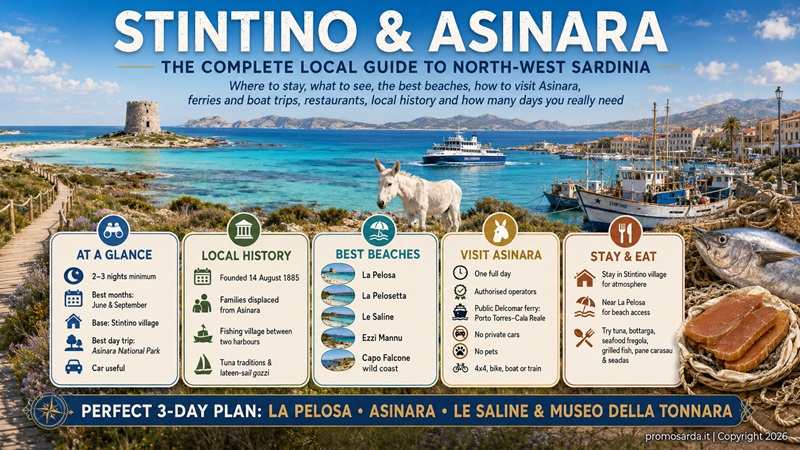
Where to stay, what to see, the best beaches, how to visit Asinara, ferries and boat trips, restaurants, local history and how many days you really need
If you ask somebody from Sassari what Stintino means to them, the answer probably depends on their age.
For many visitors today, Stintino means one thing: La Pelosa.
I understand why. It is one of those beaches that seems specifically designed to appear on magazine covers.
But when I was growing up in Sassari, Stintino meant something broader.
It meant the long drive north when the summer heat had already begun early in the morning. It meant cars full of cousins, towels and food. It meant somebody’s father insisting he knew a quieter place than everybody else, only to discover that half of Sassari had apparently received the same information.
It meant Le Saline, fishing boats, the harbour, the strange shape of the peninsula and Asinara always sitting on the horizon like another world.
And Asinara really was another world.
For much of my youth, it was not simply the national park that tourists know today. The prison remained active until the 1990s, and the island carried an aura of distance and prohibition. You could look at it from Stintino, but it belonged to a history that felt separate from normal summer life.
Today you can visit it.
And in my opinion, you should not come to Stintino for La Pelosa alone.
If you have two or three days, Stintino and Asinara together make one of the most interesting destinations in northern Sardinia: extraordinary beaches, a fishing village born from forced displacement, tuna-fishing traditions, one of Italy’s most unusual former prison islands, wildlife, cycling, hiking and some exceptionally beautiful stretches of Mediterranean coast.
This is how I would organise it.
Stintino and Asinara at a Glance
For anyone planning quickly:
| Question | My recommendation |
|---|---|
| How many days in Stintino? | 2–3 nights minimum |
| Is Asinara worth visiting? | Absolutely |
| How much time for Asinara? | One full day |
| Best base | Stintino village for restaurants and atmosphere |
| Best for beaches | La Pelosa, Le Saline, Ezzi Mannu |
| Best cultural attraction | Museo della Tonnara |
| Best day trip | Asinara National Park |
| Best months | June and September |
| Need a car? | Very useful, but not essential for every itinerary |
| Can you drive your own car on Asinara? | Normally no; motorised access is regulated and requires Park authorisation |
| Are dogs allowed on Asinara? | No |
| Best food to try | Local fish, tuna traditions, fregola, bottarga, seadas |
Where Is Stintino?
Stintino lies at the extreme north-western tip of Sardinia, about 50 kilometres from Sassari.
The village occupies a narrow strip of land extending towards Asinara, almost as though Sardinia were pointing a finger towards the island.
This peculiar geography gives Stintino two different coastlines.
Locals traditionally distinguish between the mare di dentro, the sheltered Gulf of Asinara side, and the mare di fuori, the rougher exposed western side.
That distinction is useful for visitors.
On the eastern side you find calmer stretches including La Pelosa, L’Ancora, Punta Negra, Le Saline and Ezzi Mannu.
The western side around Capo Falcone is much wilder: cliffs, rocky coves and a very different sea.
Sardinia’s official tourism information describes precisely this contrast between Stintino’s protected inner coast and its high, jagged western coastline.
Why Stintino Exists: The Story Most Visitors Miss
Stintino has one of the more unusual foundation stories in Sardinia.
It was not a village that gradually developed over centuries.
It has a birthday:
14 August 1885.
That year the Italian government decided to establish a maritime quarantine station and an agricultural penal colony on Asinara.
The people already living on the island — Sardinian shepherds and fishing families, some of Ligurian origin — were forced to leave.
Forty-five families eventually created a new settlement on the mainland.
That settlement became Stintino. The official municipal tourism site still identifies 14 August 1885 as its exact founding date.
Even the name tells you something about its geography.
The local term Isthintini refers to the narrow, intestine-like shape of the two inlets around which the settlement developed.
Stintino grew between Porto Minore and Porto Mannu, with low houses that still recall aspects of Cala d’Oliva on Asinara.
This is why I always suggest walking through the village rather than treating it merely as the place where you sleep before La Pelosa.
Without understanding Asinara, you only understand half of Stintino.
And without understanding Stintino, you miss part of Asinara’s story.
How Many Days Do You Need in Stintino?
For most first-time visitors, I recommend three days and two or three nights.
A very efficient itinerary is:
Day 1 — Stintino + La Pelosa + La Pelosetta
Day 2 — Full-day Asinara National Park excursion
Day 3 — Le Saline + Ezzi Mannu + Museo della Tonnara + Stintino harbour
With four days, add Capo Falcone, a diving or sailing experience, another Asinara activity or simply a slow beach day.
With only one day?
Choose between La Pelosa and Asinara.
Trying to do both properly in one day would be like ordering two excellent dinners and eating each in twenty minutes.
Technically possible.
Completely missing the point.
What to See in Stintino Besides La Pelosa
1. Walk Around the Old Village
Stintino is small.
That is an advantage.
You do not need an architectural itinerary or a list of fifteen monuments. Walk around the narrow peninsula, follow Lungomare Cristoforo Colombo, look at the boats and explore the two harbour areas.
Stintino remains closely associated with traditional wooden lateen-sail gozzi, and its fishing identity has survived beneath the modern tourism economy. Sardinia’s official tourism authority still describes Stintino as a capital of this traditional sailing culture.
The village is at its best early in the morning or around sunset, when many beach visitors have disappeared.
Museo della Tonnara: Why You Should Visit It
If there is one cultural attraction I would recommend in Stintino, it is the Museo della Tonnara, often abbreviated to MUT.
Do not imagine a dusty little fishing museum filled exclusively with rusty hooks.
The museum uses video, historic photographs, oral testimony, documents, traditional clothing, fishing tools and boat reproductions to explain the life of Stintino’s tuna fishermen and the historic tonnara.
Fishing — particularly tuna fishing — defined local life for generations. The Tonnara Saline remained fundamental to Stintino’s economy well into the twentieth century.
When I was younger, older people in this part of Sardinia still spoke about the tonnara as something belonging to living memory rather than museum history.
That generation is disappearing.
Which is exactly why the museum matters.
It helps explain why tuna is not merely a menu item here.
It was work, danger, ritual, income and community.
Allow roughly an hour, perhaps longer if you are genuinely interested.
I particularly recommend it on:
very hot afternoons,
windy days,
cloudy beach days,
or after lunch before returning to the sea.
The Best Beaches Around Stintino
La Pelosa deserves its own guide, so I will not repeat everything here.
But Stintino’s coastline is much more than La Pelosa.
La Pelosa
The famous one.
White sand, extraordinarily shallow turquoise water and the Torre della Pelosa offshore.
During the regulated season, access is controlled and booking is required.
For the complete rules, booking system, compulsory mat and parking strategy, I would treat La Pelosa as a separate planning task rather than simply arriving and hoping for the best.
La Pelosetta
Immediately beside La Pelosa, La Pelosetta is smaller, rockier and visually dominated by the historic tower.
I like it because the landscape feels more compact.
It is not a substitute for La Pelosa if your dream is the famous long shallow water, but it deserves a look in its own right.
Le Saline Beach
Le Saline is one of the beaches I recommend most often to people who ask:
“Where should we go if La Pelosa is too crowded?”
The answer is not necessarily to find another miniature La Pelosa.
Go somewhere completely different.
Le Saline is long and spacious, with pale rounded pebbles and exceptionally clear water.
There is more visual breathing room.
You are also close to the wetland areas of Stintino, another side of the local landscape that many beach-focused visitors barely notice.
Sardinia’s official tourism authority identifies Le Saline as one of the characteristic beaches along Stintino’s more sheltered Gulf coast.
Ezzi Mannu Beach
Continue south and you reach Ezzi Mannu.
Again, there is more space and a much more open coastal feeling than at La Pelosa.
I would choose Ezzi Mannu if:
you dislike compact beaches,
you have already visited La Pelosa,
you want a long relaxed afternoon,
or you simply want less ceremony around going to the sea.
La Pelosa is the photograph everybody recognises.
Ezzi Mannu is closer to what many Sardinians mean when they say, “Let’s just go to the beach.”
Capo Falcone and the Wild Side of Stintino
Visitors concentrating exclusively on La Pelosa can leave Stintino believing the whole peninsula consists of protected turquoise lagoons.
It does not.
Go towards Capo Falcone and the character changes dramatically.
You encounter the exposed western sea, cliffs, rocky coves and a landscape far more severe than La Pelosa.
Sardinia’s tourism authority describes Capo Falcone’s tower as the highest Spanish coastal tower in the Nurra area and notes that peregrine and Eleonora’s falcons can be seen in the surroundings.
This is one of my favourite parts of the peninsula outside midsummer.
In July at midday, I want to be in the water.
In April, May, late September or October, I am much happier walking somewhere like Capo Falcone.
Asinara National Park: Why You Should Go
From Stintino, Asinara appears so close that it almost seems connected to the mainland.
Geographically it is close.
Historically it was very far away.
For more than a century the island lived under conditions of unusual isolation.
Before 1885 it supported a civilian community of shepherds and fishermen. Then came the quarantine station and penal agricultural colony.
During World War I, thousands of Austro-Hungarian prisoners were held there.
Later came the prison system.
In 1975 a maximum-security facility was created, eventually holding members of terrorist organisations, kidnappers and major organised-crime figures.
The prison finally closed in 1997.
Today the island is protected within the Asinara National Park and Marine Protected Area.
The irony is striking.
The isolation imposed for some very dark reasons helped preserve an extraordinary Mediterranean landscape.
How to Get from Stintino to Asinara
This is where travellers need to distinguish between transport to the island and organised excursions around the island.
Stintino is the closest mainland embarkation point for Asinara excursions. Sardinia’s official tourism authority specifically identifies it as the nearest place from which to visit the National Park.
The National Park publishes an official list of authorised maritime passenger operators for the Stintino–Asinara route, together with authorised excursion, guiding, vehicle and marine operators.
Important advice
I strongly recommend booking through an operator appearing on the official National Park list.
Do not choose a boat purely because somebody at the harbour offers you a good deal.
Authorised operators can change.
The official Park list is therefore more trustworthy than a travel blog naming “the best company” five years after publication.
Official Asinara National Park authorised operators
Can You Take a Public Ferry to Asinara?
Yes, but there is an important distinction.
The National Park identifies Delcomar as the operator of the public territorial-continuity maritime service between Porto Torres and Cala Reale on Asinara. The service operates from the Dogana-Segni quay at Porto Torres.
That is different from the tourist excursion services departing from Stintino.
So:
For an organised tourist day from Stintino: choose an authorised Stintino–Asinara operator.
For the public maritime connection: check the current Delcomar Porto Torres–Cala Reale timetable.
This distinction is useful because searches for “Stintino Asinara ferry” often mix together completely different products.
How Long Is the Boat from Stintino to Asinara?
The crossing is short compared with most island excursions.
Depending on departure point, destination and boat type, you should think in terms of roughly half an hour, rather than a long ferry journey.
A Stintino hotel describing local excursions gives approximately 25 minutes from Stintino to Asinara, which is a reasonable planning figure rather than a timetable guarantee.
Exact times naturally depend on the vessel, sea conditions and which part of Asinara you reach.
What Is the Best Way to Visit Asinara?
There is no single best answer.
It depends on what kind of traveller you are.
Guided 4×4 Tour
For a first visit, this is probably the most efficient option.
You cover much more of the island than on foot while retaining access to interpretation from a guide.
The National Park lists authorised operators providing vehicle-based guided services.
This is the option I would recommend to:
families,
first-time visitors,
travellers with one day only,
people particularly interested in history and wildlife.
Visit Asinara by Bicycle
This is one of the best ways to experience the island if you are reasonably fit.
The regional tourism authority specifically identifies cycling as one of the ways to explore Asinara.
But do not underestimate:
heat,
distances,
wind,
lack of shade,
and water requirements.
A bicycle tour in May is not the same thing as one at 13:00 in August.
I would choose cycling in spring, June, September or autumn before choosing peak midsummer.
Visit Asinara on Foot
Walking is wonderful if you are interested in landscape, wildlife and silence rather than covering the entire island.
But Asinara is not a small theme park where every attraction sits ten minutes from the ferry terminal.
You need to choose a realistic route.
For serious walking itineraries, use an authorised guide where required and obtain current information from the Park.
Tourist Train on Asinara
There are also authorised tourist-train services on the island.
The National Park currently lists SB Service – Trenino Verde among authorised operators.
For families with younger children or travellers who prefer a low-effort day, this can be an appealing compromise between sightseeing and comfort.
Sailing and Boat Tours Around Asinara
You do not have to explore Asinara exclusively by land.
The National Park lists numerous authorised operators for guided marine excursions and sailing-related services.
This can be the better option if your priority is:
swimming,
snorkelling,
coastal scenery,
small coves,
or simply spending a day at sea.
But understand what you are buying.
A boat tour around Asinara and a full historical land tour of Asinara are not the same experience.
If your main interest is the prison history, Cala d’Oliva and the interior, choose a tour with substantial land content.
If your main interest is swimming and coastline, choose a marine excursion.
Can You Take Your Own Car to Asinara?
For normal tourists, you should plan on not taking your private car around Asinara.
The Park regulations state that access and movement by motorised vehicles require authorisation from the Park authority, and authorised circulation is restricted to specified roads.
That is why organised authorised transport exists.
Do not approach Asinara as though it were La Maddalena, where taking a normal vehicle on the ferry can form part of an ordinary visit.
Different island.
Different rules.
Can You Bring a Dog to Asinara?
No.
The Asinara National Park’s visitor information explicitly states that dogs, cats and other pets are not allowed on the island.
This is important enough to check before booking accommodation or boat tickets if you are travelling around Sardinia with a pet.
What to See on Asinara
Cala Reale
Cala Reale is one of the principal historical and logistical areas of the island.
The old quarantine and administrative history is particularly visible around this part of Asinara.
It is also the arrival point for the public maritime connection from Porto Torres.
Cala d’Oliva
For me, Cala d’Oliva is essential.
Its cluster of buildings gives the strange impression of a small Mediterranean village that somebody suddenly emptied.
Historically it was tied to both the civilian population and the later prison system.
Remember that some of the families displaced from Asinara in 1885 subsequently founded Stintino.
Standing in Cala d’Oliva after having walked around Stintino the previous evening connects the two places in a way that reading a sign never quite achieves.
The Park also maintains the Osservatorio della Memoria in the former central prison branch at Cala d’Oliva.
The Former Prison at Fornelli
Asinara’s prison history is one of the reasons the island feels unlike any ordinary Mediterranean national park.
Fornelli is particularly associated with the maximum-security period.
The story is difficult, recent and deeply connected to modern Italian history.
Do not visit expecting theatrical prison tourism.
The fascination comes from seeing a landscape where extraordinary natural beauty and institutional isolation existed side by side.
The Austro-Hungarian Ossuary
Another unexpected chapter concerns the First World War.
Asinara held thousands of Austro-Hungarian prisoners during the conflict.
Sardinia’s official tourism information notes the ossuary built in 1936, containing the remains of approximately 7,000 Austro-Hungarians who died after deportation.
It is a sobering stop.
And it is precisely why I resist describing Asinara simply as “an island with white donkeys and beautiful water.”
It is much more complicated than that.
The White Donkeys of Asinara
Yes, you may see the famous white donkeys.
They have become the popular symbol of the island.
Children naturally love them, and adults immediately photograph them.
But please remember the obvious:
these are animals in a protected environment, not props for tourist photographs.
Keep appropriate distance and follow your guide’s instructions.
Asinara’s fauna is part of the reason the island is protected.
The Beaches of Asinara
Asinara contains some extraordinary coves, but visitors should understand that protection levels differ, and access to particularly sensitive areas may be limited.
Sardinia’s official tourism information highlights places such as Cala Sant’Andrea, Cala d’Arena and Cala dei Ponzesi/Punta Sabina, while also noting the island’s highly protected character.
Do not assume that every beautiful patch of sand visible from the road is available for unrestricted swimming.
Follow the current Park rules and your authorised guide.
This is a national park, not an all-inclusive beach resort.
Can You Sleep on Asinara?
Yes, but accommodation on the island is extremely limited compared with Stintino.
The National Park lists La Locanda del Parco, at Cala d’Oliva, among authorised services for sleeping inside the Park.
An overnight stay changes the experience completely.
Once most day visitors leave, the isolation that shaped Asinara’s history becomes much easier to understand.
For a first northern Sardinia road trip, however, I would normally stay in Stintino and visit Asinara as a full-day excursion.
Sleeping on the island is more appealing for a second visit or for travellers specifically interested in nature and isolation.
Where to Stay in Stintino
As with the La Pelosa guide, I would favour places currently above the rating threshold of 4.1/5, while remembering that ratings change over time.
For people who want to stay inside Stintino village, 103 Boutique Hotel Stintino is directly on Lungomare Cristoforo Colombo and currently sits around 4.3/5.
Its main advantage is not resort-style isolation.
It is location.
You can walk out in the evening, reach restaurants easily and actually experience the village.
For travellers who prefer a smaller B&B, Domo Sul Porto is particularly interesting: its current rating is an exceptional 5.0/5 from a substantial number of reviews, and the port-side position is exactly what I would choose for a short Stintino stay.
Another very strong B&B option is B&B Sa Serra, currently around 4.8/5.
And if you prefer to position yourself farther south near another excellent beach rather than in central Stintino, 309 – Le Saline currently rates around 4.6/5 and makes sense for travellers prioritising beach access and driving flexibility.
My local choice
For two nights, stay in Stintino village.
For four or five beach-focused nights, staying farther along the peninsula or around Le Saline becomes more attractive.
Where to Eat in Stintino
Stintino is one of those places where I strongly recommend eating fish at least once.
That does not mean every restaurant beside a harbour automatically deserves your money.
Choose carefully.
Traditional Seafood
Ristorante Lina – Stintino (SS) is one of the best-established names in town, currently rated around 4.3/5 with more than 2,600 reviews.
For visitors who want an obvious seafood dinner in central Stintino, it is one of the safer choices.
A More Intimate Dinner
Trattoria Opera Viva currently carries approximately 4.5/5 and is another place I would shortlist for a proper evening meal.
Something Closely Connected to Fishing
For an experience more explicitly based around the fishing tradition, Ittiturismo Antares currently rates around 4.6/5.
An ittiturismo is particularly appropriate here because Stintino’s identity is fundamentally maritime rather than merely touristic.
Close to the La Pelosa Road
If you want something convenient after the beach without returning immediately to central Stintino, Ristorante Bar L’Ancora Porticciolo sits along Viale La Pelosa and currently rates around 4.3/5.
What Should You Eat in Stintino?
Obviously fish.
But be more specific than that.
Look for local or regional dishes involving:
tuna, when appropriate and responsibly sourced;
bottarga;
octopus;
fregola with seafood;
fresh grilled fish;
shellfish according to season;
Sardinian cheeses;
pane carasau;
seadas.
And drink a Sardinian Vermentino if somebody else is driving.
One thing I would not do is spend three nights eating only the same generic dishes available in every tourist town in Italy.
You are in a village whose history was organised around fishing.
Let dinner tell you something about it.
Should You Stay in Stintino or Near La Pelosa?
This is one of the highest-value practical questions.
Stay near La Pelosa if:
your priority is the beach;
you have very young children;
you want to minimise morning driving;
you intend to spend several days swimming.
Stay in Stintino if:
you want restaurants within walking distance;
you enjoy evening harbour walks;
you are planning an Asinara departure;
you want the trip to feel like more than a beach holiday.
I prefer Stintino itself for a first visit.
La Pelosa becomes quiet when the beach day ends.
Stintino becomes more interesting.
Best Time to Visit Stintino and Asinara
For me, the answer is easy.
June
Probably the best combination of:
long days,
good swimming weather,
less pressure than August,
beautiful landscapes,
and manageable temperatures for Asinara.
July
Excellent beach conditions but increasingly busy.
Fine for Stintino.
Hotter for exploring Asinara on foot or by bicycle.
August
Peak Sardinia.
Stintino becomes extremely busy.
La Pelosa requires serious planning.
Restaurants should be booked.
Parking requires patience.
And on Asinara, midday heat can make active excursions much less comfortable.
I would still visit if August were my only option.
I simply would not pretend it is the calmest version of Stintino.
September
My favourite.
The sea is warm, the days remain beach-friendly and the intensity gradually declines.
For combining La Pelosa + Asinara + sightseeing, September may be the best overall choice.
April, May and October
Excellent for walking, landscape, history and a quieter Stintino.
Swimming depends much more on weather and personal tolerance.
Asinara can be particularly rewarding during these shoulder periods because you experience the environment rather than fighting the heat.
Is Stintino Good for Families?
Very.
But I would build a family itinerary around variety.
For example:
Day 1
La Pelosa in the morning.
Rest in the afternoon.
Stintino harbour and dinner.
Day 2
Asinara excursion with an authorised operator, preferably a format appropriate to the child’s age.
Day 3
Le Saline or Ezzi Mannu.
Museo della Tonnara later.
This gives children swimming, boats, animals, history and movement.
Far better than dragging them to three beaches per day because an online list called them “unmissable”.
Is Asinara Good for Children?
Yes, particularly for school-age children.
The boats, wildlife, white donkeys, abandoned-looking buildings and former prison environment naturally create questions.
My only warning is to select the right excursion format.
A six-hour technical history tour may fascinate me.
It may not fascinate a six-year-old.
A mixed excursion with transport, wildlife, short cultural stops and swimming works much better for most families.
And remember again: pets cannot come with you.
Stintino Without a Car: Is It Possible?
Yes.
Stintino itself is compact.
Seasonal public transport can connect it with Sassari, Porto Torres and La Pelosa, and Asinara excursions can depart from Stintino.
You could therefore construct a short holiday without driving.
However, I would still choose a car for a broader northern Sardinia itinerary involving:
Alghero,
Castelsardo,
Capo Caccia,
Argentiera,
Ezzi Mannu,
or inland Nurra.
Public transport can take you to Stintino.
A car gives you the Stintino peninsula.
Those are slightly different things.
Getting to Stintino from Alghero
Alghero and Stintino combine naturally in a Northern Sardinia road trip.
By car, allow roughly an hour depending on summer traffic and your exact starting point.
The sensible itinerary is:
Alghero → Stintino → Asinara → Castelsardo
rather than repeatedly driving back to Alghero every evening.
That was exactly the logic behind the larger Northern Sardinia itinerary.
Getting to Stintino from Porto Torres
Porto Torres is considerably closer.
This makes Stintino an excellent first or final stop for travellers arriving by ferry from Barcelona or mainland Italy.
It also matters for Asinara because Porto Torres has the public Delcomar connection to Cala Reale identified by the National Park.
If you are travelling without a car and want an independent Asinara connection rather than a Stintino tourist excursion, Porto Torres deserves serious consideration.
Stintino or Alghero: Which Is Better?
This is the wrong competition.
They serve different purposes.
Choose Alghero for:
a larger historic centre,
nightlife,
more restaurants,
architecture,
Capo Caccia,
a more complete city experience.
Choose Stintino for:
La Pelosa,
Asinara,
small-village atmosphere,
beach time,
fishing heritage.
On a road trip, visit both.
If forced to choose one place for a seven-night stay, I would probably choose Alghero because it offers greater variety.
If forced to choose where to spend three perfect summer days, Stintino has a very strong argument.
Stintino or Castelsardo?
Again, different experiences.
Castelsardo is medieval, vertical, architectural and dramatic.
Stintino is maritime, horizontal and defined by water.
One is a town you climb.
The other is a town from which you leave by boat.
Together they work extremely well.
My Perfect Three-Day Stintino & Asinara Itinerary
Day 1 — La Pelosa and Stintino
Arrive early at La Pelosa with your reservation already organised.
Spend the morning swimming.
Do not try to “see” the beach in an hour.
Have lunch.
Return to your accommodation and rest during the hottest part of the day.
In late afternoon, explore Stintino properly.
Walk around Porto Minore and the waterfront.
Visit the Museo della Tonnara if opening times suit your schedule.
Dinner in the village.
Day 2 — Full Day on Asinara
Book an authorised excursion in advance.
Choose your format based on what you care about:
4×4 for efficient first-time exploration.
Bike for active travellers.
Boat/sailing for sea and swimming.
Guided walking for nature and depth.
Tourist train for an easier family experience.
Include some combination of Cala Reale, Cala d’Oliva, the former prison areas, wildlife and protected coastline.
Return to Stintino.
Eat well.
Sleep deeply.
Day 3 — The Other Stintino
This is the day many visitors never have.
Go to Le Saline or Ezzi Mannu.
If the weather is cooler, explore Capo Falcone.
Spend time somewhere that is not La Pelosa.
Have lunch without checking your phone every fifteen minutes.
Then return to Stintino for one final walk.
That is when the village usually begins to make sense.
What I Remember from Stintino Before the Crowds
People sometimes ask locals whether tourism has “ruined” Stintino.
I dislike that word.
Tourism has changed it.
Profoundly.
When I was young, the idea of reserving access to La Pelosa online would have sounded absurd.
We simply went.
We did not plan beach days several months ahead.
There were certainly summer crowds, especially from Sassari, but not today’s international volume.
Asinara also felt different.
It was visible, physically close and psychologically distant.
The prison still gave the island an identity based on exclusion rather than tourism.
Today Stintino is more prosperous, more famous and considerably busier.
Some changes are irritating.
Traffic is worse.
August can feel overwhelming.
Some corners that once felt almost local now belong to everybody.
But something else happened as well.
Asinara became protected.
Its history became accessible.
The tuna-fishing heritage began being actively preserved.
Visitors can understand why Stintino exists at all.
And there is now an awareness that places such as La Pelosa cannot simply absorb unlimited human pressure forever.
So when I become nostalgic, I try to remember the whole picture rather than only the empty parking spaces.
Stintino & Asinara FAQ
Is Stintino worth visiting?
Yes. Stintino combines some of Sardinia’s most famous beaches with fishing history and direct access to Asinara National Park. It deserves at least two nights rather than a rushed La Pelosa day trip.
How many days should I spend in Stintino?
Three days is ideal for a first visit: one day for La Pelosa and Stintino, one full day for Asinara and one day for Le Saline/Ezzi Mannu and local culture.
Is Asinara worth visiting?
Absolutely. It is one of Northern Sardinia’s most distinctive experiences because it combines protected nature, wildlife, beautiful coastline and an extraordinary history of quarantine, war imprisonment and penal institutions.
Can you visit Asinara from Stintino?
Yes. Stintino is the closest mainland embarkation area and the National Park lists authorised Stintino–Asinara maritime operators.
Is there a ferry from Stintino to Asinara?
There are authorised passenger and excursion services between Stintino and Asinara. These should not be confused with the public territorial-continuity ferry, which the Park identifies as operating between Porto Torres and Cala Reale with Delcomar.
Where should I book an Asinara excursion?
Use an operator listed by the Asinara National Park rather than relying solely on third-party reseller sites.
Check authorised Asinara operators
Can I take my car to Asinara?
Normal tourist road access with a private vehicle should not be assumed. The Park regulations require authorisation for motorised vehicles.
What is the best way to explore Asinara?
For first-time visitors, a guided 4×4 excursion offers the best balance between coverage and context. Cycling is excellent in cooler periods, while boat tours are better for swimming and coastline.
Can you cycle around Asinara?
Yes. Cycling is one of the recognised ways of exploring the National Park, although distances, heat and water requirements should not be underestimated.
Are dogs allowed on Asinara?
No. The Park explicitly prohibits dogs, cats and other pets.
What animals can you see on Asinara?
The island is particularly famous for its white donkeys, alongside a wider protected fauna and birdlife.
Can you swim on Asinara?
Yes, in permitted areas. Some beaches and zones receive higher levels of environmental protection, so follow Park rules and instructions from authorised guides.
Can you stay overnight on Asinara?
Yes, but accommodation is very limited. The National Park lists La Locanda del Parco at Cala d’Oliva among authorised overnight services.
What are the best beaches in Stintino?
The essential choices are La Pelosa, La Pelosetta, Le Saline and Ezzi Mannu. La Pelosa has the most spectacular shallow turquoise water; Le Saline and Ezzi Mannu offer considerably more space.
What is there to do in Stintino besides the beach?
Visit the Museo della Tonnara, explore the old harbour, learn about Stintino’s fishing history, walk around Capo Falcone and take an excursion to Asinara.
When was Stintino founded?
Stintino was founded on 14 August 1885 by families displaced from Asinara after the Italian government established a quarantine station and penal colony there.
What is the best month for Stintino?
For me, June and September offer the best combination of beach weather, warm sea and more manageable visitor levels.
Is August too crowded in Stintino?
It is very busy, but not impossible. Book accommodation, restaurants, La Pelosa access and Asinara excursions well ahead.
Is Stintino good with children?
Yes. Shallow beaches, boat trips and wildlife on Asinara make the area particularly suitable for families.
Can I visit Stintino without a car?
Yes, particularly if you stay in the village and use seasonal buses and organised excursions. A car is much more useful if Stintino forms part of a wider Northern Sardinia road trip.
Final Thoughts: Stintino Is More Than La Pelosa
I would never tell somebody coming to Sardinia for the first time not to see La Pelosa.
That would be local snobbery.
It is famous because it is genuinely extraordinary.
But my advice is to look behind the beach.
Walk through Stintino and remember that the village exists because families were forced from the island you can see across the water.
Visit the Museo della Tonnara and understand what fishing meant here before restaurants began serving tourists.
Take the boat to Asinara.
Stand among the buildings at Cala d’Oliva.
Listen to the story of the prison.
See a white donkey wandering through a landscape that was closed to ordinary visitors within living memory.
Then return to Stintino in the evening.
The boats will be moving gently in the harbour. People will be choosing restaurants. Somebody will be eating an ice cream. Children will be running around exactly where previous generations grew up in a village dependent almost entirely on the sea.
And Asinara will still be sitting on the horizon.
When I was young, that island represented somewhere we could not really go.
Today it is one of the strongest reasons to come.
That may be the greatest change of all.