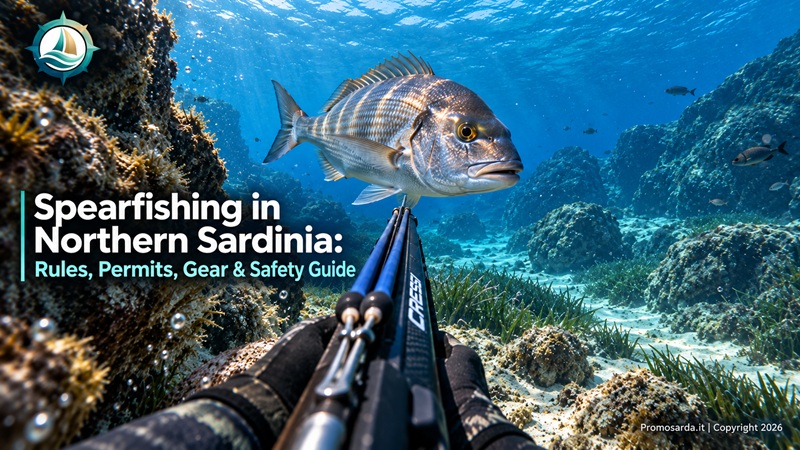
Where you can spearfish, where you absolutely cannot, what permits you need, equipment, techniques, target species and essential safety rules
Updated September 2026
Spearfishing in Northern Sardinia can be extraordinary.
Clear water, granite reefs, underwater cliffs, Posidonia meadows and rocky coastlines create exactly the type of environment that makes a freediver want to enter the water.
But Northern Sardinia is also one of the easiest places to make a serious legal mistake.
Some of the most beautiful stretches of coast are inside Marine Protected Areas. Around Asinara, Capo Caccia, Capo Testa and Tavolara, spearfishing restrictions are strict. La Maddalena has its own unusual system. During summer, beaches full of swimmers create another set of restrictions.
And there is one rule that comes before everything else:
Spearfishing in Italy must be carried out while breath-hold diving. You cannot use scuba equipment to hunt fish.
The Sardinian authorities explicitly state that recreational underwater fishing must be carried out without auxiliary breathing equipment.
This guide explains how to approach spearfishing in Northern Sardinia legally and safely, whether you are entering from shore or using a boat.
If you are interested in conventional fishing as well, start with our complete Fishing Guide to Northern Sardinia.
Can Tourists Spearfish in Sardinia?
Yes.
A visitor can recreationally spearfish in ordinary Sardinian sea areas where underwater fishing is permitted, provided they comply with national registration requirements and all applicable fishing, safety and local rules.
However, that answer changes completely when you enter a Marine Protected Area or another specially regulated zone.
A spot can look perfect for spearfishing and still be completely illegal.
The simplest rule I can give you is:
Never enter the water with a speargun until you have checked whether the coastline is inside a protected area.
Northern Sardinia Spearfishing Rules at a Glance
| Rule | What it means |
|---|---|
| Fishing method | Breath-hold diving only — no scuba-assisted spearfishing |
| Minimum age for using a speargun | 16 years under the general rules |
| Legal hours | Sunrise to sunset |
| Diver-down flag | Mandatory |
| Maximum distance from flag | 50 metres |
| Flag visibility | At least 300 metres |
| Busy bathing beaches | No spearfishing within 500 m of beaches frequented by swimmers |
| Fishing nets / fixed fishing gear | Stay at least 100 m away |
| Anchored ships outside ports | Stay at least 100 m away |
| Port approaches / shipping lanes | Spearfishing prohibited in designated traffic areas |
| Loaded speargun at surface | Prohibited |
| Scuba-assisted spearfishing | Prohibited |
| General daily recreational catch | Max 5 kg, except one individual fish exceeding 5 kg |
| Grouper | Maximum one specimen per day, subject to stricter local rules |
| Coral / crustaceans / most shellfish | Recreational underwater collection prohibited |
| Selling your recreational catch | Prohibited |
| Marine Protected Areas | Check individually — several northern Sardinian MPAs prohibit spearfishing completely |
There can also be temporary ordinances, biological closures and species-specific restrictions.
So treat this table as your starting point, not as permission to fish a particular cove.
The Two Registrations You Need to Understand in 2026
This changed recently, which is why older Sardinia spearfishing guides can now be misleading.
1. MASAF / SIAN Recreational Fishing Registration
Italy operates a national communication system for recreational and sport sea fishing.
The registration is carried out through the MASAF/SIAN system. The Ministry also provides a dedicated procedure for foreign users.
This is often casually called a “fishing licence”, although technically it is a national fishing communication/registration rather than the type of paid licence familiar in some other countries.
Do it before your trip.
Do not arrive on a rocky coast at sunrise and decide that this is the perfect moment to work out Italian government login systems.
2. RecFishing — Important 2026 Change
From 2026 there is another element.
People over 16 who practise recreational or sport spearfishing must register through the EU RecFishing application.
After registration, RecFishing generates a code that must be entered when the national SIAN fishing registration is issued or renewed.
The system also requires declaration of catches belonging to certain monitored species:
| Species currently listed | Scientific name |
|---|---|
| Bluefin tuna | Thunnus thynnus |
| Swordfish | Xiphias gladius |
| Dolphinfish / mahi-mahi | Coryphaena hippurus |
| Albacore | Thunnus alalunga |
There is an important temporary 2026 exception.
Until 31 December 2026, MASAF has suspended the requirement that a RecFishing “fishing session” must be opened exactly when the fishing trip begins. The underlying registration requirement and required catch declarations remain in force.
Do not interpret the presence of a species in RecFishing as automatic permission to target it.
Species such as bluefin tuna can be governed by separate annual measures and authorizations.
For the ordinary visiting spearfisher, my advice is simple:
do not build a holiday trip around tuna or other heavily regulated pelagic species.
Do You Need a Spearfishing Certificate?
The general recreational rules regulate registration, minimum age, fishing methods, signalling, distances, catches and prohibited areas.
They do not create a general recreational “spearfishing qualification exam” comparable to a scuba certification.
That does not mean training is unnecessary.
FIPSAS offers dedicated spearfishing courses covering breath-hold physiology, risks, marine environment, fishing techniques, equipment, legislation, Marine Protected Areas, first aid and safe conduct.
For a complete beginner, I would strongly prefer a proper course over learning breath-hold spearfishing with a speargun from YouTube.
Where Spearfishing Is Prohibited in Northern Sardinia
This is probably the most important section in the entire guide.
Four of the best-known coastal areas of Northern Sardinia contain Marine Protected Areas where recreational spearfishing is prohibited.
And then there is La Maddalena, which works differently.
Asinara Marine Protected Area
Spearfishing: NO
Do not take a speargun to Asinara expecting to use it.
The protected-area framework prohibits recreational spearfishing.
The practical rule for a visitor is extremely simple:
Asinara is not a recreational spearfishing destination.
The surrounding Gulf of Asinara outside the protected-area perimeter is a different matter.
If you want to understand the island and its marine environment, read our Stintino and Asinara guide and our dedicated guide to diving around Asinara.
For exploring the coast without fishing, see Stintino and Asinara by boat.
Capo Caccia – Isola Piana Marine Protected Area
Spearfishing: NO
This one deserves emphasis because the coast looks almost designed for spearfishing.
It is not legal inside the AMP.
The 2026 Capo Caccia – Isola Piana regulations explicitly prohibit recreational spearfishing within the Marine Protected Area.
That applies regardless of whether the underwater terrain looks perfect.
Do not confuse authorization for ordinary recreational fishing in certain sectors with authorization for spearfishing.
They are different activities.
If you are visiting the area, our Capo Caccia guide explains the coastline from above, while the best dive sites in Northern Sardinia guide covers ways of exploring it underwater without hunting.
Capo Testa – Punta Falcone Marine Protected Area
Spearfishing: NO
This is another particularly important one for Northern Sardinia.
The Capo Testa – Punta Falcone MPA includes spectacular granite coastline around Santa Teresa Gallura.
Its official regulations list recreational spearfishing among the activities not permitted inside the protected area.
Some recreational rod fishing is permitted in specified zones and under specific conditions.
That does not apply to spearfishing.
So seeing somebody discussing “fishing at Capo Testa” does not mean you can enter with a speargun.
Read our dedicated Capo Testa guide before exploring this section of coast.
Tavolara – Punta Coda Cavallo Marine Protected Area
Spearfishing: NO
The Tavolara Marine Protected Area states this very clearly:
spearfishing is prohibited inside the MPA.
This matters if you are based around:
Porto San Paolo, Tavolara, Capo Coda Cavallo or the wider Golfo Aranci / Olbia area.
Do not assume that obtaining a recreational-fishing permit for the AMP authorizes spearfishing.
It does not.
What About La Maddalena?
For most visiting spearfishers: treat it as NO
La Maddalena is unusual.
It is a National Park rather than one of the standard Marine Protected Areas described above, and it has its own regulations.
Under the current sport-fishing regime, underwater fishing in eligible Mb waters is restricted to residents of the Comune di La Maddalena, subject to personal authorization and additional conditions.
For an ordinary non-resident visitor:
do not plan to recreationally spearfish inside the Park.
If transporting spearfishing equipment through the Park, check the current Park requirements before departure rather than assuming that unloaded equipment can simply be carried anywhere.
For navigation and protected-zone information, see our complete guide to La Maddalena boating rules.
And if your objective is experiencing the underwater world rather than taking fish, read our guide to diving in La Maddalena.
Protected Areas Quick Reference
| Area | Visiting recreational spearfisher |
|---|---|
| Asinara MPA | ❌ Prohibited |
| Capo Caccia – Isola Piana MPA | ❌ Prohibited |
| Capo Testa – Punta Falcone MPA | ❌ Prohibited |
| Tavolara – Punta Coda Cavallo MPA | ❌ Prohibited |
| La Maddalena National Park | ❌ Not available to ordinary non-resident visitors under the current sport-fishing regime |
| Ordinary coast outside protected areas | ✅ Potentially permitted, subject to national, regional and local rules |
This table is exactly why I would never choose a spearfishing location by opening Google Maps and looking for blue water.
Check the legal boundary first.
Where Can You Spearfish in Northern Sardinia?
There is still an enormous amount of coastline outside the protected areas.
Rather than publishing precise rocks and GPS marks, I prefer thinking in coastal sectors.
That is better for fishing and better for the coast.
Stintino and the Gulf of Asinara
Do not confuse Stintino with the Asinara Marine Protected Area.
Sections of the mainland coast and wider Gulf lie outside the AMP and can offer suitable spearfishing habitat where ordinary rules apply.
The important part is confirming the protected-area boundary.
Near heavily used beaches, the 500-metre swimmer rule becomes particularly important in summer.
This is one of the reasons why arriving at sunrise can be useful.
Not because fish understand alarm clocks.
Because beaches and boat traffic become much busier later.
And remember: legal spearfishing begins at sunrise, not before it.
The Nurra and Argentiera Coast
For experienced spearfishers, the western coast around the broader Nurra and Argentiera sector can be much more interesting.
You find:
rock;
drop-offs;
mixed bottom;
Posidonia;
deeper water relatively close to shore.
But this coast is considerably more exposed to swell.
A beautiful spearfishing area can become a terrible exit point if the sea changes while you are underwater.
Before entering from shore, ask yourself a second question:
Can I still get out here if the sea rises?
If the answer is uncertain, choose somewhere else.
Alghero Outside the Capo Caccia MPA
The Alghero coast combines many different habitats.
But the first thing you should look at is not the fish.
It is the Capo Caccia – Isola Piana MPA boundary.
Outside protected waters and other restricted zones, suitable rocky and mixed-bottom stretches can provide legal recreational spearfishing opportunities.
Inside the AMP, leave the speargun at home.
That distinction needs to be completely clear.
Castelsardo and the North Coast
The coastline around Castelsardo and farther east contains rocky sections, mixed ground and areas exposed to northerly weather.
Potential species include:
white seabream;
mullet;
salema;
seabass;
dentex in suitable deeper habitat;
and pelagic visitors.
Visibility can change dramatically after bad weather.
The best conditions for seeing fish are not necessarily the safest conditions for getting into the water.
Isola Rossa and Costa Paradiso
This type of granite coastline is visually perfect for spearfishing.
It is also physically demanding.
Expect irregular entries, sharp or slippery rock, exposed sectors and potentially long swims.
For experienced spearfishers, mixed rock and Posidonia habitat can be very interesting.
For beginners, the difficulty of the shore access can outweigh the fishing potential.
Always plan the exit before loading the gun.
Santa Teresa Gallura
This area requires particular attention because the Capo Testa – Punta Falcone MPA removes a significant part of the obvious coastline from consideration for spearfishing.
Outside the protected perimeter there may be legal fishing areas, but never assume that “Santa Teresa” automatically means permitted.
The Strait of Bonifacio can also produce strong wind and current.
That combination makes local knowledge particularly valuable.
Palau and the Coast Facing La Maddalena
The same logic applies around Palau.
Mainland coastline outside the La Maddalena National Park can potentially be fished where no other prohibition applies.
Cross into Park waters and another rulebook begins.
If you are using a boat, GPS awareness becomes particularly important.
A spearfisher swimming from shore may have a good intuitive understanding of where they entered.
A boat can cross a protected-area boundary surprisingly quickly.
Golfo Aranci
Golfo Aranci offers interesting rocky and mixed habitat.
But the Tavolara – Punta Coda Cavallo MPA is close.
Again, location is everything.
Outside the AMP, ordinary rules may permit spearfishing.
Inside it, they do not.
Understanding the 500-Metre Beach Rule
This is probably one of the most misunderstood rules.
The prohibition concerns spearfishing within 500 metres of beaches frequented by bathers.
Notice the wording.
It does not simply say:
“500 metres from every piece of sand in Sardinia.”
The practical issue is whether the beach is being used by bathers and whether additional local bathing ordinances impose further restrictions.
In July and August, assume popular beaches will be busy.
Instead of trying to interpret the rule creatively, choose rocky access well away from swimming areas.
It is safer.
It is easier.
And you do not become the person swimming around tourists with a speargun.
The Diver-Down Buoy Is Not Optional
The spearfisher must signal their presence with a float carrying the classic red flag with a white diagonal stripe.
The flag must be visible from at least 300 metres.
You must remain within 50 metres of the vertical line of your buoy or support vessel.
If a support boat is used, the flag is displayed on the vessel.
I would not use the smallest legal-looking buoy I could buy.
Around Northern Sardinia there are plenty of:
RIBs;
small rental boats;
tour boats;
sailing boats;
jet skis outside restricted areas.
Visibility is survival equipment.
A larger, highly visible float is better than a tiny plastic torpedo disappearing between waves.
My Preferred Spearfishing Float Setup
I want enough buoyancy to carry:
the mandatory flag;
water;
a small emergency kit;
spare shaft or basic spare equipment when necessary;
a catch system positioned away from my body;
and ideally a compact phone in a genuinely waterproof container.
A float line also gives you a constant connection to the surface marker.
Avoid creating a floating tackle shop covered in lines.
Entanglement is another hazard.
Simple is better.
Speargun Rules
A speargun may only be kept loaded while you are actually submerged and engaged in the dive.
Keeping a loaded speargun at the surface is prohibited.
That means I unload before climbing onto rocks, boarding a boat or dealing with another person.
Always.
Do not point an unloaded speargun at somebody either.
Mechanical safety devices can fail.
Your behaviour should be the primary safety mechanism.
Which Speargun for Northern Sardinia?
There is no single perfect gun.
The right length depends on technique, visibility and habitat.
| Speargun | Best use |
|---|---|
| 60–75 cm | Hole hunting, confined rocky areas, limited visibility |
| 75–90 cm | Mixed ground, stalking, general shallow-water hunting |
| 90–100 cm | Excellent all-round choice for clear Sardinian water |
| 100–110 cm | Ambush waiting and clearer open water |
| 110+ cm | Specialist open-water use for experienced spearfishers |
If somebody asked me for one gun for a Northern Sardinia holiday, I would normally start somewhere around 90 cm, then adjust according to experience and preferred technique.
A powerful 110 cm gun is useless if you cannot manoeuvre it between granite rocks.
A tiny 60 cm gun becomes frustrating when visibility is 20 metres and fish refuse to approach.
Bands, Shaft and Reel
For a normal Mediterranean all-round setup, I prefer reliability over maximum power.
A conventional single- or double-band system is simpler to maintain than taking an unnecessarily complicated setup on holiday.
A shaft in the typical 6.5–7 mm range covers many situations, depending on gun configuration.
A reel is extremely useful.
Not because every fish in Sardinia is a monster.
Because a reel gives you options if:
a fish runs;
the shaft becomes wedged;
you need to reach the surface instead of fighting equipment underwater.
That last point matters most.
You can replace a shaft.
You cannot replace your breath.
Spearfishing Wetsuit
For Sardinia I prefer a proper two-piece freediving or spearfishing wetsuit rather than a generic scuba suit.
Useful features include:
open-cell interior;
integrated hood;
loading pad;
good anatomical fit.
Thickness depends on season and personal cold tolerance.
| Conditions | Typical starting point |
|---|---|
| Warm summer water | 3–5 mm |
| Spring / autumn | Around 5 mm |
| Colder season / cold-sensitive diver | 5–7 mm |
Those are equipment guidelines, not hard rules.
Cold tolerance differs enormously.
Being slightly warm is inconvenient.
Shivering during a breath-hold session is a reason to get out.
Weight Belt
Your belt must have a quick-release buckle.
No exceptions.
Do not overweight yourself because you want to stay glued to the bottom.
Correct weighting changes with:
wetsuit thickness;
body composition;
salinity;
depth.
I would rather work slightly harder during the first part of a descent than create a situation where I am negatively buoyant near the surface when tired.
Especially for beginners:
less lead and shallower fishing is the intelligent combination.
Mask, Snorkel and Fins
Use a low-volume mask that seals properly on your face.
Fit matters far more than brand.
The snorkel should be simple.
You do not need an elaborate dry-valve scuba snorkel for spearfishing.
Long freediving fins make surface swimming and descent more efficient.
Plastic blades are perfectly adequate for many recreational spearfishers.
Fiberglass and carbon can improve performance but are not a shortcut to better breath-hold ability.
Technique matters first.
Knife
Carry a knife.
Not as a weapon.
As an entanglement tool.
Fishing line, discarded netting and ropes exist around almost every coast in the Mediterranean.
The knife should be:
easy to reach;
possible to deploy with either hand if practical;
secured properly;
simple enough to use under stress.
Some divers carry a dedicated line cutter as well.
That makes sense.
Gloves and Socks
I consider both important in Northern Sardinia.
Neoprene socks prevent fin abrasion.
Gloves protect hands from rough granite, sharp shells and accidental contact with rock.
They are not permission to grab everything underwater.
Do not damage marine life because you are wearing gloves.
Torch
A small underwater torch can be useful when inspecting cracks and cavities where the activity and local regulations permit it.
Do not use a torch as an excuse to shoot at a fish you cannot positively identify.
If you cannot see the fish properly, you do not take the shot.
Essential Equipment Checklist
My basic Northern Sardinia kit would contain:
mask and simple snorkel;
long fins;
appropriate wetsuit;
neoprene socks and gloves;
quick-release weight belt;
speargun with reel;
spare bands or basic repair kit;
legal diver-down buoy and flag;
float line;
knife or line cutter;
measuring device;
drinking water;
sun protection;
waterproof phone protection;
compact first-aid kit.
The buoy, flag and safety equipment are not optional accessories that come after the gun.
They are part of the system.
Main Spearfishing Techniques
Northern Sardinia is suitable for several classic Mediterranean spearfishing techniques.
The Italian terms are widely used around the Mediterranean, but throughout this guide I use the English names first.
Ambush Waiting (Aspetto)
With ambush waiting, known in Italy as aspetto, you descend, settle quietly and allow curious fish to approach.
Useful target species can include:
dentex;
seabass;
gilthead seabream;
mullet;
pelagic fish.
Positioning matters.
Try to become part of the bottom rather than constantly moving.
Avoid unnecessary fin movement.
Use rocks, shadows and changes in terrain to break up your silhouette.
The biggest mistake beginners make is trying to extend the wait too long.
A fish is never worth turning a comfortable dive into an emergency ascent.
Stalking (Agguato)
Stalking, or agguato in Italian, is one of my favourite techniques in rocky Sardinian shallows.
Rather than waiting for a fish to come to you, you use the terrain to approach it without being seen.
Move slowly behind:
rocks;
ridges;
Posidonia;
changes in bottom profile.
Then appear only when you are already within a realistic shooting distance.
A shorter, more manoeuvrable speargun often works well for this style of fishing.
Stalking is particularly effective where the bottom gives you plenty of cover.
Hole Hunting
Hole hunting, corresponding broadly to the Italian pesca in tana, means looking for fish inside cracks, cavities and rocky shelters.
Rocky Sardinian seabeds contain countless potential hiding places.
That does not mean you should insert half your body into every hole you find.
Entanglement and loss of orientation are real hazards.
Keep an exit visible.
Do not push deep into confined spaces.
Approach the hole slowly.
Look before you position the gun.
And remember that Marine Protected Areas may completely prohibit spearfishing even when the habitat looks perfect.
Controlled Descent (Caduta)
A controlled descent, often called caduta by Italian spearfishers, involves descending quietly toward fish positioned below you or away from structure.
The goal is not to chase aggressively.
It is to let your descent do most of the work.
Avoid excessive finning close to the fish.
Control your body position.
Minimize noise and unnecessary movement.
This technique becomes progressively more demanding as depth increases.
Do not turn depth into a competition.
A fish sitting at 25 metres does not mean you need to become a 25-metre spearfisher.
Sometimes the correct technique is:
leave it there.
Which Fish Can You Encounter?
Northern Sardinia offers a broad Mediterranean mix.
| Species | Habitat / behaviour | Typical approach |
|---|---|---|
| White seabream | Rocks and mixed ground | Stalking / hole hunting |
| Gilthead seabream | Mixed rock, sand and Posidonia | Ambush waiting / stalking |
| Seabass | Shallow coast, white water and structure | Ambush waiting / stalking |
| Mullet | Shallow coast and mixed ground | Ambush waiting |
| Salema | Rocky and vegetated areas | Stalking / ambush waiting |
| Dentex | Drop-offs, structure and deeper ground | Ambush waiting / controlled descent |
| Amberjack | Open water and offshore structure | Ambush waiting / controlled descent |
| Mediterranean barracuda | Open rocky coast | Ambush waiting |
| Grouper | Rocky cavities and deeper structure | Hole hunting |
| Octopus / cephalopods | Rocky bottom | Visual search / hole hunting |
Species identification needs to happen before the shot.
Not after.
Catch Limits
For ordinary recreational spearfishing, Sardinian official guidance states a general maximum of 5 kg of catch per person per day, except where a single fish itself exceeds 5 kg.
A recreational spearfisher may take no more than one grouper per day, subject to any stricter species or area rule.
A Marine Protected Area can be stricter.
A species-specific rule can be stricter.
A temporary closure can be stricter.
The general 5 kg rule is not a guarantee that every species within those 5 kg can legally be taken.
Minimum Fish Sizes
Minimum sizes apply.
Sardinia maintains regional minimum-size rules and national or EU regulations can also apply or impose stricter requirements.
For example, Sardinian official information identifies minimum sizes for species including European seabass and dentex.
Because species-specific rules can change or be superseded by newer legislation, I do not recommend relying on an old screenshot or laminated chart found online.
Carry a measuring device.
Check the current rule for species you intend to take.
And if you are uncertain:
do not shoot it.
Sea Urchins: Do Not Collect Them Recreationally
This needs its own paragraph because tourists still see people collecting sea urchins and assume everyone can do it.
For the 2026 season, recreational and sport collection of sea urchins in Sardinia is prohibited.
Professional harvesting operates under a separate regulated system.
Do not confuse seeing somebody legally working underwater with permission for you to collect them.
Coral, Crustaceans and Shellfish
Recreational spearfishers cannot simply collect everything they encounter underwater.
Restrictions apply to coral, crustaceans and various molluscs and protected organisms.
There are also species-specific conservation measures.
Leave lobster, coral, protected shells and similar organisms alone unless you are completely certain that collection is lawful.
Spearfishing is not an underwater grocery-shopping licence.
Never Dive Alone
This is where I am much less interested in what is technically mandatory and much more interested in whether you come home.
Freediving blackouts happen.
A blackout near the surface can occur to experienced divers as well as beginners.
Whenever possible, practise one-up, one-down buddy diving.
One diver hunts.
The other observes from the surface and watches the final part of the ascent.
Your partner should pay particular attention to the last metres and the first moments after surfacing.
Two people diving independently 100 metres apart are not buddies.
They are two solo divers who happened to arrive in the same car.
Do Not Hyperventilate
Do not use aggressive hyperventilation to extend your breath hold.
It can suppress the urge to breathe without giving you a corresponding safe increase in oxygen reserves.
That can remove one of your body’s most important warning signals.
The objective is not the longest possible dive.
The objective is returning to the surface comfortably every single time.
Formal freediving or spearfishing instruction is valuable precisely because breath-hold physiology, blackout risk and rescue procedures deserve more than a paragraph on a travel website.
Depth Is Not a Target
You will see videos of people spearfishing Sardinia at impressive depths.
That does not make those depths appropriate for you.
Northern Sardinia has productive fishing in shallow water.
Five metres fished well is better than twenty metres fished badly.
Never increase depth simply because:
visibility is good;
another diver went deeper;
you saw a dentex below;
your new carbon fins make you feel invincible.
Depth requires training and gradual adaptation.
Surface Recovery
Do not repeat dives immediately because you saw a fish.
Recover properly.
Breathe normally.
Let your heart rate settle.
Allow adequate surface recovery before the next descent.
If a fish disappeared because you rested another minute, that is fine.
Another fish will exist tomorrow.
You need to exist tomorrow too.
Current and Wind
Northern Sardinia can have deceptively strong current.
This is especially relevant around:
the Strait of Bonifacio;
headlands;
offshore rocks;
channels between islands.
Wind matters even when you are underwater.
Why?
Because at some point you have to swim back.
A following wind on the way out becomes a headwind on the way home.
Look at the sea before entering.
Then keep reassessing it from the water.
Conditions do not owe you consistency.
The Mistral
The mistral deserves respect.
It can turn parts of the northern and western coast from beautiful to unpleasant very quickly.
If strong wind is forecast, choose a protected sector or do something else.
A useful Northern Sardinia trip should always have alternatives.
Our guide to Northern Sardinia beyond the beaches covers hiking, cycling and other activities when the sea refuses to cooperate.
Shore Diving or Boat Spearfishing?
Both work.
But they are very different.
From Shore
Advantages:
simple;
cheap;
no boat logistics;
easy for short sessions.
Disadvantages:
you must carry equipment;
entry and exit can be difficult;
long surface swims;
limited ability to move if conditions change.
For a first visit, shore diving is often enough.
From a Boat
A boat dramatically expands your options.
It also adds:
navigation;
protected-area boundaries;
anchoring restrictions;
boat traffic;
weather exposure;
support logistics.
If your route goes anywhere near La Maddalena, read our La Maddalena boating rules before leaving the harbour.
And remember:
having a boat does not expand the legal fishing area.
Sometimes it simply allows you to reach an illegal area faster.
Support Boat Safety
If a support boat accompanies the spearfisher, the diver-down flag must be displayed on the vessel.
Additional safety requirements may apply when support vessels carry breathing equipment or other diving systems.
For practical purposes, I prefer having somebody competent aboard whenever serious boat-supported spearfishing is involved.
A completely empty support boat is not much support.
Spearfishing Around Swimmers and Boats
Even when you are technically outside a prohibited bathing zone, common sense matters.
If boats repeatedly pass between you and your float, move.
If swimmers appear around your entry point, unload the gun.
If a tourist boat arrives and starts dropping people into the water, the fishing session is over.
Do not fight for your right to fish.
Move.
Best Time of Day
My favourite time is the beginning of the legal fishing day.
From sunrise onward.
The advantages are practical:
less boat traffic;
fewer swimmers;
less wind on many mornings;
quieter coast.
Late afternoon can also work.
But remember the other legal boundary:
spearfishing ends at sunset.
There is no recreational night spearfishing with a torch.
Best Season
There is no single best month.
Spring can give you beautiful conditions without peak summer crowds.
Summer offers warm water and long sessions but creates the biggest problems with swimmers and boat traffic.
September and October can be excellent because the water remains relatively warm while tourist pressure begins to fall.
Winter can produce interesting fish and quiet coastline but demands better thermal protection and much more respect for weather.
I would choose conditions over calendar.
Every time.
Beginners: What I Would Actually Recommend
If this is your first spearfishing trip, do not start with a deep rocky headland.
Start somewhere legal with:
easy shore entry;
shallow mixed ground;
good visibility;
minimal current;
no boat traffic;
a competent buddy.
Use a manageable 75–90 cm gun.
Stay shallow.
Spend more time learning how fish behave than trying to descend deeper.
Practise simple stalking and ambush waiting in shallow water rather than trying to imitate advanced deep-water techniques.
The first skill in spearfishing is not shooting.
It is being comfortable underwater.
What Experienced Spearfishers Should Bring to Sardinia
For an experienced travelling spearfisher, my practical setup would be:
a 90–100 cm all-round speargun;
a shorter backup gun if hole hunting is important;
reel;
appropriate shafts and spare bands;
5 mm suit for broad three-season usefulness, adjusted for conditions;
long fins;
low-volume mask;
simple snorkel;
high-visibility float;
robust float line;
knife;
basic spares;
measuring tool.
You can buy equipment in Sardinia.
But losing half a day of your holiday searching for the exact wishbone that fits your unusual setup is not my idea of entertainment.
Bring the small parts that can end a session.
Spearfishing and Snorkeling
Some of the same habitats that attract spearfishers are also fantastic for snorkeling.
If you are travelling with a partner or family who do not fish, read our guide to the best snorkeling spots in Northern Sardinia.
But never combine ordinary recreational snorkeling and active spearfishing inside the same crowded group.
A loaded speargun and swimmers do not belong together.
Spearfishing and Diving
Northern Sardinia is one of those destinations where leaving the speargun behind occasionally makes sense.
Asinara, Capo Caccia, La Maddalena and Tavolara contain spectacular underwater environments precisely because they receive significant protection.
Our guide to the best dive sites in Northern Sardinia covers the best alternatives.
The fact that a place is closed to spearfishing does not make it less interesting underwater.
Usually the opposite.
Michele’s Pre-Dive Legal Check
Before entering the water with a speargun, I ask five questions.
Am I outside a Marine Protected Area or other no-fishing zone?
Is my national fishing registration valid and have I completed the applicable RecFishing requirements?
Am I far enough from swimmers, fishing nets, anchored ships and navigation channels?
Is my diver-down flag correctly displayed?
Are there any temporary local ordinances or species restrictions affecting today’s session?
If I cannot answer one of them confidently, I do not load the gun.
That is much cheaper than arguing with the Coast Guard.
Michele’s Pre-Dive Safety Check
Then I ask five different questions.
Can I enter safely?
Can I get out safely if wind or swell increases?
Do I have a proper buddy or support plan?
Am I correctly weighted?
Am I physically comfortable today?
The last one is underrated.
Poor sleep, dehydration, illness, seasickness, alcohol and exhaustion do not combine well with breath-hold diving.
Sometimes the smartest fishing decision is not going fishing.
Respect the Fish
Spearfishing is one of the most selective forms of fishing.
You see the fish before taking it.
That gives you responsibility.
Do not shoot something because:
you are bored;
you have been in the water for two hours;
it is the only fish you have seen;
you are not completely sure what species it is.
A good spearfishing session does not need a full stringer.
Sometimes the best session ends with nothing taken.
You still swam along one of the most beautiful coastlines in the Mediterranean.
That is not a bad morning.
Final Advice from Michele
Northern Sardinia is fantastic spearfishing country.
But the words “fantastic spearfishing country” do not mean every beautiful bay is open to spearfishing.
Quite the opposite.
Some of the most attractive underwater landscapes are protected.
Asinara: do not spearfish.
Capo Caccia: do not spearfish inside the MPA.
Capo Testa – Punta Falcone: do not spearfish inside the MPA.
Tavolara: do not spearfish inside the MPA.
La Maddalena: visiting non-residents should not treat the National Park as a recreational spearfishing area.
Outside those protected waters there is still an enormous coast to explore.
Register properly.
Carry the correct buoy and flag.
Stay away from swimmers and boat traffic.
Spearfish only while breath-hold diving.
Respect minimum sizes and catch limits.
Know what you are shooting.
Never keep a speargun loaded at the surface.
Use techniques appropriate to your ability — whether that means ambush waiting, stalking, hole hunting or controlled descent.
And never extend a breath hold because one fish looks worth the risk.
It isn’t.
The best spearfisher is not the person who goes deepest or comes home with the most fish.
It is the person who understands the sea well enough to know where to dive, when to dive, what to take — and when to leave everything alone.
