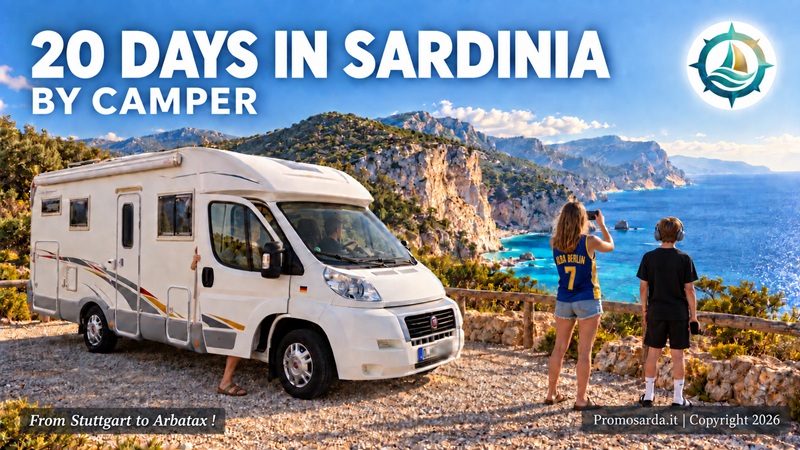
June 3–22, 2026. Two adults, two children, one ageing Rimor, and considerably more fried fish than originally planned.
Slowly Arriving
Before Sardinia: what I packed, and what Emilia would have preferred
My name is Anton. We live near Stuttgart, and I keep a notebook in the door pocket of our motorhome.
It contains mileage, fuel consumption, campsite addresses and measurements that nobody else in my family considers interesting. My wife, Emilia, once found a drawing showing how I intended to reorganise the storage compartment.
“You have designed a bedroom for the folding chairs,” she said.
The motorhome is a 2014 Rimor Europeo 87P on a Fiat Ducato chassis, with the 2.3-litre, 130 hp diesel engine. It is old enough to have acquired a personality, but still young enough that I regularly explain why replacing it would be unnecessary.
Before this journey, I had updated the electrical system with professionally installed solar panels, additional battery capacity and a suitable inverter. Karl, our twelve-year-old, had influenced the specification. His contribution to the route planning was minimal; his contribution to the requirements for the 32-inch television and PlayStation 5 was extensive.
Britta, eighteen, wanted swimming, walking and somewhere to charge her phone for photographs. She rarely looked at the screen otherwise.
Emilia wanted comfortable bathrooms, good wine and occasional freedom from making beds in a vehicle.
We agreed on organised campsites throughout, a full week in Arbatax and one proper hotel night. I booked the hotel before leaving Germany. This was probably my most useful preparation.
The practical equipment included a serviceable spare wheel, compressor, tyre-pressure gauge, warning equipment, first-aid kit, drinking-water hose, electrical adapters and tools. We checked the loaded weight before departure. Once four people, water, outdoor furniture and my supposedly essential equipment were aboard, some things stayed at home.
We drove from Stuttgart to Genoa and took the overnight ferry to Olbia with the camper and a four-berth cabin. The sea crossing gave us something the motorway could not: a definite moment when ordinary life stopped. The Genoa–Olbia route is offered by Moby.
My accounts below use €2 per litre of diesel and an estimated island average of 12 litres per 100 kilometres. Distances are rounded route estimates. Fuel is allocated to the day it is consumed, even when we fill the tank on another day.
Food bought in supermarkets is similarly allocated to the meals we eat. Otherwise, shopping day looks extravagant and the next three breakfasts appear miraculously free.
Day 1 – Wednesday, June 3
Olbia to La Maddalena: the first swim
We ate breakfast on the ferry: cappuccinos for us, pastries for everyone and a juice Karl finished before we had found a table.
On the vehicle deck, I checked the navigation while Emilia checked whether we had left anything in the cabin. Britta was already photographing the light coming through the open bow.
We drove north towards Palau. I resisted the temptation to begin sightseeing immediately. After a crossing, even one with a cabin, the sensible first objective is somewhere to park, eat and recover.
At Palau, we boarded the short ferry to La Maddalena with the motorhome. Taking the camper across made sense for our two-night stay; it also meant we could settle once rather than organise two separate excursions from the mainland. Delcomar operates the Palau–La Maddalena connection.
Our base was Camping Maddalena. Once parked, I connected the electricity and checked the levelling. Emilia opened the windows, then asked why “settling in” always seemed to give her the bedding while I received the interesting cables.
Lunch was beneath the awning: bread, tomatoes, pecorino, fruit and cold water. Nobody wanted a restaurant yet.
In the afternoon, we walked down for our first swim. Britta went straight in. Karl approached the water in stages, announcing the temperature at each one.
Emilia applied sunscreen to his shoulders and reminded me that a cooling breeze does not cancel the sun.
Later, we wandered into La Maddalena town, looking at the waterfront and the small streets behind it. We bought ice creams and returned before everyone became overtired.
I cooked pasta with courgettes and a little bottarga for dinner. Emilia opened our first bottle of Vermentino.
What stayed with me was the silence after we put the plates away: distant voices, cutlery from another pitch, the occasional scooter. We had been on the island for only a few hours, but Stuttgart already felt pleasantly distant.
daily report — four people: 50 km; 6 litres; diesel €12. Camping €60. Food €102: breakfast €18, lunch €26, dinner €42, coffees and ice creams €16. Local ferry allowance €60. Attractions €0; extras €0; road tolls €0. Day total: €234.
Day 2 – Thursday, June 4
Caprera: Garibaldi, pine trees and a very good sandwich
Breakfast took longer than expected because our neighbours were German.
They were from near Ulm, travelling in a considerably newer motorhome. Within five minutes, the conversation had moved from the weather to battery capacity.
Emilia eventually put my coffee beside the two vehicles.
“I thought you might be living here now.”
We left the camper at the campsite and used local transport to reach Caprera. This was a better decision than trying to accommodate a large vehicle wherever we felt like stopping.
Our main visit was the Compendio Garibaldino. The house and its surroundings made Garibaldi feel less like a name from a history book and more like someone who had chosen to live in this particular landscape.
Karl was interested in the practical objects. Britta kept looking through the trees towards the sea. Emilia appreciated the garden more than the military history.
Lunch was at I Mille, the sandwich stop on Caprera near the Garibaldi complex. We ordered substantial panini and cold drinks, then sat in the shade discussing which combination of local cheese and cured meat had been the best choice.
It was precisely the right lunch for the day: informal, filling and without another hour at a dining table. The business has a strong review record, with a score above the threshold we had used for our planning. I Mille, Caprera.
We spent the afternoon on a short walk and at the water rather than attempting to see all of Caprera. Britta would happily have continued. Karl had reached the stage where every uphill section required negotiation.
Back at camp, he had his agreed gaming hour while Emilia and I prepared dinner: salad, bread, grilled vegetables and sausages cooked on our permitted camping equipment.
Our neighbours joined us for a glass of wine. We compared routes, but the conversation eventually escaped the subject of motorhomes.
Their best advice was simple: leave some days unfinished.
daily report: camper parked; diesel €0. Camping €60. Food €130: breakfast €14, lunch €54, dinner €44, snacks and drinks €18. Museum admission allowance €20. Local transport €40. Extras €0; road tolls €0. Day total: €250.
Gallura, Granite and Everyday Negotiations
Day 3 – Friday, June 5
Arzachena and Porto Cervo: prehistoric stone, modern prices
We packed after breakfast, returned to Palau by ferry and continued towards Arzachena.
Our first stop was Nuraghe Albucciu, where we had checked access and parking before arriving. I was immediately interested in the relationship between the building and the rock around it. Karl wanted to know how people had moved the stones without machinery.
That question occupied him longer than I expected.
The visit gave the morning some substance before Porto Cervo, where the dominant questions were rather different: who owns that yacht, how much does it cost, and why does a shirt require such a serious window display?
We ate our packed lunch before walking into the centre. Bread, cheese and tomatoes taste perfectly respectable beside expensive boats, although Emilia suggested that I should avoid describing this as a financial victory.
Britta was photographing a reflection in a shop window when her sandal failed.
One strap on her old Birkenstocks finally gave up. She stood still, holding her foot at an angle, and looked at me as though I had personally scheduled the problem.
We found no suitable replacement immediately. Rather than buy an expensive pair she disliked, we rearranged the afternoon and continued towards San Teodoro, where we found a pair in her size at a footwear shop.
This added driving. I recorded it without comment.
By evening, we had reached Camping Village Tavolara, near Porto Taverna, our base for four nights. Its position suited our plans around Olbia, Punta Molara and the coast further south. Camping Village Tavolara.
Dinner was at the camper: tomato pasta, salad and melon. Britta placed her new sandals carefully beneath her chair.
My favourite moment had been the quiet around Albucciu. Emilia’s was seeing me pay for the replacement sandals without mentioning the fuel used to find them.
Anton’s account: 135 km; 16.2 litres; diesel €32.40. Camping €65. Food €110: breakfast €14, picnic €30, dinner €48, refreshments €18. Archaeological admission allowance €20. Return island ferry and parking €66. Birkenstocks €120. Road tolls €0. Day total: €413.40.
Day 4 – Saturday, June 6
Olbia: a town beyond the ferry terminal
At breakfast, Emilia announced that today she wanted lunch brought to the table.
I had no objection. We had eaten well at the camper, but there is a point at which washing another chopping board loses its charm.
We drove to Olbia and parked outside the tightest streets, walking into the centre. The morning belonged to San Simplicio, the streets around Corso Umberto and the pleasure of exploring a town without luggage or a boarding deadline.
Olbia felt more ordinary than Porto Cervo, which we liked. People were shopping, working, greeting neighbours and doing things unrelated to our holiday.
Britta photographed shutters, balconies and a bicycle leaning against a wall. Karl found a shop window containing electronics and briefly became our most patient pedestrian.
Lunch was at Il Gambero. Emilia ordered seafood and established that fried fish would be appearing regularly during the coming weeks. We shared starters, then chose a mixture of seafood pasta and fish dishes, with wine for Emilia and water for the driver.
The restaurant’s TheFork listing records a score of 9.1/10.
After lunch, Emilia ordered a cappuccino.
I mentioned that we had been told Italians generally preferred espresso after a meal.
“I am enjoying my holiday,” she said.
The cappuccino arrived without diplomatic consequences.
We returned to Porto Taverna in the afternoon and walked down to the beach. Tavolara stood across the water with the solid appearance of something that had no intention of moving for anyone.
Dinner was deliberately light: tomato salad, mozzarella, bread and fruit beneath the awning.
The town had surprised us. We had expected to use Olbia. Instead, we had enjoyed it.
daily report: 55 km; 6.6 litres; diesel €13.20. Camping €65. Food €218: breakfast €14, Il Gambero lunch €150, dinner €36, coffees and treats €18. Parking €8. Attractions €0; extras €0; road tolls €0. Day total: €304.20.
Day 5 – Sunday, June 7
Punta Molara: the knee incident
We left the motorhome parked and arranged a local transfer towards Punta Molara. I had no desire to discover the turning radius of a narrow coastal lane with an audience.
Breakfast was yoghurt, fruit, bread and coffee. Emilia packed sunscreen, water and a second packet of tissues. I packed the small first-aid kit.
Britta chose a short coastal walk, with time for photographs and a swim. She described it as easy.
For Britta, this meant that she would not need to run.
The landscape was beautiful in a more intimate way than the broad beach at Porto Taverna: granite, low vegetation, little openings towards the sea. We stopped often, partly for photographs and partly because Karl preferred to investigate things at walking speed.
His slip happened on a small uneven section.
There was no dramatic fall, just an awkward foot placement, a hand on the ground and one scraped knee. It hurt, and he was embarrassed that it had happened while following his sister.
We stopped in the shade, cleaned and dressed the scrape, and shortened the walk. Britta became unusually attentive, offering to carry his bag without making a joke.
Our picnic was eaten on towels: sandwiches, cucumber, fruit and water that was no longer particularly cold.
Back at camp, Karl rested while we replaced the used first-aid supplies. His account of the incident grew slightly more serious with each retelling.
Dinner was at La Tavernetta Ristorante at Porto Taverna, where Emilia returned to seafood and we enjoyed a more leisurely meal overlooking the coastal setting. We chose pasta, fish and vegetables rather than ordering an entire feast after our picnic. La Tavernetta Ristorante.
What I remembered most was Britta slowing down for her brother. The scenery was excellent, but that was the better part of the day.
daily report: camper parked; diesel €0. Camping €65. Food €218: breakfast €14, picnic €26, dinner €160, refreshments €18. Local transfers €45. Replacement first-aid supplies €12. Attractions €0; road tolls €0. Day total: €340.
Day 6 – Monday, June 8
Porto Ottiolu and Budoni: learning to leave the afternoon empty
I checked Karl’s knee before breakfast. He asked whether an injury entitled him to additional PlayStation time.
The medical evidence did not support his claim.
We drove south to Porto Ottiolu, parked where there was room to manoeuvre and walked around the harbour. Britta photographed ropes, boats and the changing colours in the water. Emilia looked at restaurant menus despite having eaten breakfast less than two hours earlier.
We continued towards Budoni, where the plan was simply a beach and a picnic.
This turned out to be one of our better plans.
We carried bread, cheese, tomatoes, fruit and enough water. Emilia insisted on another application of sunscreen before anyone entered the sea. Karl objected until she showed him the pink line appearing above his T-shirt sleeve.
Britta swam, walked along the shore and returned with photographs of almost identical waves that were, she explained, completely different.
I read six pages of a book. Then I watched people for considerably longer.
There was no excursion to catch and no attraction we would regret missing at four o’clock. We stayed until the light softened and the children became hungry.
After returning to camp and showering, we went back to La Tavernetta. We had enjoyed it, knew how to get there and did not feel obliged to test a new restaurant every evening.
Emilia ordered fried seafood again. Karl chose pasta. I asked for a local dish I had not tried, and Britta negotiated a shared dessert before we had finished the main course.
Back at the camper, I entered the mileage.
Emilia asked what I had written under “activities”.
“Beach.”
“That is enough.”
daily report: 75 km; 9 litres; diesel €18. Camping €65. Food €211: breakfast €14, picnic €32, dinner €145, coffees and ice creams €20. Parking €8. Attractions €0; extras €0; road tolls €0. Day total: €302.
Orosei and the Long Road South
Day 7 – Tuesday, June 9
Cala Ginepro: arriving before we were tired
Moving day began with a familiar division of labour, which we were gradually improving.
I dealt with the outside equipment. Britta and Karl secured loose objects. Emilia supervised the kitchen, then reminded everyone that supervision did not mean she intended to clean everything herself.
We drove south to Camping Cala Ginepro, near Orosei, and arrived with enough of the day remaining to enjoy the place.
The campsite’s trees and access to the coastal landscape were the attraction. We had chosen it for a comfortable camping stay, not because we expected hotel service. Camping Cala Ginepro.
Once settled, we ate lunch beneath the awning: bread, a chickpea salad, cheese and peaches. Britta cut the vegetables. Karl discovered that drying plates takes longer when you try to do it with one hand while holding a device in the other.
In the afternoon, we walked to the beach.
The shallow water, pale sand and darker rocks made this feel different from our previous stops. We did not need to drive somewhere else to improve it.
A German couple nearby recognised our number plate and asked how the journey had been. They were travelling more slowly, staying a week wherever they felt comfortable.
I found this admirable and slightly threatening to my itinerary.
Dinner was cooked at camp: malloreddus with tomato sauce and grated pecorino, followed by fruit. Emilia opened a bottle of wine while I washed up.
Later, the children sat outside together. Karl showed Britta something on his screen; she showed him a photograph he had accidentally walked into.
For a few minutes, neither seemed irritated by the other.
I left them to it.
daily report: 65 km; 7.8 litres; diesel €15.60. Camping €65. Food €110: breakfast €14, lunch €30, dinner €48, refreshments €18. Attractions €0; other transport €0; extras €0; road tolls €0. Day total: €190.60.
Day 8 – Wednesday, June 10
Orosei: the wrong street and the spare wheel
I had looked at the map.
Unfortunately, looking at a map does not make a motorhome narrower.
On the approach to our parking place in Orosei, I followed a turn that would have been unremarkable in a car. In the Rimor, it became a slow exercise involving walls, mirrors and a kerb I judged badly.
The tyre struck the edge.
We stopped at the first safe place. The damage was to the sidewall, and the tyre was losing pressure. This was not a job for a bottle of sealant.
I had the spare and the equipment, but with the vehicle loaded and the available space poor, I called for tyre assistance rather than attempt an awkward roadside lift. Having the correct spare made the situation much simpler.
Emilia took the children for a short walk while I dealt with the practicalities. She returned with water and no immediate criticism, which I appreciated.
We reached Trattoria Moderna da Pupo later than planned. Lunch became our reset: seafood pasta, a Sardinian pasta dish to share, cold drinks and enough time to stop discussing the kerb.
The restaurant has a 4.2/5 Tripadvisor rating and serves both seafood and Sardinian dishes. Trattoria Moderna da Pupo.
Afterwards, we explored Orosei on foot: Piazza del Popolo, the exterior of San Giacomo, shaded streets and quiet corners that deserved more attention than we had initially given them.
A replacement tyre was arranged locally so that we would not continue the holiday without a usable spare.
Dinner was simple at camp: an omelette, salad and bread.
I wrote the extra cost in the notebook.
Below it, in smaller letters: Never follow the shortest route into an old town without checking the width.
daily report: 30 km; 3.6 litres; diesel €7.20. Camping €65. Food €208: breakfast €14, lunch €140, dinner €38, refreshments €16. Parking €8. Tyre, fitting and assistance allowance €260. Attractions €0; road tolls €0. Day total: €548.20.
Day 9 – Thursday, June 11
Orosei to Muravera and Costa Rei: a proper driving day
We started early, with coffee made before the children emerged.
Today was the longest planned transfer of the holiday. Rather than force the large camper along every scenic section of the old coastal route, we used the inland approach through the Nuoro area and continued south towards Ogliastra, Muravera and Costa Rei.
It still required patience.
We stopped properly for lunch, parking in a suitable place and eating the sandwiches Emilia and Britta had prepared. Karl complained about another driving day, then became absorbed in a downloaded game.
Britta asked me to stop when she saw animals near a field. I continued until there was a safe place to pull off. She accepted the short walk back and returned with photographs of goats looking considerably less impressed by Sardinia than we were.
At Muravera, we stretched our legs and had a brief walk through town. It was a modest visit rather than an attempt to exhaust the area in one afternoon.
We continued to Camping Capo Ferrato, our overnight base at Costa Rei.
After setting up, the beach was all we wanted. Emilia stood in the water for a long time without speaking. Then she reminded me that tomorrow was the hotel.
Dinner was at Ristorante Guido, inside the campsite. Its location made the evening wonderfully uncomplicated: we could enjoy the meal without driving again. Emilia chose seafood; the rest of us ordered a mixture of fish and pasta, with vegetables and a shared dessert. Ristorante Guido.
We walked back beneath a darkening sky.
The day had involved more road than romance, but ending it with a swim and a good dinner made the distance feel worthwhile.
Anton’s account: 245 km; 29.4 litres; diesel €58.80. Camping €70. Food €219: breakfast €14, picnic €32, dinner €155, refreshments €18. Attractions €0; other transport €0; extras €0; road tolls €0. Day total: €347.80.
Emilia’s Hotel and Our Arrival in Arbatax
Day 10 – Friday, June 12
Villasimius: the day Emilia stopped tidying
Breakfast at the camper was unusually cheerful.
Emilia packed a small overnight bag and left the rest of her belongings exactly where they were.
“For twenty-four hours,” she said, “someone else can arrange the cushions.”
We drove south to Almar Timi Ama in Villasimius. This was our deliberate extension of the Muravera and Costa Rei stage: a five-star stay with a substantial spa offering and accommodation suitable for the whole family.
I had arranged the room configuration and motorhome parking in advance. A large vehicle and a spontaneous luxury-hotel arrival are not always a harmonious combination.
The resort’s Almablu Thalasso & Spa was the main reason for choosing it. Emilia’s gift included a reserved spa experience, a full-body massage and a facial, booked as separate treatments rather than assumed to be included in the room. Almar Timi Ama.
Lunch was at the hotel, with a table, proper glasses and nobody searching for the salt in an overhead cupboard. We ordered salads, seafood and something more substantial for Karl, who appeared to be growing during the meal.
While Emilia went to the spa, Britta headed for the beach and Karl alternated between swimming and reading messages in the shade. I sat down without a task.
It took some adjustment.
Emilia returned looking deeply content and smelling faintly of products more sophisticated than our camper shower gel.
Dinner was another hotel meal, taken slowly. She wore a dress that had spent nine days waiting patiently in a cupboard. We chose fish, wine and desserts, and stayed at the table after the children had finished.
The best luxury was not the room size or the towels.
It was that Emilia did not have to remember anything for anyone else that evening.
daily report: 35 km; 4.2 litres; diesel €8.40. Hotel accommodation allowance for four, including the following breakfast, €900. Food €376: breakfast €16, hotel lunch €120, dinner €220, refreshments €20. Spa and treatments €330. Other transport €0; attractions €0; road tolls €0. Day total: €1,614.40.
Day 11 – Saturday, June 13
Arbatax: a small hesitation, then a village celebration
Nobody hurried at breakfast.
Karl approached the buffet methodically. Britta returned with fruit and enough bread to suggest she had been swimming competitively. Emilia ordered another coffee.
We eventually retrieved the camper and began the drive north towards Arbatax.
On two occasions, under acceleration, the engine hesitated briefly. The first was so slight that I wondered whether I had imagined it. The second was clear enough to notice, but it disappeared immediately.
There was no persistent loss of power. I checked what I could at our next stop and noted the symptoms. At that stage, I did not know the fuel pump was beginning to fail.
We arrived at Camping Telis, our home for seven nights.
For our requirements, it was the strongest match: an organised campsite in Arbatax, with a terraced setting, beach access and facilities that allowed us to leave the camper parked for a week. Its appeal was comfortable outdoor living; the slopes and pitch access were reasons to arrange a suitable space in advance. Camping Telis.
Lunch was bread, salad, cheese and fruit after setting up. We then did very little until evening.
Our arrival coincided with the Santa Lucia celebrations in Tortolì, held on June 13–14, 2026. We took a taxi into town after an early supper at camp, joining the evening atmosphere around the festivities. The dates and programme were reported locally. Santa Lucia celebrations in Tortolì.
Children moved between groups of adults; people greeted one another across the square. We listened, watched and bought something sweet.
For once, we had arrived somewhere without the place needing to perform specifically for visitors.
daily report: 145 km; 17.4 litres; diesel €34.80. Camping €75. Food €104: breakfast included, lunch €34, early dinner €40, festival refreshments €30. Return taxi allowance €50. Festival admission €0; extras €0; road tolls €0. Day total: €263.80.
The Week We Finally Stayed Still
Day 12 – Sunday, June 14
Porto Frailis and San Gemiliano: finding our local rhythm
At half past seven, I was awake and considering whether to reorganise the outside storage.
Emilia suggested coffee instead.
We ate bread, eggs, yoghurt and fruit beneath the awning. The children appeared gradually. There was no departure time to enforce, and the change in everyone’s mood was noticeable.
We spent the morning around Porto Frailis, swimming and learning the small practical geography of our temporary neighbourhood: where to walk, where to buy something cold, which route back involved the least unnecessary climbing.
Later, we took a short outing towards San Gemiliano, looking at the tower from outside and enjoying the coastal views. Britta would have explored further, but Karl’s knee was still healing, and nobody needed to prove anything.
Lunch was at the camper: tuna and bean salad, bread and tomatoes.
In the afternoon, Emilia read. Karl played for a while, then came outside to ask whether anyone wanted to swim again. Britta was already ready.
Dinner was at Acquolina Ristorante Pizzeria, a relaxed choice around Porto Frailis with a review score comfortably above our minimum. We ordered a mixture of pizza and seafood dishes, giving Karl a break from our enthusiasm for regional pasta. Acquolina.
Emilia had a glass of wine. I did too, because the camper was staying exactly where it was.
On the walk back, Karl said that staying in one place was better than expected.
I agreed, although I did not tell him how many possible excursions remained in my notebook.
daily report: camper parked; diesel €0. Camping €75. Food €199: breakfast €16, lunch €30, dinner €135, coffees and ice creams €18. Local transport €25. Attractions €0; extras €0; road tolls €0. Day total: €299.
Day 13 – Monday, June 15
The Gulf of Orosei by boat: a day worth planning around
We had booked our boat excursion with Helios Turismo, choosing the smaller Helios Quinto option for a more intimate day on the water.
The operator describes Quinto as a wooden vessel carrying up to twelve passengers. That suited us better than a much larger group, and we accepted the higher cost. Helios Turismo.
Breakfast was early and simple. Emilia checked sunscreen and hats. I checked the booking. Britta checked the camera lens on her phone. Karl checked whether the boat had a toilet.
These were all reasonable priorities.
A transfer took us to the departure point. Once underway, the coastline began to explain why people spoke about the Gulf of Orosei with such intensity.
Cliffs rose from the sea with very little suggestion that roads or towns might exist behind them. The colour of the water changed with depth and light.
Our swimming and beach stops included Cala Mariolu and Cala Biriala, following the skipper’s decisions and the conditions that day. We treated the itinerary as a boat trip, not a promise that the sea would deliver every photograph from the brochure.
Britta was in her element. Karl became more confident after the first swim and needed less encouragement at each stop.
Lunch was provided aboard and is included in the excursion cost below. We ate what was served, drank water and sat looking at the coast rather than at our phones.
By late afternoon, everyone was pleasantly tired.
Dinner at the camper was an intentionally undemanding meal of pasta, tomatoes and fruit. Nobody wanted to dress for a restaurant.
I had taken fewer photographs than Britta. I had also spent more time simply looking.
For me, this was the most spectacular day of the holiday.
daily report: camper parked; diesel €0. Camping €75. Food outside the excursion €70: breakfast €16, lunch included aboard, dinner €38, refreshments €16. Boat excursion allowance for four €440. Transfers €40. Extras €0; road tolls €0. Day total: €625.
Day 14 – Tuesday, June 16
Rocce Rosse: the colour we had not expected
After yesterday’s blue, today was red.
We had a late breakfast, hung wet towels properly and took our time getting out. A boat excursion produces a surprising quantity of damp possessions.
Our destination was Rocce Rosse in Arbatax.
The rocks had appeared in photographs during our planning, but their colour and position made more sense in person. They were not isolated in some inaccessible wilderness. The working town and harbour were nearby, which gave the scene a character we liked.
Britta spent a long time looking for an angle without other visitors. Karl found a place to sit and became an unwilling model.
We stayed on safe, accessible ground. After the scraped knee, neither child needed encouragement to demonstrate rock-climbing ability.
Lunch was at La Capannina. Emilia ordered fried seafood with the satisfaction of someone continuing a carefully maintained research project.
We shared starters, then ate fish and pasta, with water, wine and coffee. The restaurant’s coastal setting made a long lunch feel justified. La Capannina, Arbatax.
Afterwards, we walked a little around Arbatax rather than immediately returning to camp.
Fishing equipment, ordinary buildings and the harbour reminded us that this was a place where people worked, not simply somewhere arranged around beaches.
The afternoon ended with swimming. Dinner was salad, bread and an omelette at the camper.
When I asked the children what had impressed them most, Britta said the red against the sea. Karl said lunch had been better than expected.
Both answers seemed fair.
daily report: camper parked; diesel €0. Camping €75. Food €229: breakfast €16, lunch €155, dinner €38, refreshments €20. Local transport €30. Attractions €0; extras €0; road tolls €0. Day total: €334.
Laundry, Wine and the Last Easy Days
Day 15 – Wednesday, June 17
The washing-machine day, with an excellent dinner
A twenty-day camper holiday cannot consist entirely of swimming coves and sunset wine.
Eventually, somebody must wash the socks.
We ate breakfast, sorted laundry and established a clear division of work. I took the washing. Britta cleaned the table and prepared lunch ingredients. Karl shook sand from things that had supposedly never been near the beach.
Emilia sat down with her book.
She looked pleased.
At the laundry area, I met another German motorhome owner. We discussed routes, tyre pressures and the importance of booking pitches suitable for longer vehicles. I mentioned the tyre incident. He told me about reversing into a low branch in France.
This was reassuring without being useful.
Lunch was a rice salad at camp, with vegetables, cheese and fruit. We spent the hottest part of the afternoon in the shade, then went swimming.
That evening, we took a taxi to Ristorante Arbatasar.
We had reserved it as one of our more considered dinners: a chance to explore Sardinian cooking with the attention and service that a relaxed evening allows. The hotel and restaurant present a strong connection to local ingredients and island cuisine. Arbatasar.
We chose dishes across the menu rather than all ordering the same fish. Emilia asked about the wines, and the conversation became part of the meal.
Karl surprised us by trying something he had initially rejected on the basis of its description. Britta made him admit that it was good.
We returned to clean bedding.
Emilia said the evening had been excellent. Then she added that clean bedding was even better when she had not been responsible for it.
daily report: camper parked; diesel €0. Camping €75. Food €286: breakfast €16, lunch €32, dinner €220, refreshments €18. Taxis €30. Laundry, drying and detergent allowance €10. Attractions €0; road tolls €0. Day total: €401.
Day 16 – Thursday, June 18
Tenute Gebelias: Emilia’s kind of excursion
We began with a swim and breakfast at camp.
Today’s excursion was inland, to Tenute Gebelias near Bari Sardo, where we had arranged a family visit and wine tasting in advance.
We booked a return transfer. Emilia wanted me to take part properly, and I wanted to enjoy the afternoon without calculating when I would next be driving.
The estate offers tasting experiences around its vineyards and wines. We confirmed the arrangements for Karl beforehand, including a non-alcoholic option, rather than assuming a standard adult tasting would suit all four of us. Tenute Gebelias visits and tastings.
Lunch was a light meal at the camper before leaving: bread, salad and a little cheese. We did not want to arrive either hungry or too full.
Emilia asked the most questions at the winery. She was interested in the differences between the wines, the food pairings and how much the local conditions shaped what was in the glass.
Britta photographed the vines and tasted selectively. Karl listened for a while, then became interested in the practical side of making and storing the wine.
I enjoyed hearing someone discuss equipment with as much enthusiasm as I normally reserve for the camper.
We bought bottles to take home. These appear under extras in the accounts, rather than being counted again as food consumed during the trip.
Dinner was at camp: vegetables, bread, cheese and pasta, assembled without much effort.
Emilia examined the labels on our purchases once more.
For her, the day had given the holiday something beyond scenery: names, people and wines that would still mean something when opened in Stuttgart.
daily report: camper parked; diesel €0. Camping €75. Food €106: breakfast €16, lunch €30, dinner €42, refreshments €18. Family winery-visit allowance €120. Return private transfer €100. Wine to take home €60. Road tolls €0. Day total: €461.
Day 17 – Friday, June 19
Our last full day at Telis
I woke early and began thinking about departure.
Then I deliberately left the notebook closed.
We ate breakfast slowly. By now, we knew the sounds around our pitch: someone moving a chair, the next family preparing coffee, footsteps passing towards the facilities.
Britta went for an early swim. Karl joined her later, without being asked.
Emilia and I stayed beneath the awning. She said this week had changed her opinion of the trip.
She still preferred hotel bathrooms. She still disliked making beds in restricted spaces. But staying in one place, sharing the work and going out for proper meals had made the camper feel less like an additional household assignment.
I accepted this as useful information.
Lunch was a picnic-style meal at camp, with the remaining salad ingredients, bread and local cheese. In the afternoon, we swam again and began packing only the things we would not need overnight.
I checked the tyres, secured outside equipment and looked over the vehicle. The engine started normally. The earlier hesitation had not repeated while the camper stood parked, which of course proved very little.
We returned to Acquolina for our last Arbatax dinner. Karl chose a familiar favourite. Emilia ordered seafood, and we shared dessert.
Back at camp, we said goodbye to neighbours we had come to recognise. One German couple was staying another week.
For the first time, I envied their schedule without immediately calculating how ours might be adjusted.
Seven nights had felt generous when I booked them.
Now they felt exactly right.
daily report: camper parked; diesel €0. Camping €75. Food €211: breakfast €16, lunch €32, dinner €145, refreshments €18. Attractions €0; other transport €0; extras €0; road tolls €0. Day total: €286.
Lanusei, Trouble and the Harbour at Last
Day 18 – Saturday, June 20
Lanusei: family lunch, ancient tombs and a difficult road north
We left Telis after breakfast and drove towards Lanusei, where a relative was expecting us.
As the road climbed, the engine hesitated again.
This time, there was no question. Under load, the power would disappear briefly, then return. The sensation was unsettling: not a complete stop, but enough uncertainty to make every acceleration something I noticed.
We reached our relative’s house and parked.
The welcome was immediate and generous. There was coffee, water and the familiar insistence that we must be hungry.
Using our relative’s car, we visited the Seleni archaeological area, associated with the Gennacili complex and its Giants’ Tombs. A guided visit helped us understand structures we might otherwise have reduced to “very old stones”. The wooded setting was a welcome change from the coast. Seleni archaeological visits.
Lunch was at the house: pasta, vegetables, bread, cheese and more food than our host considered sufficient. Emilia enjoyed a glass of wine. I stayed with water.
The children listened to family stories and looked at old photographs. Britta found one of me that she intends to keep indefinitely.
Before continuing, I sought mechanical advice about the symptoms. The plan became a cautious journey towards Olbia on the main route, with assistance available if the behaviour worsened.
It was an unpleasant drive.
The hills around Lanusei exposed the problem most clearly. I left large margins, avoided forcing overtakes and stopped where it was safe when I needed to reassess. We abandoned any thought of additional sightseeing.
The engine kept running, but the repeated gaps in power made the journey tiring in a way that ordinary distance does not.
We eventually reached our booked campsite near Porto Taverna, south of Olbia. Dinner was cooked quietly: pasta, salad and little conversation.
I was relieved to be there. I was also annoyed with myself for not having resolved the earlier warning signs.
daily report: 250 km; estimated 30 litres; diesel €60. Camping €65. Food €76: breakfast €16, family-hosted lunch €0, dinner €42, refreshments €18. Seleni guided-visit allowance €25. Gift for our hosts €35. Other transport €0; road tolls €0. Day total: €261.
Day 19 – Sunday, June 21
Olbia: the mechanic who gave us our holiday back
Sunday was an inconvenient day to need a diesel specialist.
Through local contacts and assistance arrangements, we secured an exceptional appointment with an independent mechanic in Olbia. This was not ordinary Sunday opening, and I would never advise planning a ferry journey around the assumption that such help will always appear.
Breakfast was brief.
At the workshop, I described the symptoms in order: the two earlier hesitations before Arbatax, the increased frequency around Lanusei and the repeated loss of response under load.
The mechanic tested rather than guessed.
In our case, the problem was traced to the low-pressure diesel supply pump. Its failing delivery explained the interruptions when the engine demanded more fuel. This was not a complete high-pressure injection-system replacement, and the bill below should not be read as a general price for every Ducato fuel fault.
The family left me with the vehicle and went into Olbia. I joined them once the work was underway.
We ate lunch at Il Gambero, returning to somewhere we already knew. Emilia ordered fried fish again.
I was not inclined to comment.
We walked afterwards, bought cold drinks and sat in the shade. Karl asked whether the PlayStation would still work if the engine did not.
It was a technically separate question, but not one I wished to explore.
Later, the replacement and checks were completed. The road test mattered more to me than the explanation: steady acceleration, no sudden hesitation, no feeling that the power might disappear.
The relief was physical. My shoulders dropped.
We returned to camp and ate a simple dinner. I packed the ferry documents, checked the departure arrangements and finally wrote the repair cost in the notebook.
An expensive day. A very good outcome.
daily report: 65 km, including workshop movements and testing; estimated 7.8 litres; diesel €15.60. Camping €65. Food €222: breakfast €16, lunch €150, dinner €38, refreshments €18. Local taxis €45. Diagnostic work, pump replacement, exceptional attendance and testing allowance €780. Attractions €0; road tolls €0. Day total: €1,127.60.
Day 20 – Monday, June 22
Olbia: no last-minute adventures
I started the engine before breakfast.
It ran normally.
Emilia watched me listening to it.
“Are we allowed to eat now?”
We used the morning for the ordinary jobs that make departure easier: emptying and filling where appropriate, cleaning the fridge, securing loose items and checking every cupboard.
Karl packed the gaming equipment properly. Britta found a surprising quantity of sand in a bag that had supposedly contained only clean clothes.
Breakfast was bread, yoghurt, fruit and the last of our preferred coffee.
We took one final walk by the water. Nobody asked for a major outing. The previous two days had used our appetite for uncertainty.
Lunch was at the camper before leaving: a generous salad, bread, cheese and the remaining fruit. Emilia insisted that “using things up” did not mean eating an unpleasant combination simply to avoid carrying it onto the ferry.
We drove to Olbia with a generous margin before check-in.
The camper behaved exactly as it should. I noticed every smooth acceleration.
At the port, the children compared their favourite photographs. Britta had hundreds. Karl had fewer, but his included several unexpectedly good images from the boat trip.
Once aboard and settled into our cabin, we had dinner in the ferry restaurant. It was more expensive than eating at camp, less memorable than our best Sardinian meals and extremely welcome.
As we left, Emilia asked whether I would bring the Rimor back.
“Yes,” I said.
She considered this.
“Then next time, two hotel nights.”
I wrote nothing in the notebook until she had gone to the cabin.
Then I added: Reasonable.
daily report: 25 km; 3 litres; diesel €6. No further Sardinian accommodation charge. Food €162: breakfast €16, lunch €38, ferry dinner €90, refreshments €18. Attractions €0; other local transport €0; extras €0; road tolls €0. Day total: €168.
The overnight ferry and cabin are included separately in the return-journey budget below.
What the Journey Actually Cost
Twenty days, with the small expenses left in
I enjoy keeping accounts. I do not enjoy pretending a holiday cost less than it did.
A campsite pitch is only part of a camping holiday. There are restaurant meals, boat trips, parking, laundry, ice creams and the occasional tyre that meets a kerb.
Our island diary included eighteen campsite nights and one hotel night. The twentieth evening ended aboard the return ferry.
All figures below are the planning estimates used consistently throughout this reconstructed logbook. Restaurant totals include our allowance for drinks and cover charges. Camping allowances cover the family and vehicle, electricity and an allowance for applicable local charges.
| Category | Twenty-day total |
|---|---|
| Diesel in Sardinia: 1,175 km, 141 litres at €2 | €282.00 |
| Eighteen campsite nights | €1,235.00 |
| One luxury hotel night for four, including breakfast | €900.00 |
| Food, restaurant drinks, coffees and snacks | €3,567.00 |
| Admissions, guided visit, boat excursion and winery experience | €625.00 |
| Local ferries, taxis, transfers and parking | €555.00 |
| Spa, shopping, laundry, gifts and repairs | €1,607.00 |
| Sardinian road tolls | €0.00 |
| Total for the twenty-day diary | €8,771.00 |
The €1,607 in extras deserves explanation. It contains €330 for Emilia’s spa treatments, €120 for Britta’s sandals, €12 for first-aid supplies, €260 for the tyre incident, €10 for laundry, €60 for wine to bring home, €35 for our hosts’ gift and €780 for the fuel-pump repair.
The tyre and pump together added €1,040.
The boat lunch sits inside the excursion cost. The hotel breakfast sits inside the room allowance. The wine brought home sits under shopping. None is counted twice.
Stuttgart–Genoa and the sea crossings
For the mainland journey, I have allowed approximately 660 kilometres each way, using a route through Switzerland and northern Italy.
At an estimated 11.5 litres per 100 kilometres, that means:
| Additional journey cost | Allowance |
|---|---|
| Mainland diesel: 1,320 km, 151.8 litres at €2 | €303.60 |
| Italian motorway tolls, both directions | €50.00 |
| Genoa–Olbia return ferry, camper and four-berth cabin | €1,200.00 |
| Additional mainland travel meals | €160.00 |
| Swiss annual motorway vignette | CHF40 |
The Swiss vignette calculation assumes a vehicle with a registered maximum authorised weight no greater than 3.5 tonnes. A heavier registration requires a different calculation. The same annual vignette covers both crossings. Swiss customs: motorway vignette.
The Italian toll figure is a route allowance, not a reproduced receipt. Motorway classification depends on the vehicle’s characteristics; two-axle vehicles are distinguished partly by height over the front axle. Autostrade vehicle classes.
The ferry allowance is likewise a planning figure. Vehicle dimensions, sailing dates, cabin choice and booking conditions can change it substantially.
Estimated complete family journey: €10,484.60, plus CHF40.
Across the whole road journey, the fuel calculation is:
2,495 kilometres → 292.8 litres → €585.60 in diesel.
We could have spent less. More cooking, fewer taxis and a simpler hotel would have reduced the total considerably.
But the point of bringing the camper was freedom and comfort on our own terms. It did not require us to reject a good restaurant, a smaller boat excursion or an afternoon that made Emilia very happy.
The Sardinia that stayed with us
When I look through the notebook, the expensive days are easy to find.
The more important days are harder to distinguish by their totals.
There was Britta slowing down after Karl scraped his knee. There was Emilia drinking a lunchtime cappuccino without concern for anyone’s opinion. There were conversations beneath awnings, a family table in Lanusei and a mechanic patiently testing a problem that had occupied my thoughts for two days.
We remember the enormous shape of Tavolara, the water beneath the cliffs of the Gulf of Orosei and the red rocks at Arbatax.
We also remember tomatoes cut on a small camping board, damp towels that refused to dry in the shade, and the pleasure of returning to the same pitch for seven evenings.
The Rimor brought us home.
A few days later, I began a list of improvements for the next journey.
Emilia looked over my shoulder.
At the top, before anything electrical, I had written:
Two hotel nights.