Bosa: Deep Dive and Comprehensive Guide
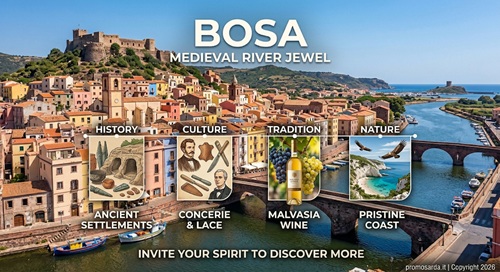
Situated along the western coast of Sardinia where the Temo River empties into the Mediterranean, Bosa is celebrated as the island’s only true river city. Framed by dramatic, volcanic hills and dominated from above by the medieval Serravalle Castle, Bosa balances a picturesque historic quarter, deep-seated maritime and agricultural traditions, and a pristine coastline featuring vibrant, multi-hued coves.
The Historic Region of Planargia
Bosa serves as the primary urban center of Planargia, a fertile, volcanic plateau extending from the Marghine range down to the sea, sandwiched between the regions of Villanova to the north and Montiferru to the south. The region’s name derives from its gently undulating, plateau-like topography.
Administered within the Province of Oristano, Planargia encompasses ten municipalities: Bosa, Flussio, Magomadas, Modolo, Montresta, Sagama, Sindia, Suni, Tinnura, and Tresnuraghes. Favored by a mild year-round climate and mineral-rich volcanic soils, the region is internationally renowned for its viticulture, most notably the production of Malvasia di Bosa DOC.
The Municipality of Bosa
Standing at an elevation of just 2 meters above sea level at its riverfront, Bosa counts 7,465 inhabitants (as of December 31, 2021). The municipal territory is classified as hilly, featuring steep altimetric variations, dense olive groves, and the winding course of the Temo River.
Prestigious Designations
-
I Borghi più belli d’Italia: Bosa is officially recognized among the most beautiful villages in Italy (alongside Atzara, Carloforte, Castelsardo, Posada, and Sadali in Sardinia) for preserving its artistic, historical, and environmental heritage.
-
Città dell’Olio: A member of the national association dedicated to protecting olive culture, safeguarding the agricultural landscape, and promoting quality olive oil.
-
Città del Vino: Part of the network supporting sustainable viticultural development, local gastronomy, and wine tourism.
Etymology
The name Bosa is of pre-Latin origin, historically recorded in ancient forms such as Bessenses and Bosanenses. While its exact linguistic root remains unclear, Phoenician and pre-Roman influences are widely posited.
Historical Overview
-
Antiquity: Human presence dates to pre-nuragic and nuragic epochs, as evidenced by local hypogea and nuraghi. According to myth, the city was founded by Clamedia, daughter or wife of Sardus Pater. Historically, Bosa was established as a Phoenician settlement—attested by a 9th-century BC inscription—and expanded into a flourishing Punic-Roman port.
-
Medieval & Feudal Eras: Under the Giudicato of Logudoro, Bosa belonged to the curatoria of Planargia. After coastline raids forced inland retreats, the noble Tuscan Malaspina family built the Serravalle Castle on the hilltop in 1112. The town later passed to the Giudicato of Arborea and eventually to the Crown of Aragon.
-
Royal City Status: In 1499, King Ferdinand II elevated Bosa to the status of Città Regia (Royal City). Direct royal jurisdiction freed Bosa from feudal subjugation, allowing self-governance via elected councilors and representation in the Sardinian Parliament.
-
Modern Era: In 1807, Bosa became a provincial capital. The 19th century brought an economic revival driven by leather tanning (concerie), viticulture, lace-making, and maritime trade. Key infrastructure followed, including the 1870 port, the 1871 stone triple-arched bridge across the Temo, and the 1887 public aqueduct.
Notable Historical Figures
-
Pietro Delitala: Renowned Renaissance poet of the Spanish era, remembered as the first Sardinian author to write poetry in Italian.
-
Giovanni Francesco Fara: Esteemed historian and Bishop of Bosa who authored seminal historical treatises on Sardinia.
-
Cavalier Giovanni Antonio Pischedda: Founder of Bosa’s historical Agricultural School.
-
Emilio Scherer (1845–1924): A celebrated painter born in Parma who trained in scenography and historical art under Domenico Morelli. Scherer settled in Bosa, becoming a pivotal figure in late 19th-century local culture and embellishing local churches with extensive artworks.
Festivals and Traditions
-
January 16–17: Festival of Saint Anthony the Abbot (Sant’Antoni de Pont), featuring the blessing of bread, traditional bonfires, and the official opening of the carnival season.
-
Carnival (Karrasegare ‘Osincu): A famous, highly satirical, and spontaneous carnival:
-
Gioggia Laldaggiolu: Masks collect food offerings (su laldaggiolu) while mocking onlookers.
-
Fat Tuesday (Martedì Grasso): Begins with S’Attittidu, where black-clad mourners (attittadoras) wail over the doll Gioldzi, asking for “a drop of milk” (tikkirigheddu de latte, metaphorically asking for Malvasia wine). At sunset, carnival participants dress in white (Giolzi), searching for the hiding carnival spirit with lanterns before burning giant effigies (Gioldzi a su Fogu).
-
-
Holy Week (Setmana Santa): Organized by the Holy Cross Confraternity. Features the Tuesday Procession of the Mysteries (Sos Misterios) accompanied by multi-voice Miserere and Stabat Mater chanting, Maundy Thursday altars of repose, and the Good Friday S’Iscravamentu (Deposition from the Cross).
-
May 28: Feast of the Patron Saints Emilio and Priamo.
-
First Sunday of August: Festival of Santa Maria del Mare, featuring a colorful procession of decorated boats along the Temo River.
-
Second Sunday of September: Festival of Nostra Signora de Regnos Altos, featuring neighborhood altars (altarittos) adorned with fine Filet lace and local flower displays.
Traditional Food and Wine Products
Bosa’s cuisine reflects a harmonious fusion of river, sea, and agricultural heritage.
-
Malvasia di Bosa DOC: The crown jewel of Planargia’s viticulture. Made almost exclusively from the Malvasia di Sardegna grape (minimum 95%), it yields an amber-gold wine with complex aromas of dried fruit, honey, and toasted almonds. Available in dry, sweet, and aged Riserva expressions.
-
Filet di Bosa: Though a textile craft rather than a food item, this intricate, handmade lace is an iconic cultural tradition produced on specialized net looms by local women.
-
S’Azzada (Agiada): A classic local sauce made with garlic, sun-dried tomatoes, chili pepper, and vinegar, traditional for seasoning fried dogfish or skate.
-
Fae a Landinu: A hearty, rustic winter stew made with fresh broad beans, dried pork cuts, wild fennel, and local olive oil.
-
Seafood and River Specialties: Bosa’s coastal and riverine setting brings rock lobster, sea urchins, fried smelt, and cured mullet roe (bottarga) to the table, alongside river eel dishes.
Exploring the Center of Bosa
The Temo Riverfront and Sa Costa
The town is built along the right bank of the Temo, dominated by the colorful medieval neighborhood of Sa Costa, where vibrant three-story houses scale the slopes toward the castle. Opposite Sa Costa, on the left bank, stand Sas Conzas—19th-century former leather tanneries designated as national monuments. Connecting both banks is the Ponte Vecchio (Ponte Nazionale), a triple-arched bridge crafted from red trachyte.
Key Landmarks in Town
-
Serravalle Castle (Castello Malaspina): Built atop Serravalle Hill beginning in 1112 by the Malaspina family. Encloses a 10,000 m² bailey with red trachyte towers. Inside stands the 14th-century Palatine Chapel of Santa Maria de Sos Regnos Altos, housing a rare cycle of 14th-century fresco paintings.
-
Concatedral de Santa Maria Immacolata: The town’s primary cathedral, rebuilt between 1805 and 1809 by Salvatore Are in late-baroque and neoclassical styles. The interior features rich marble altars, paintings by Emilio Scherer, and an unfinished 1683 bell tower.
-
Church of Nostra Signora del Carmelo: Built in 1779 alongside a former Carmelite convent, featuring a Rococo high altar.
-
Church of the Santa Croce: Seat of the ancient Holy Cross Confraternity, housing 19th-century frescoes by Emilio Scherer and the sacred processional statues of the Passion.
-
Church of Nostra Signora del Santo Rosario: Located along Corso Vittorio Emanuele II, featuring a late-baroque façade topped by a public clock installed in 1875.
-
Sas Conzas & Museum of Tanning (Museo delle Conce): Situated at Via Sas Conzas 62, this preserved 18th-century tannery exhibits original masonry curing vats and historical leather-processing machinery.
-
Piazza Costituzione & Fontana Umberto I: Known locally as Sa Fhuntana Manna, situated opposite the 18th-century fortified Palazzo Don Carlos.
-
Town Hall (Municipio): Located on Corso Giuseppe Garibaldi within the historic Puggioni Piga complex, constructed from local red volcanic stone.
Exploring the Surroundings and Coastline
Archaeological Sites & Ex-Cathedral
-
Ex-Cathedral of San Pietro Apostolo (San Pietro Extramuros): Situated 2 km inland at Calameda, this is one of Sardinia’s oldest Romanesque churches. An interior inscription dates the foundation to 1062 under Bishop Costantino de Castra. Features a Gothic-influenced 13th-century façade built by Anselmo di Como.
-
S’Abba Druche Archaeological Area: Located near the coast, featuring a sacred nuragic well, Roman-era rock-cut vats, and an ancient necropolis.
-
Torre Argentina: A 1578 Spanish coastal watchtower built from trachyte tuff atop a limestone promontory, standing 33 meters above the sea.
Bosa Marina and Coastal Beaches
-
Bosa Marina & Isola Rossa: A coastal hamlet featuring a large sandy beach, a marina, and the 16th-century Torre dell’Isola Rossa. The parish church of Santa Maria del Mare hosts the annual August boat procession.
-
Cumpoltitu Beach: A secluded, pristine cove surrounded by white limestone cliffs and lush Mediterranean macchia, located 5 km north of town.
-
Porto Managu: A sheltered bay with a small islet facing a beach of fine amber sand and smooth pebbles.
-
Cala Ittiri, Cala Bernardu & Cala Rapina: Rugged, turquoise coves situated along the rocky coastline toward Capo Marargiu, ideal for snorkeling, trekking, and birdwatching. The area is one of the last European refuges for the native griffon vulture (Gyps fulvus).