Arzana and the Ogliastra Region
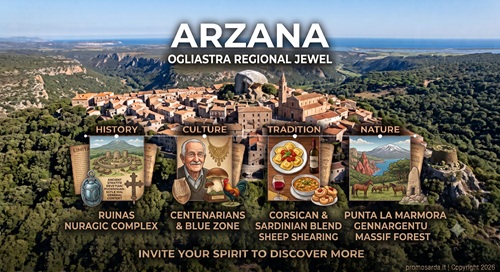
Perched on the slopes of Mount Idolo within the Gennargentu mountain range at an elevation of 672 meters above sea level, Arzana is an inland mountain municipality in Ogliastra. It is internationally recognized for its exceptionally high longevity rates (as part of the Sardinian Blue Zone) and encompasses Punta La Marmora, the highest peak in Sardinia.
The Region of Ogliastra
Ogliastra is a region in central-eastern Sardinia defined by rugged mountain terrains, limestone tablelands (tacchi), deep gorges, dense oak forests, and a dramatic coastline featuring granite cliffs and red porphyry rock formations.
Overview of Arzana
Commanding broad views over the Ogliastra coast and inland valleys, Arzana features a mountain landscape ranging from coastal administrative enclaves at sea level up to 1,834 meters at Punta La Marmora.
The local economy combines traditional agriculture (cereals, citrus, olives, and vineyards) and livestock farming (cattle, sheep, goats, and pigs) with food processing, woodworking, and gold jewelry craftsmanship.
Blue Zone & Longevity
Arzana is classified as one of Sardinia’s primary Blue Zones (Zone Blu)—demographic regions identified by researchers Gianni Pes and Michel Poulain for having the highest concentration of centenarians and exceptional human longevity in the world.
Name Origins
-
The name Arzana (Sardinian: Àrtzana) is of Proto-Sardinian origin.
-
It relates to the local terms ártzana or árthana, which denote a freezing cold breeze or mountain mist (derived from árzu, “frost”).
-
Alternative theories suggest derivations from the Phoenician Ar (“high mountain”), Etruscan Arzana (“elevation”), Byzantine Greek Orsa Maggiore (“Great Bear”), or Latin Aer Sana (“healthy air”).
Historical Boundary Feud: Silisè and Orruinas
Between the 16th and 17th centuries, Arzana absorbed the territory of two plague-abandoned medieval mountain villages, Silisè and Orruinas. According to local tradition, refugees from these sites were granted asylum in Arzana’s Preda ’e Maore district in exchange for pasture rights. A subsequent territorial dispute with neighboring Desulo culminated in a dawn walking race triggered by a rooster’s crow; a clash occurred at Sa forada de dexiotto (“The Ravine of the Eighteen”). Legal boundaries were permanently settled in Arzana’s favor in 1691.
Notable Figures
-
Stanislao “Stanis” Dessy (1900–1986): Renowned Sardinian painter, engraver, and sculptor who studied in Rome, collaborated with leading 20th-century artists, and mastered woodcut and etching techniques.
-
Anselmo Contu (1900–1975): Jurist, co-drafter of Sardinia’s Special Statute, and the first President of the Regional Council of Sardinia (1949).
-
Historical Outlaws: Birthplace of infamous 19th-century fugitive Samuele Stochino (“La Tigre d’Ogliastra”), as well as late 20th-century figures Pasquale Stochino and Attilio Cubeddu.
Cultural Traditions & Gastronomy
Local Gastronomy & Crafts
-
Porcino Mushrooms: Known locally as “the potato of Gennargentu,” celebrated as a regional delicacy.
-
Artisanal Jewelry: Long-standing tradition of fine gold- and silversmithing.
Local Festivals
-
Feast of Sant’Antonio Abate (January 17): Winter gathering centered around ceremonial neighborhood bonfires.
-
Patronal Feast of San Giovanni Battista (June 24): Solemn religious procession featuring the patron saint’s statue carried on an ox-drawn cart, held alongside scientific symposia on Gennargentu medicinal herbs.
-
Cheese and Sheep Shearing Festival (Sagra del Formaggio e della Tundimenta) (July): Celebration of pastoral traditions, wool shearing, and dairy production.
-
Feast of San Vincenzo Ferrer (Last Sunday of August): Multi-day festival featuring costumed equestrian processions, traditional launeddas music, and folk dances.
-
Sagra del Porcino d’Oro (Early November): A major three-day autumn festival featuring guided mycological excursions, public tastings, and a competitive culinary tournament among prominent Sardinian chefs.
-
Feast of San Martino (November 11): Autumn liturgical feast celebrated at the ancient chapel of St. Martin.
Urban Landmarks and Architecture
Arzana’s original urban core preserves traditional medieval architecture, characterized by narrow lanes and multi-story tower-like stone dwellings (case a torre).
Key Highlights in Town
-
Parish Church of San Giovanni Battista: Rebuilt in 1865 in Neoclassical style over a pre-existing church. Features a single barrel-vaulted nave with a Latin cross layout, a 24.5-meter square bell tower with a pyramidal spire, and a travertine floor. It houses the 14th-century or mid-17th-century Bronze Processional Cross of Orruinas, a 17th-century silver monstrance by Antioco Canavera, a war memorial plaque signed by sculptor Enrico Spano, and venerated statues.
-
Church of San Vincenzo Ferrer: Located atop a panoramic pine-forested terrace in San Vincenzo Park. A whitewashed chapel with a traditional timber-and-reed roof structure (cannetto) and a small bell gable (campanile a vela).
-
Church of San Martino: One of Arzana’s oldest religious structures, originally a rural chapel now enclosed by town expansion. Contains valuable historical frescoes and artwork.
-
Birthplace of Stanis Dessy: Located on Via Sardegna, marked as the 1900 birthplace of the artist.
-
Su Mulinu Area: Historic public square containing the Su Mulinu stone fountain, a stone mushroom monument (Su Cardulinu ’e Preda), and a sacred statue of the Virgin Mary.
-
Public Monuments: Includes Pinuccio Sciola’s Monumento al Pastore (“Genti de bidda mia”) in Piazza San Rocco (1995) and Sciola’s War Memorial in Piazza dei Caduti (1996).
-
Former Preventorio: A massive 2,500-square-meter horseshoe-shaped medical complex built in 1911 (formerly the Regional Anti-Tuberculosis Sanatorium), representing a prominent piece of regional institutional history.
-
Town Hall & Public Gardens: Located on Via Monsignor Virgilio, opposite public gardens featuring a statue of Bishop Emanuele Virgilio and a monument to the Porcino d’Oro.
-
Sports Facilities: Includes the Sturrusè Municipal Stadium (home to Idolo Calcio, with synthetic turf and athletic field facilities), the Mannoi Sports Complex, and a multi-purpose gym at the middle school.
Surrounding Natural & Archaeological Landmarks
Natural Monuments & High Peaks
-
Punta La Marmora (Perdas Carpìas): The highest peak in Sardinia at 1,834 meters. Named after general and naturalist Alberto Ferrero La Marmora, the rounded, bare summit offers vistas across the island from Barbagia to the coasts of Ogliastra, Oristano, and Cagliari.
-
Gennargentu Massif: An ancient geological formation composed of schists, granites, and limestones, designated as a protected Natura 2000 European environmental site.
-
Tedderieddu (Tadderi) Yew Forest: A centuries-old grove of ancient yew trees (Taxus baccata) situated within the upper mountain valleys.
-
Fontana Onniga Municipal Park: A wooded park equipped with picnic areas surrounding the Onniga natural spring.
-
Arzana Belvedere: A elevated natural viewpoint looking out over the mountain valleys of Ogliastra.
Archaeological Heritage & Historic Railways
Archaeological Site and Nuragic Complex of Ruinas (Orruinas)
Located beneath Mount Tuvera at an altitude of 1,205 meters, this is the highest archaeological complex in Sardinia (Presone de Molathò).
-
The Nuraghe: A complex trilobed nuraghe featuring a central main tower (tholos intact) surrounded by a bastion with three secondary towers and an inner courtyard.
-
The Village: Over 200 circular stone huts form an extensive prehistoric and medieval village, alongside a large 20×30 meter rectangular meeting building, a Giants’ Tomb ruin, and a Sacred Well.
-
Artifact Finds: Excavations uncovered bronze figurines, gold leaf beads, a serpent-shaped fibula, a votive sword, and an ancient steatite Egyptian/Phoenician-style scarab amulet set in silver. The site demonstrates continuous human habitation from the Bronze Age through the 15th-century plague era.
Other Prehistoric Sites
-
Nuraghe de Sa Tanca (Nuraghe Orrubiu): A single-tower (monotorre) granite nuraghe located at 978 meters elevation.
-
Nuraghe Unturgiadore: An unclassified nuraghe built at 1,082 meters near the remains of a prehistoric hut village, taking its name from the Sardinian word for vulture (unturgiu).
-
Roman Thermal Remains: Traces of Roman baths (su Bangiu) within the town territory, alongside settlement ruins at Tedderieddu and Silisè.
Heritage Railway (Trenino Verde)
Arzana’s territory hosts three historic railway stops along the 19th-century Mandas-Arbatax narrow-gauge line, operated seasonally for tourism:
-
Arzana Railway Station (located 5 km southwest of town).
-
Sella Elecci Railway Stop (established 1893).
-
Villagrande Railway Station (located within Arzana’s boundaries near Lake Alto Flumendosa).