Ardara and the Meilogu Region
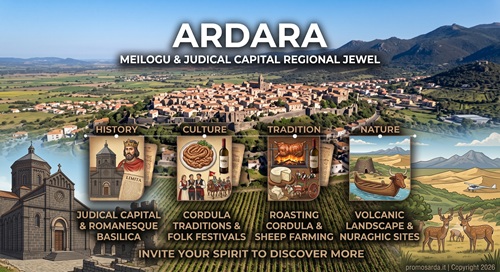
Perched on a volcanic plateau at the eastern slopes of Montesanto, Ardara is a historic agricultural municipality in the Meilogu region that served as the capital of the medieval Judicate of Torres.
The Region of Meilogu
Meilogu (meaning “middle place” in Sardinian) forms the central district of historic Logudoro. Characterized by fertile agricultural plains, abundant water springs, and volcanic elevations, its economy is centered on cereal farming, vegetable cultivation, and dairy sheep farming.
Overview of Ardara
Situated at an altitude of 297 meters above sea level, Ardara is surrounded by volcanic hill formations such as Monte Cheja (420 m) and Salto di Binza (490 m).
The municipal economy relies primarily on agriculture (cultivation of wheat, fodder, vegetables, wine grapes, and olives) and livestock raising (cattle, sheep, goats, pigs, and horses). Small-scale industrial activities include food processing, metallurgy, construction, and power generation.
Name Origins
-
During the medieval period recorded as Ardar or Aldara.
-
Linguists suggest potential Paleo-Sardinian origins linked to Srdara (“sacrificial altar”) or Latin roots from Arduum (“steep” or “rugged place”).
Cultural Traditions & Events
Local Gastronomy & Traditions
-
Cordula: A classic Sardinian culinary specialty made from braided lamb intestines, traditionally prepared roasted or braised with peas during major religious holidays.
Local Festivals
-
Sagra della Cordula (June): A summer gastronomic festival held near the Municipal Amphitheater featuring roasted cordula, local red wines, live tenores singing, poetic competitions, and open-air painting contests.
-
Patronal Feast of Nostra Signora del Regno (May 9): The town’s principal religious celebration, preceded by a nine-day novena beginning May 1. Features solemn liturgical rites, formal processions with the Virgin’s statue, traditional music, and folk performances.
-
Feast of San Pietro (June): Celebrated at the hilltop rural chapel with religious services and a procession accompanied by costumed horseback riders.
-
Ferragosto Ardarese (August 15): A mid-summer homecoming festival celebrating returning emigrants.
-
Feast of the Holy Cross (Santa Croce, September): Traditional religious gathering held at the Church of Santa Croce.
Architecture and Urban Landmarks
The historic core of Ardara is set on an elevated outcrop surrounded by modern low-density residential areas, parks, and tree-lined streets.
Key Highlights in Town
-
Basilica Sanctuary of Nostra Signora del Regno: Built between 1065 and 1107 in Pisan-Romanesque style with Lombard influences by the anonymous Maestro d’Ardara. Constructed from dark volcanic trachyte blocks, this historic palatine chapel served as the royal coronation and burial church for the rulers of Torres.
-
Architecture & Interior: Features a three-nave basilican layout divided by two rows of dark trachyte columns topped with Doric and Corinthian capitals, 15th-century frescoes depicting the Last Judgment, 17th-century column portraits of the Apostles, and an carved 16th-century wooden pulpit.
-
Major Altarpiece (Retablo Maggiore): Standing ten meters high and five meters wide, this gilded early-16th-century polyptych represents one of Europe’s largest wooden altarpieces, housing a late-15th-century Gothic-Renaissance statue of the Virgin and Child.
-
-
Ruins of the Medieval Judical Palace (Castello Giudicale): The foundation remains and a 12-meter tower ruin of the 11th-century palace (Palacium) that served as the fortified residence of the Judges of Torres.
-
Church of Santa Croce: Built in 1898 in Neo-Medieval style on the site of a 16th-century oratory formerly run by the historic Cunfraria de Santa Rughe brotherhood.
-
Church of San Pietro: A dark trachyte Romanesque chapel rebuilt in the early 15th century atop the ruins of an early Christian sanctuary, preserving an original single-light apse window.
-
Historic Public Fountain (Fonte Pubblica): A late 19th-century stone water fountain constructed using recycled masonry blocks from the town’s original medieval defensive walls.
-
Civic Architecture & Amenities: Includes the Town Hall (Municipio), an open-air Municipal Amphitheater, street murals along Via Roma, a local airfield for ultralight aircraft, and municipal sports fields.
Surrounding Archaeological Sites
The territory surrounding Ardara contains 27 nuraghi alongside prehistoric, Punic, and Roman archaeological deposits.
Archaeological Landmarks
Nuraghe Scala de Boes (Nuraghe Santedero)
A Nuragic tower structure featuring stepped wall masonry and an interior mezzanine. Excavations at the site yielded a Bronze Age bronze boat artifact (navicella) featuring a carved bull’s head (protome taurina)—now preserved at the Sanna National Museum in Sassari—alongside ancient Punic coinage bearing horse motifs.
Nuraghe de Rio Runaghe
A massive complex nuraghe whose ground floor remains partially submerged beneath accumulated soil. The central tower retains an intact, complete ground-floor tholos vault.
Additional Archaeological Sites
Other prehistoric structures within the municipal boundaries include the single-tower nuraghi Arigau, Arrubiu, and Santu Domini, as well as complex nuraghi such as Arbici, Colombus, Nuratteddu, and Ortu Comidu.