Arbus and the Monreale Region
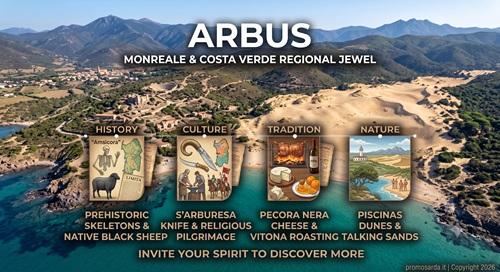
Situated along the slopes of the Monte Linas range and the Arburese mountains, Arbus is a historic municipality in southwestern Sardinia known for its extensive coastal dunes, pastoral traditions, and 19th- and 20th-century industrial mining heritage.
The Region of Monreale
The Monreale (also known as Campidano di Sanluri) is a historic region of southwestern Sardinia that belonged to the medieval Judicate of Arborea. Characterized by rolling hills, fertile plains, and rich mineral deposits, the territory preserves archaeological evidence spanning from pre-Nuragic times to the Roman and medieval eras.
Overview of Arbus
Perched at an altitude of 314 meters above sea level, Arbus features a varied terrain extending from mountainous ridges down to coastal plains and coastal dune fields.
The municipal economy combines agriculture, apiculture (belonging to the national network Città del Miele), and livestock farming—notably the native Arbus Black Sheep (Pecora Nera di Arbus)—with artisanal knife-making, ceramics, and ecotourism. The town’s vast territory encompasses preserved industrial mining sites integrated into the UNESCO-recognized Historical and Environmental Geomining Park of Sardinia.
Name Origins
-
One hypothesis derives the name from the Latin albus (“white”), associated with regional Sardinian variants such as Arbu or Arvu.
-
Another theory suggests a pre-Roman root alba, signifying a “height” or “elevated terrain”.
Artisanal Cutlery: S’Arburesa
Arbus is internationally recognized for its traditional folding knife, S’Arburesa (or Arburese). Designed primarily as a skinning knife for hunting, it features a distinct curved handle—often carved from a solid piece of ram horn—and a broad, belly-shaped blade. The town houses the Museum of the Sardinian Knife, founded by master artisan Paolo Pusceddu, which displays historic obsidian blades, antique blacksmith tools, and famous oversized display knives.
Cultural Traditions & Events
Local Breeds & Products
-
Pecora Nera di Arbus: A native horned sheep breed with small ears whose milk yields high-quality cheeses and whose coarse dark wool was historically woven into traditional Sardinian homespun cloth (orbace).
Local Festivals
-
Feast of Sant’Antonio Abate & San Sebastiano (January 17 & 20): Celebrated with traditional neighborhood bonfires (Su Fogu de Santu Sebastianu) and the distribution of blessed oranges.
-
Feast of the Madonna d’Itria (First Sunday after Pentecost): A rural pilgrimage where the Virgin’s statue is carried in procession to the country sanctuary.
-
Sagra di Sant’Antonio da Padova (June 13): The town’s primary religious festival, featuring a 33-kilometer pilgrimage procession accompanied by costumed groups, decorated ox-carts (traccas), and mounted riders traveling from Arbus to the coastal hamlet of Sant’Antonio di Santadi.
-
Sagra della Pecora Nera di Arbus (Late July): A culinary and cultural festival dedicated to the indigenous black sheep breed, featuring public tastings and agricultural workshops.
-
Sagra della Vitella & Festa dell’Emigrato (Early August): A summer gathering hosted in Torre dei Corsari featuring open-spit roasted meats and community celebrations.
-
Feast of San Lussorio (Sa Festa Manna, August 21): Historic patronal celebrations featuring solemn processions from the parish church to the municipal amphitheater.
-
Feast of the Beata Vergine Maria Regina (September 8): Celebrated at the modern parish church with family blessings and civic events.
Urban Landmarks and Architecture
The historic core of Arbus is defined by narrow, winding streets, granite stone houses, and traditional mud-and-straw sun-dried brick structures (làdiri).
Key Highlights in Town
-
Parish Church of San Sebastiano Martire: Originally built prior to 1591 and modified through the 17th and 19th centuries. Its current facade and bell tower date to 1895 restorations, while the interior houses an 1845 main altar, a 1770 marble balustrade, a 1701 statue of Saint St. Sebastian, and a 1665 pipe organ.
-
Parish Church of Beata Vergine Maria Regina: Built in 1970 in modern reinforced concrete, featuring a broad grand entrance staircase.
-
New Church of San Lussorio: Erected to replace a historic 16th-century chapel demolished in 1956.
-
Museum of the Sardinian Knife (Museo del Coltello Sardo): Located on Via Roma, displaying the historical evolution of Sardinian cutlery from prehistoric obsidian daggers to modern masterwork folding knives, alongside a reconstructed 19th-century blacksmith workshop.
-
Piazza dell’Immacolata (Pratz ‘e Cresia): A central circular plaza featuring a mid-20th-century statue of the Virgin Mary, the Old Town Hall building (1895), and the historic Monte Granatico.
-
Former Monte Granatico: Built in 1763 as a communal grain bank to support local farmers, now restored as an exhibition space for mining history and cultural events.
-
Piazza Mercato (Pratza de Sa Panga): A central square containing a monument honoring 18th-century medical pioneer Pietro Leo and jurist Raimondo Garau.
-
Piazza San Lussorio: A historic square formerly containing an ancient chapel and parish cemetery, now serving as an educational and civic space.
-
Municipal Amphitheater: A 1,200-seat open-air arena dedicated to civic ceremonies and performance arts.
-
Municipal Sports Grounds: Includes the historic Mario Peddis soccer field (1953), the Santa Sofia Municipal Stadium (1,000-seat natural grass pitch and track), and an indoor sports arena.
Mining Heritage & Historic Industrial Villages
The municipality of Arbus encompasses extensive abandoned lead and zinc mining complexes that formed major industrial settlements during the 19th and 20th centuries.
Montevecchio Mining Complex
Spanning the border between Arbus and Guspini, Montevecchio was one of Europe’s premier industrial mining operations.
-
Gennas Village & Direction Palace: Built between 1870 and 1877 in Neo-Renaissance style around a central courtyard, featuring Liberty-style interior frescoes and the adjoining Church of Santa Barbara.
-
Western Works (Cantieri di Ponente): Located in the Arbus sector, comprising the Sanna Mine, the Telle Mine (featuring the Amsicora Shaft and La Marmora Washery), and the Casargiu Mine (Fais Shaft).
Ingurtosu & Gennamari Mining Complexes
-
Ingurtosu Mining Village: Nestled in a valley leading toward the sea, this 19th-century administrative village features the French/German-inspired Direction Palace (“The Castle”), former employee housing, and a historic hospital.
-
Pitzinurri Village: A residential mining hamlet featuring Villa Ginestra (Villa Idina)—built by mine owner Lord Brassey for his wife—and the 1916 granite Church of Santa Barbara.
-
Industrial Processing Facilities: Includes the Pireddu Washery, the Gal Shaft (now an industrial mining museum), the Turbina Shaft, and the monumental Brassey Washery at Naracauli (1900).
-
Gennamari Mining Village: An upper valley mining settlement featuring a ruined Direction Palace and the remains of the Chapel of Sant’Antonio da Padova.
Surrounding Natural & Archaeological Landmarks
Prehistoric Archaeology & Human Remains
-
Ancient Skeletal Discoveries: Archaeological excavations at coastal sites near Su Pistoccu (S’Omu e S’Orku) revealed well-preserved human skeletons dating to the Mesolithic and Early Neolithic eras (8,000–10,000 years ago), including the human remains named “Amsicora”, “Beniamino”, and “Amanda”.
-
Necropolis of Monte Terli: A collection of nine domus de janas chamber tombs carved directly into hard granite rock faces, associated with standing granite menhirs (perdas fittas) and an archaic corridor-nuraghe.
-
Complex Nuraghi: Prominent prehistoric towers include Nuraghe Cugui (a trilobed granite complex set on a panoramic height overlooking the Monte Linas range), alongside Is Cabis, Narocci, and Punta Sa Rana.
Rural Sanctuaries & Natural Ranges
- Mount Arcuentu: A sharp, craggy volcanic mountain ridge rising to 785 meters above sea level, capped by dense holm oak forests. At its summit lie the sparse stone perimeter ruins of the 10th-century medieval Castle of Monte Arcuentu, historically owned by the Judicate of Arborea.
- Sanctuary of Beata Vergine d’Itria: A 17th-century rural sanctuary featuring a low stone court wall and external roofed side loggias (stanze de Is Oberaius).
- Countryside Chapels: Includes the rural Church of Santissimo Salvatore in S’Ortali ‘e Su Monti (1901) and the historic 16th-century Church of San Lussorio.
Arbus Coast and the Costa Verde
Overview of Arbus & The Costa Verde
The Costa Verde (“Green Coast“) stretches from Capo Frasca down to Capo Pecora within the
historic Monreale (Campidano di Sanluri) and Sulcis-Iglesiente territories. Characterized by wild,
untouched landscapes, the coastline features vast sandy beaches, expansive wind-blown dune
fields, and steep coastal cliffs.
Key Coastal Sites & Landmarks
• Capo Frasca: The northern boundary of the Gulf of Oristano, featuring basaltic cliffs and the
regional military firing range.
• Pistis & Sabbie d’Oro Beaches: An extensive golden-sand coastline backed by the Dune di
Pistis, towering dynamic sand dunes reaching up to 80–90 meters in height. Tucked away
within the dunes lies the Casa del Poeta, a hidden shelter naturally formed inside an ancient
juniper tree where local poet Efisio Sanna lived in self-imposed isolation.
• Torre dei Corsari: A coastal village named after the 16th-century Spanish watchtower (Torre
di Flumentorgiu, built c. 1577–1591) that crowns the northern promontory, overlooking vast
sand dunes and beaches.
• Porto Palma & Flumentorgiu Tonnara: A sheltered cove containing the remnants of an
19th-century tuna trap fishery (tonnara) recognized as industrial archaeological heritage.
• Funtanaenza & Montevecchio Marine Colony: A picturesque bay surrounded by a dense
8-hectare pine forest. It houses the ruins of the Colonia Marina di Montevecchio, a futuristic
and massive seaside summer camp built in 1956 by the Montevecchio mining company for
miners’ children.
• Marina di Arbus (Gutturu ’e Flumini): A scenic coastal settlement framed by dark volcanic
reefs and limestone falesias known as Calata Bianca.
• Portu Maga: A small tourist hamlet set against rugged coastal hills, featuring local seafood
dining and sweeping views of the sea. Prehistoric finds near Portu Maga include the 8,400
year-old Early Neolithic human remains of Beniamino and Amanda.
• Piscinas Dunes: Home to the highest active live sand dunes in Europe (reaching up to
nearly 100 meters), forming a 7-kilometer-long desert landscape that stretches down to the
sea. The beach hosts the Hotel Le Dune, converted from a 19th-century mining warehouse
and railway terminal that once serviced the Ingurtosu and Naracauli mines. It is also home to
one of Europe’s largest officially designated naturist beaches.
• Scivu Beach: A 3-kilometer golden-sand beach bordered by sandstone cliffs, famous for its
“talking” sand (spiaggia parlante) that echoes acoustic resonance when walked upon,
alongside a rare small year-round coastal waterfall.
• Capo Pecora: The southernmost promontory of the Arbus coast, featuring light-colored
undulating cliffs, secluded pebble coves, and rock formations resembling a sheep’s head.