Ardauli and the Barigadu Region
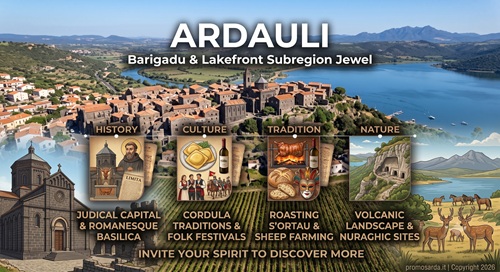
Overlooking Lake Omodeo—the largest artificial lake in Sardinia—Ardauli is a hillside municipality situated in the historic Barigadu subregion.
The Region of Barigadu
Barigadu was a historic administrative district (curatoria) of the medieval Judicate of Arborea, located along the southern shores of Lake Omodeo. The landscape is characterized by rolling hills, fertile trachyte plateaus, and Mediterranean woodlands dominated by cork and holm oaks.
Overview of Ardauli
Situated on a steep trachyte hillside at an elevation of 437 meters above sea level (ranging from 102 to 641 meters across its boundaries), Ardauli commands sweeping views of the Tirso River valley and Lake Omodeo.
The municipal economy relies primarily on agriculture (cereal farming, fodder, olive groves, and fruit orchards), viticulture (as a recognized member of the national network Città del Vino), and livestock farming. Traces of ancient agricultural activity remain throughout the countryside, including historic stone watermills, grain-threshing floors, and stone grape-pressing vats.
Name Origins
-
The name Ardauli (Sardinian: Ardaule) is of pre-Roman etymology.
-
One theory associates it with the Sardinian Ardia (“guard” or “watchpost”), referencing defensive lookout points established against coastal raids.
-
Another hypothesis links the roots Arda (“altar”) and Uli (“bull”) to an ancient altar dedicated to the Bull Deity.
-
A third theory compares the name to the Illyrian Ar-daute (“near the river”), referencing the nearby Tirso River.
-
Linguist Massimo Pittau suggests a derivation from the Latin/Etruscan Arduum, denoting a steep or precipitous height, matching the town’s sloping geomorphology.
Cultural Traditions & Gastronomy
Local Gastronomy
-
Sos Culurzones de Patata cun Nebidedda: Traditional potato-stuffed ravioli seasoned with local wild oregano.
-
S’Ortau: A traditional seasoned pork sausage precooked in natural casing.
-
Sa Coccoi: Elaborately worked traditional Sardinian bread, distributed during festivals and traditional holidays.
Local Festivals
-
Feast of Sant’Antonio Abate (Sant’Antoni de Su Fogu) (January 17): Celebrated at the countryside chapel with a communal bonfire, local wine, and traditional pastries (Su panizzeddu).
-
Su Carrasegare Antigu de Ardaule (February/March): The traditional carnival of Ardauli featuring masked figures (S’Intibidu) and street dances.
-
Sa Festa ‘e Maju (Third Sunday of May): A spring festival honoring Our Lady of Mount Carmel and Saint Isidore, featuring symbolic auctions of braided cherry garlands (Sa dita de sa cressia) and wheat ears (Sa dita de su trigu), accompanied by ox-cart processions.
-
Feast of San Giovanni Battista (June 23–24): Midsummer celebrations featuring the silent water-fetching ritual (S’abba muda), neighborhood bonfires (unu fogone), traditional songs, and friend-making rites (Sos compares de santu Juanni).
-
Feast of San Quirico & Santa Giulitta (August 25): Celebrated at the lakefront countryside sanctuary following a nine-day retreat in traditional stone lodgings (cumbessias).
-
Feast of Saints Cosmas and Damian (Second Monday of September): A three-day religious event centered around a blessing of the sick, featuring statues adorned with sacred ribbons.
-
Declinazioni d’Autunno (Mid-October): An autumn gastronomic festival dedicated to S’Ortau and local Culurzones ravioli.
-
Patronal Feast of Beata Vergine del Buon Cammino (Third Sunday of October): Solemn religious and civic celebrations honoring the parish patron.
Urban Landmarks and Architecture
The historic layout of Ardauli maintains a well-preserved rural character, featuring narrow streets lined with dark trachyte stone houses decorated with Gothic-Aragonese lintel carvings.
Key Highlights in Town
-
Parish Church of Beata Vergine del Buon Cammino: Constructed between 1630 and 1690 in Sardinian-Gothic/Catalan style with Renaissance influences. Built from cut volcanic stone, it features a broad facade anchored by two carved stone lions, a rose window decorated with botanical motifs, and a 18th-century bell tower. The single-nave interior contains barrel-vaulted side chapels and a rib-vaulted sanctuary (Capilla Mayor).
-
Church of Saints Cosmas and Damian (Santos Cosomo e Damianu): Located on the northern edge of town, this church dates originally to 1155, with major restorations in 1684 and 1828. It features a three-part stone facade, a central bell gable (campanile a vela), and a single-nave interior.
-
Casa Tatti & Ethnographic Museum: A historic court manor housing the Municipal Public Library and the Civic Ethnographic Museum (Le Cose della vita).
-
War Memorial (Monumento ai Caduti): A marble altar atop a three-tiered stone base surrounded by bronze leaf wreath details, located in Piazza Carlo Alberto.
-
Municipal Amenities: Includes the Town Hall (Municipio) in Piazza Matteotti, Piazza dell’Emigrante, municipal clay target shooting ranges, and a multi-purpose sports complex featuring an outdoor swimming pool, athletic track, and soccer field.
Surrounding Countryside Sanctuaries & Prehistoric Sites
Countryside Sanctuaries
Sanctuary of San Quirico
A historic rural church built in 1101, situated on a scenic height above Lake Omodeo. The sanctuary is encircled by cumbessias—traditional stone housing clusters used by pilgrims during the annual August novena commemorating the 4th-century martyrs Saint Quiricus and his mother Saint Julitta.
Countryside Church of Sant’Antonio Abate
Rebuilt around the late 16th or early 17th century by Capuchin friars near a former hermit community (Sos Eremos). Restored in the late 20th century, the gabled stone chapel features two pointed interior arches and a side bell gable.
Archaeological Heritage
-
Domus de Janas of Muruddu: Prehistoric rock-cut chamber tombs dating to the Neolithic era.
-
Nuraghe Monte Irao: A single-tower nuraghe located within the basin of Lake Omodeo, visible when water levels recede.
-
Nuraghe Monte Calighe: The stone remains of an unclassified prehistoric Nuragic structure in the surrounding hills.