Allai and the Barigadu Region
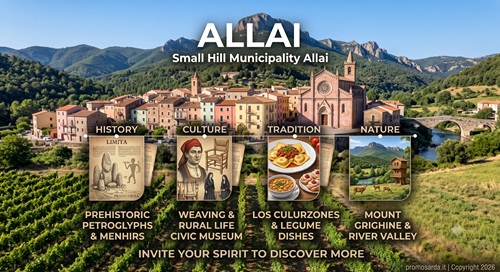
Situated along the Massari River near its confluence with the Tirso River, Allai is a small hill municipality framed by the forests and quartz ridges of Mount Grighine.
The Region of Barigadu
Barigadu is a historic region in central Sardinia bordering the southern shores of Lake Omodeo. Characterized by rolling plains, Mediterranean oak and cork forests, and rich wildlife (including Sardinian deer, wild boars, and eagles), it historically formed an administrative district of the Judicate of Arborea.
Overview of Allai
Located at an altitude of 52 meters above sea level, Allai features a varied terrain extending from the river valley up to the 672-meter peak of Mount Grighine.
The town’s economy is predominantly agricultural and pastoral, based on the cultivation of cereals, wheat, vegetables, wine grapes, and olives, alongside livestock farming. Local craftsmanship plays a notable cultural role, particularly the weaving of traditional rush-and-wood chairs (Iscannos).
Name Origins
-
Historical ecclesiastical records cite the village as Allay (1341), Alay, and Alai.
-
Etymological theories suggest pre-Sardinian or Semitic origins (el-Alah, meaning “divine place”), Phoenician roots (allal, meaning “valley” or “humid place”), or links to the Latin phytonym alium (“garlic”).
Cultural Traditions & Events
Local Festivals
Community traditions and celebrations in Allai include:
-
Feast of Sant’Antonio Abate (January 16) & San Sebastiano (January 19): Celebrated with communal bonfires in the central Sa Pratza ‘e Su Fogalone square.
-
Carnival (Carrasegare Allaese): Features parades of allegorical floats, traditional masks, and seasonal fried pastries (zeppole).
-
Feast of Sant’Isidoro & Holy Spirit Patronal Festival (May 15–16): Solemn agricultural blessing rites featuring processions of decorated tractors and horses, polyphonic choral singing, folk dancing, and a communal supper.
-
Summer in Allai (Estate Allaese) & S’Arreppiccu (July–August): A series of summer cultural events, folk performances, and a bell-ringing musical showcase.
-
Feast of Madonna del Rimedio (September 8): Held at the suburban chapel following a traditional nine-day novena.
-
Traditional Pig Slaughter Gathering (December): A winter culinary event in Sa Pratza ‘e Su Fogalone demonstrating traditional preparation methods, followed by a public feast.
Architecture and Urban Landmarks
The historic core of Allai features traditional trachyte stone architecture, narrow alleys, and street murals depicting rural traditions and ancient crafts.
Key Highlights in Town
-
Parish Church of the Holy Spirit & Our Lady of the Rosary: Built in the 16th century in late-Gothic style using local pink trachyte. It features a detailed main portal flanked by columns with floral capitals, a large rose window, a single-nave layout with pointed arches, and a star-vaulted chancel. Its sacred art collection includes 16th-century silver liturgical vessels, a 17th-century crucifix, and a medieval holy water font.
-
Civic Museum of Allai (Ci.M.A. / Casa Saba): Housed in a restored traditional residence, this dynamic museum presents alternating exhibits divided into two sections: prehistoric-to-medieval archaeological artifacts, and an ethnographic collection detailing 20th-century agricultural, viticultural, and weaving life.
-
Piazza Sant’Isidoro: An open-air ethnographic square integrated with the Civic Museum, displaying historic oil presses, bread ovens, looms, and agricultural carts.
-
Church of Nostra Signora del Rimedio: A simple 14th-century countryside chapel built of local pink trachyte, housing a historic carved wooden statue of the Virgin Mary.
-
Treehouse of Allai: A three-story public wooden structure built into a large eucalyptus tree along the banks of the Massari River, designed as a sustainable architectural site offering panoramic views of the riverbed.
-
Sa Pratza ‘e Su Fogalone: A public square featuring a central raised hearth used for traditional ritual bonfires and community gatherings.
-
Town Hall (Municipio): Located on Via Ponte Nuovo, housing municipal administrative services.
-
War Memorial: A pink trachyte monument set within a central roundabout, depicting a soldier assisting a fallen comrade.
-
Municipal Sports Grounds: Includes a grass mini-soccer pitch, a main soccer stadium, and tennis courts.
Surrounding Archaeological & Natural Landmarks
The region surrounding Allai preserves extensive archaeological evidence spanning the prenuragic, Nuragic, Roman, and medieval periods.
Archaeological Sites
Prehistoric Rock Carvings & Menhirs (Pranu Orisa)
-
The “Praying Man” (Omino Orante): A stylized prehistoric petroglyph carved into a trachyte rock face near Nuraghe Pranu ‘e Sa Cresia, depicting a male figure with raised arms in a stance of prayer or ritual adoration.
-
Statue-Menhirs of Arassedda: A group of sixteen anthropomorphic stone monoliths (perdas fittas) discovered near Nuraghe Arassedda, carved from trachyte, sandstone, and porphyry.
-
Domus de Janas Sa Cisterra: A shaft-entry rock-cut tomb featuring geometric carvings interpreted either as an ancient healing altar or a fertility symbol.
-
Necropolis of Marajana: A complex of single-cell domus de janas chamber tombs carved into trachyte rock outcrops.
Roman Engineering
-
Su Ponti Ecciu: A historic Roman stone bridge originally built around 440 AD across the Massari River along the ancient road connecting Forum Traiani (Fordongianus) to the island’s interior. Built with local red trachyte blocks, the bridge was expanded in 1157 under Judge Barisone I of Arborea and further restored in the 16th century, currently featuring seven preserved arches.
Nuragic Structures
-
Nuraghe Pranu ‘e Sa Cresia: A single-tower (monotorre) trachyte nuraghe set at an elevation of 276 meters on the Pranu Orisa plateau.
-
Nuraghe Arassedda: The overgrown remains of a complex Nuragic site located near the menhir discovery zone.
-
Additional Nuragic monuments in the surrounding area include Sa Pala de Sa Cresia, Ghenna Illighi, Pranu Ollisa, and ‘e Prunas.