Anela and the Goceano Region
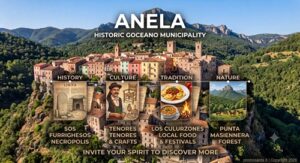
Situated at the base of the mountain dominated by Punta Masiennera, Anela is a historic pastoral municipality in the Goceano region, surrounded by an extensive state forest.
The Region of Goceano
Goceano (known in Sardinian as Sa Costèra) is a central-northern region of Sardinia encompassing the upper valley of the Tirso River and the mountain range of the same name. Its economy historically rests on grain farming in the valley basins, pastoralism, and forest management.
Overview of Anela
Located at an altitude of 446 meters above sea level, Anela features an elevated mountain terrain.
The primary sectors of the local economy are agriculture (cultivation of wheat, cereals, vegetables, wine grapes, olives, and fruit) and livestock raising (cattle, sheep, goats, pigs, and horses). The town is surrounded by a protected state forest covering roughly 1,000 hectares, composed predominantly of holm oaks, puberulent oaks, and holly trees.
Name Origins
Linguistic theories offer two main interpretations for the town’s name:
-
Derived from a Sardinian root meaning a shaded or poorly sunlit area.
-
Derived from the Sardinian word Anella (“iron ring”), referencing historic rings used to tether horses.
Cultural Traditions & Events
Local Festivals
Community traditions and celebrations in Anela include:
-
Feast of Sant’Antonio Abate (January 17): Celebrated on the eve with a traditional central bonfire (falò).
-
Feast of Santa Maria di Mesumundu (Late May): Celebrated with an evening torchlit procession carrying the statue from the town center to the countryside chapel, concluding with a gathering offering local wine and traditional sweets.
-
Feast of San Giorgio di Aneletto (First Sunday of August): A traditional rural pilgrimage festival celebrated at the mountain church in the forest, featuring a outdoor liturgy and a pastoral lunch of regional specialties.
-
Patronal Feast of Saints Cosmas and Damian (September 26): The town’s primary religious festival. The eve features vespers, music, and traditional Sardinian poetic competitions (gara poetica). The feast day includes a solemn procession with costumed riders—including women in traditional local attire—followed by folk dancing and tenores singing performances.
Architecture and Urban Landmarks
The historic core of Anela features traditional mountain stone architecture, street murals, and historic civic structures.
Key Highlights in Town
-
Parish Church of Saints Cosmas and Damian: Consecrated in 1968 to replace an earlier church building. The complex retains the restored original bell tower, while the modern interior is decorated with extensive mosaics, notably a large apse mosaic depicting the two patron saints.
-
Funtana Noa: A historic public granite fountain constructed in the town center in 1887.
-
Historic Civic Tower: A stone tower structure dating to 1886.
-
Town Hall (Municipio): Located on Via Roma, with secondary administrative entry facing Via Giovanni Pascoli.
-
Former Railway Station Ruins: The abandoned passenger terminal of the narrow-gauge Tirso–Chilivani railway line, preserving exterior perimeter walls.
-
Bastianino Lendini Bulla Municipal Sports Field: A local athletic facility situated on the town outskirts.
Surrounding Archaeological & Natural Landmarks
The territory of Anela contains prehistoric burial sites, Nuragic towers, sacred wells, Roman settlement traces, and medieval religious structures.
Prehistoric & Archaeological Heritage
Necropolis of Sos Furrighesos
A major prehistoric rock-cut cemetery comprising twenty domus de janas chamber tombs carved into a cliff face. Attributed primarily to the Ozieri Culture (c. 4000–3200 BC) with secondary use during the Filigosa period, the site features:
-
Seven tombs decorated with carved relief features, including bull heads (protomi taurine), false doors, pillars, and architraves imitating contemporary wooden dwellings.
-
Six chambers retaining traces of red ochre wall paint.
-
Tomb IX (Sa Tumba de Su Re): A monumental tomb featuring a massive four-meter-tall stele carved directly onto the cliff facade, echoing the design of giants’ tombs.
Other Prehistoric Sites
-
Giants’ Tombs & Nuraghi: Monuments include the giant’s tomb of Sa Pruna, protonuraghi (Ferulas, Siana, Siccadores), single-tower nuraghi (Sa Mela, Cambadu, Figu Niedda), and complex nuraghi (Orchinele, Biliole, Pianu Oschiri, Tremmini).
Historic & Medieval Sites
Church of Santa Maria di Mesumundu (Madonna delle Rose)
A 12th-century chapel consecrated in 1162, illustrating the transition between Romanesque and Gothic architectural styles. Built with dressed local tufa blocks, it features a single nave with an apse facing northeast, exposed timber roof trusses, and historic wood statuary (including a 17th-century figure of Saint Francis of Assisi).
Castrum & Church Site of San Giorgio di Aneletto
Located at an altitude exceeding 1,000 meters, this site was originally established as a Byzantine military outpost (Castrum) featuring a 300-meter perimeter wall and four corner towers. Built atop one of the towers are the ruins of a 12th-century Romanesque chapel donated to the Camaldolese monks in 1163. Nearby stands the modern mountain chapel of San Giorgio, center of the annual summer forest festival.
Natural Features
State Forest of Anela (Foresta Demaniale di Anela)
A vast protected forest area within the Goceano woodland complex, consisting of holm oaks, puberulent oaks, and holly. The forest encompasses Punta Masiennera (1,157 m)—the second-highest peak in the Goceano range—and houses a Forestry Corps station at an elevation of nearly 1,000 meters.