Alghero and the Nurra Region
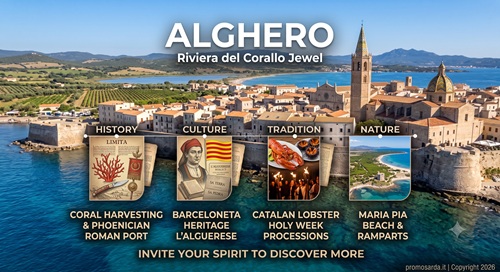
Situated on the northwestern coast of Sardinia, Alghero (known in local Catalan as L’Alguer and in Sardinian as S’Alighera) is a historic coastal city and the primary center of the Coral Riviera (Riviera del Corallo).
The Region of Nurra
The Nurra is a historic geographic region forming a lowland plain bounded by the Gulf of Asinara to the northeast, the Sardinian Sea to the west, the Rio Mannu to the east, and the Logudoro hills to the southeast. Traditionally characterized by agricultural settlements, livestock pastures (cuiles), and historic mining sites, its landscape features low coastal plains interrupted by prominent elevations such as Mount Forte (464 m) and Mount Doglia (437 m).
Overview of Alghero
Alghero sits at an average altitude of 7 meters above sea level. The municipality includes offshore islands (Piana, Foradada, Maddalena) and coastal lagoon ecosystems such as the Calik Pond.
The city is widely known as Barceloneta (“Little Barcelona”) due to its unique historical and linguistic heritage: over twenty percent of its population speaks an archaic Catalan dialect (Algherese Catalan), recognized as a protected minority language. Alghero also serves as an academic and educational hub, housing specialized university faculties.
Name Origins
-
The name Alghero is widely attributed to the abundance of Posidonia oceanica seaweeds (aliga or alga) historically accumulated along its shoreline, deriving from S’Alighera (“place of seaweed”).
Economy & Artisanal Traditions
-
Red Coral (Corallium rubrum): Alghero is world-renowned for its harvesting and artistic crafting of premium red coral, a tradition reflected in the municipal coat of arms.
-
Viticulture & Olive Oil: The city belongs to national associations celebrating olive oil and wine production. Famous local wines include Vermentino, Cannonau, Torbato, and renowned dessert wines.
-
Traditional Knives: Alghero is also recognized for artisanal cutlery, including traditional Sardinian folding knives (Sa Resolza) featuring horn handles and steel blades.
Gastronomy & Local Traditions
Cuisine
Alghero’s gastronomy blends seafood traditions with Catalan influences:
-
Aragosta alla Catalana: Local spiny lobster boiled and served with olive oil, lemon, tomatoes, and onions (or traditional egg-and-coral dressings).
-
Peutxus: Lamb or kid trotter boiled and served in a spiced sauce.
-
Polpallada: Octopus dressed in a spiced marinade.
-
Sea Urchins (Bogamarì): A prominent seasonal delicacy celebrated during winter culinary showcases.
Holy Week (Setmana Santa de l’Alguer)
Dating back to the 17th century and organized by the Brotherhood of Our Lady of Mercy (Germans Blancs), Alghero’s Holy Week is among the most famous in Sardinia, heavily marked by Catalan liturgical traditions:
-
Friday of Passion (Processò de les Dames): Black-clad women accompany the statue of Our Lady of the Seven Sorrows in a solemn evening procession.
-
Tuesday (Processione dei Misteri): Six carved statues representing moments of the Passion are carried through the historic center.
-
Holy Thursday (Alburament): A 17th-century articulated wooden statue of Christ (Sancristus) is raised at the central altar of the Cathedral.
-
Good Friday (Desclavament): The solemn deposition of Christ from the Cross, where the statue is placed in a gilded baroque bier (Bressol) and carried in a torchlit silent procession accompanied by ancient Catalan chants and Sardinian Gosos.
-
Easter Sunday (S’Incontru): The meeting of the statues of the Risen Christ and Mary amidst ringing church bells and festive gun salutes.
Major Events
-
Feast of San Michele Arcangelo (September 29): The celebration of the city’s patron saint.
-
Feast of Nostra Signora della Mercede (August): Features a historic boat regatta and commemorative floral tributes dropped into the sea.
-
Cap d’Any d’Alguer: Alghero’s month-long New Year’s festival featuring street performances, concerts, and fireworks.
Architecture and Urban Landmarks
Historic City Walls and Towers (Bastioni)
Originally constructed by the Genoese Doria family in the 12th century and later heavily fortified under Catalan-Aragonese rule, the sea-facing defensive ramparts and towers remain intact:
-
Torre della Porta di Terra (Torre del Pultal): Built in the 16th century as the primary fortified gateway to the walled city from the landward side.
-
Torre di San Giovanni (San Juan): A massive 16th-century sandstone defensive tower with walls over four meters thick.
-
Torre dello Sperone (Torre de l’Esperó Rejal / Torre Sulis): A majestic three-story round tower with six-meter-thick walls rising directly from the sea, named after the 18th-century political exile Vincenzo Sulis.
-
Torre di San Giacomo (Torre de Sant Jaume): An octagonal sea-facing tower built directly on a marine foundation.
-
Torre della Garritta & Torre della Polveriera: Smaller defensive installations along the Pigafetta ramparts, historically used as watchposts and gunpowder arsenals.
-
Torre di Sant’Erasmo (Torre de Castilla): A 16th-century tower displaying the carved coat of arms of the Crown of Aragon, now topped by a bronze statue of the Madonna.
-
Forte e Torre della Maddalena: A 16th-century coastal fortress complex (Torre de Garibaldi) overlooking the historic port.
Historic Buildings & Squares
-
Piazza Civica: The historic heart of medieval Alghero. Buildings facing the square include Palazzo d’Albis (15th century, gothic windows), the Old City Hall, the Royal Custom House, and Palazzo Lavagna (featuring an 1866 slate sundial).
-
Palazzo Machin (Casa Doria): A 16th-century noble residence featuring refined Catalan-Gothic window traceries and portals.
-
Episcopal Palace (Palazzo Vescovile): The seat of the Diocese of Alghero-Bosa, located near the town square.
-
Teatro Civico: Constructed in the 19th century in neoclassical style, featuring a unique, preserved internal wooden support frame.
Churches and Religious Monuments
-
Cathedral of Santa Maria Vergine: Designed in 1554 and consecrated in the late 16th century. It blends a late Catalan-Gothic chancel and octagonal bell tower (topped with a colorful majolica spire) with an 18th-century neoclassical facade, polychrome marble altars, and royal Savoyard mausoleums.
-
Church and Convent of San Francesco: Completed around 1360 and partially rebuilt in 1593 after a vault collapse. Built in golden sandstone, it features a 14th-century Romanesque rose window, a 16th-century star-vaulted sanctuary, a square-to-hexagonal bell tower, and an intact two-tiered cloister.
-
Church of San Michele Arcangelo: The city’s primary example of Baroque architecture, built in 1612 for the Jesuit Order. It is famous for its octagonal dome clad in vibrant, multicolored Spanish majolica tiles.
-
Diocesan Museum of Sacred Art (Former Church of the Rosary): Displays historic silver liturgical items, wood carvings, and paintings from local churches.
-
Church of Nostra Signora del Carmelo: A 1644 single-nave Carmelite church housing gilded baroque wooden altars and classic sacred art.
-
Church of Nostra Signora della Misericordia: Home to the historic brotherhood that leads Holy Week, housing the venerated 17th-century wooden Sancristus figure.
-
Church of Santa Barbara: A 14th-century church near the former Genoese walls, now serving the local Orthodox community.
Cultural Museums
-
Museo Casa Manno: A historic museum housed in the birth residence of 19th-century magistrate and historian Giuseppe Manno, documenting modern Sardinian and Savoyard history.
-
Alghero Aquarium: A marine exhibition center housing regional and exotic aquatic species.
Outer Districts & Surrounding Features
Coastal Landmarks & Sanctuaries
-
Santuario di Nostra Signora di Valverde: A rural sanctuary located southeast of the city. Rebuilt in 1635, it houses a venerated 15th-century terracotta statuette of the Virgin Mary and a mid-18th-century Carrara marble altar.
-
Church of Sant’Agostino Nuovo & Sant’Agostino Vecchio: Two historic churches dedicated to Saint Augustine; the older dates to the 14th century in the Pietraia district, while the newer 15th-century church sits in the Sant’Agostino neighborhood.
-
Church of Nostra Signora della Speranza (Poglina): A 13th-century countryside church built on the coastal road to Bosa, featuring sandstone masonry and historic wooden statuary.
-
Villa Las Tronas: A historic seaside manor built around 1880 on the ruins of an ancient watchtower, constructed in a neo-medieval castle style.
Beaches
-
Lido di San Giovanni: A two-kilometer urban beach of fine white sand and shallow, clear waters running along the northern city district.
-
Maria Pia Beach: Located north of the Lido, featuring fine white sand, gentle coastal dunes, and an extensive juniper and pine forest (Pineta Maria Pia).
-
Calabona Beach & Cove: A quiet rocky and sandy inlet located at the southern edge of the city along the coastal route toward Bosa.
Archaeological Heritage
The territory surrounding Alghero contains extensive prehistoric monuments:
-
Necropolis of Anghelu Ruju: A major prehistoric burial site comprising numerous Neolithic domus de janas chamber tombs.
-
Nuraghe Palmavera: A major complex Nuragic site featuring a central limestone and sandstone tower, secondary towers, a defensive outer wall, and a preserved meeting hut with stone bench seating.
-
Nuraghe Sant’Imbenia: A complex seaside nuraghe and associated Bronze/Iron Age merchant village settlement.
-
Giants’ Tombs: Prehistoric collective burial monuments including Palmavera, Carraxiu, and Paula Tolta.