Ales and the Marmilla Region
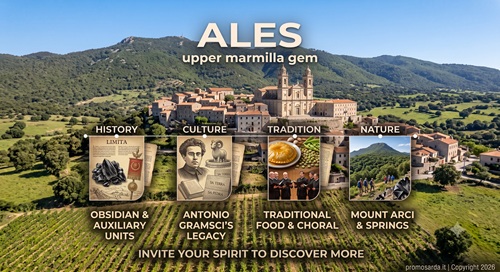
Located at the eastern slopes of Mount Arci, Ales is a historic center in upper Marmilla, long recognized as a regional hub due to its ancient episcopal see—traditionally one of the smallest bishoprics in Italy.
The Region of Marmilla
Marmilla is a geographic area in south-central Sardinia defined by rolling hills, volcanic plateaus (giare), and agricultural valleys. Prominent features include Mount Arci—a major prehistoric source of obsidian (volcanic glass)—and the basaltic tablelands of Gesturi, Siddi, and Serri.
Overview of Ales
Situated at an altitude of 194 meters above sea level, Ales features an undulating terrain extending from the plain toward the wooded slopes of Mount Arci. The municipality includes the hamlet of Zeppara.
The local economy combines traditional agriculture (cereals, olives, citrus, wine grapes, legumes) and livestock farming with small-scale industries in building materials, food production, woodworking, and jewelry crafting. Mount Arci’s natural heritage and extensive obsidian deposits attract cultural and environmental tourism.
Name Origins
-
One hypothesis suggests the name derives from the Greek alex (àleco), referencing the grass pea (cicerchia) historically grown in the area.
-
Linguist Massimo Pittau suggests the name derives from the Latin accusative plural alas (“wings”), possibly referring to auxiliary military units (alae) stationed in the area during the Roman era to protect vital trade roads and grain fields from mountain raiders.
Cultural Traditions & Events
Historical Figures
Ales is the birthplace of Antonio Gramsci (1891–1937), the influential political theorist, philosopher, and founding member of the Communist Party of Italy. Gramsci’s intellectual legacy, including his landmark Prison Notebooks (Quaderni dal carcere), is commemorated locally through dedicated public spaces, monuments, and annual literary awards.
Local Festivals
Community celebrations and cultural traditions in Ales and Zeppara include:
-
Il Paese dei Balocchi (Early January): A children’s festival held at the Museum of Traditional Toys in Zeppara.
-
Feast of San Sebastiano (January 20): Commemorated with traditional evening bonfires, religious processions, communal suppers, and folk dancing.
-
Gramsci Literary Prize & Commemorations (January 22 & April 27): Cultural events marking Antonio Gramsci’s birth and death.
-
Feast of San Simeone (February 18): The patronal festival of Zeppara, celebrated with bonfires and folk dancing.
-
Feast of Sant’Isidoro (April 4): Celebrated in Zeppara with agricultural blessing rites.
-
Feast of Sant’Antioco: Celebrated in Zeppara two weeks after Easter with concerts and community gatherings.
-
Sa Die de Sa Sardigna (April 28): Marked by local historical and cultural activities.
-
S’Infrorada (Corpus Domini): A spring tradition featuring floral decorations.
-
Patronal Feast of Saints Peter and Paul (June 29): The town’s primary religious celebration, featuring solemn liturgical rites, polyphonic choral performances, folk processions, and traditional launeddas music.
-
Feast of Santa Maria della Neve (First Saturday of August): Marked by a community pilgrimage to the rural sanctuary at Acquafrida on Mount Arci.
-
Feast of Santa Maria (September 8): Held at the historic Church of Santa Maria, featuring traditional costume processions on horseback, evening bonfires, and devotional songs (Goccius).
Architecture and Monuments in Town
The urban plan of Ales reflects its long-standing status as an episcopal see, featuring 19th-century granite townhouses, administrative centers, and a historic cathedral quarter perched above the town.
Key Highlights in Town
-
Cathedral of Saints Peter and Paul (Cattedrale dei Santi Pietro e Paolo): Built in baroque style between 1684 and 1686 over the ruins of an earlier 11th-century church demolished by a tower collapse in 1683. Designed by Genoese architect Domenico Spotorno and completed by Ignazio Merigano, it features a grand twin-towered facade with a central dome, a raised terrace with a double staircase flanked by stone lions, polychrome marble altars, 18th-century wood carvings, and interior cupola frescoes.
-
Piazza Antonio Gramsci (Piano d’Uso Collettivo): A triangular public square created in 1977 by sculptor Giò Pomodoro as a functional “anti-monument”. Constructed using local Masullas limestone, Mogoro basalt, and Trani stone, it features a sunken communal hearth, a stylized ram fountain, a millstone, and stone slabs inscribed with fundamental Sardinian words (Sa terra, S’agua, Su fogu, Sa pedra, Su soli, Sa luna, Sa roda).
-
Oratory of Nostra Signora del Rosario (Sa Cappelledda): Completed in 1721, this single-nave chapel features a green limestone trilitic doorway, a twin bell gable, and an ornate gilded baroque-renaissance altarpiece housing a historic wooden statue of the Virgin of the Rosary.
-
Episcopal Palace (Episcopio): Built in 1834 to replace an older single-story bishop’s residence, this four-level palace houses diocesan administration offices, private chapels, and residence quarters.
-
Tridentine Seminary & Diocesan Museum of Sacred Art: Housed in the historic seminary building, this museum displays religious artifacts, silver liturgical collections, historic vestments, and wood sculptures from across the diocese. It also preserves the Diocesan Historical Archive, containing over 600 administrative volumes dating from the 16th to 19th centuries.
-
Church of Santa Maria: Situated at the opening of the Rio Mulinu valley, this historic chapel is believed to have served as the temporary seat of the cathedral when the bishopric moved from Usellus around 1180.
-
Church of San Sebastiano Martire: Built in 1663 as a votive chapel following the plague of 1652 and expanded in 1724. It features a double-curved upper facade profile mirroring the nearby cathedral and exposed local yellow stone arches.
-
Gramsci Birthplace Historic Site & Museum: Located along Corso Cattedrale, housing the Antonio Gramsci Birthplace Association.
-
Town Hall (Municipio) & Film-Photography Museum: The municipal building houses a permanent exhibition of historic photographs of Ales alongside a specialized museum of antique cinema projectors, cameras, and film equipment.
-
Municipal Sports Grounds: Includes a public grass soccer field, indoor gymnasium, tennis courts, and basketball/volleyball facilities associated with local schools.
The Hamlet of Zeppara
Located just northeast of the main town, Zeppara is an agricultural hamlet that operated as an independent municipality until its incorporation into Ales in 1927.
Key Highlights in Zeppara
-
Parish Church of San Simeone Vescovo: A late 16th-century Catalan-Gothic church—the only church in Sardinia dedicated to Saint Simeon, second Bishop of Jerusalem. It features a single nave, rib-vaulted side chapels, carved stone holy water fonts, and a 1933 bell tower.
-
Museum of Traditional Sardinian Toys (Museo del Giocattolo Tradizionale): Housed in a former elementary school, this specialized ethnographic museum displays traditional handcrafted toys from across Sardinia and features an educational workshop space.
-
Zeppara Sports Center: Features a synthetic turf mini-soccer and tennis facility with spectator seating.
Surrounding Archaeological & Historic Sites
The countryside surrounding Ales preserves evidence of human occupation dating from the Neolithic era through the Middle Ages.
Archaeological & Cultural Landmarks
Castle of Barumele (Castello di Barumele)
Situated on the slopes of Barumele Hill, these ruins represent a key 13th-century fortification of the Judicate of Arborea. Built to defend the border with the Judicate of Cagliari, the site contains prehistoric obsidian flakes, Byzantine ceramic traces, a thick perimeter wall, and a polygonal defense tower later owned by the Aragonese Carroz family.
Sanctuary of Nostra Signora della Neve (Acquafrida)
A rural chapel set in dense oak forest at the Acquafrida spring on Mount Arci. Reconstructed in 1987 near the unlocated ruins of an earlier votive chapel, its rough-cut stone facade incorporates volcanic basalt blocks and large prehistoric obsidian flakes.
Other Prehistoric Sites
The surrounding territory includes the corridor-nuraghe Padroriu, single-tower nuraghi such as Bruncu Perda Calloni and Pranu Espis, and complex Nuragic structures including Gergui and Otzibi.