Albagiara and the Marmilla Region
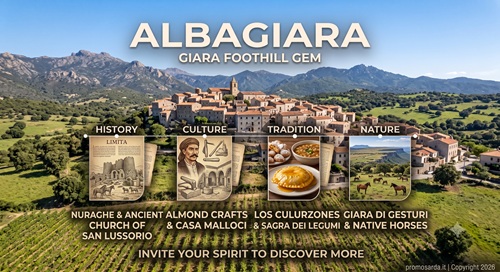
Situated at the foot of the Giara di Gesturi plateau, Albagiara is a small hillside municipality located in the northern Marmilla region.
The Region of Marmilla
Marmilla is a geographic region in south-central Sardinia characterized by rolling hills, volcanic plateaus (giare), and agricultural valleys. Prominent geological formations include the Giara di Gesturi, the Giara di Siddi, and the Giara di Serri—flat basaltic tablelands with steep, cliff-like edges that create a striking landscape.
Overview of Albagiara
Situated at an elevation of 215 meters above sea level, Albagiara features an undulating terrain spanning the foothills of the Giara di Gesturi.
The local economy is centered primarily on agriculture, including the cultivation of wheat, cereals, vegetables, wine grapes, olives, and almonds—the latter forming a key ingredient in traditional local confectionery. Small-scale local industries include food processing, construction, and woodworking. Nearby woodland areas, such as Su Padenti, feature dense stands of cork and holm oaks that provide a natural habitat for native Sardinian horses.
Name Origins
-
Historically named Ollasta Usellus (from Ollastra, referencing wild olive groves), the village adopted its current official name, Albagiara, in 1964 following a local referendum.
-
The modern name combines the Sardinian term Giara (basalt plateau) with Arbu or Arvu (“white”), poetically evoking the sunrise over the nearby plateau.
Traditions & Events
Local Festivals
Community celebrations and cultural traditions in Albagiara include:
-
Feast of San Sebastiano Martire (January 20): The town’s patronal festival, commemorated on the eve with the ceremonial blessing and lighting of a large bonfire, traditional folk dancing, music, and communal suppers.
-
Carnival (Carrasegare): Features parades of decorated floats, traditional costume disguises, and public street dancing.
-
Sagra dei Legumi (Mid-May): A regional culinary festival and trade fair (Mostra Mercato di Arti, Mestieri e Prodotti Tipici) featuring artisan exhibitions, traditional music performances, and public tastings of traditional legume dishes.
-
Feast of Sant’Isidoro (May 15): A festival celebrating the patron saint of farmers and agricultural workers.
-
Feast of Saints Peter and Paul (June 29): A traditional religious commemoration.
-
Feast of San Lussorio Martire (September 23): Celebrated at the parish church in memory of an early Christian martyr historically venerated in the area.
Architecture and Monuments in Town
The historic core of Albagiara is built primarily with traditional stone masonry and features classic Campidanese architectural elements, such as arched covered loggias (lollas) and historic stone entry gateways.
Key Highlights in Town
-
Parish Church of San Sebastiano Martire: Constructed between 1615 and 1621 on medieval foundations, this parish church features a single nave with diaphragm arches, Gothic rib-vaulted side chapels, and a restored 18th-century carved wooden main altar. The interior houses 17th-century stone holy water fonts and historic silver liturgical items.
-
Church of San Pietro: A 16th-century late-Gothic church located in the historic San Pietro district. Originally serving as the town’s primary parish church until the early 17th century, it was renovated in 1690 and now stands within the historic monumental cemetery.
-
Historic Monumental Cemetery: A 15th- to 16th-century burial ground surrounding the Church of San Pietro.
-
Casa Malloci: A preserved 19th-century Campidanese agricultural home showcasing traditional rural architecture, an inner courtyard with an ancient press and stone mill, and spaces designed for ethnographic exhibition.
-
Town Hall (Municipio): Located on Via Cagliari, housing local administrative offices.
-
Piazza del Mercato & War Memorial: A public square featuring a marble obelisk monument erected in 1978 to commemorate fallen soldiers from all world wars.
-
Municipal Sports Grounds: Includes a local grass mini-soccer pitch, tennis courts, a public bocce court, and indoor gymnasium facilities.
Surrounding Archaeological & Natural Landmarks
The surrounding countryside contains prehistoric Nuragic remains as well as traces of Roman and medieval occupation.
Archaeological & Historic Sites
Nuraghe San Lussorio
Located in a lowland area at the base of the Giara di Gesturi, Nuraghe San Lussorio is a complex multi-towered (polilobato) basalt nuraghe comprising a central main tower (mastio) and several outer secondary towers. The monument is surrounded by the overgrown remains of a large prehistoric hut village. Artifacts recovered from the site indicate continued habitation through the late Punic and Roman eras.
Ancient Church Site of San Lussorio
Situated near the nuraghe of the same name are the sparse ruins of an early medieval/Byzantine chapel dedicated to Saint Lussorius. Tradition holds that the chapel was erected at a site where the Roman officer and Christian martyr rested during his journey from Karalis (Cagliari) to Forum Traiani (Fordongianus).
Other Prehistoric Sites
-
Nuraghi: Additional Nuragic sites within the municipal boundaries include the single-tower nuraghi Furisinu and Procili, as well as the complex nuraghi Bingias and Lea.
-
New Municipal Cemetery: A modern burial ground constructed outside the urban center along Via Martiri di via Fani.