Asuni and the Upper Marmilla Region
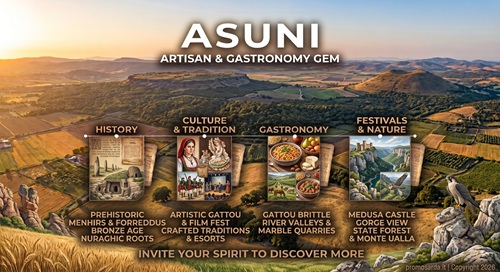
Situated at an elevation of 315 meters above sea level in the northern reaches of Upper Marmilla (Alta Marmilla), Asuni is a small rural municipality defined by an agro-pastoral economy and deep prehistoric roots. It borders the historic regions of Mandrolisai to the north and Sarcidano to the east.
The Region of Marmilla
Marmilla spans the boundary between the provinces of Oristano and South Sardinia. Upper Marmilla is characterized by rolling hills, volcanic plateaus, and river valleys. The region is bordered by the basaltic plateaus of Gesturi, Siddi, and Serri, as well as the distinctive round hill of Las Plassas, whose breast-like shape (marmilla) historically gave the subregion its name.
Overview of Asuni
Asuni’s territory lies enclosed within the valleys of the Rio Araxisi and its main tributaries, the Rio Bidissàriu and Flumini Imbessu. Elevations vary from 82 meters at the confluence of the rivers up to 589 meters on Monte Ualla.
The surrounding landscape features unique geological rock formations, including trachyte (used in local building construction) and Sardinia’s only natural marble deposits (pink marble and grey cipollino marble).
Name Origins
-
The name Asuni is of pre-Roman origin.
-
One theory suggests a Phoenician root (Asun), meaning “unhealthy or parched site,” possibly referencing an ancient fire that burned the early settlement.
-
Linguist Massimo Pittau links the topnym to the Roman family name (gentilizio) Asonius, indicating a Roman villa owner in the area.
Historical Background
-
Prehistory: Inhabited since the Neolithic and Nuragic periods, as evidenced by rock-cut tombs (domus de janas), proto-anthropomorphic menhirs, and nuraghi.
-
Middle Ages: Documented since 1189 as part of the Parte Valenza subdistrict (curatoria) within the Judicate of Arborea.
-
Aragonese & Feudal Eras: Following the collapse of Arborea in 1410, it passed through numerous feudal holdings. In 1753, the wealthy Marseille merchant Guglielmo Touffani purchased the territory, creating the County of Nureci and Asuni under King Charles Emmanuel III. Feudal rights were redeemed from the Touffani family in 1839.
Cultural Traditions, Festivals, & Gastronomy
Artistic Gattou (Sagra del Gattou)
-
Gattou: A traditional Sardinian brittle candy derived from historical local recipes and Spanish influence. While originally made with toasted chickpeas and sugar, modern Asuni gattou is made with toasted sliced almonds, sugar caramel, and lemon zest.
-
Sagra del Gattou Artistico Asunese (May): A dedicated festival celebrating the craft of making artistic gattou. Local women sculpt intricate floral arrangements and jewel-like compositions—resembling Capodimonte porcelain—by hand, gluing up to 300,000 almond slices together with caramelized sugar.
Key Annual Events
-
Feast of Sant’Antonio Abate (January 17): Winter gathering featuring neighborhood ceremonial bonfires lit on the eve of the feast.
-
Patronal Feast of San Giovanni Battista (June 24): Religious processions through the town streets alongside public cultural events.
-
Asuni Film Festival (July & September): A bi-annual cultural festival featuring a summer cinema competition followed by an autumn international gathering of poets, writers, musicians, and performers.
-
Feast of Santa Vitalia, San Daniele, & San Francesco (Mid-October): Asuni’s oldest traditional festival. Celebrated across three days with equestrian processions, armed escorts (fucilieri), folk groups, and religious services at local ruins.
Urban Landmarks and Architecture
Asuni retains a well-preserved rural layout characterized by traditional hill-town architecture built primarily using local trachyte stone.
Key Highlights in Town
-
Parish Church of San Giovanni Battista: Constructed in 1951 in Piazza Dante Alighieri. Features a simple plastered facade with a circular window, an adjoining square stone bell tower, and a single-nave interior with side chapels dedicated to the Sacred Heart and Saint Mary.
-
Town Hall (Municipio): Situated on Piazza Municipio, housing the administrative offices of the municipality.
-
Civic Amenities: Includes the municipal elementary school facilities (equipped with a synthetic turf multi-purpose sports field) and the municipal gymnasium on Via Roma.
Surrounding Prehistoric & Historical Heritage
Asuni’s countryside preserves an extraordinary concentration of Megalithic monuments, ancient rock-cut tombs, and medieval ruins.
1. Proto-Anthropomorphic Menhirs of Corongiu
Located south of the town, this megalithic group consists of three standing proto-anthropomorphic menhirs over two meters in height.
-
The first monilith stands isolated, while the second and third are closely aligned.
-
They represent an early transitional stage in prehistoric statuary where the head and body contours begin to take human form without full anatomical details.
2. Is Cirquittus Megalithic Alignment & Cromlech
Situated near the Laconi border on the slopes of Cuccuru Mandareddu:
-
The Alignment: Features a line of at least five proto-anthropomorphic menhirs. Highlights include a two-meter brown trachyte monolith and a yellow trachyte menhir carved with 135 cup marks (coppelle).
-
Astronomical Calendar Function: Academic surveys revealed that the megalithic alignment corresponds to astronomical lines connecting the sunrise of the summer solstice with the sunset of the winter solstice, as well as the winter solstice sunrise with the summer solstice sunset. The nearby cromlech (stone circle) functioned as an ancient sanctuary and calendar observatory.
3. Necropolis of Burdaga (Is Forreddus de Burdaga)
A prehistoric site featuring a complex of 17 domus de janas (rock-cut tombs) excavated into serpentine trachyte tuff platforms overlooking the valley:
-
Divided into two distinct clusters: a northern group of 13 tombs arranged at varying heights, and a southern group of 4 tombs planned in an amphitheater layout.
-
Features internal architectural carvings replicating the wooden structures of prehistoric homes, symbolic of rebirth through the Bull God and Mother Goddess. Individual tombs held up to 30 crouched burials.
4. Medusa Castle (Castello di Medusa / Castello di Ogliastra)
Perched on the cliff face of Sa Conca ‘e Su Casteddu overlooking the deep gorge of the Rio Araxisi, this medieval fortress ruin stands on the boundary between Asuni and Samugheo.
-
Of probable Byzantine origin, the quadrangular castle is partially carved directly into the natural limestone rock.
-
Surviving elements include multi-meter-high curtain walls, a watchtower, a cistern, and rectangular stone structures.
5. Ruins of the Church of San Daniele
Located in the countryside north of town, these stone ruins mark the historic site of the former chapel of St. Daniel, serving as the endpoint for annual October religious processions.