Aggius and the Gallura Region
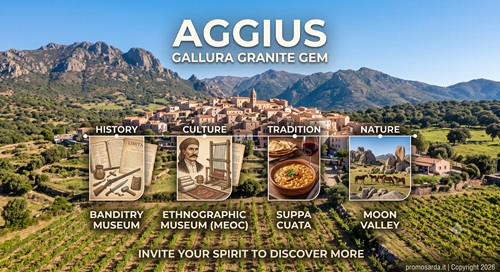
Aggius is a town recognized with the Bandiera Arancione (Orange Flag), an environmental and tourist quality mark awarded by the Touring Club Italiano.
The Region of Gallura
Situated at the northeastern tip of Sardinia, Gallura is bounded to the south by the granite massif of Mount Limbara, to the southwest by the Coghinas River, and to the southeast by Mount Nieddu. Historically one of the four medieval Sardinian Judicates (Giudicati), its modern economy revolves around tourism, the cork and granite industries, and agriculture.
The regional language is Gallurese, a Romance variety with strong links to southern Corsican while retaining historic influences from Logudorese Sardinian.
Overview of Aggius
Perched at an altitude of 514 meters above sea level on the slopes of Mount Sozza, Aggius sits between the Mount Limbara range and the jagged granite peaks known locally as the Resegone Sardo (the “Sardinian Saw”).
The local terrain ranges from low valley basins to elevations exceeding 900 meters. The economy relies heavily on granite extraction and processing, traditional cork harvesting, agriculture, livestock farming, and textile arts—specifically the hand-weaving of traditional Sardinian wool carpets.
Name Origins
Attested in historical documents since the 14th century in forms such as Alvargos, Abbarios, and Agios, the town’s name has several hypothesized origins:
-
From the Greek Aghios (meaning “holy” or “sacred”).
-
From the Latin Agnus (meaning “lamb”), referring to early pastoral settlements.
-
From the local term Ajus (“without law”), referencing the rebellious character of its historic inhabitants.
Gastronomy & Local Traditions
Aggius is celebrated for its traditional Gallurese cuisine, featuring dishes such as:
-
Zuppa Cuata (Suppa Cuata): The signature dish of Gallura, made with layered stale bread, fresh and aged cheeses, herbs, and warm broth, often served topped with a rich meat ragù (Ghisatu).
-
Mazza Frissa: A traditional cream made from cooked cream, semolina, and butter, served over fried bread.
-
Bruglioni & Chjusoni: Handmade cheese-filled ravioli and traditional Sardinian hand-rolled gnocchi.
Canto Aggese (Traditional Choral Singing)
Aggius is famous for Canto Aggese, a distinct polyphonic singing tradition performed during both religious liturgical rites and secular gatherings. The traditional style (A Tasgjia) features a precise four-part vocal arrangement—Tinori (tenor), Trippi/Tripli (third upper), Contra (counter/baritone), and Grossu (bass)—which together produce a natural acoustic illusion of a harmonic fifth voice in a higher octave.
Festivals and Events
Key events throughout the year include:
-
Holy Week (Settimana Santa): Features ancient liturgical chants performed by the historic Brotherhoods of the Rosario and Santa Croce, culminating in traditional Stabat Mater and Miserere renditions on Good Friday.
-
Feast of San Giovanni (June 23): Marked by the lighting of aromatic herb bonfires in designated granite plazas.
-
Summer Festival (Gran Festa d’Estate): Held on the last Thursday of July, showcasing local crafts (weaving, cork, iron, and wood) alongside food tastings and live music throughout the historic center.
-
Feast of Saint Augustine: Celebrated in late August with traditional horse-riding displays (pariglie).
-
Feast of the Bachelors (Festa di li ’Agghiani): Celebrated on the first Sunday of October, featuring communal meals of Zuppa Cuata and local wines.
-
Patronal Feast of Santa Vittoria & Madonna del Rosario: Celebrated in early October with religious processions and cultural festivities.
Architecture and Monuments in Town
The urban layout of Aggius is characterized by preserved granite houses, stone-paved streets, and natural granite outcrops integrated into the town structure.
Key Highlights
-
Historic Railway Station: A preserved late-19th-century granite terminal building located on the regional narrow-gauge railway line.
-
Granite Fountains (Cagadda & Alvinu): Historic public water springs constructed from granite blocks, situated within wooded public parks.
-
Church of Nostra Signora d’Itria: Built in the mid-18th century with exposed granite masonry, featuring a single-nave interior and an altar painting depicting the Virgin Mary.
-
Oliva Carta Cannas Ethnographic Museum (MEOC): Sardinia’s largest ethnographic museum, covering fifteen rooms housed in a traditional granite structure. It showcases rural Gallurese life, traditional crafts, domestic environments, and an extensive collection of historic textile looms.
-
Oratory of Nostra Signora del Rosario: Home to the historic Brotherhood of the Rosary, this 18th-century granite church features a three-nave layout, a polychrome altar, and an imposing square bell tower.
-
Parish Church of Santa Vittoria: Dating to 1536, this Romanesque-Baroque church features a Latin cross layout, a 1902 carved wooden baptistery, an 18th-century pipe organ, and a prominent 33-meter exposed-granite bell tower.
-
Oratory of Santa Cruz (Santa Croce): Built in 1709 by the Brotherhood of the Holy Cross, featuring a classic single-nave layout and a granite bell gable.
-
Museum of Banditry (Museo del Banditismo): Housed in the historic 19th-century courthouse building, this museum documents the history of outlawry and local feuds in northern Sardinia through archival records, historical weapons, and artifacts.
Surrounding Countryside & Natural Features
The landscape surrounding Aggius is defined by dramatic granite rock formations, cork oak forests, and elevated valleys.
Natural Features
The Resegone Sardo & Panoramic Ranges
The jagged granite ridge overlooking the town includes peaks such as Monte la Croce (668 m) and Monte Sozza (788 m), offering views over the surrounding cork forests and valleys. Nearby artificial bodies of water, such as Laghetto di Santa Degna, form tranquil natural habitats surrounded by Mediterranean vegetation.
Piana dei Grandi Sassi (Valle della Luna / Moon Valley)
A vast granite plateau dotted with massive wind-sculpted boulders (tafoni) and weathered granite monoliths. The sparse vegetation and stark geological formations give the valley a unique lunar appearance.
Archaeological & Rural Monuments
-
Nuraghe Nuracu d’Izzana: Located at the edge of the Moon Valley, this well-preserved granite complex represents a hybrid Nuragic architecture, combining corridor-nuraghe elements with traditional vaulted tholos chambers.
-
Church of San Pietro de Rudas: Built in 1803 over the ruins of a medieval church, featuring a classic rural layout with an external covered loggia (pultigali).
-
Church of Santu Iaccu (San Giacomo di Pitrischeddu): A rural granite chapel dating to the 18th and early 19th centuries, featuring internal granite arches and simple pastoral architecture.
-
Church of Santu Lusunu (San Lussorio): An 18th-century countryside chapel built on the hilltop of Pala di Monti.
-
Rural Hamlets (Bonaita & San Filippo): Small rural settlements featuring historic countryside churches, including the 1948 Church of Nostra Signora della Pace and the granite Church of San Filippo Apostolo.