Assolo and the Marmilla Region
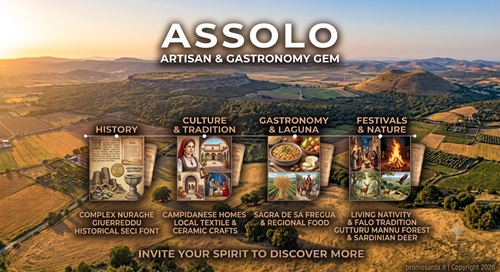
Situated at the foot of the Giara di Gesturi in the historical subregion of Marmilla, Assolo is a small hillside municipality surrounded by dense, centuries-old holm and downy oak forests.
The Region of Marmilla
Marmilla spans the border between the provinces of Oristano and South Sardinia. The region is defined by rolling hills, basaltic tablelands—including the Giara di Gesturi, Giara di Siddi, and Giara di Serri—and agricultural basins. The southern area is dominated by the distinctive round hill of Las Plassas, whose breast-like shape (marmilla) historically gave the territory its name.
Overview of Assolo
Assolo lies at an average elevation of 255 meters above sea level, with its municipal territory reaching up to 527 meters.
The local economy is predominantly agricultural and pastoral, focusing on cereal and wheat cultivation, forage, vineyards, olive groves, and orchards, alongside livestock farming (cattle, sheep, horses, and pigs).
Name Origins
-
The name Assolo (Sardinian: Assolu) is of obscure origin, likely dating back to the Proto-Sardinian period.
-
Alternative theories link the topnym to a Phoenician root (Hescel), meaning “wooded grove” or “wild area”.
Historical Background
-
Prehistory to Middle Ages: Inhabited since the Nuragic era, Assolo later belonged to the Judicate of Arborea under the subdistrict (curatoria) of Parte Valenza.
-
Aragonese & Feudal Eras: Following the collapse of Arborea in 1410, it passed under Crown control and was granted to various lords, including Luigi Ludovico Pontons (1417), the Botter family (1421), and Pietro Joffrè (1426). From 1432 onward, it was incorporated into the Barony of Senis, remaining under feudal tenure (latterly under the Nin Zatrillas family) until the abolition of feudalism in 1839.
Cultural Traditions & Gastronomy
Local Gastronomy & Living Nativity
-
Sagra de Sa Fregua (Mid-August): A summer gastronomic festival featuring market stalls (In Sa ‘ia de Is Potabis) and public tastings of traditional Sardinian fregula dishes.
-
Living Nativity Scene (Sulla via della Cometa): A Christmas theatrical reenactment featuring over two hundred costumed figures depicting the birth of Jesus along the historic streets of the town center.
Annual Festivals
-
Patronal Feast of St. Sebastian (January 20): Features ceremonial bonfires on the eve of the festival, a morning procession with the saint’s pierced statue, traditional street dancing, and the “Cake for San Sebastiano” culinary contest.
-
Feast of Sant’Isidoro (May 15): Honors the patron saint of farmers with a procession accompanied by decorated ox- or tractor-drawn carts (traccas).
-
Countryside Feast of Santa Lucia (Third Sunday of September): Begins with a procession transporting the flower-decorated statue of St. Lucy from the parish church to her countryside chapel, accompanied by traccas, traditional horseback demonstrations, and evening folk concerts.
Urban Landmarks and Architecture
Set against a continuous rocky wall backdrop, Assolo preserves a strong rural character characterized by traditional Campidanese courtyard houses featuring grand arched entry portals, internal courtyards, and wide covered loggias (lolle).
Key Highlights in Town
-
Parish Church of San Sebastiano Martire: Built in 1663 atop a natural hill in the center of town. It features a plastered facade with a crescent moon window and a single-nave interior flanked by two side chapels dedicated to Our Lady of the Assumption and Our Lady of Sorrows.
-
16th-Century Baptismal Font: Preserved inside the parish church, this chalice-shaped baptismal font carved out of marly limestone by Antonio Seci in 1589 stands nearly a meter tall. It originally belonged to the former Church of Santa Maria.
-
Municipal Buildings & Schools: Includes the Town Hall (Municipio) on Via Arborea and the local middle school complex equipped with multi-purpose sports courts.
Surrounding Archaeological & Historical Heritage
Assolo’s countryside preserves a dense concentration of Nuragic sites, ancient thermal ruins, and historical landmarks.
The Archaeological Area & Country Chapel of Santa Lucia
Located northeast of the town within an olive grove, this site showcases layered history spanning from the Nuragic to the early medieval periods:
-
The 13th-Century Chapel: Reconstructed in 1922 over medieval ruins, this three-nave church was built using spolia from a nearby Roman complex, including a Roman mortuary plaque embedded in its walls. It is surrounded by traditional pilgrim shelters (cumbessias).
-
Roman Thermal Complex: The chapel sits directly atop an ancient Roman bath house (thermae), partially incorporating its footprint. An apsidal structure attached to the rear wall marks the basin of a calidarium, flanked by rectangular rooms. The surrounding terrain contains an extensive Late Roman and Early Medieval necropolis.
-
Nuraghe Santa Lucia: Located just north of the chapel complex, this single-tower (monotorre) truncated conical nuraghe stands at an elevation of 219 meters, preserving a base of four courses of dry-laid stone blocks.
Nuraghi of Giuerreddu Hill
Southeast of the town, on the tableland of Colle di Giuerreddu facing the Giara plateau, two prominent nuraghi stand as historic lookouts over the northern valley:
-
Nuraghe Giuerreddu: A complex nuraghe standing at an altitude of 496 meters.
-
Nuraghe Giuerri Mannu: A single-tower nuraghe situated at 482 meters near the boundary with Nureci.
-
Sa Rutta ‘e Gruppìu: A natural cavity within the rock formations of the hill, tied to local folklore as the historical hideout of the 19th-century outlaw Agrippino Maxia (known as “Gruppìu”).
Additional Nuragic Sites
The surrounding countryside preserves numerous single-tower nuraghi, including Anadi, Anadi II, Fruscu, Guduri, Monte Figu, Moro, Mummuzzola, Orasasa, Palanuedda, Planu Narbonis, Porcilis, Pranu Serra, Sa Cirra, San Pietro, and Sassaioni.