Assemini
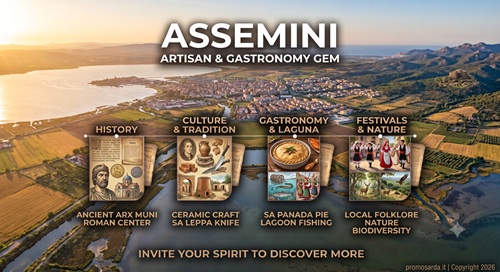
Situated in the lower Campidano plain just northwest of Cagliari, Assemini is an urbanized municipality within the Metropolitan City of Cagliari. It sits near the northern tip of the Santa Gilla lagoon and is bordered by the Cixerri, Flumini Mannu, and Sa Nuxedda rivers.
The Region of Campidano di Cagliari
The Campidano is a broad lowland plain running approximately 100 kilometers across southwestern Sardinia. Formed by the infilling of a Tertiary geological depression, its southern sector—the Campidano di Cagliari—opens onto the Gulf of Cagliari. It is characterized by alluvial soils, coastal salt lagoons, and intensive agricultural output, including wheat, olives, citrus, and wine grapes.
Overview of Assemini
Located at an average altitude of 7 meters above sea level, Assemini spans both lowland plains and rugged hinterlands. While part of the metropolitan urban area, Assemini maintains distinct agricultural, industrial, and artisanal identities.
Name Origins
-
Historical documents record the name Assemini starting in 1107.
-
Early theories suggested a Latin compound (Arsum Semen, meaning “parched seed”) or Punic coinage (Ascemiu).
-
The prevailing hypothesis points to a cartographic reference on Mercator’s 1589 map of Sardinia, which identified a fortified site called Arx Muni (later evolving into Arse Muni and Arsemini).
Historical Background
-
Prehistory to Antiquity: Inhabited since the Neolithic (Ozieri culture) and Nuragic periods, the area yielded Punic coins and later grew into an important Roman agricultural settlement.
-
Byzantine Era: Leaving significant structural heritage, most notably the 10th- to 11th-century Church of San Giovanni.
-
Judical and Feudal Eras: Incorporated into the Civita subdistrict (curatoria) of the Judicate of Cagliari. Following the fall of the Judicate in 1258, feudal control passed successively to the Counts of Della Gherardesca, the Republic of Pisa, the Damiano family, and later Spanish feudal houses (the Carroz, Centelles, and Osorio de la Cueva families).
Traditions, Crafts, & Gastronomy
Assemini holds official recognition as a center of ancient pottery traditions and distinct regional gastronomy.
The Ceramic Tradition (Strexiaius)
Ceramic production in Assemini dates back to prehistoric times, as evidenced by Neolithic and Punic vessel fragments found in the Sant’Andrea district.
-
The Workshops (Strexiaius): Pottery was traditionally made inside open courtyard workshops equipped with clay extraction wells, decanting basins, wheels, drying sheds, and cylindrical wood-burning kilns.
-
Guilds & Modern Era: Medieval trade guilds (Gremi) strictly regulated shapes and decorative motifs. During the Spanish period, pottery making integrated into the courtyards of Campidanese homes. Today, the town features active artisan studios, a municipal Pilot Center for Ceramics, and a permanent exhibition space housing over 250 historic ceramic pieces.
Traditional Knife Making
Assemini is one of Sardinia’s recognized centers for hand-forged knives (Sa leppa or S’Arresoja). According to island custom, receiving a handcrafted knife symbolizes a wish for a prosperous future by “severing past ties”; tradition dictates that the recipient gives a small coin in return so as not to “cut” the friendship.
Local Gastronomy
-
Sa Panada: Assemini’s signature dish—a round, unleavened pie dough crust filled with seasoned ingredients, sealed with a braided edge (spighitta), and baked in a wood-fired oven. Traditional fillings include lamb/kid with potatoes or peas, or wild eel with potatoes (reflecting historical lagoon fishing traditions).
-
Su Coccoi: A traditional hard-wheat decorative bread crafted for daily consumption as well as religious festivals.
Key Annual Events
-
Festa di Santa Lucia (First Sunday after Easter): Local feast centered around the 19th-century Santa Lucia chapel.
-
Sagra della Mietitura & Sant’Isidoro (Mid-June): Traditional wheat harvesting festival.
-
Festa di San Giovanni Battista & Sagra della Pecora (Late June): Religious feast paired with a traditional mutton culinary festival.
-
Patronal Feast of St. Peter & St. Paul (June 29): Solemn religious services and public celebrations honoring the town’s patron saints.
-
Ethnodanza & Is Pariglias (Late July): International folklore and identity dance festivals showcasing global cultural ensembles alongside the traditional local bell dance (Sa Solidali).
-
Matrimonio Tipico Asseminese & Festa di San Cristoforo (Late July/August): Reenactment of a traditional Campidanese wedding conducted entirely in the Sardinian language, where bride and groom are symbolically linked with chains by witnesses.
-
Sagra de Sa Panada (Early September): Culinary festival held in the municipal amphitheater celebrating the local pie dish.
-
Festa di Sant’Andrea & Sagra del Pesce (Third Weekend of September): Procession and fish roast organized near the historic country chapel of Sant’Andrea.
Architectural Heritage & Urban Landmarks
Traditional Campidanese Architecture
Assemini preserves numerous examples of traditional Campidanese houses (case campidanesi). Built using sun-dried mud-and-straw adobe bricks (làdiri), these multi-story dwellings feature:
-
A large vaulted outer gate.
-
A central courtyard historically housing wells, grain mills, and pottery kilns.
-
An arched ground-floor covered porch (lolla) functioning as a hallway and outdoor living space.
Key Highlights in Town
-
Byzantine Oratory of San Giovanni Battista: Built between the 10th and 11th centuries, this small limestone church is a rare example of Middle Byzantine architecture in the Mediterranean. Designed as an inscribed Greek cross within a 10-meter square, it features a central dome over an octagonal drum, barrel-vaulted arms, and 10th-century Greek inscriptions citing early Sardinian rulers (Arkontes).
-
Parish Church of San Pietro Apostolo: Originally built in the 11th century and reconstructed during the 16th century in Catalan-Gothic style. Features a square-to-hexagonal bell tower, a flat crenellated facade, a single-nave interior with late Gothic side chapels, and 18th-century exterior modifications.
-
Church of the Beata Vergine del Carmine: Modern parish complex constructed between 1973 and 2000 to replace a small 1900 stone chapel located in the historic Carmine district. Includes a 27-meter bell tower.
-
Church of Santa Lucia: Built around 1820 near the town cemetery, featuring a three-nave layout under a barrel vault, a small rose window, and an arched bell gable.
-
Church of San Cristoforo: A modest rectangular chapel documented in the early 19th century as having served temporarily as a local surgical and dental shop.
-
Church of Sant’Andrea Apostolo: An 18th-century rural chapel now incorporated into the town, featuring a five-column front porch (lolla).
-
Civic Architecture & Amenities: Includes the modern Town Hall on Piazza della Repubblica, the adjacent Municipal Amphitheater, the historic Old Town Hall on Piazza San Pietro, and the Terracotta Public Park.
-
Transport Links: Served by three railway stations along the Sardinian trunk line: Assemini main station (opened 1871), Assemini Carmine, and Assemini Santa Lucia.
Surrounding Countryside & Natural Sites
-
Gutturu Mannu Valley: A deep forested gorge situated within the Sulcis Regional Park. An isolated administrative enclave of Assemini, this valley contains dense oak forests that harbor endangered species such as the Sardinian deer (Cervus elaphus corsicanus) and golden eagle. Roman-era road remnants along the Flumini Mannu suggest ancient connections between local settlements and the Punic-Roman port of Nora.
-
Is Fanebas Nuraghe: Archaeological site preserving the stone ruins of a complex Nuragic fortress situated in the forested hinterland.
-
Outlying Hamlets: Rural sub-districts including Macchiareddu (industrial and agricultural district), Truncu Is Follas, Sa Traia, Terrasili, Su Carroppu, and Sant’Andrea.