Arzachena and the Gallura Region
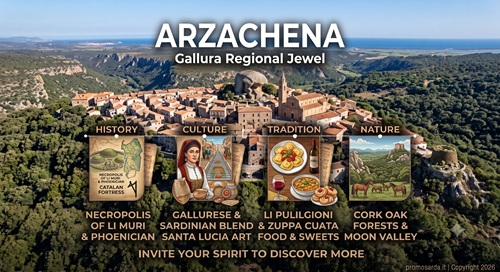
Situated on and around granite hills in northeastern Sardinia, Arzachena is the most populous municipality in inland Gallura after Olbia and Tempio Pausania. It serves as a major agricultural, commercial, and tourism hub.
The Region of Gallura
Gallura (Gaddùra in Gallurese, Caddùra in Sardinian) occupies the northernmost tip of Sardinia, bounded by Mount Limbara to the south, the Coghinas River to the southwest, and Mount Nieddu to the southeast. Historically organized as one of the four medieval Judicates (Giudicato di Gallura), the region is defined by granite rock formations, cork oak forests, and a distinct culture where the Gallurese language—closely related to southern Corsican—is spoken alongside Sardinian.
Overview of Arzachena
Situated at an average elevation of 83 meters above sea level, Arzachena sits among eroded granite ridges and oak-covered hillsides.
The municipal economy, historically rooted in pastoralism and agriculture (stazzi culture), transitioned in the mid-20th century toward high-end coastal and inland tourism. Additional industries include granite extraction, boat building, craftsmanship, and viticulture—notably the production of DOCG Vermentino di Gallura wines. Arzachena is also an official member of the national network Città del Vino.
Name Origins
-
The town’s name has ancient Proto-Sardinian origins.
-
Historical documents attest the spelling Arsaghene as early as 1421 in a feudal land charter granted by King Alfonso V of Aragon.
-
In Roman times, the settlement near the Mushroom Rock was recorded as Turibulum (Turibulum Maior and Turibulum Minor). During the Judical period, it served as the administrative center (Arseguen) for the Unale subdistrict (curatoria).
Cultural Traditions & Gastronomy
Local Gastronomy
-
Zuppa Cuata: Traditional Gallurese baked bread casserole layered with cheese and savory broth.
-
Li Pulilgioni: Sweetened ricotta- or cheese-stuffed ravioli served with tomato sauce.
-
Li Fiuritti & Li Chiusoni: Fresh handmade egg pastas and hand-rolled gnocchi.
-
Local Meats & Sweets: Roasted suckling pig (porcetto), spit-roasted lamb, fresh pecorino and ricotta cheeses, and honey-based desserts.
Local Festivals
-
Patronal Feast of Our Lady of the Snow (Madonna della Neve) (Second Sunday of September): Major religious and civic celebration featuring solemn masses, processions, folk music, and traditional games.
-
International Folklore Festival (Mid-July): An international gathering of cultural groups showcasing Sardinian and global heritage, traditional crafts, and local gastronomy (Arzachena nel piatto).
-
Countryside Cussorgia Festivals (May–October): Traditional seasonal feasts organized in rotation by local rural families (cussorgia) at outlying country chapels, including celebrations for St. Michael, St. John, St. Francis, and St. Mark.
Urban Landmarks and Architecture
Arzachena’s historic core is built entirely along the slopes of a granite hill, characterized by granite-walled stone houses, pastel facades, and stepped pedestrian lanes.
Key Highlights in Town
-
The Mushroom Rock (Roccia del Fungo / Monti Incappidatu): An enormous natural granite monolith eroded by wind and water into the distinct shape of a mushroom. Known in Roman antiquity as Turubulus Maior, prehistoric tools found at its base indicate it served as an ancient rock shelter and lookout point.
-
Old Church of Santa Maria Maggiore (Tempio Vecchio): Originally constructed in 1716 out of exposed granite blocks near a former cave chapel, this church served as the town’s early parish center. Expanded in 1776 and 1864, it features a prominent square granite bell tower, carved granite holy water stoups (1885), and a historic wooden crucifix.
-
New Parish Church of Santa Maria della Neve (Tempio Nuovo): Located on Piazza Pio XII, this modern concrete and granite parish church was constructed between 1959 and 1993 to accommodate the growing population. It features a five-arched porch, twin roof spires, and a broad single-nave interior with a surrounding matroneum gallery.
-
Church of San Pietro: Rebuilt in 1934 on the site of an earlier chapel documented since 1776 as a pastoral burial house. Restored in 1999, it houses an 18th-century carved wooden statue of St. Peter seated on a throne.
-
Church and Steps of Santa Lucia: Situated on a granite hill overlooking the town center, construction began in 1926. It is best known for its long, 76-step monumental staircase (Scalinata di Santa Lucia), which is regularly decorated with temporary public art installations.
-
Ethnographic, Mineralogical, and Paleontological Museum: Located on Via Mozart, housing extensive collections of local fossils (ranging from Archaeocyatha to trilobites) and regional mineral specimens from Sardinia and abroad.
-
Town Hall (Palazzo Municipale): Situated near Piazza Risorgimento on Via Firenze.
-
Sports Facilities: Includes the Corra Cilvuna sports citadel, featuring the Biagio Pirina stadium, tennis complexes, and athletic tracks.
Surrounding Archaeological Heritage
Arzachena contains one of the most concentrated and important prehistoric archaeological networks in Sardinia.
Prehistoric & Nuragic Sites
Necropolis of Li Muri
A major Middle Neolithic burial complex associated with the San Ciriaco / early Ozieri cultural facies (c. 4200–4000 BC). It consists of four circular stone-lined tumuli (tombe a circolo) surrounding central rectangular stone cists (ciste litiche), an allée couverte gallery tomb, standing menhirs, and two proto-anthropomorphic menhirs. Excavations yielded polished hardstone axes, flint blades, steatite necklace beads, and a green steatite cup.
Tomb of the Giants of Li Lolghi (Li Longhi)
Located near Li Muri, this granite megalithic collective tomb measures 27 meters in total length, making it one of the largest on the island. It features an intact curved forecourt (esedra) of upright slabs, a 3.7-meter central arched stele, and a covered barrel-vaulted burial corridor built over an earlier Bronze Age gallery tomb.
Tomb of the Giants of Coddu Vecchju
Situated in the Capichera valley, this late Bronze Age tomb features a central centined stele standing over 4 meters high—the tallest recorded in Sardinia. The monument represents a multi-phase construction, expanding an early allée couverte with a semi-circular paved esedra oriented eastward toward the equinoctial sunrise.
Nuraghe La Prisgiona
A complex Nuragic fortress set on a granite outcrop in Capichera. It consists of a central main tower (tholos vault), a two-towered fortified curtain wall, a deep stone-lined draw well (7 meters deep), and an extensive surrounding village containing over 90 stone huts, workshops, and food storage chambers (dolia).
Nuragica Megaron Temple of Malchittu
An archaic megaron-style rectangular temple (in antis) dating to the Early Bronze Age (Bonannaro culture). Built from unshaped granite blocks, it features a paved vestibule (pronao), an inner rectangular sanctuary with stone benches, a central stone fire hearth, and a curved end apse for ritual offerings.
Protonuraghe Albucciu
An unusual corridor-type / pseudo-nuraghe built directly against a massive natural granite wall. Features a two-story interior, an elevated linteled entrance with a discharge window, projecting stone cantilever brackets (mensoloni) on the upper facade, and an internal stair leading to a paved roof terrace.
Tomb of the Giants of Moru
Located near Nuraghe Albucciu, this granite row-built tomb (tomba a filari) was constructed over an earlier gallery tomb. Excavations uncovered a stone blocking slab incised with a Phoenician/Punic-style letter daleth.
Countryside Sanctuaries and Rural Hamlets
-
Church of Santu Paulu Calta (San Paolo Eremita): Built between 1909 and 1911 in La Piredda, set within a grove of ancient holm oaks. Features stone picnic altars and hosts traditional pastoral gatherings.
-
Church of Santu Ghjuanni d’Alzachena (St. John the Evangelist): Situated along the banks of the San Giovanni River. Built around 1744, it holds a marble altarpiece statue depicting St. John in a boiling oil cauldron (attributed to the Bernini school).
-
Church of Santu Micali d’Alzachena (San Michele Arcangelo): A late 18th-century single-nave country chapel built near San Pantaleo, traditionally associated with an ex-voto offered by locals freed from pirate captivity.
-
Church of Santu Lucca di l’Agliuledda: A country chapel in Capichera constructed around two natural granite monoliths that support its front portico.
-
Rural Hamlets: Outlying agricultural districts include Santa Teresina (home to a modern chapel and countryside cemetery), Monticanaglia, Cuncosu, Braniatogghiu, and Mulino di Arzachena (featuring a preserved early 20th-century watermill along the San Giovanni River).