Aritzo and the Barbagia di Belvì Region
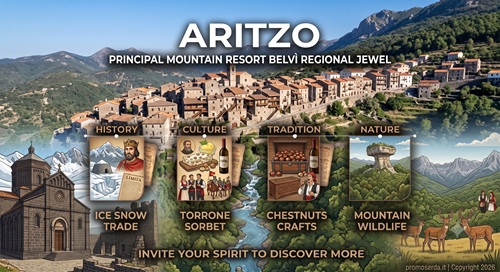
Nestled on the slopes of the Gennargentu mountain range at an elevation of 800 meters above sea level, Aritzo is the principal mountain resort and main urban center of the historic Barbagia di Belvì region.
The Region of Barbagia di Belvì
Barbagia di Belvì (Barbàgia de Brevìe) forms the central district of the greater Barbagia area, positioned between Mandrolisai to the north, Sarcidano, and Barbagia di Seulo to the south. Historically organized as a subdistrict (curatoria) of the medieval Judicate of Arborea, it is renowned for its vast chestnut forests, holm oak woodlands, and traditional mountain pastoral culture.
Overview of Aritzo
Perched on the lower ridges of Punta Funtana Congiada, Aritzo is famous throughout Sardinia as a summer and winter mountain resort.
The local economy combines mountain agriculture (cereals, olives, fruit orchards), livestock raising, and food production—notably goat cheeses, Sardinian nougat (torrone), and savoiardi-style biscuits. The town is equally celebrated for its woodcraft, specifically hand-carved chestnut storage chests (cascie or cassapanche).
The Snow Trade & Sa Carapigna
Aritzo holds a unique place in Sardinian history due to its centuries-old ice and snow trade.
-
Snow Harvest: Snow gatherers (niargios) collected winter snow in deep mountain pits lined with dry stone walls (domos de su nie or neviere) high on the Gennargentu peaks. The snow was packed with straw and ferns, forming solid ice blocks to be transported across the island during summer.
-
Sa Carapigna: A traditional lemon sorbet created using this harvested ice. It is prepared in a wooden tub (su barrile) packed with ice and rock salt surrounding a metal sorbet maker (sorbettiera) containing water, lemon juice, and sugar, which is manually rotated until frozen.
Name Origins
-
The town’s name features the characteristic Sardinian digraph TZ (representing a voiceless z).
-
Linguist Massimo Pittau suggests the pre-Roman name derives from the abundance of chestnut burs (ricci di castagne) that naturally cover the surrounding slopes.
Cultural Traditions & Events
Local Craftsmanship & Figures
-
Chestnut Wood Chests (Cascie): Intricately carved wooden trunks crafted by master Aritzo carpenters to store linen and bread.
-
Bachisio Sulis (1795–1838): Known as the “outlaw poet” (il bandito poeta), Sulis was an educated local figure and schoolmaster who spent twelve years as a fugitive after being falsely accused of a crime. He composed celebrated Sardinian-language poetry before his murder in the courtyard of Casa Devilla.
Local Festivals
-
Feast of Sant’Antonio Abate (January 17): Celebrated with a large ceremonial bonfire in Piazza de S’Erriu on the eve of the holiday.
-
Feast of San Michele Arcangelo (May 8): Patronal celebrations honoring Saint Michael the Archangel.
-
Feast of San Giovanni Battista (June 24): Midsummer festivities incorporating traditional propitiatory rites.
-
Feast of Santa Maria della Neve (August 5): A mountain pilgrimage to the countryside chapel of Santa Maria ‘e Su Nie.
-
Festa di Sant’Isidoro & Sagra de Sa Carapigna (Second Sunday of August): A festival dedicated to the traditional lemon sorbet, featuring live demonstrations, artisanal stalls, warm nougat, and local honey tastings.
-
Feast of San Basilio (First Sunday of September): A traditional gathering historically marking the departure of shepherds for seasonal transhumance, featuring greasy pole climbing competitions (Su Pinnone) and traditional devotional singing (gosos).
-
Chestnut and Hazelnut Festival (Sagra delle Castagne e delle Nocciole) (Late October): One of Sardinia’s major autumn festivals, drawing tens of thousands of visitors for roasted chestnuts, new wines, traditional crafts, and folklore parades.
Urban Landmarks and Architecture
The historic core of Aritzo features narrow, pedestrian-only alleys lined with unplastered schist-stone houses built with external timber staircases and broad chestnut balconies.
Key Highlights in Town
-
Parish Church of San Michele Arcangelo: Originally built in the 14th–15th century in Late Gothic style, with major Neo-Romanesque renovations between 1915 and 1919. Features a pink trachyte facade with a carved rose window, an 18th-century bell tower housing historic bells, a 1739 pipe organ, a 1606 wooden statue of St. Christopher by Antonio Gallo, and altarpieces painted by 20th-century Aritzo artist Antonio Mura.
-
Sa Bovida (Spanish Royal Prison): A 17th-century stone and chestnut-timber prison building featuring a pointed-arch underpass (Sa Bovida), cell blocks, and an internal courtyard with a sundial. Today it houses a permanent exhibit on Sardinian witchcraft (Bruxas), inquisitorial torture instruments, and historical engravings.
-
Casa Devilla & Chestnut Museum: An 18th-century manor house set around a trapezoidal stone courtyard, featuring a rock-cut ice pit (neviera) beneath its lower wooden floors. The manor houses the Museum of the Chestnut and Carved Chest, exhibiting local woodcraft and historical artifacts.
-
Castello Arangino: A Neo-Gothic manor built in 1917 in the style of a medieval castle, featuring a stone facade, pointed arches, ironwork gates, and an asymmetrical tower.
-
Antonio Mura Museum: Located in the former Municipal Building on Pratz ‘e Iscola, dedicated to the works and engravings of painter Antonio Mura (1902–1972).
-
Pastissu Municipal Park & Ecomuseum of the Sardinian Mountain: A wooded urban park of native chestnuts, oaks, and hollies housing the Ecomuseum. The museum displays over 3,000 ethnographic items, including traditional Barbagia costumes, animal carnival masks (Su Mamutzone, S’Ulzu), blacksmithing tools, and historic equipment used in the snow and sorbet trade.
-
Public Squares & Monuments: Includes Piazza Bastione e Belvedere (offering panoramic views toward the Tacco su Texile), Piazza de S’Erriu, and Piazza dei Caduti (featuring a marble war memorial statue).
Surrounding Natural & Archaeological Landmarks
Natural Monuments & Springs
-
Tacco su Texile (Meseddu de Texile): Recognized as a Regional Natural Monument, this isolated 975-meter limestone-dolomite plateau features a mushroom-like shape with sheer vertical cliffs set above dense forests. Prehistoric artifacts, Bronze Age pottery, and Roman coins have been discovered at its base.
-
Is Alinos Spring: A natural mountain spring surrounded by woods, known for its mineral waters and scenic views.
Rural Sanctuaries & Archaeology
-
Countryside Church of Santa Maria della Neve (Santa Maria ‘e Su Nie): Rebuilt in native schist stone atop a mountain ridge (Serra Santa Maria), serving as a pilgrimage destination along the historic paths used by snow gatherers.
-
Tomb of the Giants of Talanusè: A granite Nuragic collective tomb situated at 873 meters altitude, preserving its rectangular stone-lined burial chamber.
-
Tomb of the Giants of Su Carraxione: A well-preserved granite tomb featuring a ten-meter chamber and a nearby stone slab (Sa Perda ‘e Su Costiu), interpreted either as a Nuragic corridor protonuraghe remnant or a ritual offering altar.
-
Protonuraghe Sa Mecure: An archaic corridor-type nuraghe constructed from granite blocks atop a rocky bluff overlooking the Flumendosa River valley.
-
Domus de Janas of Seilatzu: A single-cell prehistoric rock-cut chamber tomb carved directly into a schist rock face near the Corruda Stream.