Arborea and the Campidano di Oristano Region
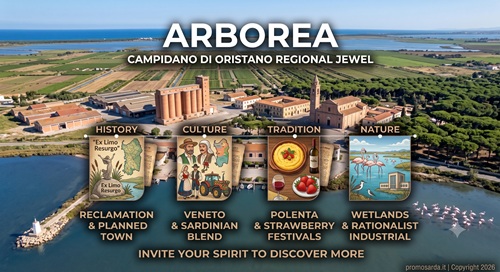
Founded during the 1920s land reclamation project of the Terralba plain, Arborea is a planned agricultural town situated in the Oristano plain (Campidano di Oristano).
The Region of Campidano di Oristano
The Campidano is a vast lowland plain in southwestern Sardinia extending roughly 100 kilometers between the Gulfs of Cagliari and Oristano. The Oristano subregion features coastal wetlands, agricultural plains irrigated by the Tirso River, and a rich biodiversity of waterfowl and aquatic habitats.
Overview of Arborea
Situated at an average altitude of 7 meters above sea level, Arborea lies on a flat coastal plain characterized by coastal lagoons, pine forests, and structured agricultural plots.
The town’s economy is heavily centered around dairy farming, agricultural co-operatives, food processing, and viticulture. Major local economic entities include:
-
Cooperativa Assegnatari Associati Arborea (3A): Sardinia’s premier dairy processor, producing milk, cheese, and butter products.
-
Cooperativa Pescatori di Arborea (C.P.A.): A major mussel-farming and fishing co-operative in the Gulf of Oristano, known for marketing Mediterranean mussels under the Nieddittas brand.
-
Agricultural Sectors: Cultivation of strawberries, watermelons, citrus, wheat, fodder, and Doc regional wines.
Name Origins
-
Built in 1928, the settlement was originally named Villaggio Mussolini and elevated to an independent municipality in 1930 under the name Mussolinia di Sardegna.
-
In 1944, following World War II, the town was officially renamed Arborea, referencing the historic medieval Judicate of Arborea (Arbarèi).
Cultural Traditions & Events
Due to its founding in the late 1920s, Arborea was settled largely by farming families resettled from the Veneto, Friuli, and Emilia-Romagna regions alongside local Sardinian families, creating a distinct cultural blend.
Local Festivals
-
Agricultural Fair & Strawberry Festival (Sagra delle Fragole): Held in late April or early May, celebrating local fruit production.
-
Infiorata (Corpus Domini): A religious tradition featuring intricate floral carpets laid along the streets near the parish church.
-
Feast of San Marco Evangelista (April 25): Celebrated in the Primo Centro Sassu hamlet.
-
Patronal Feast of Christ the Redeemer (Cristo Redentore): Celebrated on July 26 with a ceremonial blessing of decorated agricultural tractors, a formal procession, and floral displays.
-
Festa delle Etnie & Watermelon Festival (Sagra delle Angurie): Held in late July, highlighting regional dishes from the diverse settler communities.
-
Feast of the Assumption (August 15): Celebrated in the rural hamlets of Secondo Centro Sassu and Luri.
-
Polenta Festival (Sagra della Polenta): Held in late September and mid-November across the rural hamlets, celebrating Northern Italian culinary roots shared with sister communities in Veneto and Friuli.
Architecture and Urban Layout
Arborea presents an unusual architectural landscape: its urban plan combines eclectic Alpine, Umbertine, Neo-Romanesque, and Italian Rationalist styles within a completely flat, reclaimed marshland setting.
Key Architectural Styles & Designers
-
Giovanni Giuseppe Enrico Bianchi: Designed the parish church in a blend of Neo-Romanesque and Neo-Gothic forms.
-
Carlo Avanzini: Designed early civic and residential buildings incorporating Liberty, Umbertine, and historicist Alpine elements.
-
Flavio Scano: Applied functionalist and Deco-Futurist elements to industrial reclamation structures (such as water pumping stations and grain silos).
-
Giovanni Battista Ceas: Introduced formal Italian Rationalism to the town’s institutional buildings during the mid-1930s.
-
Nino Cerlienco: Designed post-WWII civic monuments and structural additions in local trachyte and basalt.
Civic & Industrial Landmarks in Town
-
Parish Church of Christ the Redeemer (Cristo Redentore): Designed in 1925 by Giovanni Bianchi in Neo-Romanesque/Neo-Gothic style. Features an asymmetrical facade, modern mosaic work, modern interior timber framing, and a bell tower inscribed with the town motto Ex limo resurgo (“From the mud I rise”). The altar display includes a painting of the Multiplication of the Loaves by Sardinian painter Filippo Figari.
-
Town Hall (Municipio): Constructed in 1931 by Carlo Avanzini in a late Liberty and Neo-Renaissance style, featuring solid trachyte masonry and a wood-carved council chamber.
-
Former Società Bonifiche Sarde Headquarters: An eclectic 1930 building designed by Carlo Avanzini inspired by 16th-century Venetian villas, incorporating rusticated stonework, modern friezes, and Decò accents.
-
Arborea Reclamation Museum (MUBA – Museo della Bonifica): Housed in the restored 1930s industrial grain mill (Mulino di Arborea), designed by Flavio Scano. Displays historical land reclamation documentation alongside an archaeological collection containing Bronze Age items from the Orrì sacred well and grave goods from the S’Ungroni necropolis.
-
Former Grain Silos & Enopolio: Historic industrial processing structures built in 1931. The 35-meter grain silo is undergoing conversion into a regional literary center, while the former winery (Enopolio) features basalt rustication and red-brick arch accents.
-
Casa del Balilla: A 1934 Rationalist building designed by Giovanni Battista Ceas featuring brick-faced entryways, circular port windows, and glass-block illumination panels.
-
Casa del Fascio: Built in 1934 by Ceas, featuring a square bell tower (Torre Littoria), alternating white plaster and exposed orange brickwork, and a recessed ground-floor portico.
-
Former M.V.S.N. Barracks: Designed in 1935 by Ceas in simple Rationalist style, now housing the Municipal Public Library.
-
Former Carlo Avanzini Hospital: Constructed in 1929 as a medical treatment center during the anti-malaria campaigns, now restored as a community center.
-
Piazza Santa Maria Ausiliatrice: The main central green square, home to a war memorial base topped by a two-meter Carrara marble statue of Our Lady Help of Christians, sculpted by Nicola Arrighini.
-
Executive Residences (Villa del Direttore & Villa del President): Eclectic 1930 private manors designed by Avanzini, set within wooded grounds and featuring Venetian single-light window rows, Greek-cross layouts, and Liberty friezes.
-
Civic Market: Built in the late 1920s by Avanzini as a concrete-frame market facility.
Outlying Hamlets & Industrial Architecture
The countryside surrounding the urban center is organized into planned agricultural hamlets (borgate or corti coloniche), each originally developed around a centralized steward house (Casa del Fattore):
-
S’Ungroni: Home to a historic 1920s steward residence and the nearby Barany Pine Grove.
-
Pompongias, Torrevecchia, & Linnas: Agricultural hamlets established during the 1920s reclamation, preserving original corporate farm architecture.
-
Primo Centro Sassu & Secondo Centro Sassu: Farming settlements established in the drained bed of the former Sassu Lagoon, featuring small countryside chapels dedicated to Saint Mark and the Assumption.
-
Luri: Hamlet containing a historic rural chapel and the Luri Water Pumping Station (Idrovora di Luri), built in 1930 by Flavio Scano.
Key Water Reclamation Engineering
-
Sassu Pumping Station (Idrovora di Sassu): Designed in 1931 by Flavio Scano and inaugurated in 1934. A landmark of Italian Rationalism and Futurist-inspired industrial engineering, it features a central block with semicylindrical side wings and geometric brickwork, designed to drain the 2,000-hectare Sassu marsh.
-
Coastal Forest Observation Tower: A 32-meter skeletal iron-and-concrete Rationalist watchtower designed in 1952 by Nino Cerlienco, set within the seaside pine forest.
Natural & Archaeological Features
Wetlands & Coastline
-
S’Ena Arrubia Lagoon: A protected wetland reserve of 1,870 hectares recognized under the Ramsar Convention. Formed from the undrained remnants of the Sassu marsh complex, it provides an estuarine habitat for pink flamingos, herons, and marsh birds.
-
Corru S’Ittiri Lagoon & Corru Mannu Pond: Coastal brackish lagoons bounded by sand spits and pine woods, forming protected Natura 2000 marine ecosystems utilized for sustainable fish and shellfish harvesting.
-
Marina di Arborea & Horse Country Resort: A ten-kilometer stretch of sand backed by a 400-hectare coastal pine forest planted in the 1930s as a windbreak against the Maestrale wind.
Archaeological Sites
-
Sacred Well of Orrì: The stone remains of an ancient Nuragic water temple featuring an entrance vestibule, access steps, and a circular spring chamber (tholos).
-
S’Ungroni Necropolis: A Roman burial ground discovered in 1868 containing subterranean tomb vaults, ancient coinage, lamps, and ceramic vessels.