Arbatax and the Ogliastra Region
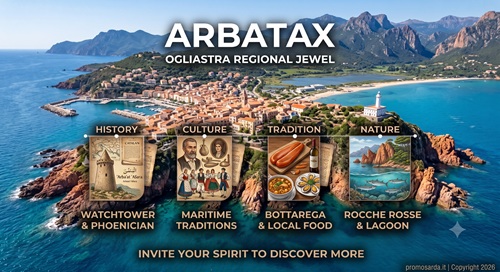
Situated on the slopes of the Capo Bellavista peninsula, Arbatax is a major maritime hamlet and port village in the Ogliastra region, famous for its red porphyry sea cliffs.
The Region of Ogliastra
Ogliastra is a region in eastern Sardinia defined by a rugged, wild landscape where steep granite and red porphyry mountains drop into deep gorges and crystal-clear coastal coves.
Overview of Arbatax
Arbatax lies along the central-eastern coast of Sardinia at an elevation of 10 meters above sea level, bordering the Tortolì Lagoon and overlooking the Tyrrhenian Sea.
Historically a small fishing settlement centered around coastal watchtowers, modern Arbatax serves as a key industrial, maritime, and tourist hub. Its economy is driven by commercial shipping, shipbuilding, fishing, and seasonal tourism.
Name Origins
-
One hypothesis attributes the name Arbatax to the Arabic arbaʿat ʿašara (“fourteen”), denoting the 14th coastal watchtower erected along the shoreline from the south during Spanish rule.
-
Another theory suggests a derivation from the Latin arbutus (“strawberry tree”), a plant common in the regional flora.
-
A third linguistic theory traces the name to a corruption of Boccàsara or Baccàsara, a historical site near the lagoon outlet.
Gastronomy
Arbatax and the neighboring lagoon yield high-quality seafood:
-
Grey Mullet Bottarga (Bottarga di Muggine): Premium cured fish roe harvested from wild grey mullet in the Tortolì Lagoon according to century-old traditions.
-
Local Catch: Lobster, bluefin tuna, swordfish, sea bream, and oysters harvested by the local fishing cooperative.
Cultural Traditions & Events
Local Festivals
-
Feast of San Giorgio (Mid-May): The patronal festival of the village, featuring processions with traditional instruments (launeddas, accordion), folk groups, and costumed horseback riders.
-
Arbatax Borgo Marinaro (June): A maritime festival highlighting historical connections with the island of Ponza, blending local and Ponza seafood traditions.
-
Feast of San Silverio (June 20): A traditional religious commemoration.
-
Sea Procession & Feast of Stella Maris (July): Celebrated during the third weekend of July in honor of Our Lady Star of the Sea; features a formal procession of boats in the harbor, seafood tastings, and floral offerings dedicated to those lost at sea.
-
Rocce Rosse Blues: An international music festival established in the 1990s, traditionally hosted against the backdrop of the red porphyry cliffs.
-
Sagra di San Gemiliano (Late August / Early September): Features a costumed parade with decorated ox-carts (traccas) escorting the saint’s statue from town to the seaside chapel.
-
Feast of San Lussorio & Feast of Santissimo Salvatore: Traditional late-summer countryside festivals.
Urban Landmarks and Architecture
Coastal Towers & Port Area
-
Torre di Arbatax (Torre di San Michele): A 16th-century truncated-conical watchtower constructed from granite and porphyry blocks to defend against pirate raids.
-
Port of Arbatax: A major maritime complex comprising a commercial ferry terminal, an industrial shipyard area, and a sheltered 80-berth marina.
-
Red Rocks (Rocce Rosse): Dramatic 15-meter-high cliffs of natural red porphyry emerging directly from the emerald sea near the port harbor plaza.
-
Capo Bellavista Lighthouse & Weather Station: Situated at an elevation of 156 meters on the Capo Bellavista headland, this historic 1866 square-section light tower and military meteorological station overlooks the entire coastline.
Churches and Civil Structures
-
Parish Church of San Giorgio Vescovo: Consecrated in 1997, this modern church features Byzantine architectural influences, an octagonal dome, stone column arcades, and relief artwork depicting Saint George.
-
Church of Beata Vergine Stella Maris: A 1966 rectangular port church featuring stone trim, a colorful glass rose window, and a standalone three-tiered stone bell tower.
-
Ruins of Nostra Signora d’Adamo: The remains of an 18th-century rural stone chapel built with a gabled facade and juniper-timber roof.
-
Former Railway Terminal: The late-19th-century terminal station overlooking the Cala dei Genovesi cove, serving as a seasonal terminus for the historic Trenino Verde heritage railway line.
-
Former Cartiera di Arbatax Site: The industrial remains of a massive 20th-century paper mill complex located in the Boccàsara industrial district.
Contemporary Outdoor Art (Su Logu de S’Iscultura)
-
Souvenir: A massive carved block of pink trachyte set in the port pine grove.
-
Nagjima: A yellow enamel steel four-pointed star sculpture set on a seaside lawn in Porto Frailis Square.
-
Giardino di Mirto: An outdoor installation combining granite beams, earthen mounds, and gravel along Porto Frailis beach.
-
Scultura 1995 & Scultura 2003: Contemporary outdoor installations located along Viale Europa, including a stylized iron bull’s head (protome taurina) monument.
Coastal Inlets and Beaches
Beaches North of the Headland
-
Spiaggia di Ponente: A sheltered sandy shore adjacent to the western port mole.
-
Spiaggia della Capannina: A long beach of pale sand backed by a dense pine forest separating the sea from the Tortolì Lagoon.
Beaches South of the Headland
-
Cala Moresca: A cove defined by red porphyry and granite cliffs, featuring a sheltered gravel-and-sand beach and clear, calm waters.
-
Porto Frailis: A horseshoe-shaped bay protected by two green hills, featuring fine golden sand and smooth granite rock formations.
-
San Gemiliano, Basaùra & Sos Flores: A long, continuous stretch of rice-grain coarse sand and clear waters running along coastal campgrounds and the former airport runway.
-
Lido di Orrì (S’Orologiu & Orrì): Wide expanses of fine golden sand interspersed with smooth, rounded sea-worn granite boulders.
-
Foxi Lioni (Musculedda): A large, clean beach of pale sand bounded by smooth granite outcrops.
-
Golfetto (Cala Ginepro / Muxì): A sheltered cove famous for white sand, shallow turquoise waters, and a shaded juniper grove.
-
Cea Beach (Is Scoglius Arrubius): A kilometer-long white sand beach famous for two 20-meter-tall red porphyry sea stacks (faraglioni) standing offshore.
Archaeological Heritage & Rural Sanctuaries
Prehistoric & Archaeological Sites
S’Ortali ‘e Su Monti Archaeological Park
A major seven-hectare archaeological park comprising:
-
Trilobed Nuraghe: A complex granite-and-porphyry central nuraghe surrounded by an elliptical curtain wall connecting three secondary towers. Excavations inside yielded a cache of 19 Bronze Age axes.
-
Giants’ Tomb: A megalithic burial monument featuring a curved stone enclosure (esedra) and a central arched stele.
-
Domus de Janas: A rock-cut granite chamber tomb featuring five internal burial niches.
-
Menhirs & Megalithic Circle: Standing granite monoliths (perdas fittas) and a Copper Age stone ring.
Monte Terli Complex
-
Menhirs & Necropolis of Monte Terli: A collection of standing granite menhirs and nine domus de janas chamber tombs carved directly into hard granite rock faces.
-
Protonuraghe of Monte Terli: The remains of an archaic corridor-nuraghe showcasing primitive Nuragic stone architecture.
Petroglyph of Orrì
-
An ancient rock carving on an offshore granite boulder at Orrì Beach dating to the Chalcolithic period (3rd–2nd millennium BC), depicting a stylized human couple standing beneath a solar disc.
Historic Rural Sanctuaries
-
Church of San Gemiliano: A 16th-century rural gabled chapel rebuilt in 1948, situated near the sea on the San Gemiliano headland near a 17th-century Spanish watchtower (Torre di San Gemiliano).
-
Church of San Lussorio: A 16th-century Aragonese-style rectangular chapel built on the site of ancient Roman settlement traces.
-
Church of Santissimo Salvato
Arbatax and the Ogliastra Region
Situated on the slopes of the Capo Bellavista peninsula, Arbatax is a major maritime hamlet and port village in the Ogliastra region, famous for its red porphyry sea cliffs.
The Region of Ogliastra
Ogliastra is a region in eastern Sardinia defined by a rugged, wild landscape where steep granite and red porphyry mountains drop into deep gorges and crystal-clear coastal coves.
Overview of Arbatax
Arbatax lies along the central-eastern coast of Sardinia at an elevation of 10 meters above sea level, bordering the Tortolì Lagoon and overlooking the Tyrrhenian Sea.
Historically a small fishing settlement centered around coastal watchtowers, modern Arbatax serves as a key industrial, maritime, and tourist hub. Its economy is driven by commercial shipping, shipbuilding, fishing, and seasonal tourism.
Name Origins
-
One hypothesis attributes the name Arbatax to the Arabic arbaʿat ʿašara (“fourteen”), denoting the 14th coastal watchtower erected along the shoreline from the south during Spanish rule.
-
Another theory suggests a derivation from the Latin arbutus (“strawberry tree”), a plant common in the regional flora.
-
A third linguistic theory traces the name to a corruption of Boccàsara or Baccàsara, a historical site near the lagoon outlet.
Gastronomy
Arbatax and the neighboring lagoon yield high-quality seafood:
-
Grey Mullet Bottarga (Bottarga di Muggine): Premium cured fish roe harvested from wild grey mullet in the Tortolì Lagoon according to century-old traditions.
-
Local Catch: Lobster, bluefin tuna, swordfish, sea bream, and oysters harvested by the local fishing cooperative.
Cultural Traditions & Events
Local Festivals
-
Feast of San Giorgio (Mid-May): The patronal festival of the village, featuring processions with traditional instruments (launeddas, accordion), folk groups, and costumed horseback riders.
-
Arbatax Borgo Marinaro (June): A maritime festival highlighting historical connections with the island of Ponza, blending local and Ponza seafood traditions.
-
Feast of San Silverio (June 20): A traditional religious commemoration.
-
Sea Procession & Feast of Stella Maris (July): Celebrated during the third weekend of July in honor of Our Lady Star of the Sea; features a formal procession of boats in the harbor, seafood tastings, and floral offerings dedicated to those lost at sea.
-
Rocce Rosse Blues: An international music festival established in the 1990s, traditionally hosted against the backdrop of the red porphyry cliffs.
-
Sagra di San Gemiliano (Late August / Early September): Features a costumed parade with decorated ox-carts (traccas) escorting the saint’s statue from town to the seaside chapel.
-
Feast of San Lussorio & Feast of Santissimo Salvatore: Traditional late-summer countryside festivals.
Urban Landmarks and Architecture
Coastal Towers & Port Area
-
Torre di Arbatax (Torre di San Michele): A 16th-century truncated-conical watchtower constructed from granite and porphyry blocks to defend against pirate raids.
-
Port of Arbatax: A major maritime complex comprising a commercial ferry terminal, an industrial shipyard area, and a sheltered 80-berth marina.
-
Red Rocks (Rocce Rosse): Dramatic 15-meter-high cliffs of natural red porphyry emerging directly from the emerald sea near the port harbor plaza.
-
Capo Bellavista Lighthouse & Weather Station: Situated at an elevation of 156 meters on the Capo Bellavista headland, this historic 1866 square-section light tower and military meteorological station overlooks the entire coastline.
Churches and Civil Structures
-
Parish Church of San Giorgio Vescovo: Consecrated in 1997, this modern church features Byzantine architectural influences, an octagonal dome, stone column arcades, and relief artwork depicting Saint George.
-
Church of Beata Vergine Stella Maris: A 1966 rectangular port church featuring stone trim, a colorful glass rose window, and a standalone three-tiered stone bell tower.
-
Ruins of Nostra Signora d’Adamo: The remains of an 18th-century rural stone chapel built with a gabled facade and juniper-timber roof.
-
Former Railway Terminal: The late-19th-century terminal station overlooking the Cala dei Genovesi cove, serving as a seasonal terminus for the historic Trenino Verde heritage railway line.
-
Former Cartiera di Arbatax Site: The industrial remains of a massive 20th-century paper mill complex located in the Boccàsara industrial district.
Contemporary Outdoor Art (Su Logu de S’Iscultura)
-
Souvenir: A massive carved block of pink trachyte set in the port pine grove.
-
Nagjima: A yellow enamel steel four-pointed star sculpture set on a seaside lawn in Porto Frailis Square.
-
Giardino di Mirto: An outdoor installation combining granite beams, earthen mounds, and gravel along Porto Frailis beach.
-
Scultura 1995 & Scultura 2003: Contemporary outdoor installations located along Viale Europa, including a stylized iron bull’s head (protome taurina) monument.
Coastal Inlets and Beaches
Beaches North of the Headland
-
Spiaggia di Ponente: A sheltered sandy shore adjacent to the western port mole.
-
Spiaggia della Capannina: A long beach of pale sand backed by a dense pine forest separating the sea from the Tortolì Lagoon.
Beaches South of the Headland
-
Cala Moresca: A cove defined by red porphyry and granite cliffs, featuring a sheltered gravel-and-sand beach and clear, calm waters.
-
Porto Frailis: A horseshoe-shaped bay protected by two green hills, featuring fine golden sand and smooth granite rock formations.
-
San Gemiliano, Basaùra & Sos Flores: A long, continuous stretch of rice-grain coarse sand and clear waters running along coastal campgrounds and the former airport runway.
-
Lido di Orrì (S’Orologiu & Orrì): Wide expanses of fine golden sand interspersed with smooth, rounded sea-worn granite boulders.
-
Foxi Lioni (Musculedda): A large, clean beach of pale sand bounded by smooth granite outcrops.
-
Golfetto (Cala Ginepro / Muxì): A sheltered cove famous for white sand, shallow turquoise waters, and a shaded juniper grove.
-
Cea Beach (Is Scoglius Arrubius): A kilometer-long white sand beach famous for two 20-meter-tall red porphyry sea stacks (faraglioni) standing offshore.
Archaeological Heritage & Rural Sanctuaries
Prehistoric & Archaeological Sites
S’Ortali ‘e Su Monti Archaeological Park
A major seven-hectare archaeological park comprising:
-
Trilobed Nuraghe: A complex granite-and-porphyry central nuraghe surrounded by an elliptical curtain wall connecting three secondary towers. Excavations inside yielded a cache of 19 Bronze Age axes.
-
Giants’ Tomb: A megalithic burial monument featuring a curved stone enclosure (esedra) and a central arched stele.
-
Domus de Janas: A rock-cut granite chamber tomb featuring five internal burial niches.
-
Menhirs & Megalithic Circle: Standing granite monoliths (perdas fittas) and a Copper Age stone ring.
Monte Terli Complex
-
Menhirs & Necropolis of Monte Terli: A collection of standing granite menhirs and nine domus de janas chamber tombs carved directly into hard granite rock faces.
-
Protonuraghe of Monte Terli: The remains of an archaic corridor-nuraghe showcasing primitive Nuragic stone architecture.
Petroglyph of Orrì
-
An ancient rock carving on an offshore granite boulder at Orrì Beach dating to the Chalcolithic period (3rd–2nd millennium BC), depicting a stylized human couple standing beneath a solar disc.
Historic Rural Sanctuaries
-
Church of San Gemiliano: A 16th-century rural gabled chapel rebuilt in 1948, situated near the sea on the San Gemiliano headland near a 17th-century Spanish watchtower (Torre di San Gemiliano).
-
Church of San Lussorio: A 16th-century Aragonese-style rectangular chapel built on the site of ancient Roman settlement traces.
-
Church of Santissimo Salvatore: A gabled rural church situated at the base of Mount Genna Graita, featuring a side porch and juniper-timber roof beams.
-