Alà dei Sardi and the Monteacuto Region
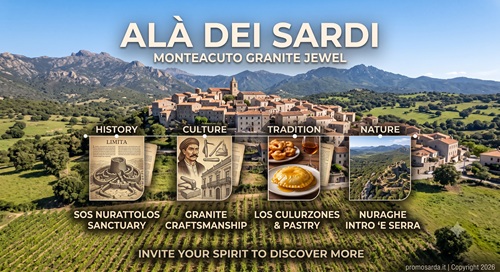
Perched on a plateau surrounded by granite formations and cork oak forests, Alà dei Sardi is a historic municipality situated in the eastern portion of the historic Monteacuto region.
The Region of Logudoro Monteacuto
Monteacuto (or Logudoro Monteacuto) forms the eastern subregion of historical Logudoro. Its landscape alternates between fertile plains, such as Chilivani, and rugged mountain ranges. The regional dialect is Logudorese Sardinian.
Overview of Alà dei Sardi
Situated at an altitude of 700 meters above sea level beneath the slopes of Punta di Senalonga, Alà dei Sardi features an elevated, mountainous terrain marked by dramatic granite outcrops and dense oak woodlands.
The municipality’s economy relies on traditional agriculture, livestock farming (primarily cattle), forestry management, and granite quarrying and stonemasonry. The region is widely recognized for its skilled stonecraft and fieldstone masonry traditions.
Name Origins
The name Alà is of ancient Paleo-Sardinian origin. Scholars have proposed several linguistic theories regarding its etymology:
-
From a derivative of the Basque alba (“pasture”), reflecting the region’s historic pastoral traditions.
-
From the Phoenician root ala (“high” or “elevation”), referencing the town’s elevated geographic position on the plateau.
-
From the ancient Balari or Ilienses tribes—early indigenous inhabitants of the central Sardinian highlands who resisted Roman conquest.
-
The official suffix “dei Sardi” was added in 1863 to distinguish the municipality from other Italian towns named Ala.
Traditions & Events
Local Festivals
Cultural traditions and community events in Alà dei Sardi include:
-
Feast of Sant’Antonio da Padova (June 13): A traditional religious celebration.
-
Feast of San Giovanni Battista (June 24): Celebrated with traditional midsummer bonfires (Sos Foghilones de Santu Juanne), singing, folk dancing, and traditional pastries.
-
Alasport Cross-Country Event: An internationally recognized annual athletic competition held at the Sas Seddas sports grounds.
-
Estate Alaese: A summer cultural showcase featuring international folklore performances and local product exhibitions honoring traditional musicians.
-
Patronal Feast of Sant’Agostino (Late August): The primary annual town celebration, followed by festivities for San Sebastiano and Santa Rosa.
-
Feast of San Francesco d’Assisi (October 4): A major rural pilgrimage festival held at the sanctuary in the Norile region.
Architecture and Monuments in Town
The historic center of Alà dei Sardi is distinguished by its exclusive use of grey granite blocks for all traditional buildings, from modest homes to grand 17th- and 19th-century residences featuring wrought-iron balconies.
Key Highlights in Town
-
Parish Church of Sant’Agostino: Built on the site of the historic 1619 Church of Santa Maria, this modern parish church houses a venerated 17th-century carved wooden statue of the Virgin Mary.
-
Castello Corda Colonna: A 19th-century granite manor built by a prominent local family, now restored by the municipality as a cultural center. An exterior mural commemorates the historical 1870 Bardana raid.
-
Su Puthu ’e Mesu ’Iddha: A covered cylindrical granite well dating to 1901, topped with a carved granite bust depicting a parish priest.
-
Historic Town Hall Building: A 19th-century granite municipal building located on Via Pigozzi.
-
Bicocca dei Dessena: A historic private residence constructed from polished pearl-grey granite, featuring a raised garden entryway.
-
Church of San Giovanni Battista: Built prior to 1830, this granite church served as the town’s primary place of worship for much of the 19th and 20th centuries.
-
New Town Hall (Municipio): A modern civic facility located on the main avenue.
-
S’Abbadolzu: A historic public stone washhouse and fountain complex constructed between the late 19th and early 20th centuries.
-
Sa Funtana de Serì: An ornamental grey granite fountain constructed in 1901, featuring a circular pediment resting on side columns.
-
Church of Sant’Antonio da Padova (Sant’Antoneddhu): Constructed in 1931 using repurposed stone masonry from older historic structures.
-
Sas Seddas Athletic Complex: A sports facility equipped with a soccer pitch and running tracks.
Surrounding Archaeological & Natural Landmarks
The surrounding territory contains numerous prehistoric monuments, including Nuragic sanctuaries, giants’ tombs, dolmens, and mountain shrines.
Archaeological Highlights
Sos Nurattolos Archaeological Complex
Situated at an altitude of 1,000 meters, Sos Nurattolos is an ancient Nuragic sanctuary dating between 1600 BC and 900 BC. The site comprises several distinct sacred structures:
-
Sacred Well (Fonte Sacra): Enclosed within a circular stone wall (10–11 meters in diameter), this linteled structure features a rectangular vestibule, internal stone benches, and an intact tholos-vaulted well chamber without steps.
-
Megaron Temple: Located within an elliptical stone enclosure, this rectangular temple structure is accompanied by two adjoining circular chambers.
-
Communal Meeting Hall: A large circular stone structure with perimeter bench seating, situated near the summit.
-
Temple in Antis: Set near the peak of Punta di Senalonga, this temple structure preserved ancient votive ceramic offerings.
Nuraghe Intro ’e Serra
A well-preserved complex nuraghe situated on a hill overlooking the town. It features multiple internal chambers and an intact stone staircase leading to upper levels.
Nuraghe Boddò
A single-tower (monotorre) granite nuraghe occupying a hilltop position on Monte Su Annaiu, incorporating both corridor and false-dome architectural elements.
Giants’ Tomb of Mala Carruca (Sa Pinnettedda)
A prehistoric stone burial monument featuring a megalithic cista integrated into its curved facade (esedra).
Rural Sanctuaries & Mountain Sites
-
Sanctuary of San Francesco d’Assisi (Norile Region): A rural granite chapel founded in 1906, set within a wooded park. The annual October festival includes traditional outdoor feasts and costumed equestrian processions.
-
Open-Air Chapel of Madonna della Neve (Su Crabione): Located at an elevation of 940 meters on a rocky peak, featuring an outdoor altar and a statue of the Virgin Mary overlooking the plateau.
-
Rural Country Chapels: Small historic chapels serving surrounding rural hamlets, including Santa Maria de Mazzinaiu, San Giuseppe de Badde Suelzu, and San Giovanni Battista de Sos Sonorcolos.