Abbasanta and the Guilcier Region
Near the town of Abbasanta lies the Nuraghe Losa, one of Sardinia’s four most significant Nuragic complexes.
The Region of Guilcier
Situated at the heart of the island, Guilcier is a geographic area featuring a basalt plateau that overlooks a plain traversed by the Tirso River and Lake Omodeo. The Guilcier area contains numerous archaeological and historical features, including: Nuraghe Losa, Church of San Pietro di Zuri, Aragonese Tower of Ghilarza, Santa Cristina Archaeological Complex, Petrified Forest of Soddì, and the Templar Church of Norbello.
Overview of Abbasanta
Located on a central basalt plateau, Abbasanta sits at an altitude of 313 meters above sea level. The surrounding countryside is rich in natural woodlands and springs. The local economy relies heavily on traditional agriculture and livestock, alongside light industries such as food processing, building materials, metallurgy, textiles, and woodworking. The landscape is defined by flat basalt formations descending into the Tirso valley, intermingled with cork oaks, wild olives, and puberulent oaks. Vast pastures highlight a long-standing harmony between the natural environment and human activity.
Name Origins
The name derives from the Sardinian words “Abba” (water) and “Santa” (holy/sacred), referencing ancient springs near the village praised for their therapeutic properties. In Roman times, the settlement was known as Ad Medias Aquas. The form Aba Sancta first appears in 12th-century ecclesiastical tax records (Rationes decimarum Sardiniae).
Gastronomy & Local Traditions
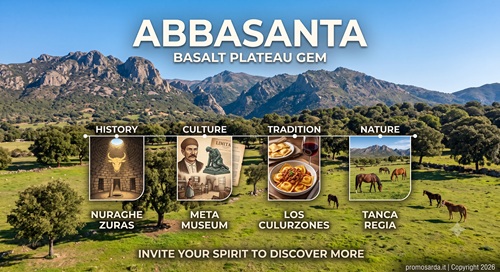
The area is celebrated for its culinary traditions. A standout specialty is Los Culurzones—handmade ravioli filled with soft local cheeses. Traditionally a festive dish, they are commonly served with a rich meat ragù and accompanied by local Sardinian red wine.
Festivals and Events
- Feast of Saint Anthony the Abbot (Sant’Antonio de Su Fogu): Commemorated on January 17 (and its eve) with the lighting of Sas Tuvas—hollowed tree trunks reaching up to 7 meters high, adorned with laurel leaves. Locals gather around the fires to enjoy Paniscedda (a traditional seasonal sweet) and local wine, followed by a communal supper (Succhena).
- Feast of Sant’Amada: Celebrated on February 6, featuring the lighting of Sa Tuva de Sant’Amada on the eve.
- Carnival (Carnevale Abbasantese): Highlights include Sa Cursa a Sa Pudda (an equestrian game of skill), high-speed trick-riding races (pariglie), and costume parades.
- Feast of Sant’Isidoro: Celebrated in May.
- Feast of Saint John the Baptist: Celebrated on June 24 and August 29, featuring the Is Carrus de S’Abiu parade (carts decorated with alder branches).
- Feast of Saint Augustine: Held on August 28 at the rural church of Sant’Agostino, featuring equestrian displays (Sas Pariglias), craft beer displays, the Sagra della Pecora (Mutton Festival), and folk performances.
- Feast of Saint Catherine of Alexandria: The town’s patron saint celebration on November 25, featuring traditional market stalls with copper, iron, woodcrafts, and local sweets.
Architecture and Monuments in Town
Abbasanta features a historic center built largely from dark basalt stone, with architectural roots dating back to the 16th and 17th centuries, including traditional single-story homes with three-story towers.
- Abbasanta Railway Station: Built in the late 19th century on the Dorsale Sarda line, featuring a traditional two-story passenger building flanked by single-story wings.
- Church of Santa Maria delle Grazie: Located in the northeastern area, dating to the 14th century, formerly surrounded by muristenes and used as a public burial site in the 18th and early 19th centuries.
- Church of Sant’Antonio Abate: Originally built in the late 17th century, featuring simple exposed basalt masonry and an off-center bell gable (campanile a vela).
- Piazza della Vittoria Mural: A prominent outdoor mural depicting local figures and wildlife, painted on a basalt stone building in the square.
- Town Hall (Municipio): Located on Corso Giuseppe Garibaldi, preserving an archival 1794 copy of the local Barracelli regulations, written in Sardinian (Limba).
- War Memorial: Situated in Piazza dei Caduti, a white marble monument topped with a bronze dying soldier.
- META Museum (Ethnographic Museum): Housed in a restored 16th-century Aragonese-style residence, recreating domestic and working environments of late 19th- and early 20th-century rural Sardinian life.
- Parish Church of Santa Caterina d’Alessandria: Built between 1870 and 1886 on older foundations, featuring a basalt facade, an 28-meter octagonal cupola, and a gilt wooden statue of Saint Catherine from the 1500s.
- Church of Sant’Amada: A 16th-century Gothic-Aragonese church with stone seating (istradeddas) in its square.
- Oratory Site of San Martino: The former site of a 17th-century chapel that once overlooked the Chenale valley.
- Municipal Sports Complex: Features a soccer stadium with synthetic turf seating 960 spectators, alongside additional sports courts.
Surrounding Archaeological & Historic Sites
The territory contains over twenty domus de janas, five dolmens, ten giants’ tombs, and various nuraghi.
- Nuraghe Zuras: A single-tower basalt structure with an intact tholos chamber. At dawn during the winter solstice, sunlight alignment projects a double image resembling a bull’s head onto the interior wall.
- Nuraghe Aiga: A complex nuraghe with a central two-story tower and three peripheral towers. During summer solstice, sunlight directly illuminates the base and wall niches.
- Tanca Regia Estate: A historic agricultural estate dating back to Aragonese rule, serving for centuries as a major horse breeding center for Giara, Sarcidano, and Anglo-Arabo-Sardo breeds. Includes the 1781 Church of San Filippo Apostolo.
- Rural Sanctuary of Sant’Agostino: Features an 1872 church surrounded by small stone dwellings (muristenes) hosting pilgrims during the annual August novena.
- Nuraghe Losa: A trilobed central basalt structure surrounded by defensive outer walls and a village settlement inhabited continuously from the Bronze Age through the early medieval period, featuring solstice solar alignments.