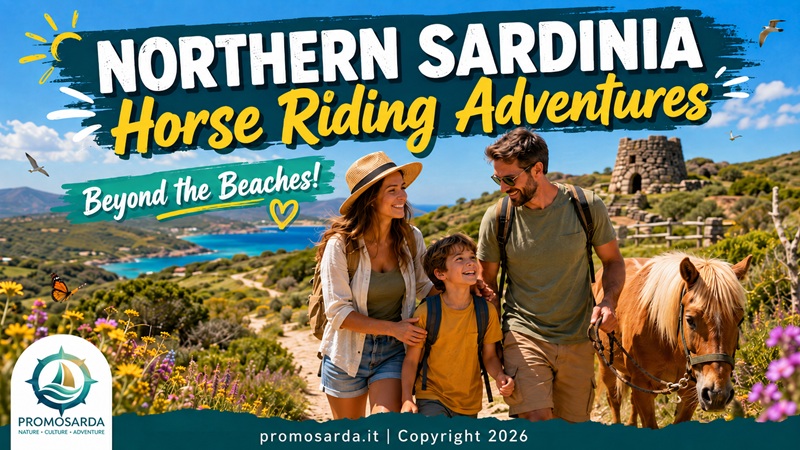
From Lake Baratz and Porto Ferro to the Coghinas River, Capo Testa, Gallura and La Maddalena: where to ride, who to book with, what to see and what I would choose for each level
Hi , it’s Gavino from Nuoro here, although Northern Sardinia has occupied a considerable amount of my free time for years. I mountain bike, hike, trek and ride horses. I am comfortable at walk, trot and canter, but I am not a professional equestrian guide and I do not pretend to be one. On this website I am the Outdoor Guide: I test places, connect routes with what is around them and tell you what I think is worth doing. When an excursion needs to be led professionally, I book somebody qualified to lead it.
That distinction matters with horses. A horse is not outdoor equipment. It has temperament, fitness and limits. A good riding centre does not simply give you “a horse”; it tries to match horse, rider, terrain and conditions. If the operator asks how many times you have ridden before, tell the truth. “I rode on holiday five years ago” is not intermediate.
Northern Sardinia is unusually good for horse riding because the landscape changes quickly. Around Alghero you can move from pine forest and Sardinia’s only natural lake to dunes and Porto Ferro. Around Valledoria there are riverbanks and broad agricultural landscapes. Santa Teresa gives you granite, old rural tracks and Nuragic archaeology. Inland Gallura adds cork woods, stazzi, rivers and prehistoric tombs. La Maddalena gives you the rare opportunity to see an island landscape from the saddle rather than through a windscreen.
Northern Sardinia Horse Riding at a Glance
| Area | Best experience | Level | Landscape | Combine it with |
|---|---|---|---|---|
| Lake Baratz / Porto Ferro | Forest, dunes, beach | Beginner–expert | Lake, pine forest, dunes | Porto Ferro, birdwatching |
| Porto Ferro | Coastal panorama & towers | Beginner–expert | Cliffs, beach, Mediterranean scrub | Torre Bianca, Porto Conte |
| Valledoria / Coghinas | River & countryside | Beginner–intermediate | River, fields, dunes | Castelsardo, Coghinas mouth |
| Santa Teresa Gallura | Ancient tracks & granite | All levels, route-dependent | Granite, juniper, stazzi | Lu Brandali, Capo Testa |
| Arzachena / Liscia Valley | Inland Gallura | Beginner–experienced | River, cork woodland, countryside | Li Lolghi, Li Mizzani, Li Muri |
| Cannigione | Rural Gallura | Route-dependent | River valley, countryside | Arzachena archaeological park |
| La Maddalena | Island horseback ride | Beginner+ | Granite, maquis, island views | Spalmatore, La Maddalena town |
My overall choice for a first-timer is Lake Baratz and Porto Ferro. For a rider with real experience I would ask about the advanced Porto Ferro itinerary. For archaeology plus horses, I would go to Gallura or Santa Teresa. For pure novelty, La Maddalena.
1. Lake Baratz to Porto Ferro — The Best All-Round Horse Ride in Northern Sardinia
If somebody asked me for only one recommendation, I would start here. Lake Baratz is Sardinia’s only natural lake, separated from Porto Ferro by a large dune system and surrounded by pine forest, Mediterranean vegetation and important wetland habitat. The official regional tourism authority specifically identifies the area for walking, MTB and horseback riding, and notes its birdlife, freshwater turtles and extensive network of paths.
The most obvious operator is Maneggio Baratz, Via dei Fenicotteri 23, 07100 Sassari, currently rated 4.9/5. The centre describes itself as a riding school offering excursions for children, beginners and experienced riders, and its story is worth mentioning: several of its horses came from situations of neglect or mistreatment and were rehabilitated before the school opened to the public.
For beginners and intermediate riders, their published route is roughly 7 km and 1.5–2 hours: pine forest close to Lake Baratz, sandy dunes, Porto Ferro and then the lake environment on the return. Riders receive an initial horse familiarisation and basic briefing; the centre currently sets a 90 kg rider limit and recommends long trousers and closed footwear. Children and beginners are accompanied by staff.
Experienced riders have a different option, and I appreciate that. Their advanced route is approximately 12 km, requires control at walk, trot and canter, and can include trotting through woodland, coastal viewpoints, Porto Ferro, Torre Bianca and — where sea conditions permit — cantering along the shoreline and entering shallow water.
Gavino’s view
This is exactly how a riding centre should separate experiences. If somebody tells me that the same trail, same pace and same group are perfect both for a person who has never touched reins and somebody comfortable at canter, I become suspicious.
For me the highlight is not actually riding on the beach. It is the transition: lake → pine forest → dunes → open coast. The horse allows you to experience the geography rather than jump between attractions by car.
Gavino’s detour
After the ride, do not immediately drive back to Alghero. Spend time at Porto Ferro. The surrounding Baratz–Porto Ferro dune system is environmentally significant, while the wider area connects towards Porto Conte. The lake itself is excellent for quiet bird observation — without approaching wildlife simply because you own a telephoto lens.
Gavino wouldn’t do this
I would not book the advanced ride simply because the description contains the word gallop. The operators specifically require control of all three gaits. A beach gallop on an unfamiliar horse is not where you learn canter.
2. Porto Ferro and the Aragonese Towers — Best Ride for Coastal Scenery
The second experience overlaps geographically but has a slightly different character. Tre Stelle Sa Mandra operates from Strada Provinciale 117, Sassari, close to Porto Conte and Porto Ferro, and currently carries a 4.8/5 rating. It specialises in equiturismo rather than simply arena riding and keeps around 18 horses, predominantly Sardinian Anglo-Arabs.
Before every excursion the centre runs a short introduction and horse trial. Its shorter ride takes roughly one hour, using panoramic tracks above the Gulf of Porto Ferro and reaching an Aragonese watchtower; the longer approximately two-hour route adds the beach, Torre Bianca and further coastal tracks. Current published departures are deliberately early and late — around 07:00 and 18:00 — rather than in the worst summer heat.
That last detail earns points from me.
I would be much more interested in how a riding centre handles August heat than whether its Instagram account contains drone footage. Horses are doing the work too.
Which Porto Ferro centre should you choose?
For somebody particularly interested in Lake Baratz ecology and having different routes for genuine riding levels, I lean towards Maneggio Baratz. For somebody whose priority is coastal scenery, the towers and a sunrise/sunset experience, Tre Stelle Sa Mandra makes excellent sense.
Published prices should be reconfirmed directly. At the time of research Tre Stelle’s own site listed €40 for the shorter route and €75 for the longer one, while a connected Sa Mandra page showed a different figure for the two-hour excursion. When two legitimate pages disagree, I do not choose the cheaper number and pretend certainty: ask before booking.
3. Valledoria and the Coghinas — Best for River Landscape and Sunset
Moving east changes the landscape. Around Valledoria, the Coghinas reaches the Gulf of Asinara through wetlands, agricultural terrain, dunes and long sandy shores. The regional tourism authority specifically mentions horseback riding among the ways to explore the river-mouth environment.
River Ranch asd currently operates seasonally between Littigheddu/Sedini from roughly June to October and Valledoria–San Pietro from mid-October to late May. Its own website currently advertises guided outings suitable for beginners as well as more experienced customers, including morning, evening and sunset departures.
This is the experience I would pair with Castelsardo rather than making a special cross-island trip only for an hour in the saddle. Ride in the morning or around sunset; spend the other half of the day in Castelsardo or around the Coghinas landscape.
The ranch also currently offers an optional post-ride tasting/grill arrangement featuring local wine, cheese and cured meats. That makes sense geographically and culturally: this is exactly the kind of business connection I like to see in an outdoor article, because it extends the same experience instead of randomly recommending a restaurant fifteen kilometres away.
Gavino’s detour
If you like birds, slow down around the Coghinas environment. The broader river and lake system supports significant birdlife, and the regional guide specifically identifies its banks for walking, cycling, horseback riding and birdwatching.
Leave it better
Wetlands collect other people’s lightweight rubbish remarkably efficiently. Plastic that starts in a car park ends up against vegetation. I carry a small rubbish bag. If there is a bottle beside a viewpoint and I have free hands, it leaves with me.
No medal required.
4. Santa Teresa Gallura — Best Horseback Riding for Granite, Old Tracks and Archaeology
This is one of the strongest combinations in the whole article. Santa Teresa’s official tourism service describes local horseback itineraries following old tracks through granite formations, juniper, pine woodland and traditional Gallurese stazzi, with rides particularly attractive in spring and autumn.
The local tourism office currently lists two riding operations in the La Testa area: La Ultata di Kristian Avellino, Loc. La Testa, +39 338 2392602, and Circolo Ippico Li Nibbari, Strada La Testa, +39 338 5067541. Li Nibbari currently rates 4.7/5.
This area becomes much more interesting when you stop thinking of it as “horse ride with sea view”. Local equestrian itineraries documented by Santa Teresa tourism include Lu Brandali, the Contessa/Capo Testa natural area, routes between Petra di Li Cossu and Littichedda in Aglientu, and Isola di Coluccia near Porto Pozzo.
And Lu Brandali is not a decorative stop. The archaeological complex preserves a Nuragic settlement, defensive structures and funerary remains dating broadly between the 14th and 10th centuries BC, spread across a granite promontory in Mediterranean vegetation.
Gavino’s choice
Ask the centre what route it is actually running that day and tell them that archaeology interests you. Do not assume that booking “two hours” automatically means Lu Brandali or Capo Testa; routes depend on level, conditions and operator planning.
I would choose this area in April, May, June, September or October before a hot August afternoon. Santa Teresa tourism itself describes spring and autumn as particularly good riding periods.
After the ride
Go to Lu Brandali properly if the horseback itinerary only passes nearby. A glimpse from the saddle and an archaeological visit are different things. Then continue to Capo Testa or Santa Teresa itself.
Outdoor travel is better when activities connect rather than compete.
5. Arzachena and the Liscia Valley — Best Combination of Horse Riding and Prehistory
This is probably the route area most naturally suited to Gavino the amateur archaeology obsessive.
La Prugnola Ranch – Passeggiate a cavallo Costa Smeralda is on SP115 in the Arzachena countryside, phone +39 392 926 5797, and currently rates 5.0/5 from a substantial set of reviews. The farm covers more than thirty hectares in the Liscia River valley and operates horse experiences through countryside, river and woodland.
Its programmes are unusually well differentiated. The short “Dream of Sardinia” experience is about 45 minutes and is suitable from age five; “River Adventure” is roughly an hour; “Under the Wood” expands into cork oak, juniper and alder woodland and is aimed at both beginners and experienced riders from age eight.
But the archaeological connection is what makes this area special. The ranch’s longer equestrian material references routes towards sites including the Giants’ Tombs of Li Mizzani and Li Lolghi, while the wider Arzachena countryside contains one of the densest archaeological landscapes in Gallura: Li Muri, Nuraghe Albucciu, Malchittu, La Prisgiona, Coddu Vecchiu and Li Lolghi.
Li Lolghi alone is worth the detour. It stands roughly seven kilometres west of Arzachena and is considered among Sardinia’s most important and best-preserved Giants’ Tombs, with its monumental granite stele and large exedra dominating a hilltop landscape.
Li Mizzani, closer to Palau, is smaller but archaeologically distinctive and sits on a plateau with views extending towards Corsica.
Gavino’s ideal day
Morning ride in the Liscia countryside. Lunch. Then one or two archaeological sites, not six.
My combination would be La Prugnola + Li Lolghi + Li Muri.
Trying to complete the entire Arzachena archaeological park after two hours on horseback turns archaeology into stamp collecting.
If you find something
Do not pick it up to show the riding guide.
Do not clean it.
Do not put it in a pocket “for safekeeping”.
A suspected archaeological find belongs where it is until the appropriate authorities determine otherwise. Photograph the context without disturbing it, note the position and report a potentially significant discovery through the competent heritage authorities.
Gavino is curious.
Gavino is not a treasure hunter.
There is a very large difference.
6. Cannigione — A Smaller Gallura Alternative
For travellers staying around Cannigione rather than inland Arzachena, HorseRide&River is another local equestrian operation, currently rated 5.0/5, combining horses with the river/countryside environment.
I would treat this as an alternative base to investigate locally, rather than inventing a detailed route I have not verified. Call, explain your level and ask exactly where that day’s ride goes.
That may sound less exciting than claiming I know every turn.
It is more useful.
The entire Arzachena–Cannigione area benefits from being surrounded by the archaeological landscape mentioned above, so even a straightforward countryside ride can be combined with La Prisgiona, Coddu Vecchiu or Li Lolghi rather than immediately returning to the Costa Smeralda resorts.
7. La Maddalena — The Most Unusual Ride
Horse riding is probably not the first activity anybody associates with La Maddalena.
Which is precisely why I like it.
Maneggio Cala Spalmatore – La Maddalena is based at Località Spalmatore 4, La Maddalena, currently rated 4.9/5.
Current bookable experiences describe approximately two-hour American-style rides departing from the Spalmatore area, suitable for beginners and children from around seven years old, with riding equipment and helmet supplied. Some packages currently include transfer between La Maddalena ferry port and the riding centre; always confirm the exact inclusions when booking.
Cala Spalmatore itself lies on the north-eastern side of La Maddalena island, surrounded by Mediterranean scrub and pink granite, with an old maritime history linked to fishermen using the sheltered inlet. Behind the bay is a small wetland habitat, while nearby viewpoints open across La Maddalena and towards Caprera.
Why I would do it
Because almost everybody experiences this island from a car, scooter or boat.
A horse changes the speed.
You notice vegetation.
Ground.
Smell.
The way granite changes from one section to another.
The ride should not replace a day exploring Caprera or the archipelago. It should add a completely different half-day.
Gavino wouldn’t do this
I would not take a ferry from mainland Sardinia, rush directly to the stables, ride, then catch the first ferry home.
If you have crossed to La Maddalena, stay.
Walk the town.
Explore the island.
Otherwise you have travelled a long way to experience only the inside of a timetable.
Best Riding Experience for Beginners, Children and Experienced Riders
| Rider | My first choice | Why |
|---|---|---|
| First ever ride | Lake Baratz | Briefing, controlled route, beginner support |
| Family with children | Baratz or La Prugnola | Explicit family/beginner programmes |
| Couple | Porto Ferro sunset | Scenery and manageable duration |
| Intermediate rider | Gallura countryside | Varied terrain without needing speed |
| Experienced rider | Advanced Baratz–Porto Ferro route | Trot/canter and longer route |
| Archaeology lover | Arzachena or Santa Teresa | Li Lolghi/Li Mizzani or Lu Brandali |
| Island experience | La Maddalena | Completely different setting |
| Food + ride | Valledoria / River Ranch | Sunset ride and local-food option |
The important word here is matching. Beginner rides should not be made “more exciting” by forcing pace. Advanced rides should not be advertised as advanced if the entire group is restricted to a slow nose-to-tail walk regardless of ability.
Ask before booking.
What Should You Wear Horse Riding in Sardinia?
Long trousers. Closed shoes with a secure sole. Clothes that can become dusty. Sun protection appropriate to the season.
Do not arrive for a two-hour countryside excursion wearing swim shorts and flip-flops because the photograph showed a beach.
Several of the operators above explicitly recommend long trousers and closed footwear, and the La Maddalena experience specifies a helmet as compulsory.
If the centre provides a helmet, wear it.
My ability on a horse does not make my skull harder.
Do You Need Riding Experience?
No, for many of these excursions.
But there is an important difference between “suitable for beginners” and “nothing can happen.”
A horse can move unexpectedly. Terrain can be uneven. A branch can be lower than it looked. Another horse can react.
This is why I like operators who begin with a briefing and horse assessment.
At La Prugnola, booking information even requests age, height and riding level. At Baratz, beginners are given initial instruction and additional staff support.
Those details tell me more about an operator than a photograph of somebody galloping at sunset.
Rider Weight Limits
Ask.
Do not take offence.
Horse welfare comes first.
Maneggio Baratz currently publishes a 90 kg maximum rider weight for the relevant excursions. Other centres may use different limits depending on horse, route and policy.
A responsible operator should be willing to say no when rider/horse matching is unsuitable.
I trust that operator more afterwards, not less.
Is Horse Riding in Northern Sardinia Good in August?
Possible?
Yes.
My favourite month?
No.
Heat affects rider and horse. Some operators therefore shift departures to early morning and evening and explicitly schedule according to temperature and horse conditions. Baratz states this directly; Tre Stelle currently runs its main departures around sunrise and evening.
For me the best periods are April–June and September–October.
Spring gives you greener countryside, flowers and comfortable temperatures. September gives warm light and a landscape already dried by summer but usually more manageable than August midday. Santa Teresa’s own tourism office likewise identifies spring and autumn as particularly attractive for riding.
Horse Riding on Sardinian Beaches: Can You Just Take a Horse onto the Sand?
Do not assume that because an organised operator uses a beach route, private riding is automatically allowed there whenever you want.
Access can depend on local regulations, season, time of day, protected-area provisions and specific permissions. The sensible solution for a visiting tourist is simple: use an established riding centre whose route is organised for the conditions and rules applicable at that time.
The same applies to protected dunes.
A hoof can damage fragile habitat just as effectively as a tyre.
Follow the route.
How I Judge a Horse-Riding Operator
I look at the horses before the landscape.
Body condition. Feet. Behaviour. Tack. Water. Shade.
Then I watch what the staff does with a nervous beginner.
Then I listen to the briefing.
Only afterwards do I care where we are going.
I also like operators that change or cancel activities because of heat, weather or horse condition. That is professionalism, not inconvenience.
If the sales message suggests that nothing — temperature, wind, rain, terrain or animal welfare — could possibly interfere with your booked sunset photograph, I would choose somebody else.
Where I Would Take a Riding Lesson Before an Excursion
If you are staying several days and feel rusty, one arena lesson before a longer trail is money well spent.
Around Alghero, Club Ippico Capuano operates from Località La Scaletta and currently rates 4.9/5. Near Sorso, Maneggio Il Ginepro currently rates 4.9/5.
I am not recommending either because you need a riding lesson to survive a beginner excursion.
I am recommending the idea because competence makes an outdoor experience more enjoyable.
Ten minutes spent remembering how to stop properly can improve two hours dramatically.
Combine Horse Riding with Archaeology — But Respect the Site
Northern Sardinia is particularly good for this because archaeological monuments are often embedded in the countryside rather than isolated behind urban museum walls.
Around Santa Teresa there is Lu Brandali. Around Arzachena you have Li Lolghi, Li Muri, Coddu Vecchiu, La Prisgiona and more.
That does not mean ride wherever you see ancient stones.
Use permitted tracks. Dismount where required. Do not tie a horse to archaeological structures. Do not move stones.
And if something genuinely looks like an unrecorded archaeological object, curiosity stops where preservation begins.
That is one of my rules.
Gavino’s Best Three-Day Horse-Riding Mini Itinerary
Day 1 — Lake Baratz & Porto Ferro: morning or late-afternoon ride, then Porto Ferro and Alghero for dinner. Day 2 — Castelsardo & Valledoria: explore Castelsardo, then a late ride around the Coghinas/Valledoria countryside and, if desired, a local-food experience. Day 3 — Gallura: ride around Arzachena/Liscia, then visit Li Lolghi and Li Muri.
I would not attempt all three on consecutive days if you have never ridden before.
Your legs will explain why before I do.
Horse Riding in Northern Sardinia FAQ
Where is the best horse riding in Northern Sardinia?
For the best combination of terrain, organisation and landscape, I would start with Lake Baratz–Porto Ferro. Gallura is stronger for countryside and archaeology; Santa Teresa for granite and historic tracks; La Maddalena for novelty.
What is the best horse ride near Alghero?
Lake Baratz and Porto Ferro. Several organised routes connect pine forest, dunes, lake and coast, with options for beginners and experienced riders.
Can beginners go horse riding in Sardinia?
Yes. Many northern centres offer beginner-specific rides, initial briefings and quiet horses selected for the participant’s ability.
Can children ride horses in Northern Sardinia?
Yes, subject to operator age, size and route restrictions. Current examples range from approximately age five at some La Prugnola experiences to six at Baratz and seven for the current La Maddalena excursion.
Can you ride horses on the beach near Alghero?
Organised operators around Porto Ferro run beach-inclusive routes when conditions and current access arrangements permit. Book through the centre rather than assuming independent horse access to a beach is unrestricted.
Is there horse riding in Costa Smeralda?
Yes. The Arzachena/Liscia countryside offers riding experiences close to Costa Smeralda without being confined to the resort coast. La Prugnola is one current example.
Can you ride horses in La Maddalena?
Yes. A riding centre operates around Cala Spalmatore and current excursions are sold from the island, including options suitable for beginners.
Is horse riding available near Santa Teresa Gallura?
Yes. Santa Teresa tourism currently lists La Ultata and Li Nibbari, with routes in the wider area involving granite landscapes, old tracks and destinations such as Lu Brandali and Capo Testa.
What is the best season?
I would choose spring or September–October. Summer rides are better early or late in the day rather than around midday.
What should I wear?
Long trousers, closed shoes and weather-appropriate clothing. Use the riding helmet supplied or required by the operator.
Do horse rides include insurance?
Conditions vary. Some current experience packages explicitly include insurance, but never assume every riding centre uses the same arrangement. Ask what accident/liability coverage is included before booking.
Do I have to tell the operator my weight?
If asked, yes, accurately. Weight limits protect both horse and rider. Some centres publish explicit limits.
Can experienced riders gallop?
Some operators offer routes specifically for riders who can independently manage walk, trot and canter. Whether cantering or galloping is appropriate on the day still depends on horse, terrain, group and conditions.
Final Thoughts: A Horse Makes You Look at the Landscape Differently
Mountain biking makes me look for gradients.
Hiking makes me look for distance.
My little 4×4 makes me look at the ground and wonder whether I really need to drive the final kilometre.
A horse does something different.
It makes me pay attention to another living creature at the same time as the landscape.
You cannot switch it off when you stop for a photograph.
You cannot throw it into the boot when the day becomes hot.
You cannot blame it because you exaggerated your riding level.
That responsibility improves the experience.
Around Baratz I notice the transition from wetland to forest to dunes. In Gallura I notice old tracks that make more sense at the pace they were originally travelled. Around archaeological sites I begin wondering how people actually moved through these landscapes thousands of years ago.
And I pick up rubbish.
Not all of it. I am not the municipal waste service.
But if somebody has left a plastic bottle beside a viewpoint, a Giants’ Tomb or the entrance to a trail, and I can carry it out, I do.
I remember what the place looked like the first time I arrived.
Somebody coming tomorrow deserves the same chance.
That is as close as I have to an outdoor philosophy.
Ride the horse you can actually manage. Use the trail you are allowed to use. Look at the old stones without taking them home. Respect whoever is guiding the excursion. Respect the animal carrying you.
And when you leave, leave very little evidence that you were ever there.
Except, perhaps, one less plastic bottle.
