Guide and Tips to Sardinian Fregola: History, Artisanal Craft, Buying Guide, and Authentic Recipes
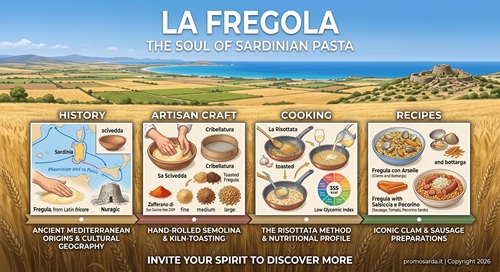
Fregola (traditionally spelled Fregula in Sardinian dialects, derived from the Latin fricare, meaning “to rub”) is one of the Mediterranean’s oldest pasta traditions. Often referred to as “Sardinian couscous,” this sun-drenched island staple dates back over a millennium, bridging Phoenician, Punic, and North African trade routes with native Sardinian agro-pastoral heritage.
Unlike industrially extruded pasta or smooth rolled pearls, genuine artisanal Fregola is celebrated for its irregular, rough-textured spheres and its multi-hued, kiln-toasted finish.
1. Regional Roots & Cultural Geography
While enjoyed across all of Sardinia, specific territories hold distinct historic ties to Fregola’s production and traditional preparations:
- The Campidano Plain (Southern/South-Western Sardinia): The agricultural breadbasket of Sardinia where high-protein durum wheat (grano duro) has been harvested since Roman times. This is the heartland of home-rolled Fregula made in family kitchens using local terracotta ware.
- The Gulf of Oristano & Marceddì Lagoon: Famous for shallow brackish lagoons yielding sweet clams (arselle or telle) and mullet roe (bottarga). Marceddì hosts annual festivals dedicated to lagoon fish and Fregula con Arselle.
- The Gulf of Cagliari & Santa Gilla Lagoon: The classic staging ground for seafood-infused fregula al brodo di pesce (rockfish broth) and cuttlefish ink preparations.
- Carloforte & San Pietro Island: A Ligurian-Tunisian enclave off the southwestern coast where Fregola merges seamlessly with tuna culinary traditions (tonno rosso di corsa).
- The Barbagia Mountain Region (Central Sardinia): Inland pastoral villages where Fregola transitions into hearty winter fare simmered with wild boar ragù, fresh sheep sausage scented with wild fennel, cardoons, and aged Pecorino Sardo DOP.
2. Artisanal Craft: How Authentic Fregola Is Made
The traditional production of Fregula is an intricate, rhythmic manual discipline passed down through generations:
- The Vessel (Sa Scivedda): Coarse, stone-ground durum wheat semolina (semola di grano duro) is placed into a wide, shallow, unglazed or glazed terracotta basin called a scivedda (or maffe).
- The “Rubbing” (Sfarinatura): The pasta maker gradually sprinkles warm water lightly salted and traditionally steeped with a pinch of Sardinian saffron threads (Zafferano di San Gavino Monreale DOP).
- The Palm Motion: Using circular, counter-clockwise palm motions, the semolina grains aggregate around tiny water droplets, gradually building into rustic, rough spheres.
- Sifting & Sizing (Cribellatura): The damp spheres are passed through varying gauges of reed sieves (tiriolos) to categorize them into three sizes:
- Fina (Fine, 1–2 mm): Ideal for clear broths, minestrone, and cold salads.
- Media (Medium, 2–3 mm): The most versatile all-rounder; perfect for seafood and risottata cooking.
- Grossa (Large, 3–4+ mm): Sturdy, chewy pearls built for robust meat stews, rich tomato sauces, and oven bakes.
- Air-Drying & Oven Toasting (Tostatura): After spreading on linen cloths to air-dry, the pearls are roasted in wood-fired ovens or modern convection kilns. This yields a gradient of colors—from ivory and golden blonde to deep amber and roasted brown—locking in an earthy, hazelnut-like aroma and guaranteeing an unbeatable al dente bite.
3. Global Comparisons: Fregola vs. Similar World Pastas
Fregola occupies a unique spot in the worldwide family of hand-rolled semolina spheres:
| Pasta Type | Origin | Wheat / Base | Production Method | Toasting Process | Common Culinary Use |
|---|---|---|---|---|---|
| Fregola Sarda | Sardinia, Italy | 100% Coarse Durum Semolina | Hand-rolled in terracotta bowl or bronze extruded | Yes (Kiln/Oven toasted, multi-tonal) | Cooked risotto-style in broth; paired with clams, sausage, bottarga |
| Maghrebi Couscous | North Africa (Morocco, Algeria, Tunisia) | Fine & Coarse Durum Semolina | Hand-rolled, fine grain | No (Raw, steamed over broth) | Steamed in a couscoussier; served under vegetable/meat tagines |
| Berkoukes / Moghrabieh | North Africa / Levant (Lebanon, Jordan) | Durum Semolina & Flour | Hand-rolled larger pearls (3–6 mm) | Rarely (Usually sun-dried or light dried) | Heavy stews with chicken, chickpeas, and warm spices (caraway, cinnamon) |
| Israeli Couscous (Ptitim) | Israel | Wheat Flour or Semolina | Extruded through machinery (created 1950s) | Yes (Evenly oven-baked) | Side dish, cold grain salads, lightly sautéed with herbs |
| Acini di Pepe / Pastina | Mainland Italy / USA | Refined Semolina / Durum | High-speed commercial extrusion | No (Uniform pale yellow drying) | Quick-cooking soup additive, pediatric broths |
4. Buyer’s Guide: How to Select High-Quality Fregola
When shopping online or in specialty Italian grocers, look for the following quality markers:
- 100% Italian Durum Semolina (Grano Duro 100% Italiano): Look for heritage wheat varieties like Senatore Cappelli or certified Sardinian provenance. These offer superior protein content (>13%) and richer gluten structure.
- Visible Toasting Gradients: High-quality authentic Fregola is never a uniform single shade of tan; it should display a mosaic of cream, gold, and toasted walnut brown.
- Rough Surface Texture (Trafilata al Bronzo / Handcrafted): Avoid smooth, glossy spheres. A powdery, slightly abrasive texture allows broths and sauces to cling to each pearl.
- Packaging Designations: Look for Prodotto Tradizionale della Sardegna (PAT) or reputable artisan producers based in Oristano, Nuoro, or Cagliari.
🛒 Recommended Products & Buying Links:
- Authentic Sardinian Fregola (Medium/Toasted): https://link.amazon/B04q6uZyJ
- Organic Senatore Cappelli Durum Fregola: https://link.amazon/B0hhaZ02K
- Sardinian Mullet Bottarga (Bottarga di Muggia): https://link.amazon/B0eMPfAcf
- Saffron :https://link.amazon/B0imbL0UP
- Authentic Terracotta Scivedda Bowl:https://link.amazon/B0eOKbhId
5. Nutritional Profile & Health Benefits
Fregola made from 100% durum wheat semolina is a complex carbohydrate source that digests slowly, providing sustained energy.
Nutritional Values (Per 100g Dry Fregola)
| Metric | Value | Daily Value % (DV)* |
|---|---|---|
| Calories | 355 kcal (1506 kJ) | 18% |
| Total Carbohydrates | 71.0 g | 26% |
| — of which Sugars | 2.5 g | — |
| Dietary Fiber | 3.5 g | 14% |
| Protein | 13.0 g – 14.5 g | 28% |
| Total Fat | 1.5 g | 2% |
| — of which Saturated | 0.3 g | 1% |
| Sodium | 5 mg | <1% |
| Iron | 1.8 mg | 10% |
| Magnesium | 45 mg | 11% |
*Percent Daily Values are based on a 2,000-calorie standard diet.
- Low Glycemic Index: Thanks to the compact starch-protein matrix of durum wheat and the roasting process, Fregola produces a more gradual rise in blood sugar than refined white pasta or white rice.
- Satiety: High protein and soluble fiber content keep you feeling full for longer periods.
6. The Master Cooking Method: La Risottata
While Fregola can be boiled in salted water like ordinary pasta (10–14 minutes depending on size), authentic Sardinian recipes almost exclusively use the Risottata technique:
- Aromatics & Toasting: Sauté garlic, onions, or chili in extra virgin olive oil. Add dry Fregola and toast it dry for 60–90 seconds to reactivate its nutty grain aromas.
- Deglazing: Pour in a splash of dry Sardinian white wine (such as Vermentino di Sardegna DOC) and let it evaporate completely.
- Simmering: Gradually ladle in hot, seasoned stock (fish, shellfish, chicken, or vegetable broth) one ladle at a time, stirring periodically.
- Starch Emulsion: As the pasta cooks, it sheds surface starch into the broth, yielding a naturally glossy, velvety sauce without needing heavy cream or thickeners.
7. Authentic Step-by-Step Recipes
Recipe 1: Fregula con Arselle e Bottarga (Clams & Cured Mullet Roe)
The undisputed icon of Sardinian coastal cooking.
- Yield: 4 servings
- Prep Time: 20 mins
- Cook Time: 20 mins
- Difficulty: Intermediate
Ingredients
- 320g Medium Toasted Sardinian Fregola
- 1 kg (2.2 lbs) Fresh Littleneck clams or Manila clams, purged and scrubbed
- 3 tbsp Extra Virgin Olive Oil (Sardinian DOP preferred)
- 3 cloves Garlic, lightly crushed
- 1 small Dried Red Chili pepper (peperoncino), chopped
- 100 ml Dry White Wine (Vermentino di Sardegna)
- 800 ml Light fish stock or filtered clam cooking liquid
- 2 tbsp Fresh flat-leaf parsley, finely chopped
- 30g Cured Mullet Bottarga (Bottarga di Muggia), finely grated or shaved
[Check Price on Amazon: Link]
Instructions
- Open the Clams: In a wide pan over high heat, add 1 tbsp olive oil, 1 crushed garlic clove, and the rinsed clams. Cover with a lid for 3–4 minutes until shells pop open. Remove from heat immediately. Discard any unopened clams. Strain the pan juices through a fine cheesecloth/sieve and combine with your warm fish stock. Shell half the clams; leave the rest in shell for presentation.
- Toast the Fregola: In a heavy skillet or Dutch oven, warm remaining 2 tbsp olive oil with the remaining garlic and chili over medium heat. Add the dry Fregola and toast for 1 minute until fragrant.
- Deglaze: Pour in the Vermentino wine and let it bubble away.
- Simmer Risotto-Style: Begin ladling the hot clam-infused stock over the Fregola, stirring occasionally. Maintain a steady simmer for approximately 12–14 minutes until the pearls are tender with a firm core.
- Finish & Serve: Fold in the shelled clams, whole clams in shell, and fresh parsley for the final 60 seconds. Turn off the heat. Plate immediately and finish each bowl with a generous dusting of freshly grated golden Bottarga.
Recipe 2: Fregula Sarda con Salsiccia e Pecorino (Sausage, Tomato & Aged Sheep’s Cheese)
A rustic mountain classic from the Barbagia hills.
- Yield: 4 servings
- Prep Time: 15 mins
- Cook Time: 25 mins
- Difficulty: Easy
Ingredients
- 320g Large or Medium Toasted Fregola
- 300g Fresh Italian/Sardinian pork sausage (coarsely ground with fennel seeds and black pepper), casings removed
- 1 small Yellow Onion, finely minced
- 1 sprig Fresh Rosemary & 2 Fresh Bay Leaves
- 80 ml Dry Red Wine (Cannonau di Sardegna DOC)
- 400g Canned San Marzano peeled tomatoes, crushed by hand
- 700 ml Hot vegetable or light beef broth
- 60g Aged Pecorino Sardo DOP (or Pecorino Romano), finely grated
- 2 tbsp Extra Virgin Olive Oil
- Salt & freshly cracked black pepper to taste
Instructions
- Brown the Meat: In a heavy-bottomed pan, heat the olive oil over medium heat. Add minced onion and sauté until translucent (3 mins). Crumble in the fresh sausage meat, breaking it into bite-sized chunks with a wooden spoon until browned and crispy (5–6 mins).
- Deglaze: Add the rosemary sprig and bay leaves, then deglaze with the Cannonau red wine, scraping the flavorful browned bits (fond) from the bottom of the pan.
- Add Tomato & Pasta: Stir in the crushed tomatoes and the dry Fregola. Cook together for 2 minutes to allow the pasta to absorb the rich tomato base.
- Simmer: Add hot broth ladle by ladle, keeping the mixture at a gentle boil. Cook for 14–16 minutes, stirring regularly so the pasta doesn’t stick.
- Mantecatura (Rest & Cheese): When the Fregola is tender and the sauce is thick and luxurious, remove from heat. Discard rosemary and bay leaves. Vigorously stir in half of the grated Pecorino Sardo. Let rest for 2 minutes, then serve with extra Pecorino and cracked black pepper on top.
8. Summary: Curated Pantry Checklist
To recreate an authentic Sardinian dining experience at home, ensure your pantry is equipped with these essentials: