Bonnanaro
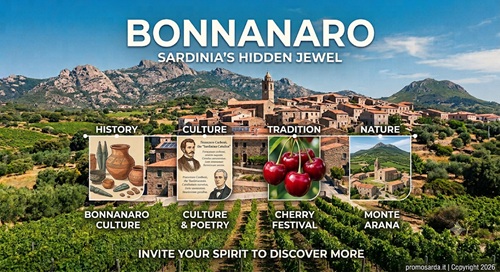
Bonnanaro is a charming hill town set on a hill overlooking a vast expanse of vineyards and orchards near the Rio Frida valley, situated between the Logudoro and Meilogu plateaus. It is dominated to the north by the Monte Pelao massif (730 meters high) and to the east by Monte Arana, an extinct volcano standing at 535 meters.
The Historic Region of Meilogu
During the medieval period, the Logudoro was one of the four Giudicati of Sardinia, with capitals successively at Porto Torres, Ardara, and Sassari. The region is divided into three parts: Logudoro Turritano (the Sassarese) to the north, Logudoro Meilogu to the west, and Logudoro Montacuto to the east. The name Meilogu derives from Mediu logu, meaning “in the heart of the Giudicato”.
The municipalities belonging to Meilogu are Ardara, Banari, Bessude, Bonnanaro, Bonorva, Borutta, Cheremule, Cossoine, Giave, Ittireddu, Mara, Mores, Padria, Pozzomaggiore, Semestene, Siligo, Thiesi, and Torralba. The territory is predominantly flat, producing cereals and vegetables, and features thriving sheep farming with rich dairy production supported by numerous springs and watercourses.
The Municipality of Bonnanaro
The municipality of Bonnanaro (pronunciation Bonnànaro, Sardinian name Bunnanaru, elevation 555 meters above sea level, population 930 as of December 31, 2021) has an irregular geometric profile with elevations ranging from 270 to 667 meters above sea level. It lies just two kilometers from the SS131 Carlo Felice highway.
Origin of the Name
The name is of probable pre-Roman origin. According to some, it derives from the Logudorese term Bunnánneru, referring to the evergreen plant known as greater germander (Teucrio giallo or Querciola maggiore). Other scholars suggest it stems from the Phoenician terms Bana Nahar (“House of the young”) or Bana Annaru (“House of Annaru”).
Economy & Gastronomy
-
Economy: Based on agricultural production (cereals, wheat, vegetables, fodder, olives) with a strong specialization in viticulture and cherry cultivation. The industrial sector is modest, comprising food, tanning, metallurgy, and construction companies.
-
Association: Bonnanaro is a member of the National Association of Wine Cities (Associazione Nazionale Città del Vino).
-
Cherries: The town is famous for its unique and flavorful cherries, celebrated annually with a popular festival that attracts visitors from all over Sardinia.
Historical Overview
-
Prehistory & Early History: Inhabited since prehistory, the territory boasts numerous nuraghi and archaeological remains discovered beginning in 1889. During the Early and Middle Bronze Age, it gave its name to the Bonnanaro Culture, which spread throughout Sardinia between 2200 and 1900 BC (or 1900–1600 BC in traditional chronology).
-
Medieval & Modern Eras: The village of Bonnanaro emerged in the Middle Ages around the year 1000 AD, originally called Gunar and later Gunnanor. It was incorporated into the Giudicato of Logudoro (curatoria of Meilogu and diocese of Sorres). In 1255, it passed to the Doria family, who built the majestic Castle of Capula. Contested between the Aragonese and the Judges of Arborea in 1365, it later came under Aragonese rule within the Marquessate of Valdecalzana and was governed by the Martinez family. Under Savoy rule in 1795, the population participated in the anti-feudal revolt led by Giovanni Maria Angioy, completely destroying the feudal palace.
Notable Figures
-
Frate Luca Solinas: A celebrated 16th-century preacher.
-
Padre Francesco Carboni: Born in 1745 and died in 1817, a didactic poet who wrote in Latin verse and became famous as the “Sardinian Catullus” (Catullo sardo).
Festivals and Traditions
-
April 23: Patronal feast in honor of Saint George (San Giorgio).
-
First Sunday of June: Cherry Festival (Sagra delle ciliegie), drawing thousands of visitors from across Sardinia.
-
Late July or Early August: Festival of Saint Barbara.
-
September 8: Festival dedicated to Our Lady of Graces of Monte Arana.
Exploring the Center of Bonnanaro
-
Town Hall (Municipio): Located at Via Giuseppe Garibaldi 10 within a small park. A five-a-side football pitch (Campo da Calcetto) is located behind the municipal building.
-
Sports Field (Campo Sportivo): Accessible via Via della Regione, Via Alberto La Marmora, and Via Milano.
-
Parish Church of Saint George the Martyr Cappadocie: Located on Piazza San Giorgio off Via Vittorio Emanuele. Rebuilt in the early 16th century and restructured in the 19th century in neoclassical style, it preserves important historical artifacts, including paintings of Our Lady of Mount Carmel, Saint Anthony, and Saint Gregory the Great, alongside a statue of Saint George on horseback.
-
Oratory of the Holy Cross: Built in 1624 as the seat of the Holy Cross Confraternity, featuring a late 18th-century marmorino high altar.
-
Municipal Cemetery: Located off Via del Riposo.
Exploring the Surroundings of Bonnanaro
-
Church of Santa Maria Iscalas: Located at the foot of Monte Pelau along Via Santa Maria, featuring a 17th-century stone portal with an inscribed lintel dated 1628.
-
Church of Santa Barbara: Situated north-east of Monte Pelau, hosting the late-July/early-August festival.
-
Ruins of Saint Basil Church: Located near the cemetery, believed to be the former parish church of the extinct medieval village of Nieddu or Nigellu (Sorres diocese).
-
Monte Arana & Church of Our Lady of Graces: Situated on the summit of Monte Arana, featuring a recently restored stone rural church with a bell-gable and juniper-beam roofing, surrounded by muristenes (pilgrim lodgings) where the novena and September 8 festival take place.
-
Corona Montana Necropolis: Located about 1.2 kilometers southwest of the town via Via Alberto La Marmora. Discovered and excavated by Torquato Taramelli in 1889, this site comprises five hypogeic tombs. Tomb I yielded an organic Bronze Age assemblage of 18 vessels and a bronze ring, which served as the type-site defining the Bonnanaro Culture. Finds from the necropolis are housed in the G.A. Sanna National Archaeological and Ethnographic Museum in Sassari.