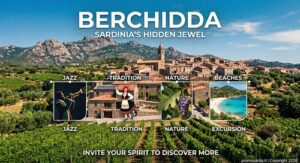
Berchidda
Berchidda is globally known as the City of Jazz (Città del Jazz), and it is visited alongside its surrounding areas, which feature the Abialzos dolmens.
The Historic Region of Monteacuto (Logudoro-Monteacuto)
During the medieval period, the Logudoro was one of the four Giudicati of Sardinia, with capitals at Porto Torres, Ardara, and Sassari. This historic region is divided into three parts: Logudoro Turritano (the Sassarese) to the north, Logudoro Meilogu to the west, and Monteacuto to the east.
The Monteacuto region includes the Chilivani plain and the foothills of the Goceano, Alà dei Sardi, and Limbara mountains. Its name originates from the giudicale castle built in Berchidda in the 13th century. Economically, the region is divided by the Coghinas River into Eastern Monteacuto (comprising Alà dei Sardi, Berchidda, Buddusò, Monti, Oschiri, and Padru) and Western Monteacuto (comprising Nughedu San Nicolò, Ozieri, Pattada, and Tula).
The Municipality of Berchidda
The municipality of Berchidda (Sardinian name: Belchidda, Gallurese: Bilchidda, elevation 324 meters above sea level, population 2,630 as of December 31, 2021) is a hilly center with a predominantly agricultural economy, renowned for cork production and Vermentino wine.
-
Geography: The landscape is rugged, bordered to the north by the Monte Limbara mountain mass (reaching 1,362 meters at Punta Balestrieri or Punta Sa Berritta, named after the traditional Sardinian headgear) and to the west by the Monte Acuto granite massif.
-
Distinction: Berchidda should not be confused with Berchida, a locality on the eastern coast featuring a famous beach.
-
Associations: The town is a member of the National Association of Olive Oil Cities (Associazione Nazionale Città dell’Olio) and the National Association of Wine Cities (Associazione Nazionale Città del Vino).
Origin of the Name
Attested in medieval sources from 1346 as Berquilla, the name may derive from the Latin feminine personal name Vercilla (from the Vercius gens), the Latin pergula (pergola), quercus (oak), the German Berg (mountain, referring to Monte Limbara), or an uninterpreted pre-Roman / Nuragic term.
Economy & Gastronomy
-
Primary & Secondary Sectors: The economy relies on agriculture (cereals, vegetables, fodder, olives, citrus, fruit, and Vermentino grapes), livestock, and growing industrial sectors including cork processing, food production, dairy, and woodworking.
-
Gastronomy: Local specialties include Suppa cuatta (Gallurese bread and cheese broth soup), bitter honey, seadas, and Sospiri (traditional almond paste pralines produced by Rau Arte Dolciaria in mirto, orange, and chocolate flavors).
Historical Overview
-
Prehistory & Antiquity: Inhabited since prehistoric times, the territory features numerous rock shelters (tafoni), domus de janas, dolmens, and nuraghi. In 1918, the Tesoro di Berchidda (Treasure of Berchidda) comprising 1,398 Roman Republican coins dated between 268 and 82 BC was discovered in Sa Contrizzola (now housed in the G.A. Sanna National Archaeological and Ethnographic Museum in Sassari). Roman remains include a road and a bridge at Silvani.
-
Middle Ages to Modern Era: In the Middle Ages, Berchidda belonged to the Giudicato of Torres (curatoria of Monte Acuto), serving as a stronghold under Adelasia of Torres and Ubaldo Visconti, and later under the Doria, Malaspina, and the Judges of Arborea. Following the Aragonese conquest, it passed to Bernardo De Centelles. During a 17th-century plague epidemic, the population relocated, abandoning the cult of Saint Sixtus (the original patron saint of the parish church) in favor of Saint Sebastian. In 2001, Berchidda transitioned from the Province of Sassari to the Province of Olbia-Tempio, returning to the Province of Sassari in 2016.
Festivals and Traditions
-
January 20: Feast of Saint Sebastian.
-
April 25: Feast of Saint Mark the Evangelist.
-
Late May: Feast of Saint Michael.
-
First Friday of June: Feast of Saint Catherine.
-
July: Triucas (Threshing Festival), a gastronomic event featuring open-air dinners with zuppa berchiddese and boiled mutton (pecora in cappotto), accompanied by choir and band performances.
-
August: Time in Jazz international music festival.
-
First Sunday of September: Patronal Feast in honor of Saints Sebastian and Lucy.
The Time in Jazz International Festival
Founded and organized annually since 1988 by Berchidda-born jazz trumpeter Paolo Fresu, Time in Jazz runs for ten days (August 8–18). It spans natural settings across Berchidda, Monti, Oschiri, Chilivani, the Monte Limbara state forest, and Tempio Pausania, drawing over 35,000 visitors and artists worldwide.
Exploring the Center of Berchidda
-
Town Hall (Palazzo Municipale): Located at Piazza del Popolo 5.
-
Piazza del Popolo: The main square historically flanked by three churches.
-
Parish Church of Saint Sebastian: Rebuilt in a modern architectural style in 1976 on the site of the older church, housing an important 18th-century polychrome wooden altar.
-
Oratory of the Madonna del Rosario: A 17th-century building adjacent to the parish church, serving as the Oratory of the Rosary Confraternity.
-
Cantina Sociale del Giogantinu: Established by 350 members cultivating 350 hectares of vines, producing DOCG Vermentino di Gallura and DOC Sardinian wines.
-
Atlantis Berchidda Winery: Founded by the Sannitu brothers, whose labels (Clos, Maju, and Crizia) have been featured in Vinitaly’s 5StarWines guide.
-
Unmaredivino Winery: Family winery founded in 1949 by Gioacchino Sini, producing wines such as the Isola dei Nuraghi Igt Passito Smeraldo.
-
Museum of Wine (Wine Museum of Sardinia): Located on Via Giangiorgio Casu, this multimedia museum and regional wine cellar highlights the history of viticulture in the Mediterranean.
-
Sebastiano Manchinu Municipal Stadium: A football stadium equipped with 450-seat stands.
-
Municipal Cemetery: Located at the eastern edge of the town along Via dei Campi.
Exploring the Surroundings of Berchidda
-
Monte Limbara State Forest: Spanning 3,200 hectares between 450 and 1,300 meters altitude, featuring Mediterranean scrub, cork oak woods, natural springs, a mouflon repopulation area, and the Mediterranean Arboretum of Limbara.
-
Church of Saint Mark the Evangelist: A rural church established around the 13th century along the SS597, hosting an annual festival with an open-air lunch on April 25.
-
Monte Acuto & Castle Ruins: Located on a granite massif at an altitude of 493 meters, featuring the largest dolmen of Monte Acuto (dating to c. 2800 BC with carved cupules) and the ruins of the medieval Giudicale Castle of Monte Acuto where Adelasia of Torres signed over her giudicato.
-
Berchidda Railway Station: A Silver-category railway station along the Sardinian main trunk line (Dorsale Sarda), opened in 1880.
-
Church of Santa Caterina d’Alessandria & Dolmen: Located in the Abialzos locality near Monte Limbara, featuring a rural church built between 1502 and 1504 and an archaic simple dolmen with a pentagonal cover slab.
-
Church of Saint Andrew & Sant’Andrea Dolmens: A 17th-century rural church (built c. 1611) with two nearby megalithic dolmens hidden among ancient holm and oak trees in Su Adu ’e Su Juru.
-
Church of Saint Michael the Archangel: A countryside church located within the San Michele park.
-
Ruins of San Salvatore di Nulvara: A Byzantine-era ruin located on the eastern limits of Berchidda near the Rio Scarraboe, where the Cippo dei Balari boundary stone was discovered in 1965, marking the ancient Roman provincial border between the Balari and the Corsi.