Armungia and the Gerrei Region
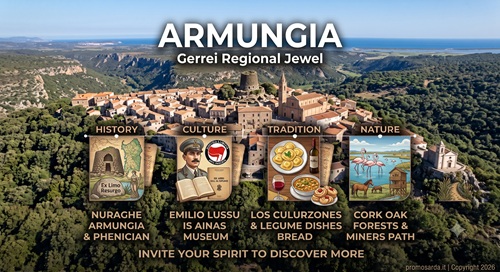
Situated on a hill at an elevation of 366 meters above sea level in the Gerrei historical region, Armungia is a small rural municipality known for its dense oak forests, pastoral traditions, rich Nuragic heritage, and as the birthplace of author and political figure Emilio Lussu.
The Region of Gerrei
Part of the broader Sarrabus-Gerrei district in southeastern Sardinia, Gerrei is an inland region defined by plateau landscapes, deep valleys, springs, and Mediterranean brush cut by the Flumendosa River.
Overview of Armungia
Rising to a maximum elevation of 625 meters within its territory, Armungia features a steep, irregular terrain dominated by cork, holm oak, and wild olive forests.
The municipal economy centers on agriculture (cultivation of vegetables, olives, fruit, and grapes for Cannonau and Monica wines) and livestock farming (cattle, sheep, goats, and pigs, which support local cheese production).
Name Origins
-
The name Armùngia is thought to derive from a sacred dedication to the Latin goddess of concord and love, Harmònia (derived from the Greek Harmonìa).
-
It is believed this deity was identified with an earlier Nuragic goddess venerated at the single-tower nuraghe located in the center of the town.
Emilio Lussu (1890–1975)
Armungia is the birthplace of Emilio Lussu, an Italian writer, military officer, and politician. A World War I captain in the Sassari Brigade, Lussu co-founded the Partito Sardo d’Azione (1921) and the anti-fascist movement Giustizia e Libertà (1929) alongside Carlo Rosselli. His experiences inspired influential literary works, including Marcia su Roma e dintorni (1936), Un anno sull’altopiano (1938), and Il cinghiale del Diavolo (1976).
Cultural Traditions & Gastronomy
Local Gastronomy
-
Culingionis de patata e casu: Traditional potato- and cheese-filled pasta parcels.
-
Su Pistoccu: Double-baked, long-preservation crisp bread historically carried by shepherds and softened in water prior to eating.
-
Local Pastries: Traditional sweets including Cassettas, Piriccittus, and Pani de saba.
Local Festivals
-
Feast of San Sebastiano (January 20 & Mid-September): Winter celebrations feature a neighborhood bonfire on the eve, traditional poetry contests, and food offerings; autumn celebrations include a religious procession through the town streets.
-
Feast of Our Lady of Bonaria (Nostra Signora di Bonaria) (April 24 & Mid-September): Celebrated twice annually with evening processions carrying the Virgin’s statue to her countryside hill chapel.
-
Patronal Feast of the Beata Vergine Immacolata (May 28): Features solemn religious services, traditional Sardinian music, poetry competitions, and folk games.
-
Sagra de Su Pistoccu (Early August): A culinary festival celebrating Armungia’s traditional double-baked bread.
-
Feast of Sant’Agostino (August 28): Traditional late-summer religious gathering.
Urban Landmarks and Museum System
Armungia features an integrated village museum network composed of four historic and cultural sites located within its urban core.
Key Highlights in Town
-
Nuraghe Armungia: A single-tower (monotorre) Nuragic structure standing over 10 meters high at an altitude of 353 meters in the middle of the village. Built from local schist stones in 21 preserved tiers, it features an intact vaulted tholos chamber with two interior niches and an elevated stair passage leading to the upper terrace.
-
Ethnographic Museum (S’Omu de Is Ainas): Housed in the mid-19th-century Old Town Hall (built over the former site of the St. John chapel and Monte Granatico grain bank). It exhibits nearly 600 agricultural, craft, and textile artifacts alongside three restored single-room stone dwellings (Case minime) featuring traditional domed bread ovens.
-
Emilio and Joyce Lussu Historical Museum: Located in the late 19th-century Casa del Segretario (Dessì Manor). The museum showcases a photographic archive detailing Emilio Lussu’s life, political career, and military service, alongside a permanent exhibition dedicated to his wife, writer and activist Joyce Lussu (Joyce Lussu: cammino di una donna nella storia del Novecento).
-
The Blacksmith’s Shop (Bottega del Fabbro): A restored 1928 stone workshop (formerly the Vellini residence) preserving original forge tools, anvils, shoeing frames, and metalworking equipment.
-
Parish Church of the Beata Vergine Immacolata: Built in the early 17th century, housing a 1668 parish bell, a carved sandstone baptismal font from 1706, an 18th-century silver lamp, and sacred silver liturgical items.
-
New Town Hall & Municipal Amenities: Includes the modern municipal offices on Via Funtanedda, a multi-purpose gym, a bocce court, a local sports ground, and the municipal cemetery.
Surrounding Countryside & Prehistoric Sites
-
Countryside Chapel of Our Lady of Bonaria (Nostra Signora di Bonaria): Built in 1893 on a rocky outcrop at an altitude of 468 meters overlooking the surrounding valley. Constructed using stone, mud mortar, and timber roof trusses, it serves as the destination for bi-annual community pilgrimages.
-
Miners’ Path (Sentiero dei Minatori): A historic 4.5-kilometer pedestrian trail passing through orchards and vineyards. It was historically used by local workers and women mineral sorters from Armungia to reach the nearby Su Suergiu antimony mine works.
-
Nuraghe Scandariu: A single-tower schist-stone nuraghe located on a plateau at 454 meters altitude, measuring over ten meters in basal diameter with an intact ogival entryway leading to a roofless chamber.
-
Additional Archaeological Remains: Unclassified Nuragic structures across the municipal territory include the stone ruins of Cuil, Ois, Palas ‘e Nuraxi, Perdu Schirru, and Srebatzi.