Aidomaggiore and the Guilcier Region
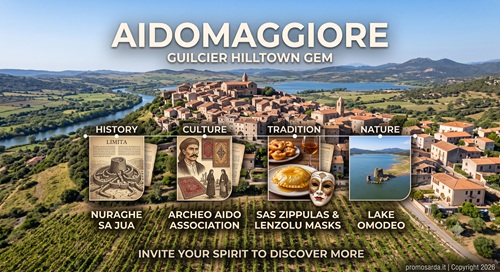
Located on the slope connecting the central plateau to the valley of Lake Omodeo, Aidomaggiore is a historic hill town surrounded by oak forests, olive groves, and vineyards.
The Region of Guilcier
Situated at the heart of the island, Guilcier is a geographic region featuring a basalt plateau that overlooks a fertile plain traversed by the Tirso River and Lake Omodeo.
The Guilcier area contains numerous historic and archaeological features, including:
-
Nuraghe Losa
-
Church of San Pietro di Zuri
-
Aragonese Tower of Ghilarza
-
Santa Cristina Archaeological Complex
-
Petrified Forest of Soddì
-
Templar Church of Norbello
Overview of Aidomaggiore
Situated at an altitude of 250 meters above sea level, Aidomaggiore features an undulating terrain that reaches elevations of up to 386 meters.
The local economy is predominantly agricultural and pastoral, supported by traditional crop cultivation (cereals, olives, citrus, and wine grapes), livestock farming, and small-scale manufacturing in food production, woodworking, and building materials. Artisanal production includes hand-woven carpets, tapestries (bertulas), and traditional reed and rush basketry.
Name Origins
-
In the medieval period, the settlement was recorded as Aidu (meaning “pass” or “gateway”), referencing its location near a primary crossing point of the Tirso River.
-
Under Spanish rule, the name expanded to Aido Mayor (“main gateway”), which was later Italianized into Aidomaggiore.
Gastronomy & Traditions
The culinary heritage of Aidomaggiore includes century-old recipes for traditional cheeses, wines, and seasonal sweets.
Carnival Celebrations (Carrasegare)
Carnival in Aidomaggiore features unique traditional masks and folk dances:
-
Maschere a Lenzolu: On Shrove Monday, participants disguise themselves completely in white bedsheets tied without stitching. On Shrove Tuesday, black attire is worn as a symbol of mourning for the end of Carnival.
-
Sa Cointrotza: A traditional serpentine group dance performed in the main square to the music of the diatonic button accordion.
-
Re Zorzi: On Shrove Tuesday, a straw effigy named Re Zorzi is carried through the streets by figures dressed in traditional mourning clothes. At the end of the evening, the effigy is mock-tried, executed, and burned in the public square, followed by the singing of traditional Carnival verses (Sas Laudes).
-
Mèrcuris de Lissìu (Ash Wednesday): Groups with blackened faces collect ingredients from local homes to prepare traditional evening fried pastries (Sas Zippulas).
Holy Week Rites (Semanas Santa)
Coordinated by the local religious brotherhoods (Confraternite), Holy Week features solemn traditional rituals:
-
Tuesday: A evening Via Crucis procession accompanied by traditional four-part male liturgical chanting (Su Cuntzertu de Jdumajore).
-
Holy Thursday: Procession of a historic Ecce Homo statue.
-
Good Friday: The solemn rites of S’Incravamentu (raising of the Cross) and S’Iscravamentu (deposition from the Cross), accompanied by historic Sardinian and Latin hymns.
-
Easter Sunday: The ceremony of S’Incontru (the meeting of the statues of Mary and the Risen Christ), preceded by a formal greeting and three bows exchange between members of the three brotherhoods.
Other Local Festivals
-
Sant’Antonio Abate (January 16–18): Features the lighting of hollowed tree trunks (Sas Tuvas) in the courtyard of the Church of San Gavino, accompanied by traditional sweets and wine.
-
Feast of Santa Greca (May 14): Held at the rural sanctuary, celebrated with communal gatherings.
-
Feast of Santa Maria delle Palme (May 24): The patronal festival of the town.
-
Feast of San Giovanni (June 24): Celebrated with midsummer bonfires (Sos fogulones), the ritual gathering of “silent water” (S’abba muda), and communal dinners.
-
Feast of Santa Barbara (Late August): The town’s major annual festival, centered around the rural sanctuary.
-
Feast of Santa Maria delle Grazie (September 8): Held at the rural sanctuary of Orracu, concluding with a traditional auction of local goods (Su prozettu).
Architecture and Monuments in Town
The historic center of Aidomaggiore is characterized by traditional residences built from dark basalt masonry.
Key Highlights
-
Parish Church of Santa Caterina / Santa Maria delle Palme: Built between the late 15th and 16th centuries and renovated in the 18th century, this Latin-cross church features a basalt and pink trachyte facade with a large rose window, an interior with a 17th-century wood-carved choir, and a square bell tower added in 1911.
-
Church of San Gavino Martire: Located on the northeastern edge of town, this Romanesque church dates prior to 1388. It served as the original parish church and houses an 18th-century retable, a 16th-century articulated wooden Ecce Homo sculpture, and an ancient Roman cinerary urn used as a holy water font.
-
Casa Serra (Archaeological Documentation Center): A historic residence housing the Archeo Aido association, featuring an outdoor lapidary garden with prehistoric menhirs, betyls, and ancient funerary stelae.
-
Funtana di Corte ’e Josso: A historic stone fountain complex built between 1879 and 1887 that supplies a public washhouse, livestock trough, and adjacent gardens.
-
War Memorial: A marble monument located near the parish church, dedicated to the fallen soldiers of all wars.
-
Emilio Lussu Municipal Library: A public cultural center named after the Sardinian writer and political figure.
-
Municipal Sports Grounds: Includes a local municipal soccer field and mini-soccer facilities.
Surrounding Archaeological & Historic Sites
The territory of Aidomaggiore is exceptionally rich in prehistoric heritage, containing 78 nuraghi, 25 giants’ tombs, and numerous Neolithic domus de janas and betyls.
Archaeological & Cultural Landmarks
Nuraghe Sa Jua
A complex basalt nuraghe built in a “tancato” layout, consisting of a main central tower linked to a secondary tower via two curtain walls enclosing a courtyard. The site is noted for a rare archeoastronomical phenomenon during the winter solstice dawn, when the sun aligns through the lintel’s discharge window to directly illuminate the central chamber and wall niche.
Rural Sanctuary of Santa Barbara di Nicomedia
A countryside sanctuary rebuilt in 1954 on the site of a historic early Christian/Byzantine religious settlement. It is surrounded by small stone dwellings (muristenes) used by pilgrims during the annual August novena.
Rural Sanctuary of Santa Maria delle Grazie (Orracu)
A 17th-century rural church featuring pink trachyte interior arches, a rose window facade, and a carved trachyte altar, set within a countryside pilgrim hamlet.
Rural Sanctuary of Santa Greca
A rural church dating to the early second millennium in Romanesque origin, rebuilt in the 19th century. It features a four-bay single nave with basalt arches and houses dual altarpiece niches.
Prehistoric Altar of Riu
An ancient stone structure located near the Riu corridor-nuraghe, displaying geometric orientation toward the winter solstice sunrise.
Lake Omodeo
A large artificial reservoir created by the historic Santa Chiara Dam on the Tirso River. During low-water periods from late spring to autumn, several submerged prehistoric monuments—including the nuraghi Pajolu, Biùgias Pilicas, Aurù, Songhe, and Su Pranu—emerge from the lakebed.